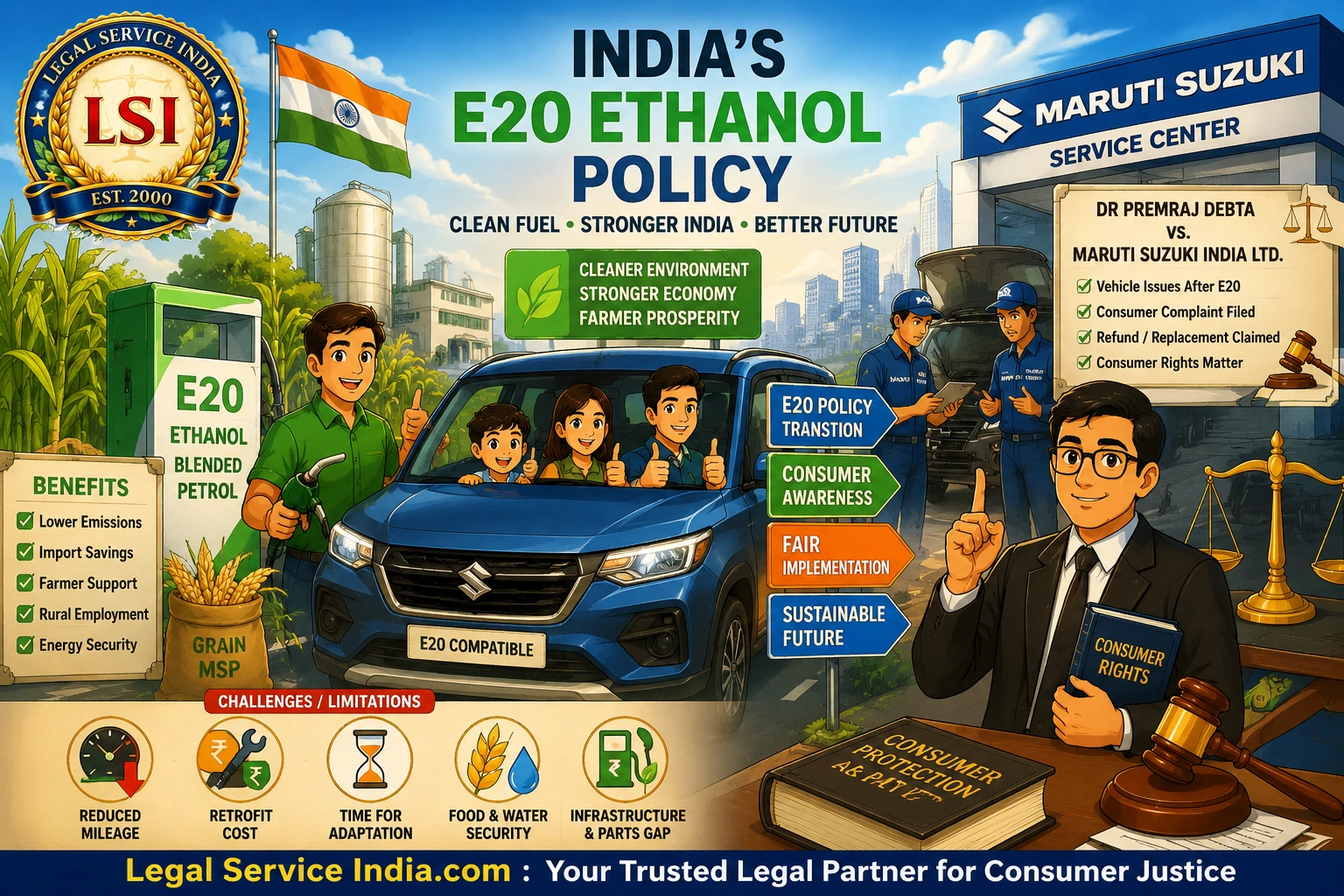
India’s E20 Ethanol Policy Explained: Benefits, Problems, Maruti Suzuki Case & Consumer Rights
A comprehensive legal and policy analysis of India's E20 ethanol fuel policy, its impact on vehicle owners, food security, environmental benefits, the Maruti Suzuki consumer dispute, and practical reforms for sustainable implementation.
Due to inflation, the cost of living increases day by day, which decreases the purchasing power of an individual. Our government also needs to maintain the equilibrium in society through adequate utilization of limited resources or needs to switch to other affordable alternatives. As India’s government is forward-approaching and slowly achieving a self-sufficiency path. As India before 2014 was the biggest importer of crude oil that was used for making petrol, it now shifted to the E10 policy, i.e., 10% ethanol must be mixed in petrol, which shifted to E20 in 2023, which makes consumers suffer and makes them unable to adapt to the change. The Indian government, compared with other developing nations that already launched those schemes many decades ago or are slowly reaching their destination, is compromised by political bias and other beneficial reasons by the purchasing power of small operators. Though ethanol has many benefits, it has problems too.
Ethanol is mainly made up of plant materials containing sugars and starches, collectively called biomass, also from other agricultural crops like sugarcane, rice, wheat, barley, sorghum, etc.
Ethanol is eco-friendly, which makes it have fewer carbon emissions. Hence, fewer chances of global warming.
Ethanol use saves the importing cost of government, i.e., 1.36 lakh crore, from 2014.
India’s highest-growing grains are rice and wheat, and it is also the second-largest producer of sugarcane globally, making it possible for the government to take action in favor of ethanol.
This helps poor farmers’ employment as the government takes their grain at MSP.
Benefits Summary Table
Benefit
Description
Renewable Fuel
Ethanol is mainly made up of plant materials containing sugars and starches, collectively called biomass, also from agricultural crops like sugarcane, rice, wheat, barley, sorghum, etc.
Environmental Benefit
Ethanol is eco-friendly, which makes it have fewer carbon emissions. Hence, fewer chances of global warming.
Import Savings
Ethanol use saves the importing cost of government, i.e., 1.36 lakh crore, from 2014.
Agricultural Strength
India’s highest-growing grains are rice and wheat, and it is also the second-largest producer of sugarcane globally, making it possible for the government to take action in favor of ethanol.
Farmer Support
This helps poor farmers’ employment as the government takes their grain at MSP.
Limitations
After 2008, mostly vehicles were structured and prepared for 5-10% ethanol, but after 2025, due to the emergence of E20 vehicles, the distance covered by a vehicle decreases thoroughly, making an average consumer pay more in less time.
Governments argue to cooperate and buy ethanol-compliant parts at a cost of ₹15,000 (which is not the reality) to prevent the vehicle from further corrosion and degradation.
The E20 policy takes a lot of time in case of effective implementation to achieve fuller adaptability.
Government uses edible crops (rice, wheat) that can be used to feed poor people, as the government needs to balance their food security in hand, as too much water is required to make ethanol, which later harms individual purchasing power.
Limitations Summary Table
Issue
Impact
Reduced Mileage
Distance covered by a vehicle decreases.
Retrofit Cost
Consumers may have to buy ethanol-compliant parts costing around ₹15,000.
Implementation
The E20 policy requires time for effective adaptation.
Food Security
Use of edible crops and high water requirements may affect food and water security.
Comparison
India compares with the Brazilian government and its citizens’ cooperation with the E20 policy launched in the 1970s, making them adaptable to the environment as they give options; they also provide subsidies and GST cuts for genuine FFV hardware retrofits and new purchases.
America, which produces more than 50% of the world’s ethanol, still does not adopt E20 but is stuck with E10; they lack essential vehicle parts and infrastructure.
Thailand and Sweden adopt E20 hastily and then realize the future of electric vehicles, and they also give options.
Country Comparison Table
Country
Approach
India
Transition from E10 to E20.
Brazil
Launched E20 policy in the 1970s with subsidies, GST cuts, and FFV support.
United States
Produces over 50% of the world’s ethanol but mainly uses E10.
Thailand & Sweden
Adopted E20 quickly and later shifted focus towards electric vehicles while providing options.
Dr Premraj Debta vs. Maruti Suzuki India Ltd
In this case, Dr. Premraj Debta brought a Maruti Suzuki Grand Vitara (Strong Hybrid Zeta+) car in June 2024 for ₹20.5 lakh that was manufactured in January 2023. Problems arise after 5-6 months, then Dr. Premraj goes to the service center, which changes the fuel after cleaning. The problem stays for some time and then starts again, which makes him continuously suffer and spend his money without any result.
On 16 June 2026, Dr. Premraj filed a complaint in the District Consumer Forum against the company, claiming they sold a damaged vehicle, and prayed for the following:
Returning ₹20.5 lakh, ₹1 lakh for mental agony, and ₹10,000 for litigation costs.
Replace the vehicle.
Maruti Suzuki’s Defence
Maruti Suzuki argued that his vehicle is all right without any defect and compatible with E20 ethanol; their old car even ran well through E20-blended petrol. You must have used adulterated fuel.
Dr Premraj’s Reply
Dr Premraj replied, ‘Why would I use any other fuel than the produced fuel in the market?’
Court Observation
Consumers had no practical fuel alternative.
The manufacturer failed to ensure compatibility.
Deficiency in service.
Maruti Suzuki can file an appeal of a consumer forum’s decision to a higher authority.
New Ethanol Scam 2026
The government wants to give some benefit to the farmers by taking their grains at MSP, but the manufacturer and the rice-milling industry play a double game. The government gives extra rice to the ethanol-making industry at a subsidized price, and some plant operators allegedly sold rice at a higher profit (₹2,600-3,000 per quintal) to private rice millers, which causes fraud of up to ₹1,160 crore.
Suggestions
Protect the fleet – Reintroduce the E10 at every pump to safeguard 66% of pre-2023 vehicles.
Fix the economics – Implement the 70% rule to offset ethanol’s lower energy density.
Bridge the tech—Approve the regulatory framework for its 15k retrofit and grant get-parity to FFV.
Secure the resources – Mandate a rapid pivot to 2G (agri-waste) ethanol to protect national food and water security.
Suggestions Summary Table
Suggestion
Purpose
Protect the Fleet
Safeguard pre-2023 vehicles through E10 availability.
Fix the Economics
Offset ethanol’s lower energy density.
Bridge the Technology Gap
Support retrofit approval and FFV parity.
Secure Resources
Promote 2G ethanol to protect food and water security.
Conclusion
India needs to learn from Brazil, who avoided the ‘chicken-and-egg’ infrastructure trap by ensuring vehicle engineering evolved simultaneously with the fuel supply chain. Success relies on hardware synchronicity.
References
Murat, Mohamed A., and Ahmed El Hassaan. “Cellulosic Ethanol: Overcoming Hurdles in Commercialization, Production Processes for Cellulosic Ethanol: Technological and Economic Challenges, Strategies for Successful Commercialization.”Sustainable Practices in Biorefinery, Springer Nature, 2026, pp. 69–87.
Sihombing, Pardomuan. “The Effect of Ethanol Addition to Gasoline Fuel: A Comprehensive Analysis of Performance, Emissions, and Material Compatibility Based on Literature Studies.”International Journal of Economics, vol. 3, 2026, pp. 1–9.
Carocha, Daniel, et al. Role of Ethanol as an Alternative for the Sustainable Expansion of Electricity Supply in Brazil. Springer Nature Switzerland, 2026, pp. 127–141.
Key Takeaways: India’s E20 Ethanol Policy
The following key takeaways summarize the major issues, benefits, challenges, and policy recommendations surrounding India’s E20 Ethanol Policy.
India’s E20 ethanol policy aims to reduce crude oil imports, strengthen energy security, and promote cleaner transportation, but it has also created significant challenges for owners of older vehicles.
Ethanol is a renewable biofuel produced from sugarcane, rice, wheat, barley, sorghum, and other biomass, making it a sustainable alternative to conventional petrol.
Major advantages of ethanol blending include lower carbon emissions, reduced dependence on imported crude oil, savings in foreign exchange, and increased income opportunities for Indian farmers through MSP procurement.
Vehicle compatibility remains a major concern, as many vehicles manufactured before widespread E20 adoption were originally designed for E5 or E10 fuel blends, potentially affecting mileage and long-term engine durability.
Consumers face an additional financial burden due to the possible need for ethanol-compatible components and retrofit solutions, while fuel efficiency may decrease because ethanol contains lower energy density than petrol.
The use of food crops such as rice and wheat for ethanol production raises concerns about food security, water consumption, and inflationary pressure on essential commodities.
International experience shows that successful ethanol adoption requires gradual implementation, consumer choice, incentives, compatible vehicle technology, and supporting infrastructure, as demonstrated by Brazil.
The United States continues to rely primarily on E10 fuel, despite being the world’s largest ethanol producer, highlighting that higher ethanol blends require extensive infrastructure and vehicle readiness.
The District Consumer Forum’s decision in Dr. Premraj Debta v. Maruti Suzuki India Ltd. underscores the importance of manufacturer responsibility where consumers have no practical alternative fuel available and vehicle compatibility issues arise.
The alleged ₹1,160 crore ethanol procurement scam highlights the need for greater transparency, stronger regulatory oversight, and accountability in India’s ethanol supply chain.
Policy reforms such as reintroducing E10 availability, encouraging flexible-fuel vehicle (FFV) adoption, supporting retrofit incentives, and expanding second-generation (2G) ethanol production could balance environmental objectives with consumer protection.
India’s long-term ethanol strategy should integrate fuel policy, vehicle engineering, infrastructure development, food security, and consumer interests to ensure a sustainable and economically viable transition to cleaner fuels.
Summary Table
Topic
Key Takeaway
E20 Policy
Reduces crude oil imports and promotes cleaner transportation but creates challenges for owners of older vehicles.
Renewable Fuel
Ethanol is produced from biomass, including sugarcane, rice, wheat, barley, and sorghum.
Environmental Benefits
Lower carbon emissions, improved energy security, foreign exchange savings, and increased farmer income.
Vehicle Compatibility
Older vehicles designed for E5 or E10 may experience reduced mileage and long-term engine concerns.
Consumer Impact
Retrofit costs and lower fuel efficiency may increase the financial burden on consumers.
Food Security
Using edible crops for ethanol production may affect food availability, water resources, and inflation.
Global Experience
Brazil demonstrates that incentives, infrastructure, and compatible vehicles are essential for successful ethanol adoption.
United States
Despite being the world’s largest ethanol producer, the U.S. primarily continues with E10 fuel.
Consumer Case
The Dr. Premraj Debta v. Maruti Suzuki India Ltd. case highlights manufacturer responsibility for fuel compatibility.
Ethanol Scam
The alleged ₹1,160 crore procurement scam highlights the need for transparency and regulatory oversight.
Policy Reforms
Reintroducing E10, supporting FFVs, retrofitting incentives, and expanding 2G ethanol can improve implementation.
Long-Term Strategy
India should balance fuel policy, vehicle technology, infrastructure, food security, and consumer protection for sustainable ethanol adoption.