





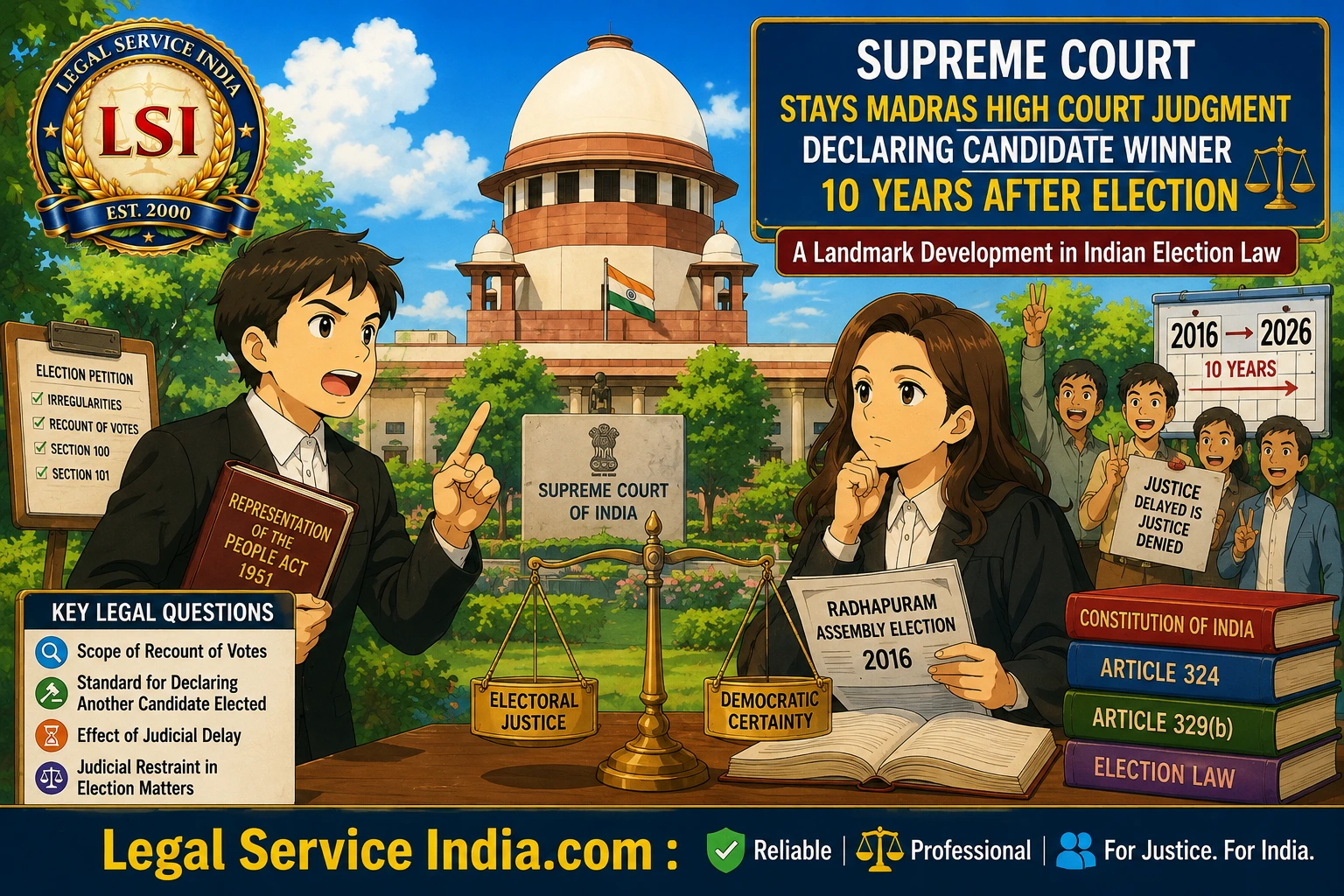
Supreme Court Stays Madras High Court Judgement Declaring Candidate Winner 10 Years After Election: A Significant Development in Indian Election Law
Introduction
In a significant interim order with far-reaching implications for election jurisprudence, the Supreme Court of India has stayed the operation of the Madras High Court’s judgement that had declared a defeated candidate as the successful candidate nearly ten years after the election. The order has once again brought into sharp focus the delicate balance between electoral justice, judicial delay, and democratic certainty.
The controversy arose from the 2016 Tamil Nadu Legislative Assembly election for the Radhapuram Assembly Constituency, where the Madras High Court, after a decade-long election petition, invalidated the election of the returned candidate and declared the defeated candidate, M. Appavu, as the duly elected representative following a recount of votes. The High Court also made strong observations regarding judicial delays in election disputes.
The Supreme Court has now intervened and stayed that judgement pending further consideration, ensuring that the legal issues raised receive comprehensive examination before any irreversible consequences follow.
Citation
Special Leave Petition (Civil) arising out of the judgement of the Madras High Court concerning the Radhapuram Assembly Election (2016).
(At the time of writing, the Supreme Court has passed an interim stay order. The detailed judgement on merits is awaited.
Background of the Dispute
The litigation originated from the 2016 Tamil Nadu Assembly Elections.
The returned candidate secured victory by an extremely narrow margin. The defeated candidate challenged the election under the Representation of the People Act, 1951, alleging serious irregularities in the counting of votes.
The election petition remained pending for almost ten years.
Eventually, after examining ballot papers and directing recounting, the Madras High Court concluded that:
- Numerous valid votes had been wrongly rejected,
- Certain invalid votes had been improperly counted
- The returned candidate had not actually secured a lawful majority.
Consequently, the High Court:
- set aside the election,
- declared the defeated candidate to be the duly elected MLA,
- directed correction of the official records.
The High Court simultaneously expressed deep concern that election petitions, which should ordinarily be decided expeditiously, had remained pending for almost an entire legislative cycle, thereby undermining democratic values.
Why the High Court Decision Was Extraordinary
Indian courts rarely declare the defeated candidate as elected.
Normally, if substantial irregularities are proved, courts merely:
- set aside the election,
- or direct a fresh election.
A declaration that the election petitioner himself is elected is permissible only where the court is satisfied that:
- after exclusion of invalid votes, or
- after inclusion of wrongly rejected valid votes,
- The petitioner actually secures the highest number of lawful votes.
Such declarations are made only after rigorous scrutiny of election records.
The Madras High Court found that this exceptional threshold had been met.
Why Did the Supreme Court Stay the Judgement?
The Supreme Court’s stay is an interim measure, not a final adjudication.
Such stays are granted where the court finds that:
- Substantial questions of law arise,
- The consequences of the impugned judgement may become irreversible
- Maintaining the status quo is necessary until the appeal is finally decided.
The stay does not imply that the High Court’s reasoning is incorrect. Nor does it mean that the High Court will necessarily be reversed.
Rather, it reflects the Supreme Court’s determination that the issues deserve full appellate consideration before the judgement is implemented.
Legal Issues Likely to Be Examined
1. Scope of Recount of Votes
Indian courts have consistently held that recounting cannot be ordered routinely.
A recount is permitted only when:
- specific pleadings exist,
- credible evidence is produced,
- The Court is satisfied that justice requires opening the sealed ballots.
The Supreme Court may examine whether these requirements were fully satisfied.
2. Standard for Declaring Another Candidate Elected
Section 101 of the Representation of the People Act permits the Court to declare another candidate elected in limited situations.
The Supreme Court may examine:
- whether every disputed vote was correctly assessed,
- whether the numerical calculations were legally sustainable,
- whether the declaration complied with statutory requirements.
3. Effect of Judicial Delay
One of the most striking features of the case is that the litigation continued for nearly ten years.
This raises larger constitutional questions.
Can meaningful electoral justice still be achieved after:
- One Assembly has completed its full tenure,
- A fresh election has already taken place
- Has democratic representation substantially changed?
These issues go beyond the individual parties and affect election law generally.
4. Judicial Restraint in Election Matters
Election disputes involve democratic mandates.
The Supreme Court may revisit:
- the degree of judicial intervention appropriate in close electoral contests,
- safeguards against unnecessary recounts,
- standards governing interference with declared election results.
Constitutional Framework
Election disputes are governed by a carefully structured constitutional framework.
Relevant provisions include:
| Constitutional Provision | Subject |
|---|---|
| Article 324 | Superintendence of elections by the Election Commission |
| Article 327 | Parliament’s power to legislate regarding elections |
| Article 329(b) | Election disputes can only be challenged through election petitions. |
The Representation of the People Act, 1951, provides the detailed statutory mechanism.
Representation of the People Act, 1951
Important provisions include:
| Section | Subject |
|---|---|
| Section 80 | Election disputes only through election petitions |
| Section 81 | Presentation of election petition |
| Section 100 | Grounds for declaring election void |
| Section 101 | Declaration of another candidate as elected |
The present litigation substantially concerns Sections 100 and 101.
Why Timely Disposal of Election Petitions Matters
The Constitution expects election disputes to be decided with utmost expedition.
The rationale is obvious.
If litigation continues throughout the tenure of the legislature:
- The elected representative completes the entire term
- The constituency remains represented
- The ultimate judgement becomes largely symbolic.
Justice delayed in election matters frequently becomes justice rendered ineffective.
The observations of the Madras High Court underline this institutional concern, although the Supreme Court will ultimately determine the legal consequences.
Supreme Court’s Consistent Approach in Election Cases
Over decades, the Supreme Court has consistently emphasised:
- purity of elections,
- sanctity of ballot,
- strict compliance with election laws,
- limited judicial interference,
- protection against frivolous election petitions.
The Court has also repeatedly held that election petitions are statutory proceedings requiring strict adherence to procedural requirements.
Broader Impact of the Supreme Court Stay
The interim stay has significance beyond the parties.
It may influence:
- future recount cases,
- standards for declaring another candidate elected,
- appellate review of election petitions,
- judicial handling of long-pending election disputes.
The eventual judgement could become another important precedent in Indian election law.
Practical Lessons for Candidates
- Preserve all election records wherever legally permissible.
- Raise objections during the counting itself.
- Plead every irregularity with precision.
- Produce credible evidence rather than broad allegations.
- Seek expeditious hearing of election petitions to preserve the efficacy of the remedy.
Possible Outcomes Before the Supreme Court
The Supreme Court may ultimately:
- uphold the High Court judgement;
- modify the findings;
- restore the original election result;
- remand the matter for fresh consideration; or
- Clarify the law governing recounts and the declaration of successful candidates.
Until then, the High Court judgement remains in abeyance because of the interim stay.
Why This Judgement Matters
The case illustrates one of the greatest challenges confronting Indian election law.
While the legal framework provides an effective remedy against electoral irregularities, prolonged adjudication can substantially diminish the practical value of that remedy.
The Supreme Court now has an opportunity to clarify not only the law governing recounts but also the broader principles relating to delayed election litigation, judicial review of electoral outcomes, and preservation of democratic legitimacy.
Whatever the final outcome, the decision is likely to become an important precedent for future election petitions across India.
Conclusion
The Supreme Court Stays Madras High Court Judgement Declaring Candidate Winner 10 Years The election marks a significant moment in India’s election jurisprudence. It raises fundamental questions regarding recounts, the declaration of elected candidates, judicial review, and the impact of prolonged litigation on democratic governance.
As the Supreme Court proceeds to examine the appeal on merits, its final decision will likely shape the future interpretation of the Representation of the People Act, 1951, and establish authoritative guidance on how courts should balance electoral justice with democratic stability. For lawyers, election candidates, political parties, and constitutional scholars alike, this case deserves close attention.
Key Takeaways
- The Supreme Court has stayed the Madras High Court’s order declaring a defeated candidate elected nearly ten years after the 2016 election.
- The dispute centres on a recount of votes and the High Court’s exercise of powers under the Representation of the People Act, 1951.
- The appeal raises important questions on recount standards, delayed election petitions, and the circumstances in which a court may declare another candidate elected.
- The Supreme Court’s final ruling is expected to become an important precedent in Indian election law.
Call to Action
Need expert legal advice on election law, election petitions, recount disputes, or constitutional litigation?
Adv. Tarun Choudhury
Supreme Court Advocate | 25+ Years of Legal Experience
📞 Call: 9891244487
💬 WhatsApp: 9891244487
