





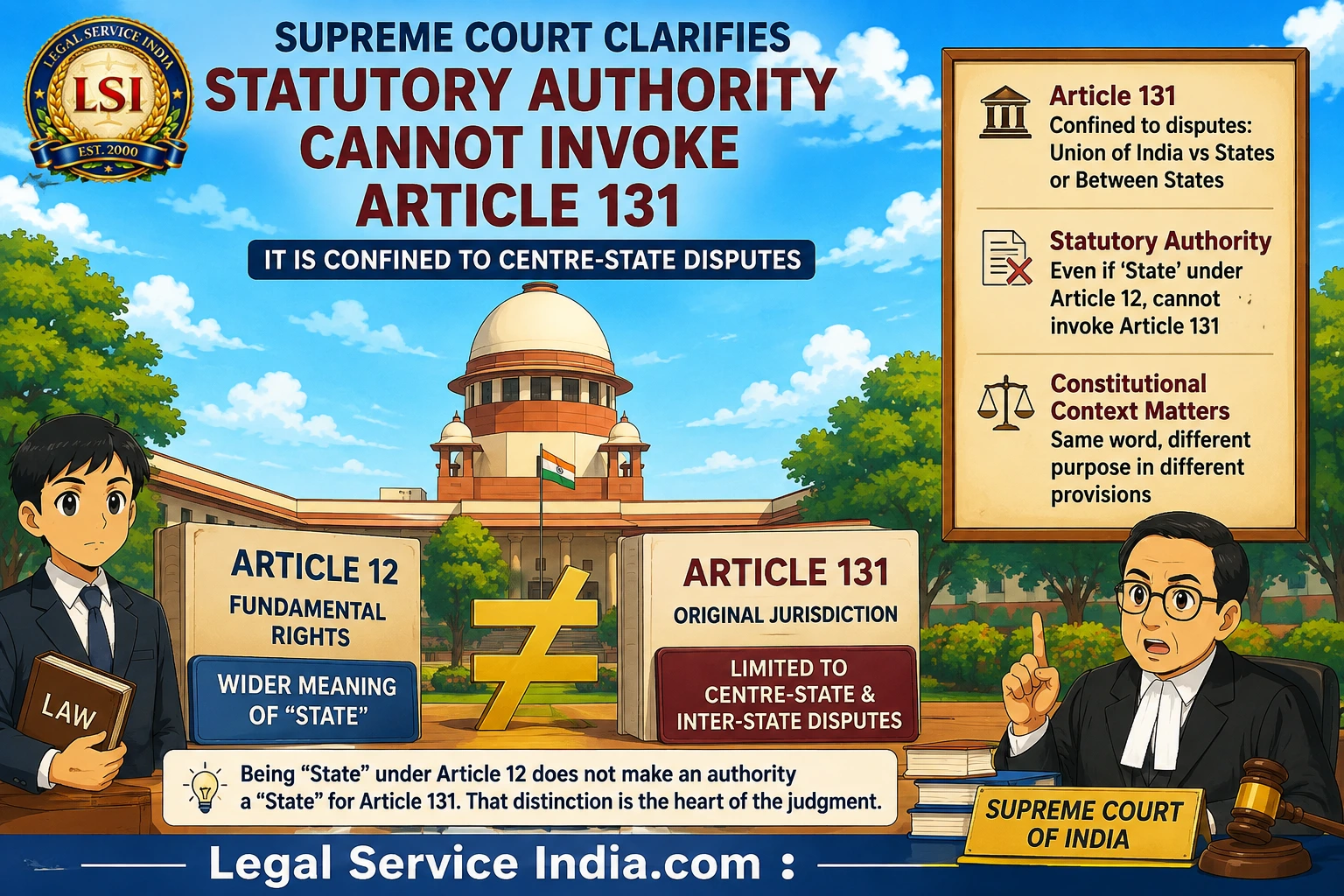
Statutory Authority Cannot Invoke Article 131; It Is Confined to Centre-State Disputes: Supreme Court
“The Constitution may use the same word in different places, but its meaning must always follow the purpose of the provision. This judgment reminds us that being a ‘state’ under Article 12 does not automatically open the door to Article 131.”
— Adv. Tarun Choudhury
Introduction
The Supreme Court has delivered an important constitutional-law ruling clarifying a distinction that is fundamental but capable of causing considerable confusion in constitutional litigation: the expression “State” does not necessarily carry the same meaning in every provision of the Constitution.
In Lucknow Development Authority v. Union of India & Ors., the Supreme Court has made it clear that a statutory authority or instrumentality that may fall within the expression “State” under Article 12 cannot, merely for that reason, invoke the Supreme Court’s exclusive original jurisdiction under Article 131.
The Court held that Article 131 is concerned with disputes between the Union of India and constituent states, or between constituent states themselves. The provision does not permit every statutory corporation, authority, board, development authority, or other instrumentality that may qualify as “State” for the purpose of Article 12 to invoke Article 131.
The ruling is significant because it prevents the constitutional expression “state” from being mechanically transplanted from one constitutional provision into another.
In Simple Terms
Being “State” under Article 12 does not make an authority a “State” for Article 131.
That distinction is the heart of the judgment.
The Supreme Court also set aside the Allahabad High Court’s decision, which had dismissed a long-pending writ petition filed by the Lucknow Development Authority and had granted liberty to the parties to pursue an Article 131 remedy. The Supreme Court found that approach legally unsustainable and remitted the matter to the High Court for fresh adjudication.
Case Details
| Particulars | Details |
|---|---|
| Case | Lucknow Development Authority v. Union of India & Ors. |
| Court | Supreme Court of India |
| Bench | Justice Dipankar Datta and Justice Sheel Nagu |
| Civil Appeal No. | 11201 of 2026 |
| Citation | 2026 LiveLaw (SC) 864 |
| Subject | Article 131 – Original Jurisdiction – Article 12 – Statutory Authorities – Centre-State Disputes – Constitutional Law |
The Core Holding
The Supreme Court’s ruling can be reduced to one important constitutional proposition:
A statutory authority cannot invoke Article 131 merely because it is an instrumentality of the State under Article 12.
Article 12 and Article 131 serve different constitutional purposes.
Article 12 occurs in Part III of the Constitution, dealing with fundamental rights. Its purpose is to identify the bodies against which constitutional rights may operate.
Article 131, on the other hand, establishes a special and exclusive jurisdiction of the Supreme Court for certain disputes involving the federal units of the Indian Union.
The Court therefore treated the word “State” in Article 131 according to the constitutional context in which that expression occurs.
The expression “States” in Article 131 refers to the constituent States of the Union identified in the First Schedule to the Constitution. It does not encompass every authority, corporation, or instrumentality that may fall within the broader definition of “state” under Article 12.
This is not merely a technical distinction. It goes to the very architecture of India’s federal Constitution.
Background of the Case
The litigation arose out of a dispute concerning land in Lucknow.
The Lucknow Development Authority (LDA) had developed a colony and allotted plots and flats to beneficiaries. A dispute subsequently arose regarding possession of the land.
According to the LDA, officers associated with the Union Government and defense establishments were interfering with the physical possession of the allottees and asserting claims over the land.
The LDA therefore approached the Allahabad High Court, Lucknow Bench, by filing a writ petition against the Union of India and concerned defense authorities, including the General Officer Commanding-in-Chief, Central Command, and the Station Commander, Sub-Area, Cantonment, Lucknow.
The litigation had an extraordinarily long history.
The writ petition had remained pending for nearly two and a half decades.
After efforts at resolving the dispute between the concerned authorities did not succeed, the Allahabad High Court, by an order dated 19 September 2023, dismissed the writ petition.
The High Court took the view that the dispute could not appropriately be resolved in the writ proceedings and granted liberty to the parties to pursue proceedings under Article 131 of the Constitution.
It was this approach that ultimately brought the matter before the Supreme Court.
What Was Wrong With the High Court’s Approach?
The Supreme Court identified a fundamental error in the reasoning of the High Court.
The dispute had effectively been treated as a dispute between the State of Uttar Pradesh and the Union of India.
But that was not the proceeding before the High Court.
The petitioner was the Lucknow Development Authority, not the State of Uttar Pradesh.
That distinction was decisive.
The Supreme Court observed that the High Court had fundamentally misconceived the nature of the proceedings by treating the matter as though the State of Uttar Pradesh itself had instituted the litigation against the Union of India.
The Court emphasized that the identity of the actual litigant matters when determining whether Article 131 is available.
The constitutional jurisdiction cannot be attracted merely because:
- One party is connected with a state government;
- The authority was created by a state statute;
- the authority performs public functions;
- the authority may qualify as “State” under Article 12; or
- The dispute has some connection with the governmental functioning of a state.
The constitutional conditions of Article 131 must independently be satisfied.
Article 12 and Article 131: Why the Distinction Matters
This is perhaps the most important part of the judgment.
Article 12: A Broad Constitutional Definition
Article 12 provides the definition of “State” for the purposes of Part III.
It includes:
- the Government and Parliament of India;
- the Government and Legislature of each State;
- local authorities; and
- other authorities within the territory of India or under the control of the Government of India.
Over the years, constitutional jurisprudence has considerably expanded the understanding of “other authorities.”
Bodies and instrumentalities performing public functions can, depending upon their structure and relationship with government, fall within Article 12.
The purpose is essentially protective.
The Constitution seeks to ensure that fundamental rights cannot be defeated merely because governmental power is exercised through a corporation, authority, board, or other institutional form.
But that broad meaning cannot automatically be carried into Article 131.
Also Read: Bar Council Must Earn Lawyers’ Respect: Justice B.V. Nagarathna on Legal Profession
Article 131 Has a Different Constitutional Purpose
Article 131 provides the Supreme Court with exclusive original jurisdiction in specified disputes.
The relevant categories include disputes:
- between the Government of India and one or more States;
- between the Government of India and one or more States on one side and one or more other States on the other; and
- between two or more states,
provided the dispute involves a question of law or fact upon which the existence or extent of a legal right depends.
The Supreme Court itself describes Article 131 as part of its original jurisdiction and explains that its exclusive original jurisdiction covers specified disputes involving the Government of India and constituent states.
The provision therefore has a distinctly federal character.
It is designed to provide a constitutional forum for disputes between the constituent units of the Union.
It is not a general-purpose jurisdiction available to every public authority.
The Same Word Can Have Different Constitutional Meanings
One of the enduring principles of constitutional interpretation is that context matters.
The word “state” cannot be interpreted in isolation from the constitutional provision in which it appears.
The Supreme Court’s present ruling is an excellent illustration.
For Article 12:
“State” is a broad category of governmental and governmental-like authorities for the purposes of Fundamental Rights.
For Article 131:
“States” = the constituent states forming part of the Union and falling within the constitutional scheme contemplated by Article 131.
Consequently, an authority may be:
- State under Article 12 → Yes
while simultaneously being:
- State under Article 131 → No
There is no contradiction.
The two provisions perform different constitutional functions.
Lucknow Development Authority’s Position
The Lucknow Development Authority is a statutory body constituted under the Uttar Pradesh Urban Planning and Development Act, 1973.
It is a body corporate and performs important public functions relating to urban planning and development.
That status, however, did not transform the LDA into a constituent state for Article 131.
The Supreme Court made the position clear: even assuming that the LDA falls within Article 12 as an instrumentality of the State, that does not make it a “state” for Article 131.
This distinction should be carefully remembered by constitutional lawyers.
Article 12 status is not a passport to Article 131 jurisdiction.
Article 131 Is Not an Alternative Writ Jurisdiction
Another important practical lesson emerges from the judgment.
Article 131 cannot be used as a convenient alternative whenever a statutory authority has a dispute with the Union Government.
A litigant cannot reason:
“I am a public authority; the opposite party is the Union Government; therefore, Article 131 applies.”
That approach is constitutionally incorrect.
The Court has effectively emphasized three separate questions:
- First—Who are the parties? Are the parties those constitutionally specified in Article 131?
- Second—What is the nature of the dispute? Does it concern a legal right of the character contemplated by Article 131?
- Third—Is the claimant itself constitutionally entitled to invoke Article 131? A statutory authority cannot satisfy the third requirement simply by relying upon its Article 12 status.
The Federal Character of Article 131
The historical and constitutional logic behind Article 131 is important.
India is a union comprising constitutionally recognized constituent units.
Disputes between the Union and those constituent units can have implications far beyond an ordinary civil dispute.
They may involve:
- legislative competence;
- executive authority;
- distribution of constitutional powers;
- federal rights;
- governmental property;
- constitutional obligations; and
- the existence or extent of legal rights between governmental units.
Article 131 provides a direct constitutional forum for such disputes before the Supreme Court.
The provision therefore protects the federal structure by ensuring that certain disputes between the Union and States, or between States themselves, are decided by the country’s highest constitutional court rather than by a court belonging to one of the disputing units.
The historical understanding of Article 131 has similarly emphasized that the parties contemplated by the provision are the constituent units of the Union and the Union Government.
Article 131 Requires More Than a Governmental Dispute
There is another important qualification.
Even when the parties are constitutionally eligible, not every disagreement between the Union and a state automatically becomes an Article 131 dispute.
Article 131 requires the dispute to involve a question of law or fact upon which the existence or extent of a legal right depends.
The Supreme Court has previously explained that Article 131 is not intended for mere political or administrative wrangling between governments.
The dispute must possess the necessary legal-right character contemplated by the constitutional provision.
Therefore, Article 131 has both:
- A party-based limitation
- A subject-matter limitation.
The present judgment primarily reinforces the first.
Why the Supreme Court Called the High Court’s Approach a Gross Error
The Supreme Court was particularly concerned that the High Court had dismissed a proceeding that had been pending for approximately two and a half decades.
The Court found it legally untenable to send the parties toward an Article 131 proceeding when the actual petitioner, the LDA, was not constitutionally entitled to invoke Article 131.
The result would have been particularly problematic because the litigant would effectively be directed towards a constitutional remedy that was unavailable to it.
In constitutional litigation, that is not a minor procedural defect.
It can determine the entire forum, maintainability, and future course of the litigation.
Supreme Court’s Final Decision
The Supreme Court:
- set aside the Allahabad High Court’s order dated 19 September 2023;
- rejected the approach that the dispute could simply be pursued under Article 131;
- held that the LDA could not invoke Article 131 merely because it may fall within Article 12;
- restored the matter to the Allahabad High Court; and
- directed/requested that the High Court decide the long-pending matter expeditiously.
Thus, the Supreme Court did not finally decide the underlying land dispute in favor of either side.
Its principal intervention was jurisdictional and constitutional.
The High Court must now examine the writ petition afresh in accordance with law.
The Difference Between Article 12 “State” and Article 131 “State”
| Aspect | Article 12 | Article 131 |
|---|---|---|
| Constitutional location | Part III | Part V – Supreme Court |
| Principal purpose | Fundamental Rights | Federal/intergovernmental disputes |
| Meaning of State | Broad | Constitutionally restricted |
| Includes statutory instrumentalities? | Potentially yes | Not merely because of Article 12 status |
| Includes constituent states? | Yes. | Yes. |
| Can LDA invoke it merely as an Article 12 authority? | Article 12 status may apply. | No |
| Character of jurisdiction | Fundamental rights framework | Exclusive original jurisdiction |
| Central question | Against whom can fundamental rights operate? | Who can bring specified federal disputes before SC? |
This table captures the essence of the judgment.
Important Earlier Constitutional Principles
The present decision is not an isolated development.
The Supreme Court’s understanding of Article 131 has evolved through several important constitutional cases.
State of Bihar v. Union of India
The Supreme Court has long recognized that Article 131 is not intended to permit private parties to be introduced into disputes falling within its exclusive original jurisdiction.
The constitutional design focuses upon disputes between the Union and constituent states or between states.
The Supreme Court’s jurisprudence has repeatedly emphasized the restricted character of Article 131.
State of Rajasthan v. Union of India
The Court also examined the constitutional character of disputes under Article 131 and emphasized that the provision concerns legal rights in the federal constitutional setting.
The existence or extent of a legal right remains an essential component.
State of Karnataka v. Union of India
The Court clarified that Article 131 is concerned with the character of the dispute and the existence or extent of a legal right; it is not necessary to import every technical requirement associated with an ordinary civil suit into Article 131.
These authorities help explain why the present judgment is important: it reinforces the identity of the parties as a foundational requirement of Article 131.
Why This Judgment Has Long-Term Significance
In my view, the real importance of this decision lies beyond the Lucknow land dispute.
It provides a useful constitutional rule that lawyers, tribunals, and high courts are likely to rely upon whenever statutory authorities become involved in disputes with the Union Government.
India has a large ecosystem of statutory and governmental bodies, including
- development authorities;
- municipal bodies;
- statutory corporations;
- regulatory authorities;
- boards;
- commissions;
- universities;
- public sector entities;
- governmental instrumentalities; and
- other bodies performing public functions.
Many such institutions may, depending upon the facts and applicable jurisprudence, fall within the expression “state” under Article 12.
But this judgment makes clear that such classification does not automatically confer the constitutional status necessary for invoking Article 131.
That is a valuable distinction.
The Judgment Prevents a Jurisdictional Expansion of Article 131
There is a broader constitutional reason for welcoming this clarification.
If every statutory authority falling within Article 12 could invoke Article 131, the Supreme Court’s exclusive federal jurisdiction could become extraordinarily broad.
Imagine disputes involving:
- a state development authority versus the Union;
- a state electricity corporation versus the Union;
- a state university versus the union;
- a municipal corporation versus a union authority;
- a statutory regulatory body versus another government instrumentality.
If Article 12 status were enough, many such disputes could potentially be dressed up as Article 131 proceedings.
That would substantially change the constitutional design of Article 131.
The present judgment prevents such an expansion.
A Statutory Corporation Does Not Become a Constituent State
This point deserves special emphasis.
A statutory body may have:
- statutory powers;
- independent legal personality;
- public duties;
- governmental control;
- regulatory functions;
- considerable financial resources; and
- constitutional obligations.
Yet none of these characteristics, individually or collectively, merely because of Article 12, converts that body into a constituent state of the union for Article 131.
The constitutional identity of the litigant remains decisive.
The LDA may be a public authority.
It may be an instrumentality of the State.
It may potentially fall within Article 12.
But it is not Uttar Pradesh.
That is the constitutional distinction the Supreme Court has reinforced.
What Does This Mean for Future Litigation?
The ruling offers a practical checklist for lawyers.
Before invoking Article 131, counsel should ask:
1. Is the plaintiff constitutionally recognized as one of the parties contemplated by Article 131?
If the plaintiff is a statutory authority rather than the state government itself, Article 131 immediately becomes problematic.
2. Is the dispute genuinely between constituent governmental units?
A dispute involving government machinery is not automatically a center-state dispute.
3. Does the dispute concern the existence or extent of a legal right?
Article 131 is not designed for every administrative disagreement.
4. Is another constitutional or statutory remedy available?
The existence of Article 131 does not eliminate the relevance of ordinary judicial remedies where Article 131 itself is unavailable.
5. Has the litigant confused Article 12 status with Article 131 status?
This is perhaps the most important question after the present ruling.
Impact on High Courts
The judgment also contains an important message for High Courts.
A High Court should not dismiss a petition merely because the dispute has a Union-versus-State flavor.
The court must first identify:
- Who actually filed the petition?
That factual question may determine whether Article 131 is constitutionally available at all.
In the present case, the answer was straightforward:
- The petitioner was the Lucknow Development Authority, not Uttar Pradesh.
Consequently, the High Court could not simply redirect the dispute into Article 131.
The Supreme Court’s intervention therefore reinforces judicial discipline in determining constitutional jurisdiction.
Does the Judgment Mean Statutory Authorities Have No Constitutional Remedies?
Absolutely not.
This is an important caution.
The judgment should not be misunderstood as saying that statutory authorities cannot approach constitutional courts.
That would be an entirely different proposition.
The Supreme Court has only clarified that Article 131 is not available to them merely because they fall within Article 12.
The appropriate remedy in a particular dispute will depend upon:
| Relevant Consideration |
|---|
| the statute creating the authority; |
| the legal rights involved; |
| the nature of the impugned action; |
| the identity of the opposing party; |
| the applicable writ jurisdiction; |
| statutory remedies; |
| civil remedies; and |
| other constitutional provisions. |
The present judgment is therefore a decision on the constitutional route under Article 131, not a blanket denial of judicial remedies to statutory authorities.
A Simple Example
Suppose the Government of State X has a constitutional dispute with the Union Government concerning a legal right belonging to the State.
That is the kind of dispute for which Article 131 may potentially be available, subject to all constitutional requirements.
Now suppose a development authority created by State X has a property dispute with the Union Government.
The authority cannot say:
“I am State under Article 12; therefore, I can file an Article 131 suit.”
That argument fails.
The authority and the state are legally distinct entities for the purpose of Article 131.
The authority must pursue the remedy legally available to it.
That is precisely the distinction brought into sharp focus by the present judgment.
The Constitutional Lesson
The deeper constitutional lesson is that definitions cannot be mechanically transferred across constitutional provisions.
Constitutional interpretation requires attention to:
- textual language;
- constitutional structure;
- purpose;
- institutional design; and
- the specific function of the provision under consideration.
Article 12 is deliberately broad because fundamental rights require a broad understanding of governmental action.
Article 131 is deliberately restricted because federal disputes require a defined constitutional forum between the constituent units of the Union.
The difference is therefore intentional, not accidental.
My Legal Assessment
Having practiced constitutional and Supreme Court litigation for many years, I regard this decision as a particularly useful judgment for practitioners because it brings clarity to a point that can otherwise create considerable confusion at the threshold of litigation.
The most important takeaway is not simply that the LDA lost its Article 131 route.
The more enduring principle is this:
Constitutional status under one provision cannot automatically be imported into another provision when the two provisions serve different purposes.
The Supreme Court has correctly separated the concept of a governmental instrumentality from that of a constitutional constituent state.
That distinction protects the institutional boundaries of Article 131.
At the same time, the Court has prevented a procedural injustice by refusing to allow a decades-old writ petition to disappear merely because the wrong constitutional route was suggested by the High Court.
The decision therefore combines two important principles:
- Constitutional jurisdiction must be respected, but
- Jurisdictional errors should not become a means of denying adjudication.
Conclusion
The Supreme Court’s decision in Lucknow Development Authority v. Union of India & Ors. is an important constitutional-law ruling because it draws a sharp and necessary line between two uses of the expression “State.”
For Article 12, the concept is broad and functional. It identifies governmental bodies and instrumentalities against which fundamental rights may operate.
For Article 131, the concept is narrower and structural. It refers to the constituent states participating in India’s federal constitutional arrangement.
A statutory authority may therefore be “State” for Article 12 purposes but not “State” for Article 131 purposes.
That distinction is now reinforced by the Supreme Court in clear terms.
The immediate consequence is that the Lucknow Development Authority cannot invoke Article 131 merely on the strength of its status as a statutory instrumentality. The long-pending dispute has instead been restored to the Allahabad High Court for adjudication according to law.
The larger constitutional message is equally important:
- Article 131 belongs to the constitutional architecture of federal dispute resolution.
- It cannot be expanded by treating every governmental instrumentality as a constituent State.
- For constitutional practitioners, this judgment should be kept close at hand whenever a dispute involving a statutory authority and the Union Government raises the question of Article 131 maintainability.
Citation
Lucknow Development Authority v. Union of India & Ors., Civil Appeal No. 11201 of 2026, decided by the Supreme Court of India, 2026 LiveLaw (SC) 864.
Legal Principle: A statutory authority or instrumentality falling within the expression “State” under Article 12 cannot invoke the original jurisdiction of the Supreme Court under Article 131; Article 131 is confined to disputes involving the Union of India and the constituent States specified in the First Schedule.
Need Legal Assistance? Consult an Experienced Supreme Court Advocate
If you need professional guidance on constitutional law, Supreme Court litigation, Article 131 disputes, writ petitions, or other complex legal matters, expert legal advice can help you understand your rights, remedies, and the appropriate legal forum.
Adv. Tarun Choudhury
Supreme Court Advocate | 25+ Years of Legal Experience
📞 Call: 9650499965
💬 WhatsApp: 8851978611
For legal consultation and professional assistance, contact Adv. Tarun Choudhury.
Frequently Asked Questions on Article 131 and Statutory Authorities
Here are 5 SEO-rich FAQs based directly on the article, designed to target searches around Article 131, Article 12, statutory authorities, and Centre-State disputes:
1. Can a Statutory Authority Invoke Article 131 of the Constitution of India?
No. A statutory authority cannot invoke Article 131 merely because it qualifies as “State” under Article 12. The Supreme Court has clarified that Article 131 is confined to specified disputes involving the Union of India and constituent states or disputes between constituent states. Article 12 status does not automatically confer Article 131 jurisdiction.
2. What Is the Difference Between “State” Under Article 12 and “State” Under Article 131?
The meaning of “state” under Article 12 is broad and includes governmental authorities, local authorities, and other instrumentalities for the purposes of fundamental rights.
In contrast, Article 131 concerns constituent States of the Union in the context of Centre-State and inter-State disputes. Therefore, an authority may be “State” under Article 12 but not qualify as a “State” for invoking Article 131.
3. Is Article 131 of the Constitution Limited to Centre-State Disputes?
Article 131 provides the Supreme Court with exclusive original jurisdiction over specified disputes involving the Government of India and one or more States, as well as disputes between two or more States, where the dispute involves a question of law or fact on which the existence or extent of a legal right depends.
It is therefore fundamentally a federal dispute-resolution jurisdiction and is not a general remedy for every dispute involving a government authority.
4. Can a Development Authority File a Case Under Article 131 Against the Union Government?
A development authority cannot invoke Article 131 merely because it is a statutory body or government instrumentality.
As clarified by the Supreme Court in Lucknow Development Authority v. Union of India & Ors., being “state” under Article 12 does not make a statutory authority a constituent state for Article 131.
The authority must pursue the appropriate legal remedy available under the Constitution or applicable law.
5. What Did the Supreme Court Decide in Lucknow Development Authority v. Union of India?
In Lucknow Development Authority v. Union of India & Ors., the Supreme Court held that a statutory authority cannot invoke Article 131 simply because it may fall within the definition of “State” under Article 12.
The Court set aside the Allahabad High Court’s order that had granted liberty to pursue an Article 131 remedy and restored the matter to the High Court for fresh adjudication.
The ruling is significant for constitutional law, Article 131 jurisdiction, statutory authorities, and center-state disputes.
🔑 Key Takeaways: Supreme Court on Article 131 and Statutory Authorities
- Statutory Authority Cannot Invoke Article 131: The Supreme Court has clarified that a statutory authority or government instrumentality cannot invoke Article 131 of the Constitution merely because it qualifies as “State” under Article 12.
- Article 131 Is Confined to Centre-State Disputes: Article 131 primarily provides the Supreme Court’s exclusive original jurisdiction for specified disputes between the Union of India and constituent states, or between two or more states.
- Article 12 and Article 131 Have Different Meanings: The expression “State” under Article 12 has a wider meaning for the enforcement of Fundamental Rights, whereas “States” under Article 131 refers to the constituent States of the Union.
- Lucknow Development Authority Is Not a State for Article 131: Although the Lucknow Development Authority (LDA) may qualify as an instrumentality of the State under Article 12, it is not a constituent state entitled to invoke Article 131.
- Identity of the Litigant Matters: The Supreme Court emphasized that the original petition was filed by the Lucknow Development Authority, not the State of Uttar Pradesh. Therefore, it could not simply be treated as a center-state dispute.
- Article 131 Is Not a General Legal Remedy: A dispute involving a government authority and the Union Government does not automatically become an Article 131 dispute. The constitutional requirements of Article 131 must independently be satisfied.
- Legal Right Is Essential: Article 131 applies to disputes involving a question of law or fact on which the existence or extent of a legal right depends. It is not intended for every administrative or political disagreement between governmental bodies.
- High Court’s Approach Was Held Erroneous: The Supreme Court set aside the Allahabad High Court’s order, which had dismissed the LDA’s long-pending writ petition and granted liberty to pursue an Article 131 remedy.
- Matter Remanded for Fresh Adjudication: The Supreme Court restored the writ petition to the Allahabad High Court for fresh consideration and requested an expeditious decision because the litigation had remained pending for nearly two and a half decades.
- Major Constitutional Law Principle: The judgment reinforces that being “State” under Article 12 does not automatically make an authority a “State” under Article 131. Constitutional expressions must be interpreted according to the purpose and context of the provision in which they appear.
Summary
The Supreme Court has ruled that statutory authorities covered by Article 12 cannot invoke Article 131, reaffirming that Article 131 is confined to specified center-state and interstate disputes involving constituent states.
Important Links
- Lawyers in India
- Copyright Registration in India
- Caveat Filing in Supreme Court of India
- Mutual Consent Divorce in Delhi NCR: WhatsApp 9650499965
