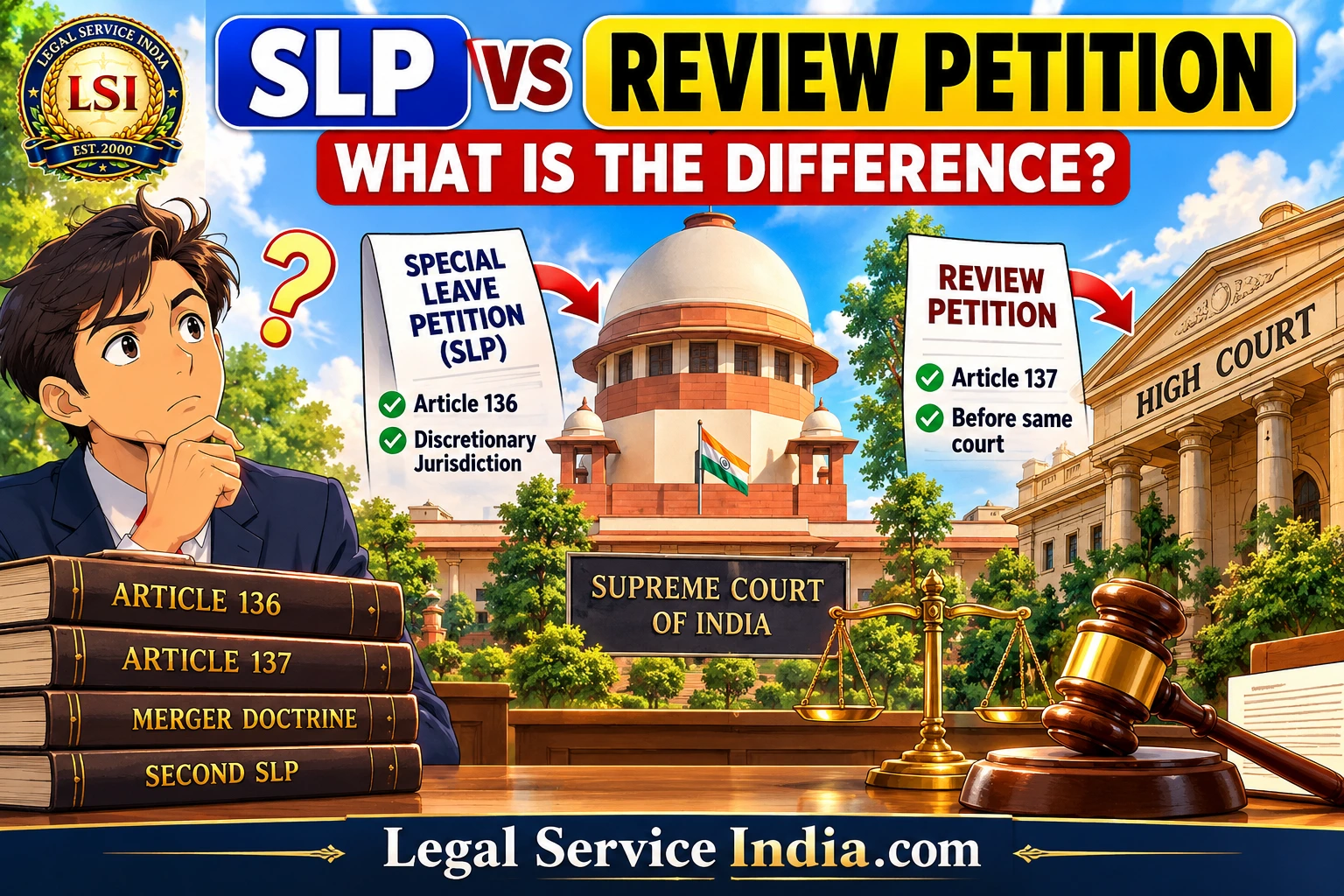
SLP vs Review Petition: What Is the Difference?
When a High Court delivers an adverse judgment, a litigant may have more than one possible remedy. Two of the remedies that are often confused are a Special Leave Petition (SLP) before the Supreme Court and a Review Petition before the same High Court.
Although both remedies may ultimately seek to correct an adverse judicial decision, they are fundamentally different in their source, purpose, scope and procedure.
The distinction becomes particularly important where a litigant has already approached the Supreme Court by way of an SLP and the SLP has been dismissed. Can the litigant still file a review before the High Court? What happens if the review is dismissed? Can another SLP then be filed before the Supreme Court? Does dismissal of an SLP result in merger of the High Court judgment with the Supreme Court’s order?
These questions have generated considerable litigation.
The Supreme Court’s decisions in Kunhayammed v. State of Kerala, (2000) 6 SCC 359, Khoday Distilleries Ltd. v. Sri Mahadeshwara Sahakara Sakkare Karkhane Ltd., (2019) 4 SCC 376, S. Narahari v. S.R. Kumar, (2023) 7 SCC 740, Manisha Nimesh Mehta v. Board of Directors, ICICI Bank, (2024) 9 SCC 573, Satheesh V.K. v. The Federal Bank Ltd., 2025 INSC 1140, and Kangra Central Cooperative Bank Ltd. v. Kangra Central Cooperative Bank Pensioners Welfare Association, 2025 INSC 1416 show why the procedural history of a case matters enormously.
As of 3 October 2026, the safest way to understand the law is not to treat every dismissal of an SLP in the same manner. The precise order passed by the Supreme Court—and whether the SLP was dismissed, withdrawn, or disposed of with liberty—can materially affect the remedies available thereafter.
SLP vs Review Petition: What Is the Difference?
At its simplest, the distinction can be stated this way:
| Special Leave Petition | Review Petition |
|---|---|
| Constitutional remedy under Article 136 | Review jurisdiction principally under Article 137, read with the applicable procedural rules |
| Filed before the Supreme Court | Filed before the court which passed the judgment or order |
| Seeks special leave to appeal | Seeks reconsideration of the judgment/order on limited review grounds |
| Discretionary jurisdiction of the Supreme Court | Exceptional corrective jurisdiction |
| Not an appeal as of right | Not a rehearing or second appeal |
| Can challenge judgments/orders of courts and tribunals, subject to constitutional and statutory limitations | Generally confined to error apparent, discovery of important matter, or other recognised review grounds |
| Leave must ordinarily be granted before an SLP becomes an appeal | Review is considered within the court’s review jurisdiction |
The distinction is not merely procedural. It determines which court can exercise jurisdiction, what the court is permitted to examine, and what consequences follow from dismissal of the proceeding.
What Is a Special Leave Petition?
Article 136 of the Constitution gives the Supreme Court a broad discretionary power to grant special leave to appeal from judgments, decrees, determinations, sentences or orders passed by courts or tribunals in India.
An SLP therefore does not operate like an ordinary appeal.
The Supreme Court does not automatically hear the matter as an appellate court merely because an SLP has been filed.
There Are Essentially Two Stages:
- The SLP stage, where the Supreme Court considers whether special leave should be granted; and
- The appellate stage, which begins once leave is granted.
This distinction lies at the heart of the Supreme Court’s jurisprudence on the doctrine of merger.
In Kunhayammed v. State of Kerala, (2000) 6 SCC 359, a three-Judge Bench carefully explained the consequences of dismissal of an SLP at different stages. The Court held that where an SLP is dismissed without granting leave, there is ordinarily no merger of the High Court judgment with the Supreme Court’s order.
That principle remains central to understanding the relationship between an SLP and a High Court review.
What Is a Special Leave Petition?
Article 136 of the Constitution gives the Supreme Court a broad discretionary power to grant special leave to appeal from judgments, decrees, determinations, sentences or orders passed by courts or tribunals in India.
An SLP therefore does not operate like an ordinary appeal.
The Supreme Court does not automatically hear the matter as an appellate court merely because an SLP has been filed.
There are essentially two stages:
- The SLP stage: where the Supreme Court considers whether special leave should be granted; and
- The appellate stage: which begins once leave is granted.
This distinction lies at the heart of the Supreme Court’s jurisprudence on the doctrine of merger.
In Kunhayammed v. State of Kerala, (2000) 6 SCC 359, a three-Judge Bench carefully explained the consequences of dismissal of an SLP at different stages. The Court held that where an SLP is dismissed without granting leave, there is ordinarily no merger of the High Court judgment with the Supreme Court’s order.
That principle remains central to understanding the relationship between an SLP and a High Court review.
What Is a Review Petition?
A Review Petition is fundamentally different.
Article 137 of the Constitution provides:
“Subject to the provisions of any law made by Parliament or any rules made under Article 145, the Supreme Court shall have power to review any judgment pronounced or order made by it.”
For civil proceedings, review jurisdiction is governed by Order XLVII of the Supreme Court Rules and the principles underlying Order XLVII Rule 1 CPC, where applicable.
A review is not an opportunity to argue the entire case again.
The Supreme Court has repeatedly emphasised that review jurisdiction is narrow. It is ordinarily attracted where there is, for example:
- an error apparent on the face of the record;
- discovery of important matter or evidence which could not, despite due diligence, be produced earlier; or
- another recognised ground of sufficient reason.
The Court has repeatedly cautioned that review cannot be converted into an appeal in disguise.
The distinction was explained in authorities including Lily Thomas v. Union of India, (2000) 6 SCC 224 and Kamlesh Verma v. Mayawati, (2013) 8 SCC 320.
Therefore, when considering SLP vs Review Petition: What Is the Difference?, the first point to remember is this:
An SLP asks the Supreme Court to exercise its special appellate discretion. A review asks the court that passed the judgment to reconsider it within the narrow confines of review jurisdiction.
The Most Important Question: What Happens When an SLP Is Dismissed?
This is where the law becomes more nuanced.
Suppose a High Court passes an adverse judgment.
The aggrieved party files an SLP before the Supreme Court.
The Supreme Court dismisses the SLP without granting leave.
Does that automatically mean that the High Court judgment has merged into the Supreme Court’s order?
No—not ordinarily.
This is the significance of Kunhayammed.
The Supreme Court distinguished between:
1. Dismissal of an SLP Without Grant of Leave
Ordinarily, there is no merger.
The High Court judgment continues to remain the operative judgment.
2. Grant of Leave Followed by Disposal of the Appeal
Here the situation is different.
Once leave is granted, the matter enters the appellate jurisdiction of the Supreme Court. The Supreme Court’s decision in the appeal can result in merger of the High Court judgment into the Supreme Court’s appellate judgment.
This distinction was reaffirmed in later decisions, including Khoday Distilleries and subsequent Supreme Court authorities.
| Procedural Stage | General Legal Position |
|---|---|
| SLP filed | The Supreme Court considers whether special leave should be granted. |
| SLP dismissed without grant of leave | Ordinarily, there is no merger of the High Court judgment with the Supreme Court’s order. |
| Leave granted | The matter enters the appellate jurisdiction of the Supreme Court. |
| Appeal decided after grant of leave | The Supreme Court’s appellate judgment can result in merger of the High Court judgment. |
Can a Review Petition Be Filed After an SLP Is Dismissed?
This is one of the most practically important consequences of the doctrine.
Where an SLP against a High Court judgment is dismissed without grant of leave, the dismissal does not ordinarily result in merger.
Therefore, the fact that an SLP was dismissed does not, by itself, destroy the High Court’s review jurisdiction.
The Supreme Court’s decision in Manisha Nimesh Mehta v. Board of Directors, ICICI Bank, Civil Appeal No. 7233 of 2024, decided on 8 July 2024, is a useful modern illustration.
In that case, an SLP against the Bombay High Court judgment had been dismissed. The High Court subsequently refused to entertain a review petition on the ground that the judgment had already been affirmed by the Supreme Court.
The Supreme Court disagreed with that approach, allowed the appeal in part and directed the High Court to consider the review in accordance with law.
The decision is consistent with the principle that dismissal of an SLP without grant of leave does not ordinarily produce merger.
But this should not be misunderstood as meaning that every review filed after an SLP dismissal will succeed. The review must independently satisfy the legal requirements for review.
Kunhayammed: The Foundation of the Law
The judgment in Kunhayammed v. State of Kerala, (2000) 6 SCC 359 remains the starting point for analysing this subject.
The Supreme Court considered the effect of an order dismissing an SLP and explained the doctrine of merger in considerable detail.
The broad principles are:
Where Leave Is Not Granted
Dismissal of the SLP does not ordinarily result in a merger.
Where the SLP Is Dismissed by a Non-Speaking Order
The Supreme Court does not ordinarily declare the law governing the dispute merely by dismissing the SLP.
Where the Supreme Court Gives Reasons While Dismissing the SLP
The reasons may have significance under Article 141, depending upon whether the order actually declares a proposition of law.
Where Leave Is Granted
The matter becomes an appeal before the Supreme Court.
Where the Appeal Is Subsequently Decided
The appellate judgment of the Supreme Court operates in the field of the High Court judgment, attracting the doctrine of merger to the extent recognised by law.
This distinction is critical.
Dismissal of an SLP is not synonymous with dismissal of an appeal after grant of leave.
Does a Speaking Dismissal of an SLP Change the Position?
Not necessarily in relation to merger—but it may have consequences under Article 141.
This is an area where considerable confusion exists.
A non-speaking dismissal of an SLP ordinarily does not mean that the Supreme Court has affirmed the reasoning of the High Court.
However, if the Supreme Court gives reasons and those reasons contain a declaration of law, the proposition of law contained in the order may have binding force under Article 141 of the Constitution.
Thus, two separate questions must be asked:
- First: Has the High Court judgment merged into the Supreme Court’s order?
- Second: Has the Supreme Court declared a proposition of law which is binding under Article 141?
These are not the same question.
The doctrine of merger and Article 141 operate in different fields.
The Review Petition After SLP Dismissal: The Practical Position
The practical position can therefore be expressed as follows:
If an SLP is dismissed without grant of leave, a legally maintainable review before the High Court is not automatically barred merely because the SLP was dismissed.
This principle is important for practitioners because a litigant may sometimes discover that the High Court judgment contains an error apparent on the face of the record or that a recognised review ground exists only after the Supreme Court has dismissed the SLP.
The decision in Manisha Nimesh Mehta reinforces the practical importance of examining the exact Supreme Court order before advising that a High Court review is barred.
But What Happens After the High Court Rejects the Review?
This is where the position becomes significantly more complicated.
Consider the following sequence:
High Court Judgment → SLP Dismissed → High Court Review Filed → Review Dismissed
Can the litigant then file another SLP against the original High Court judgment?
There is no safe universal answer that applies irrespective of the procedural history.
The answer depends upon how the first SLP was disposed of, whether it was dismissed or withdrawn, what liberty was granted, and what exactly the subsequent SLP seeks to challenge.
This is also where the unresolved reference in S. Narahari v. S.R. Kumar becomes important.
S. Narahari: The Question That Remains Important
In S. Narahari v. S.R. Kumar, (2023) 7 SCC 740; 2023 INSC 604, the Supreme Court was confronted with a difficult procedural question.
The original SLP had been withdrawn with liberty to approach the High Court by way of review.
The review petition was subsequently dismissed.
The petitioners then approached the Supreme Court again.
The two-Judge Bench recognised tension between different lines of authority and referred the issue to a larger Bench.
The question, in substance, was whether granting liberty to approach the High Court in review automatically preserves or revives the possibility of approaching the Supreme Court again if the review fails.
The importance of the reference cannot be overstated.
It prevents a lawyer from stating, as an absolute proposition, that:
“Once the High Court review is dismissed, a second SLP is always maintainable.”
Equally, it is unsafe to state the opposite as a universal proposition without examining the exact procedural history.
As of 3 October 2026, the reference remains an important unresolved aspect of this area of law. The Supreme Court’s subsequent decisions have dealt with particular procedural situations but have not converted every possible sequence into one universal rule. The case has continued to appear in the Court’s proceedings, including listings concerning the reference.
Satheesh V.K.: Why the Distinction Between Withdrawal and Dismissal Matters
The Supreme Court’s decision in Satheesh V.K. v. The Federal Bank Ltd., 2025 INSC 1140, decided on 23 September 2025, is particularly important.
There, the first SLP had been withdrawn without liberty to approach the Supreme Court again.
The petitioner subsequently pursued a review before the High Court. After the review was dismissed, another challenge was brought before the Supreme Court.
The Supreme Court held the subsequent challenge to be not maintainable.
The Court relied upon the principle that a party cannot repeatedly challenge the same order after withdrawing the earlier SLP without obtaining permission to re-approach the Supreme Court. It also considered the limitation imposed by Order XLVII Rule 7 CPC on an appeal against rejection of a review.
But There Is an Important Qualification
Satheesh was a case of unconditional withdrawal.
It should therefore not be casually cited as though it conclusively decides every case in which an SLP is dismissed and a High Court review is later pursued.
Indeed, the judgment itself considered the distinction between the facts before it and S. Narahari.
Kangra Central Cooperative Bank: Another Important Development
In Kangra Central Cooperative Bank Ltd. v. Kangra Central Cooperative Bank Pensioners Welfare Association, 2025 INSC 1416, decided on 3 December 2025, the Supreme Court again considered the maintainability of a subsequent challenge.
The procedural history was significant.
The earlier Supreme Court proceeding had been dismissed. A later application was withdrawn with liberty to approach the High Court in review. The review was thereafter dismissed, following which another SLP was filed.
The Supreme Court rejected the maintainability challenge in the subsequent proceeding. The judgment carefully considered S. Narahari, Kunhayammed, Khoday Distilleries and other authorities.
The important point for practitioners is not to read Kangra as having finally disposed of the entire question referred in Narahari.
Rather, Kangra illustrates how strongly the Supreme Court may scrutinise the exact procedural history and the scope of liberty granted in the earlier proceedings.
In particular, liberty to pursue a High Court review should not automatically be read as an express liberty to return to the Supreme Court with another SLP.
That distinction can be decisive.
What Does “Liberty” Really Mean?
This is perhaps one of the most underestimated aspects of this entire subject.
Suppose the Supreme Court records:
“The SLP is dismissed as withdrawn with liberty to approach the High Court in review.”
That order grants a specific liberty.
It does not necessarily say:
“with liberty to approach the High Court in review and thereafter return to this Court by way of a fresh SLP if the review fails.”
Those are different orders.
Therefore, when advising a litigant, the exact language of the earlier Supreme Court order should be examined.
| Practical significance | |
|---|---|
| Liberty to review | Generally permits the litigant to pursue review before the High Court. |
| Liberty to approach the Supreme Court again | This is a different and more specific form of liberty. |
| No liberty | The consequences may be substantially more restrictive, particularly where the earlier SLP was withdrawn unconditionally. |
The Supreme Court’s decisions show why lawyers should never advise on the availability of a second SLP merely by looking at the fact that “an earlier SLP was dismissed.”
The disposal order itself must be read.
Can an SLP Be Filed Against Rejection of a Review Petition?
This is another area where procedural terminology can cause confusion.
Under Order XLVII Rule 7 CPC, an order rejecting an application for review is not ordinarily appealable as an independent appeal.
The Supreme Court has also addressed the problem of attempting to use an SLP against a review rejection to indirectly reopen the original judgment.
In Bussa Overseas & Properties (P) Ltd. v. Union of India, (2016) 4 SCC 696, and subsequently in T.K. David v. Kuruppampady Service Co-operative Bank Ltd., (2020) 9 SCC 92, the Court applied principles of finality and judicial discipline in refusing to permit an SLP to be used to achieve indirectly what could no longer be achieved directly.
The Central Idea Is Simple
A review order cannot ordinarily become a procedural vehicle for reopening the original judgment after the original challenge has already reached finality.
But again, the precise procedural history matters.
Review Is Not an Appeal in Disguise
A common mistake is to approach review as though it were another round of appellate arguments.
That is not the function of review jurisdiction.
The Supreme Court has repeatedly emphasised that a review is not intended to provide a litigant with an opportunity to reargue the entire case.
In Kamlesh Verma v. Mayawati, (2013) 8 SCC 320, the Supreme Court summarised the recognised principles governing review.
The broad categories include:
- discovery of new and important matter or evidence;
- mistake or error apparent on the face of the record; and
- other sufficient grounds recognised by law.
A review cannot ordinarily be used simply because the litigant believes that another view of the evidence or law is possible.
That distinction is crucial when deciding whether to pursue review or an SLP.
What If the Law Has Changed After the Judgment?
This question also deserves careful treatment.
The mere fact that a later judgment changes or overrules a legal proposition does not automatically mean that the earlier judgment can be reopened in review.
The Supreme Court addressed this issue in Government of NCT of Delhi v. M/s K.L. Rathi Steels Ltd., 2024 INSC 454.
A three-Judge Bench examined the scope of review jurisdiction and the Explanation to Order XLVII Rule 1 CPC. The Court did not accept the proposition that a subsequent overruling of precedent, by itself, automatically creates a ground for reopening the earlier decision through review.
This remains an important limitation when considering review strategy.
Review Petition vs SLP: Which Remedy Should Be Considered?
The question should not really be framed as:
“Which is better—SLP or Review?”
The correct legal question is:
“What is the nature of the error, which court passed the impugned judgment, and what procedural stage has the litigation reached?”
If the High Court Has Committed an Apparent Error
A review before the High Court may need to be considered.
If the High Court Has Taken a Legally Unsustainable View
An SLP under Article 136 may be the appropriate constitutional route, subject to the Supreme Court’s discretionary jurisdiction.
If the SLP Has Already Been Dismissed Without Grant of Leave
The precise dismissal order should be examined before concluding that review is barred.
If the SLP Was Withdrawn
The terms of withdrawal and any liberty granted become extremely important.
If a High Court Review Has Already Been Dismissed
A further SLP requires careful examination of the earlier SLP order, the review order and the precise relief sought.
A Practical Decision Tree
The following framework is useful when advising a litigant:
High Court Judgment
↓
Was an SLP Filed?
No
Consider:
- Review before the High Court, if review grounds exist; or
- SLP before the Supreme Court, subject to Article 136.
↓
Yes
What Happened to the SLP?
SLP Dismissed Without Grant of Leave
Ordinarily:
- no merger;
- High Court judgment remains operative;
- a legally maintainable review may still be available.
↓
Was the SLP Withdrawn Instead?
Yes — unconditional withdrawal
A subsequent SLP against the same order may face a serious maintainability objection.
Yes — liberty granted to seek review
Review may be pursued.
But:
Does that liberty itself preserve a later right to file another SLP?
That question cannot safely be answered without examining the order and the developing jurisprudence, including the unresolved issue referred in S. Narahari.
↓
Was Leave Granted by the Supreme Court?
Yes
The matter has entered the appellate stage.
The doctrine of merger may then operate depending upon how the appeal is ultimately disposed of.
SLP vs Review Petition: A Case-Law Comparison
| Case | Principle Relevant to SLP vs Review Petition |
|---|---|
| Kunhayammed v. State of Kerala, (2000) 6 SCC 359 | Dismissal of SLP without grant of leave ordinarily does not result in merger |
| Khoday Distilleries Ltd. v. Sri Mahadeshwara Sahakara Sakkare Karkhane Ltd., (2019) 4 SCC 376 | Reaffirmed the distinction between dismissal of SLP and appellate adjudication after grant of leave |
| Bussa Overseas & Properties v. Union of India, (2016) 4 SCC 696 | Limits on using SLP against review rejection to reopen the original judgment |
| T.K. David v. Kuruppampady Service Co-operative Bank, (2020) 9 SCC 92 | Finality and judicial discipline prevent indirect reopening of concluded proceedings |
| S. Narahari v. S.R. Kumar, (2023) 7 SCC 740 | Question concerning subsequent SLP after withdrawal with liberty to review referred to larger Bench |
| Manisha Nimesh Mehta v. Board of Directors, ICICI Bank, (2024) 9 SCC 573 | Review before High Court was not barred merely because SLP against High Court judgment had been dismissed |
| K.L. Rathi Steels, 2024 INSC 454 | Subsequent change/overruling of law does not by itself furnish an unlimited review remedy |
| Satheesh V.K. v. Federal Bank, 2025 INSC 1140 | Unconditional withdrawal of first SLP followed by review did not permit a second challenge to the same order |
| Kangra Central Cooperative Bank, 2025 INSC 1416 | Subsequent SLP examined in light of procedural history and scope of liberty; does not eliminate the need to distinguish Narahari |
| United Labour Federation v. Gagandeep Singh Bedi, 2026 INSC 204 | Reiterates merger principles in a different procedural context; illustrates that merger depends upon the nature of the proceeding and order |
The 2026 decision in United Labour Federation v. Gagandeep Singh Bedi, 2026 INSC 204, concerned the effect of merger in contempt proceedings and should therefore not be treated as a direct answer to the unresolved second-SLP issue.
Important Limitation Periods
Practitioners must also distinguish the substantive availability of a remedy from its limitation period.
For example, under the Supreme Court Rules, the limitation applicable to an SLP depends upon the nature of the proceeding and the circumstances in which the SLP is filed.
Similarly, a review petition before the Supreme Court is ordinarily subject to the limitation prescribed by the Supreme Court Rules, while review proceedings before High Courts are governed by the applicable law and limitation provisions.
A lawyer should therefore calculate limitation from the actual judgment/order and procedural history rather than assuming that filing one proceeding automatically extends the time for another.
Curative Petition Is Different Again
After review jurisdiction has been exhausted, a curative petition may, in exceptional circumstances, be considered.
The constitutional foundation for the curative jurisdiction was explained by the Constitution Bench in:
Rupa Ashok Hurra v. Ashok Hurra, (2002) 4 SCC 388.
A curative petition is not another appeal and is not intended to provide a routine third opportunity to contest the judgment.
It is an exceptional remedy directed at preventing grave miscarriage of justice in circumstances satisfying the stringent conditions laid down by the Supreme Court.
Therefore, the hierarchy should not be understood as:
SLP → Review → Curative = three ordinary chances.
That is not how the constitutional scheme operates.
The Most Important Practical Lesson for Lawyers
In litigation involving an SLP and subsequent review, the sequence of orders is often as important as the substantive merits of the case.
Before advising a client, counsel should obtain and read:
- the original High Court judgment;
- the first SLP;
- the Supreme Court’s order disposing of the SLP;
- any order granting liberty;
- the High Court review petition;
- the High Court’s order on review; and
- the proposed grounds of the subsequent Supreme Court challenge.
The exact words used in the Supreme Court’s earlier order may determine whether a subsequent proceeding is maintainable.
This is particularly important where the earlier order says:
- “dismissed”;
- “dismissed as withdrawn”;
- “withdrawn with liberty to file review”;
- “withdrawn with liberty to approach the High Court”;
- “dismissed with liberty”; or
- “leave granted.”
These expressions cannot simply be treated as interchangeable.
SLP vs Review Petition: What Is the Difference?
The distinction can ultimately be reduced to several propositions.
Key Distinctions Between SLP and Review Petition
- An SLP under Article 136 is a discretionary constitutional remedy before the Supreme Court. It is not an appeal as of right.
- A Review Petition is a limited corrective jurisdiction exercised by the court that delivered the judgment, and it cannot ordinarily be used as a substitute for an appeal.
- Dismissal of an SLP without grant of leave does not ordinarily result in merger of the High Court judgment with the Supreme Court’s order.
- A legally maintainable review before the High Court is not automatically barred merely because an SLP against the High Court judgment was dismissed.
- Once leave is granted and the Supreme Court decides the appeal, the doctrine of merger operates on a fundamentally different footing.
- Withdrawal of an SLP is procedurally different from dismissal of an SLP. An unconditional withdrawal can create serious obstacles to a subsequent challenge.
- Liberty granted by the Supreme Court must be read according to its actual terms. Liberty to pursue a review before the High Court does not automatically have to be treated as an express liberty to return to the Supreme Court with another SLP.
- The question concerning the availability of a subsequent SLP after withdrawal of an earlier SLP with liberty to pursue High Court review remains an area requiring careful treatment in light of the reference in S. Narahari and subsequent fact-specific decisions.
How to Determine the Next Legal Remedy
The safest approach, therefore, is not to ask merely:
“Was the SLP dismissed?”
The better question is:
“How was the SLP disposed of, was leave granted, was it dismissed or withdrawn, what liberty was granted, and what exactly does the later proceeding seek to challenge?”
That is the real key to understanding SLP vs Review Petition: What Is the Difference?
Frequently Asked Questions
1. Can I file a Review Petition after my SLP is dismissed?
Ordinarily, where the SLP is dismissed without grant of leave, the dismissal does not by itself bar an otherwise maintainable review before the High Court. The exact Supreme Court order should nevertheless be examined.
2. Does dismissal of an SLP mean that the High Court judgment has merged with the Supreme Court order?
Not ordinarily where the SLP is dismissed without grant of leave. The doctrine of merger operates differently once leave is granted and the matter is decided as an appeal.
3. Is an SLP an appeal?
Strictly speaking, an SLP is a request to the Supreme Court to grant special leave to appeal under Article 136. It becomes an appeal only after leave is granted.
4. Can a second SLP be filed after the High Court rejects a review?
There is no universal answer independent of the procedural history. The earlier SLP order, whether it was dismissed or withdrawn, the terms of any liberty granted, and the nature of the proposed second SLP must all be examined.
5. What if the first SLP was withdrawn without liberty?
A subsequent SLP against the same order may be held not maintainable. Satheesh V.K. v. Federal Bank Ltd., 2025 INSC 1140, is an important recent authority on this situation.
6. What if the SLP was withdrawn with liberty to file a review?
The review can be pursued in accordance with the liberty granted. Whether a subsequent SLP is available after the review fails depends upon the precise procedural circumstances and remains a legally sensitive issue, particularly in view of S. Narahari.
7. Can a review petition be used to reargue the entire case?
No. Review is a limited jurisdiction and is not intended to operate as an appeal in disguise.
8. What is the significance of Article 141 in this context?
Even where an SLP dismissal does not produce merger, reasons contained in a Supreme Court order may, where they amount to a declaration of law, have binding effect under Article 141.
9. What is the difference between SLP dismissal and dismissal of an appeal?
An SLP is at the stage of seeking special leave. Once leave is granted, the proceeding becomes an appeal. The legal consequences of disposal at those two stages are therefore different.
10. Should a lawyer rely only on the latest Supreme Court judgment?
No. In this area, the procedural history is critical. The earlier SLP order and the precise liberty granted, if any, may determine which later authorities actually apply.
Conclusion
The law relating to SLPs and review petitions is not difficult merely because the principles are complicated. It is difficult because small differences in procedural history can produce materially different legal consequences.
A dismissed SLP, a withdrawn SLP, an SLP dismissed after hearing, an SLP dismissed without reasons, an SLP dismissed with liberty, and an appeal decided after grant of leave are not necessarily equivalent events.
That is why every case involving SLP vs Review Petition: What Is the Difference? must be analysed from the actual orders rather than from a general proposition about “dismissal of an SLP.”
For practitioners, the safest method is straightforward: read the original judgment, read the Supreme Court’s disposal order, identify whether leave was granted, identify the exact liberty granted, and only then determine the availability of review or a subsequent SLP.
That procedural discipline can prevent a potentially serious maintainability objection at the next stage of litigation.
Need Legal Advice on an SLP, Review Petition or Supreme Court Appeal?
One procedural mistake can affect your right to pursue the next legal remedy.
If your SLP has been dismissed, withdrawn, or disposed of, or if your Review Petition before the High Court has been rejected, do not assume that your next legal remedy is automatically available—or barred.
In matters involving SLP vs Review Petition, the exact wording of the Supreme Court’s order, whether leave was granted, whether the SLP was dismissed or withdrawn, and whether any liberty was granted can make a significant difference.
Before taking the next step, have your judgment, SLP order, review order and relevant case papers professionally examined.
Get Legal Consultation
If you are considering:
- Filing an SLP before the Supreme Court of India
- Filing a Review Petition before the High Court
- Challenging an adverse High Court judgment
- Filing a further SLP after dismissal of a Review Petition
- Understanding whether an earlier SLP has resulted in merger
- Determining the effect of withdrawal of an SLP
- Understanding the effect of liberty granted by the Supreme Court
- Assessing the maintainability of your next appellate remedy
Do not rely on assumptions about your case. Get the procedural position examined before you take the next step.
Consult Adv. Tarun Choudhury
Adv. Tarun Choudhury
Supreme Court Advocate | 25+ Years of Legal Experience
📞 Call: 9650499965
💬 WhatsApp: 8851978611
📧 Email: [email protected]
For consultation, send the relevant judgment/order and briefly explain what happened after the judgment. Your documents can then be examined to identify the appropriate legal remedy and the next procedural step.
Legal consultation is particularly important where limitation, maintainability, merger, withdrawal or liberty granted by the Supreme Court may affect your case.
Key Takeaways: SLP vs Review Petition
- An SLP (Special Leave Petition) is filed before the Supreme Court under Article 136 of the Constitution, while a Review Petition is filed before the court that passed the judgment or order.
- An SLP is not an appeal as of right. It becomes an appeal only when the Supreme Court grants special leave.
- Dismissal of an SLP without granting leave ordinarily does not result in merger of the High Court judgment with the Supreme Court’s order.
- A High Court Review Petition is not automatically barred merely because an SLP against the High Court judgment was dismissed, provided the review is otherwise maintainable.
- The doctrine of merger operates differently when the Supreme Court grants leave and subsequently decides the matter as an appeal.
- A speaking order dismissing an SLP may have consequences under Article 141 if the Supreme Court has actually declared a proposition of law, even though dismissal without leave ordinarily does not result in merger.
- Withdrawal of an SLP is different from dismissal of an SLP. The consequences of withdrawal depend significantly on whether the Supreme Court granted liberty to pursue another remedy.
- Unconditional withdrawal of an SLP can create a serious bar to a subsequent challenge to the same judgment or order.
- Liberty to file a Review Petition before the High Court does not automatically mean that the litigant has been granted liberty to return to the Supreme Court with another SLP.
- The question concerning a second SLP after an earlier SLP was withdrawn with liberty to pursue a High Court review remains legally sensitive and must be considered in light of S. Narahari v. S.R. Kumar and subsequent decisions.
- Satheesh V.K. v. Federal Bank Ltd. (2025 INSC 1140) is particularly relevant to an unconditional withdrawal of an earlier SLP, but it should not be treated as finally deciding every situation involving a second SLP.
- Kangra Central Cooperative Bank Ltd. v. Kangra Central Cooperative Bank Pensioners Welfare Association (2025 INSC 1416) also demonstrates that the exact procedural history and wording of the earlier Supreme Court order are crucial.
- A Review Petition is not an appeal in disguise. It is a limited remedy generally concerned with grounds such as an error apparent on the face of the record or discovery of important matter or evidence in accordance with the applicable review principles.
- A litigant should examine the exact Supreme Court disposal order before deciding whether a Review Petition or subsequent SLP is maintainable.
- The most important practical rule is: do not determine the next remedy merely by asking whether the SLP was “dismissed.” Examine whether leave was granted, whether the SLP was dismissed or withdrawn, what liberty was granted, and what the later proceeding seeks to challenge.
Summary
SLP vs Review Petition: What Is the Difference? An SLP is a discretionary constitutional remedy under Article 136 filed before the Supreme Court, whereas a Review Petition is a limited remedy filed before the court that delivered the judgment. Dismissal of an SLP without grant of leave ordinarily does not cause merger of the High Court judgment with the Supreme Court’s order and does not, by itself, prevent an otherwise maintainable High Court review. However, the position becomes more complicated where an SLP is withdrawn, particularly where liberty is granted to pursue a review. The maintainability of a subsequent SLP depends on the exact procedural history, the wording of the earlier Supreme Court order and the scope of any liberty granted. The Supreme Court decisions in Kunhayammed, Manisha Nimesh Mehta, S. Narahari, Satheesh V.K. and Kangra Central Cooperative Bank are particularly relevant.