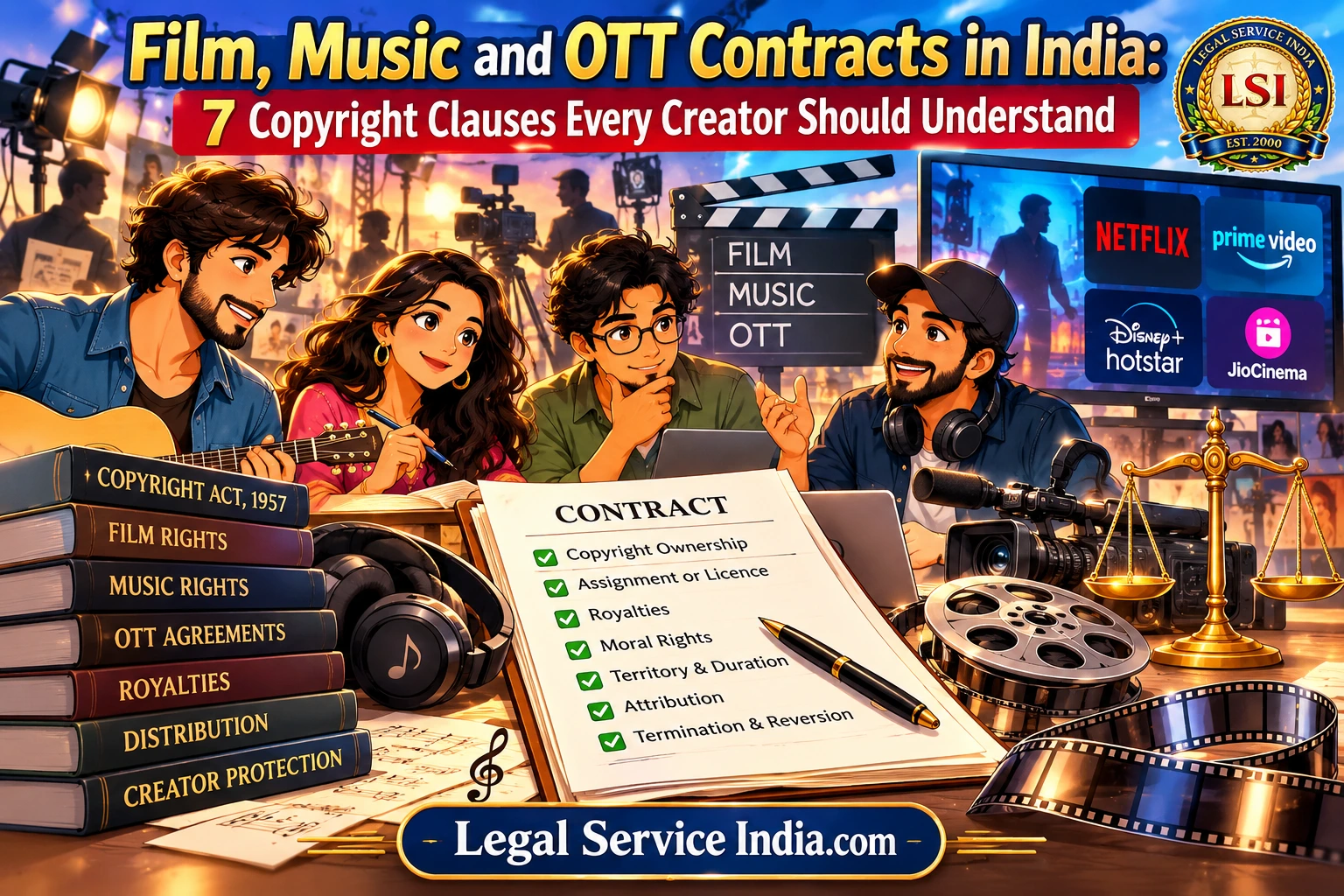
Film, Music & OTT Contracts in India: 7 Copyright Clauses to Know
A song becomes a hit, but the composer discovers that the rights to use the underlying music have already been transferred. A lyricist hears their work in an advertising campaign they never expected to be part of. A filmmaker finds that an OTT platform is streaming a version of the film that differs substantially from the one originally delivered. An independent producer grants exclusive distribution rights to a company that never releases the film, leaving the project tied up in a contract with no clear exit.
These are not merely commercial misunderstandings. They raise fundamental questions about copyright ownership, contractual obligations and the control creators retain over their work.
In the entertainment industry, the consequences of a poorly drafted agreement may not become apparent until a project succeeds. A song that initially forms part of a film may later be released independently, licensed for advertising, adapted into a new version or exploited across digital platforms. A film may find audiences in territories that were never part of the original distribution plan. When these opportunities arise, the agreement signed at the beginning can determine who has the right to pursue them and who receives the resulting revenue.
This is why film, music and OTT contracts in India deserve more careful scrutiny than they often receive. The issue is not simply whether a creator has been paid or whether a producer has acquired the rights needed to release a project. It is whether the agreement accurately reflects the parties’ commercial intentions and complies with the applicable copyright law.
Under the Copyright Act, 1957, a song, its lyrics, its sound recording and the film in which it appears may involve distinct copyright interests. Ownership of one does not automatically establish ownership of the others. The Act, including the amendments introduced in 2012, also contains important provisions concerning assignments, royalties and authors’ rights.
For composers, lyricists, screenwriters, directors, independent producers and other entertainment professionals, understanding these provisions is essential before signing an agreement.
Seven clauses deserve particular attention.
1. Copyright Assignment: Are You Transferring Ownership or Granting Permission?
One of the most important questions in any entertainment contract is also one of the easiest to overlook: what, precisely, is the creator agreeing to give away?
An agreement may transfer copyright ownership or grant another party permission to use specified rights. Although both arrangements can support commercial exploitation, their legal and practical consequences differ.
Section 18 of the Copyright Act, 1957, permits the owner of copyright to assign rights wholly or partially, generally or subject to limitations, and for the entire term of copyright or a shorter period. Section 30 provides the framework for licences granted by copyright owners, while Section 30A applies the relevant assignment provisions to licences, subject to necessary adaptations and modifications.
The distinction matters because an assignment transfers the specified copyright interests to the assignee, whereas a licence authorises particular uses without necessarily transferring ownership.
Understanding Separate Copyrights in Films and Music
The position becomes more complicated when a film or song contains several separately protected works.
Consider a song created for a feature film. The lyrics may qualify as a literary work, the tune as a musical work, the recorded performance as a sound recording and the film itself as a cinematograph film. These rights may be held by different people or entities, depending on the circumstances in which the works were created and the agreements governing them.
A producer’s ownership of the film does not, by itself, settle every question concerning the underlying lyrics or musical composition. Equally, a composer who owns a musical work does not automatically own the sound recording made for a particular film.
Section 17 and First Ownership of Copyright
Section 17 addresses the question of first ownership. Although the author is ordinarily the first owner of copyright, the section contains exceptions and provisos dealing with matters such as employment, commissioned works and the incorporation of underlying works into cinematograph films. The outcome therefore depends on the applicable statutory provisions and the circumstances of the particular engagement.
The Supreme Court’s decision in Indian Performing Right Society Ltd. v. Eastern India Motion Pictures Association, (1977) 2 SCC 820, remains an important part of the development of Indian film-copyright law. The judgment considered the relationship between copyright in a cinematograph film and rights associated with the literary and musical works incorporated into it. Its reasoning must, however, be read in the context of the statutory framework then in force and the changes subsequently introduced by the 2012 amendments.
More recent disputes involving composers and film music reinforce the importance of identifying the particular copyright interest in question. A claim to ownership of a musical composition is not necessarily a claim to ownership of the lyrics or the original sound recording.
Drafting Effective Copyright Assignment Clauses
For anyone negotiating film, music and OTT contracts in India, the practical lesson is straightforward: never rely on a broad statement of ownership without examining which rights the agreement actually transfers.
A well-drafted clause should identify the rights being assigned or licensed, including reproduction, distribution, communication to the public, synchronisation, digital streaming, adaptation and sublicensing, where relevant.
It should also state whether the grant is exclusive, identify any restrictions and clarify which rights remain with the creator.
For example, a composer who agrees to let a producer use a composition in one film should understand whether the agreement also covers standalone soundtrack releases, advertising campaigns, remixes and other independent uses. An independent producer, meanwhile, should ensure that the rights acquired are sufficient for the intended distribution strategy.
The objective is not to make every agreement unnecessarily complicated. It is to ensure that the rights granted are the rights the parties actually intended to grant.
2. Royalties: What Does the Creator Receive After the Initial Payment?
An upfront fee may be entirely appropriate for a creative engagement. The difficulty arises when that payment is treated as a complete answer to every question about future exploitation.
A song may generate revenue long after the film’s release. The underlying composition may be performed, communicated to the public, licensed for a new use or exploited through a sound recording. Whether the original creator is entitled to further payment depends on the applicable law, the nature of the rights involved and the contractual arrangement.
Royalty Protections Under the Copyright Act, 1957
Sections 18 and 19 of the Copyright Act contain specific protections concerning royalty entitlements for authors of literary and musical works.
The relevant provisos to Section 18 protect specified royalty entitlements associated with the use of literary and musical works incorporated into cinematograph films, subject to the statutory conditions and exceptions. Related provisions address qualifying literary and musical works incorporated into sound recordings that do not form part of cinematograph films. Sections 19(9) and 19(10) also address the preservation of specified royalty and consideration entitlements.
These provisions are important because contractual language cannot simply eliminate statutory protections where the Act prohibits an agreement to the contrary.
However, it would be misleading to suggest that every composer or lyricist automatically receives a fixed percentage of every payment connected with a film, song or OTT release. The statutory entitlement must be assessed in light of the relevant provision, the form of exploitation and any applicable exception.
Contractual Royalties and Revenue-Sharing Arrangements
Contractual royalties present a separate question.
A creator may negotiate a revenue share, a licence fee, a minimum guarantee, an advance against royalties or another commercial arrangement. The contract should make clear how the agreed payment structure works and how it interacts with any applicable statutory entitlement.
This is where vague drafting becomes a problem.
A clause promising royalties “as mutually agreed” does little to resolve a dispute if the parties later disagree about the revenue covered, permissible deductions or the timing of payments.
Essential Elements of a Well-Drafted Royalty Clause
A properly drafted royalty clause should address the following:
- Revenue base: Whether royalties are calculated on gross receipts, defined net receipts or a specified amount actually received by the contracting party.
- Permitted deductions: Which expenses, taxes, advances or other amounts may be deducted before calculating the contractual share.
- Reporting: How frequently royalty statements must be provided and what information they must contain.
- Payment deadlines: When amounts become payable after the relevant receipts are received.
- Audit rights: Whether the creator may inspect relevant records and challenge discrepancies.
- Third-party licensing: How receipts from distributors, platforms and sublicensing arrangements are treated.
Royalties in OTT Contracts
OTT agreements require particular attention because a platform may pay a fixed licence fee or minimum guarantee rather than a royalty calculated separately for every stream. The contract should identify the payment model and establish how the creator’s entitlement is calculated.
A creator should also understand whether a negotiated payment is intended to compensate only for the initial work or includes additional rights and future uses.
The most effective royalty clause is not necessarily the one promising the largest percentage. It is the one that clearly defines what is payable, how it is calculated and how compliance can be checked.
3. Moral Rights: Can the Creator Object to Changes Made After Assignment?
Copyright ownership does not exhaust the rights an author may have in a creative work.
Section 57 of the Copyright Act recognises certain special rights of authors independently of copyright ownership. These include the right to claim authorship and the right to seek relief against specified distortions, mutilations, modifications or other acts concerning the work where the statutory conditions are satisfied, including the relevant requirement concerning prejudice to the author’s honour or reputation.
These rights can remain relevant even after copyright has been assigned.
For film and OTT projects, the issue is particularly sensitive because creative works frequently undergo changes during editing, distribution and adaptation.
A film may be shortened for a particular release. A scene may be edited to meet classification requirements. A soundtrack may require technical changes for delivery to a platform. A work may be dubbed, subtitled or adapted for another market.
Not every such alteration amounts to a violation of moral rights. Section 57 should not be interpreted as an unrestricted right to prevent every editorial or technical decision. Whether an alteration engages the statutory protection depends on the facts and the applicable legal test.
Nevertheless, a creator’s concerns about attribution, material alterations and professional reputation should not be dismissed simply because copyright has been assigned.
Distinguishing Routine Production Changes From Material Alterations
A carefully negotiated agreement can establish a workable distinction between routine production changes and alterations that may materially affect the creator’s contribution or reputation.
For example, the parties might agree on a consultation or notification process for specified substantial changes, while preserving the producer’s ability to make ordinary technical adjustments required for distribution.
Credit arrangements can also be addressed contractually. The agreement should identify how the creator will be credited in the film, promotional material and relevant digital metadata.
A blanket waiver of moral rights should not be assumed to eliminate protections that continue to apply under the statute.
For creators, the important point is to address these issues before a disagreement develops. For producers, clear provisions can reduce uncertainty while preserving the flexibility needed to complete and distribute a project.
4. Non-Exploitation: What If the Acquired Rights Are Never Used?
An exclusive assignment can restrict a creator or producer from pursuing other commercial opportunities. That restriction may be justified when the assignee actively develops and exploits the work. It becomes much harder to defend commercially when the rights remain unused and the project is effectively stalled.
How Unused Exclusive Rights Can Restrict Commercial Opportunities
Imagine that an independent producer grants exclusive digital distribution rights to a company. The company does not release the film, but the agreement continues to prevent the producer from approaching another distributor. The problem is no longer merely delayed distribution; it is the loss of alternative commercial opportunities.
Section 19(4): Failure to Exercise Assigned Rights
Section 19(4) of the Copyright Act addresses the failure to exercise assigned rights within one year of the assignment. It provides that the assignment in respect of those rights is deemed to have lapsed after the expiry of that period unless otherwise specified in the assignment.
The qualification matters. The provision does not mean that every assignment automatically reverts to the original owner whenever a work is not exploited within a year. The wording of the assignment and the applicable statutory framework must be examined.
Nor should the parties assume that exploitation of one category of rights necessarily amounts to the exercise of every other right covered by the agreement. A theatrical release, for example, may raise a different question from the exercise of separately assigned digital distribution rights.
The agreement should therefore identify what counts as exploitation for each commercially significant category of rights.
Contractual Safeguards Against Non-Exploitation
Where appropriate, the parties may also negotiate specific release deadlines, notice requirements, cure periods and contractual mechanisms for the return of rights.
Section 19A provides a separate statutory mechanism for addressing qualifying disputes concerning assignments. Following the relevant legislative changes, the provision refers to the Commercial Court and permits the Court to consider revocation in specified circumstances, subject to the statutory requirements and limitations.
These remedies should not be confused with an automatic contractual right to recover every assigned right. The appropriate position depends on the facts, the agreement and the applicable law.
Questions to Ask Before Signing an Exclusive Assignment
Before signing an exclusive assignment, creators and producers should consider asking:
- By what date must the work be released or the assigned rights exercised?
- What specific acts will count as exploitation?
- Are different deadlines required for theatrical, television and digital distribution?
- Will the assignee have a reasonable opportunity to remedy a failure?
- What happens to sublicences already granted to third parties?
- Is there a contractual mechanism for reversion if the agreed milestones are not met?
A carefully drafted non-exploitation clause can protect both sides. It gives the assignee a clear opportunity to use the rights acquired while reducing the risk that a project remains tied up indefinitely without meaningful commercial progress.
5. Territory and Duration: How Far Do the Rights Extend?
A copyright agreement should make clear where the rights may be exercised and how long the grant will last.
These questions are particularly important when a project is intended for international distribution or long-term streaming.
What Sections 19(2), 19(5), 19(6) and 19(7) Provide
Section 19(2) requires an assignment to identify the work and specify the rights assigned, the duration and the territorial extent. Under Section 19(5), an assignment is deemed to be for five years if the period is not stated. Section 19(6) provides that, where the territorial extent is not specified, the assignment is presumed to extend within India. Section 19(7) excludes certain pre-1994 assignments from the application of subsections 19(2) to 19(6).
These provisions demonstrate why silence in a contract can have significant consequences.
| Statutory Provision | Subject | Practical Significance |
|---|---|---|
| Section 19(2) | Scope, duration and territorial extent | The assignment should specify the work, rights, duration and territory. |
| Section 19(5) | Duration of assignment | A five-year period applies if the duration is not stated, subject to the statutory framework. |
| Section 19(6) | Territorial extent | The assignment is presumed to extend within India if the territory is not specified. |
| Section 19(7) | Certain pre-1994 assignments | Excludes specified earlier assignments from the application of subsections 19(2) to 19(6). |
An assignment for five years is commercially different from one covering the entire term of copyright. Likewise, a grant limited to India may not satisfy the requirements of a producer planning worldwide distribution.
The agreement should state the intended duration and territory expressly. It should also address renewals, extensions, reserved territories and the relationship between the grant and any downstream licences.
The parties should be especially careful when the creator intends to retain rights for certain markets or forms of exploitation. A reservation that conflicts with the rights granted to a distributor or platform may create uncertainty rather than provide protection.
Future Technologies and Modes of Exploitation
Technology adds another dimension.
The relevant proviso to Section 18 addresses modes or media of exploitation that did not exist or were not in commercial use when an assignment was made. The provision requires specific reference to such modes or media for the assignment to apply to them.
As a result, broad expressions such as “all future technologies” should be examined against the statutory language and the rest of the agreement rather than assumed to settle every question.
This does not mean that every new distribution technology requires an entirely new contract. It means that the drafting should be sufficiently precise to reflect the intended scope of the grant within the applicable legal framework.
For OTT and digital distribution agreements, territory, duration and permitted modes of exploitation should be treated as core commercial terms, not administrative details.
6. Credit and Attribution: Do Not Leave Recognition to Assumption
Credit is sometimes negotiated as though it were a minor production detail. For composers, lyricists, screenwriters and directors, it can have a lasting effect on professional recognition and future opportunities.
Attribution also has practical significance in the digital environment. Accurate metadata helps identify creators and rights holders across platforms, while errors or omissions can complicate the administration of rights and payments.
Section 57 recognises an author’s right to claim authorship, subject to the applicable law. Contractual provisions should make the practical arrangements for credit clear.
What Should a Copyright Agreement Say About Credit?
A promise that a creator will be “duly credited” may sound reassuring, but it leaves several questions unanswered. Where will the credit appear? What form will it take? Who is responsible for ensuring that it appears in digital listings and promotional materials?
A more useful agreement specifies, where relevant:
- The creator’s approved professional name.
- The form and placement of credit in opening or closing titles.
- Attribution in trailers and promotional materials.
- Credit in OTT listings and music-platform metadata.
- Responsibility for supplying and checking accurate information.
- A procedure and reasonable timeline for correcting inadvertent omissions.
The agreement should also address credit in authorised versions of the work, where appropriate, without creating an impractical approval process for every routine promotional decision.
For example, the parties can specify the credit format to be used across the principal release and associated digital materials while establishing a process for correcting errors.
This is a relatively straightforward area to address during negotiations. Leaving it unresolved may create avoidable disputes long after the production has been completed.
7. Termination and Reversion: What Happens When the Agreement Breaks Down?
Most entertainment agreements are negotiated with the expectation that the project will proceed smoothly. A sound contract must also address the possibility that it will not.
A producer may fail to pay an agreed amount. A distributor may fail to meet release milestones. A party may repeatedly fail to provide royalty statements or comply with another material obligation.
The termination clause should establish what happens in these circumstances.
It should identify material breaches, applicable notice requirements and any opportunity to remedy a breach before termination. It should also specify the consequences of termination for payments, continuing obligations and the rights previously granted.
An important distinction must be maintained between termination and reversion.
Ending the commercial relationship does not necessarily restore every copyright interest to its original owner. The legal consequences depend on the nature of the grant, the contractual terms, the applicable statute and any rights already granted to third parties.
For example, the termination of a distribution agreement may not automatically extinguish an OTT platform’s rights under a separate agreement that remains effective.
The parties should therefore address the treatment of existing licences and sublicences, rather than assuming that termination resolves every downstream issue.
What Should a Termination Clause Cover?
A comprehensive clause should consider:
- The events that constitute material breach.
- Notice requirements and cure periods.
- The treatment of rights already assigned or licensed.
- The survival of existing third-party arrangements.
- Payment of accrued royalties and other outstanding amounts.
- Continuing obligations, including confidentiality and applicable indemnities.
- Delivery or return of masters, stems, promotional materials and unreleased content.
- Any express contractual mechanism for the reversion of rights.
Where the agreement includes a right to recover unused or otherwise specified rights, the mechanism should explain how and when that right operates.
The commercial objective is simple: both parties should understand the consequences of ending the relationship before they sign the agreement.
Seven Questions Every Creator and Producer Should Ask Before Signing
Before signing film, music and OTT contracts in India, it is worth checking whether the agreement provides clear answers to seven questions.
- What exactly is being transferred? Is the arrangement an assignment or a licence? Does it distinguish between the underlying composition, lyrics, sound recording and film?
- What happens after the initial payment? Are contractual royalties clearly defined? Have applicable statutory entitlements, reporting obligations and audit arrangements been considered?
- How are authorship and reputation addressed? Does the agreement specify credit arrangements and provide an appropriate framework for handling material alterations?
- What happens if the work is not exploited? Does the contract address non-exploitation, the relevant statutory provisions and any agreed release milestones or reversion mechanism?
- Where and for how long can the rights be exercised? Are the duration, territory, permitted uses and relevant modes of exploitation expressly identified?
- Is the credit obligation sufficiently specific? Does it cover the principal release, promotional materials, OTT listings and digital metadata, with a process for correcting mistakes?
- What happens if the agreement ends? Are termination triggers, notice periods, accrued payments, existing third-party licences and any reversion arrangements clearly addressed?
If any of these questions cannot be answered from the agreement itself, the relevant provisions should be examined more closely before the contract is signed.
Conclusion: A Good Contract Protects More Than the Initial Transaction
The value of a creative work rarely ends with its first release. A song may find a new audience through streaming, an advertisement or a later adaptation. A film may acquire distribution opportunities in additional territories. A screenplay or musical composition may become the basis for further commercial exploitation.
These opportunities can create value for creators, producers and distributors alike. They can also expose weaknesses in an agreement that was drafted without sufficient attention to the future.
The purpose of a well-drafted contract is not to anticipate every possible dispute. It is to establish a clear and workable understanding of ownership, permitted uses, payment obligations, attribution, exploitation and the consequences of termination.
Indian copyright law provides an important framework for these questions, including statutory protections that cannot simply be displaced by contractual language. But the legal position in an individual case will depend on the applicable provisions, the nature and date of the work, the circumstances of its creation and the terms of the agreement.
For anyone entering the entertainment industry, or negotiating a new project, film, music and OTT contracts in India should be reviewed as long-term arrangements governing creative rights, not merely as paperwork required to get a production started.
Careful drafting before signature can help preserve commercial flexibility, reduce uncertainty and prevent disputes that might otherwise arise only after a work has achieved success.
Signing a Film, Music or OTT Contract? Protect Your Copyright and Royalty Rights Before You Sign.
One clause can affect who owns your creative work, how long your rights remain assigned, and whether you receive the royalties you are entitled to. Whether you are a filmmaker, musician, lyricist, composer, producer or content creator, understanding your contract before signing can help you avoid costly legal disputes later.
Don’t leave your copyright ownership, royalty arrangements or creative rights to assumptions. Get your agreement reviewed, understand the legal implications of its key clauses, and make informed decisions before committing to a film, music or OTT deal.
Need Legal Guidance on a Film, Music or OTT Agreement?
Adv. Tarun Choudhury
Supreme Court Advocate | 25+ Years of Legal Experience
Seek legal guidance on matters involving:
- Copyright assignment and licensing in film, music and OTT agreements
- Music royalties and contractual payment obligations
- Copyright ownership, moral rights and attribution
- OTT streaming, digital distribution and exploitation rights
- Contract review, termination and reversion of rights
- Copyright disputes and entertainment law matters
Take the Next Step to Protect Your Creative Rights
If you are about to sign an agreement, have concerns about an existing contract, or need clarity on your copyright and royalty rights, reach out to discuss your legal options.
- 📞 Call: 9650499965
- 💬 WhatsApp: 8851978611
- ✉️ Email: [email protected]
Your creative work has value. Understand your rights before you sign them away.
Legal guidance depends on the facts, the agreement’s wording and the applicable law. Contacting an advocate does not guarantee a particular outcome. This article is for general informational purposes and does not, by itself, create an advocate-client relationship.
Frequently Asked Questions (FAQs)
1. What Should I Check Before Signing a Film, Music or OTT Contract in India?
Before signing a film, music or OTT contract in India, carefully review the clauses dealing with copyright ownership, assignment or licensing of rights, royalty payments, contract duration, territorial scope, credit, termination and reversion of rights. Check whether the agreement covers existing and future uses of your work, including digital streaming and distribution. If any clause is unclear or gives the other party unusually broad rights, consider seeking legal advice before signing.
2. Who Owns the Copyright in a Song, Film or Other Creative Work Under Indian Copyright Law?
Copyright ownership in India depends on the nature of the work, the circumstances in which it was created, the applicable provisions of the Copyright Act, 1957, and the terms of any valid agreement. Different rights may exist in a song’s lyrics, musical composition, sound recording and cinematograph film. A contract may assign copyright or grant a licence, but the legal effect depends on its wording and the applicable law. Creators should clearly establish which rights they retain and which rights they transfer.
3. Are Musicians, Lyricists and Composers Entitled to Royalties From Films and OTT Platforms in India?
Musicians, lyricists and composers may have statutory royalty entitlements under Indian copyright law, depending on the type of work, the rights involved and the circumstances of its use. Sections 18 and 19 of the Copyright Act, 1957, contain important provisions concerning copyright assignments and certain authors’ royalty rights. However, royalty entitlement is not the same as an automatic fixed percentage of every film or OTT payment. The relevant agreement and applicable law must be examined to determine the rights and payments involved.
4. Can a Filmmaker, Musician or Content Creator Get Copyright Back if the Producer or OTT Platform Does Not Use the Work?
In certain circumstances, Indian copyright law provides remedies where assigned rights are not exercised. Section 19(4) of the Copyright Act, 1957, addresses situations in which an assignee fails to exercise assigned rights within the statutory period, subject to the provision’s terms and applicable exceptions. However, copyright does not automatically revert in every case of non-use. The assignment agreement, the nature of the rights granted and the surrounding circumstances must be examined before determining whether a remedy is available.
5. Why Should I Consult an Entertainment Lawyer Before Signing a Film, Music or OTT Agreement in India?
Consulting an entertainment lawyer before signing a film, music or OTT agreement can help you understand the legal and commercial consequences of its copyright, royalty, licensing, territory, duration, credit and termination clauses. A legal review may identify ambiguous terms, broad rights transfers, unclear payment arrangements or restrictions that could affect future exploitation of your work. For creators, producers and music professionals, obtaining advice before signing can help them make informed decisions and better understand their contractual rights and obligations.
Need Legal Guidance on a Film, Music or OTT Contract?
Adv. Tarun Choudhury
Supreme Court Advocate | 25+ Years of Legal Experience
- 📞 Call: 9650499965
- 💬 WhatsApp: 8851978611
- ✉️ Email: [email protected]
These FAQs provide general legal information, not advice on any specific agreement. The legal position depends on the facts, the contract and applicable law.
Disclaimer
This article is intended for general information on Indian copyright law and does not constitute legal advice. A particular agreement should be assessed in light of the complete document, the relevant statutory provisions, applicable judicial decisions and the facts of the transaction.
Key Takeaways: Film, Music and OTT Contracts in India
- Review copyright ownership before signing: Film, music and OTT contracts in India should clearly specify who owns the copyright and whether rights are being assigned or licensed.
- Understand music royalty rights: Lyricists, composers and other eligible authors may have statutory royalty entitlements under the Copyright Act, 1957. Royalty rights depend on the nature of the work, the applicable law and the contractual arrangement.
- Check the scope of copyright assignment: Read the agreement carefully to understand which rights are transferred, how they may be used, and whether the agreement covers digital streaming, OTT distribution and future modes of exploitation.
- Protect your moral rights as a creator: Section 57 of the Copyright Act, 1957, addresses authors’ special rights, including rights relating to authorship and certain forms of distortion or modification of their work.
- Pay attention to non-exploitation clauses: Section 19(4) provides for certain consequences when an assignee fails to exercise assigned rights within the statutory period, subject to the provision’s terms and applicable exceptions. Copyright does not automatically revert in every case of non-use.
- Specify territory and contract duration: A well-drafted agreement should define the geographical scope, duration and permitted uses of the rights granted, reducing uncertainty about future exploitation.
- Clarify credit and attribution requirements: Creators should understand how their names will be credited and whether the contract addresses attribution across film releases, music platforms and OTT services.
- Read termination and reversion clauses carefully: Check the circumstances in which the agreement can be terminated, what happens to the licensed or assigned rights, and whether any rights return to the creator.
- Seek legal advice before signing: A review by an experienced lawyer can help filmmakers, musicians, lyricists, composers, producers and content creators understand their contractual obligations and identify potentially ambiguous or restrictive terms.
In summary: Understanding copyright ownership, music royalties, licensing, moral rights and termination provisions is essential when negotiating film, music and OTT contracts in India. Reviewing these clauses before signing can help creators make informed decisions about their intellectual property and contractual rights.
Important Links
- Lawyers in India
- Copyright Registration in India
- Caveat Filing in Supreme Court of India
- Mutual Consent Divorce in Delhi/NCR : WhatsApp 9650499965