





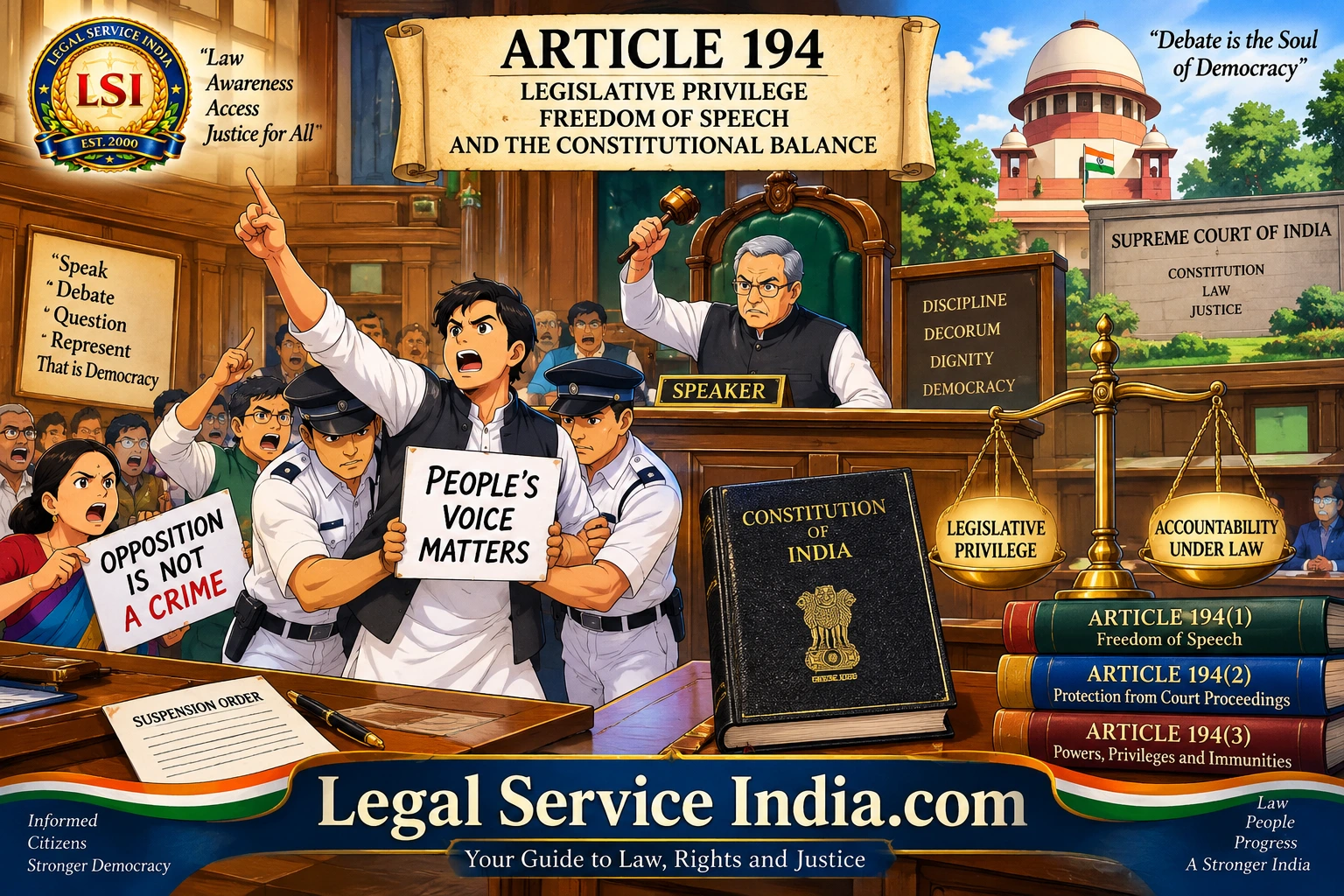
Legislative Privilege And Freedom Of Speech Under Article 194
Every budget session now seems to end with the same image: marshals dragging out slogan-raising legislators, followed by the Speaker’s suspension order. It is a scene that keeps returning to one unresolved constitutional question – where does the House’s power to discipline a member end, and where does a member’s freedom to speak within it begin?
Article 194 And The Constitutional Protection Of Legislative Speech
Article 194 of the Constitution, at the time of its passage, was interpreted as a means of protecting legislators, a promise that no matter what was spoken or voted on within the walls of the State Legislature, it would not be subject to the scrutiny of a normal court of law. This interpretation is not the extent of the article’s meaning.
Three Protections Under Article 194
Firstly, Article 194(1) provides freedom of speech in the Legislature. Secondly, Article 194(2) protects members from court proceedings arising from any statement made or vote cast in the House. Thirdly, Article 194(3) bestows upon the House “the powers, privileges and immunities” which were possessed by the House of Commons “at the commencement of the Constitution”, until defined by law.
Nearly three-quarters of a century later, such defining legislation has yet to be passed either by Parliament or the State Legislature.
Supreme Court And The Evolution Of Legislative Privilege
For much of the history of the Indian Constitution, this privilege has been regarded almost as absolute. According to the Supreme Court in the case of M.S.M. Sharma vs. Sri Krishna Sinha (1959) [1], the privilege of the Legislature can trump even the right of an individual citizen to publish reports of the proceedings of the Assembly, making privilege a blanket constitutional protection, as has been discussed. [2]
Kuldip Nayar And The Scope Of Article 194
Over the next few decades, the Supreme Court began limiting such an interpretation. In Kuldip Nayar v. Union of India (2006) [3], it was held that the elections to the Rajya Sabha are not “proceedings” in the House and are thus beyond the purview of protection provided by Article 194, as elucidated in the analysis of the judgement.
State Of Kerala v. K. Ajith And The Essentiality Test
The more definitive clarifications were provided in State of Kerala v. K. Ajith (2021) [4]. In this case, the MLA members charged for the destruction of Assembly furniture were claiming protection under Article 194(2). The Supreme Court, however, rejected such an interpretation.
According to the Court, the privilege can be claimed only for matters essential to members’ legislative activities, and any criminal activity inside the House cannot be exempt from the general law. [5]
Sita Soren And The Limits Of Legislative Privilege
This “essentiality test” was applied in the case of Sita Soren v. Union of India (2024) [6], where a seven-judge bench overruled its earlier decision in P.V. Narasimha Rao v. State (1998) [7]. In the latter case, the Bench ruled that even if a Member of the Legislature accepted a bribe, he was privileged to claim protection of the act of legislation if he voted in accordance with his promise.
The former case held that corruption would always corrupt the legislative process and thus be not essential to any act.
Judicial Review Of Legislative Privilege And Disciplinary Powers
Together, these rulings suggest a judiciary increasingly willing to narrow the scope of the privilege when a member invokes Article 194 to defend himself against a criminal charge.
However, what it has been far more reluctant to review is the other side of the very same article: the powers that the House has to discipline or suspend its members for what those members say and do in the House – precisely the protected speech under Article 194(1).
Ashish Shelar and the Maharashtra Legislative Assembly
One of the most prominent cases in which the judiciary has stepped in to challenge the House’s powers is Ashish Shelar & Ors. v. Maharashtra Legislative Assembly (2022[8]). In this case, twelve BJP MLAs were suspended for a year following allegations of misbehaving with the presiding officer.
The Supreme Court ruled in favour of the petitioners, striking down the suspension, as a punishment exceeding the period of the session meant that the constituencies would not be represented in the House for longer than expulsion could do.
Crucially, however, the Court challenged only the period and nature of the punishment – not whether it was constitutional to suspend opposition members for protesting.
Recent Assembly Suspensions And The Constitutional Question
The disparity has only grown larger since then.
Delhi Assembly Suspensions in 2025
In February 2025, the Delhi Assembly Speaker suspended 21 MLAs of the Aam Aadmi Party for staging a protest through pictures of B.R. Ambedkar, adding a rider that the suspended MLAs should vacate the whole Assembly complex, including its lawns and the office of the Leader of Opposition, which has been widely reported in the media [9].
West Bengal Assembly Suspensions In 2025
In September 2025, five BJP MLAs were suspended for raising slogans while the Chief Minister was addressing the House, leading to physical exchanges with the marshals [10].
Karnataka Assembly Suspensions In 2025
Eighteen BJP MLAs have been suspended from the Karnataka Assembly for six months in 2025 on the grounds of “indiscipline and disrespecting the Speaker”, invoking the precedent of Maharashtra to argue that a suspension beyond the ongoing session would be unconstitutional [11].
It is interesting to note that while the Karnataka High Court stayed all criminal proceedings against an MLA for intemperate language directed at a minister in the same year, the very Article 194(2) privilege had failed to save members from such suspensions. [12]
The Two-Pronged Jurisprudence Of Article 194
What follows is a two-pronged jurisprudence.
- On one hand, when a member relies on Article 194 to avoid normal criminal liabilities, the courts have been quite strict about the applicability of the essentiality test, as shown by the case of Ajith and Sita Soren.
- However, when the House itself invokes its disciplinary powers under Article 194(3) to suspend a member precisely because of the very speech which he or she was entitled to under Article 194(1), then there has been no judicial scrutiny of whether silencing that speech was proportional or necessary for the conduct of the House except a mere procedural one as to whether the suspension exceeded the life of the session or the principles of natural justice.
Two Corrections That Need To Be Made
Apply The Essentiality Test To Disciplinary Power
Two corrections need to be made. First, the logic of essentiality that currently informs the privilege-as-shield approach must be applied to privilege-as-sword so that the court examining the suspension decision will not only consider whether the due process requirement was satisfied but also whether the silencing of the member was indeed essential to maintaining the House’s integrity or could have been achieved through lesser sanctions.
Legislate Legislative Privileges and Disciplinary Procedures
Second, the State Legislatures must finally exercise the power conferred upon them by Article 194(3) since 1950 to legislate their own privileges and disciplinary procedures and stop borrowing from the nineteenth-century practice of the House of Commons, which was never meant to be used in an elected body that is based on universal adult suffrage.
The Constitutional Test For Article 194 Today
Article 194 was intended to protect the freedom of legislative speech from judicial and executive interference. It may be much more difficult for it to pass the more relevant test in today’s situation and prove that the House cannot misuse it to silence its own members.
References
- Pandit M.S.M. Sharma v. Sri Krishna Sinha, AIR 1959 SC 395 (India).
- Aminpalli Sai Sharath Nihar, Parliamentary Privilege in Indian Constitutional Law: M.S.M. Sharma (1959) and P.V. Narasimha Rao (1998), Indian Journal of Law & Legal Research (June 6, 2025).
- Kuldip Nayar v. Union of India, (2006) 7 S.C.C. 1 (India).
- State of Kerala v. K. Ajith, 2021 SCC OnLine SC 510 (India).
- Baglekar Akash Kumar, Time to Define Parliamentary Privileges, Bar & Bench (Sept. 23, 2021).
- Sita Soren v. Union of India, 2024 INSC 161 (India).
- P.V. Narasimha Rao v. State, (1998) 4 SCC. 626 (India).
- Ashish Shelar & Ors. v. Maharashtra Legislative Assembly & Anr., (2022) 12 SCC. 273 (India).
- Ashish Srivastava, Delhi Speaker Suspends 21 AAP MLAs Till Feb 28 Over Assembly “Disruptions”, New Indian Express (Feb. 26, 2025).
- Five BJP MLAs Suspended from West Bengal Assembly Amid Heated Debate on Migrant Labourers, News On AIR (Sept. 4, 2025).
- Revoke MLAs’ Suspension or BJP Will Protest at Speakers’ Meet: Arvind Bellad to UT Khader, Deccan Herald (May 19, 2025).
- Ambarish B, Karnataka HC Stays Proceedings Against CT Ravi Over Laxmi Hebbalkar’s Complaint, Deccan Herald (Jan. 30, 2025).

