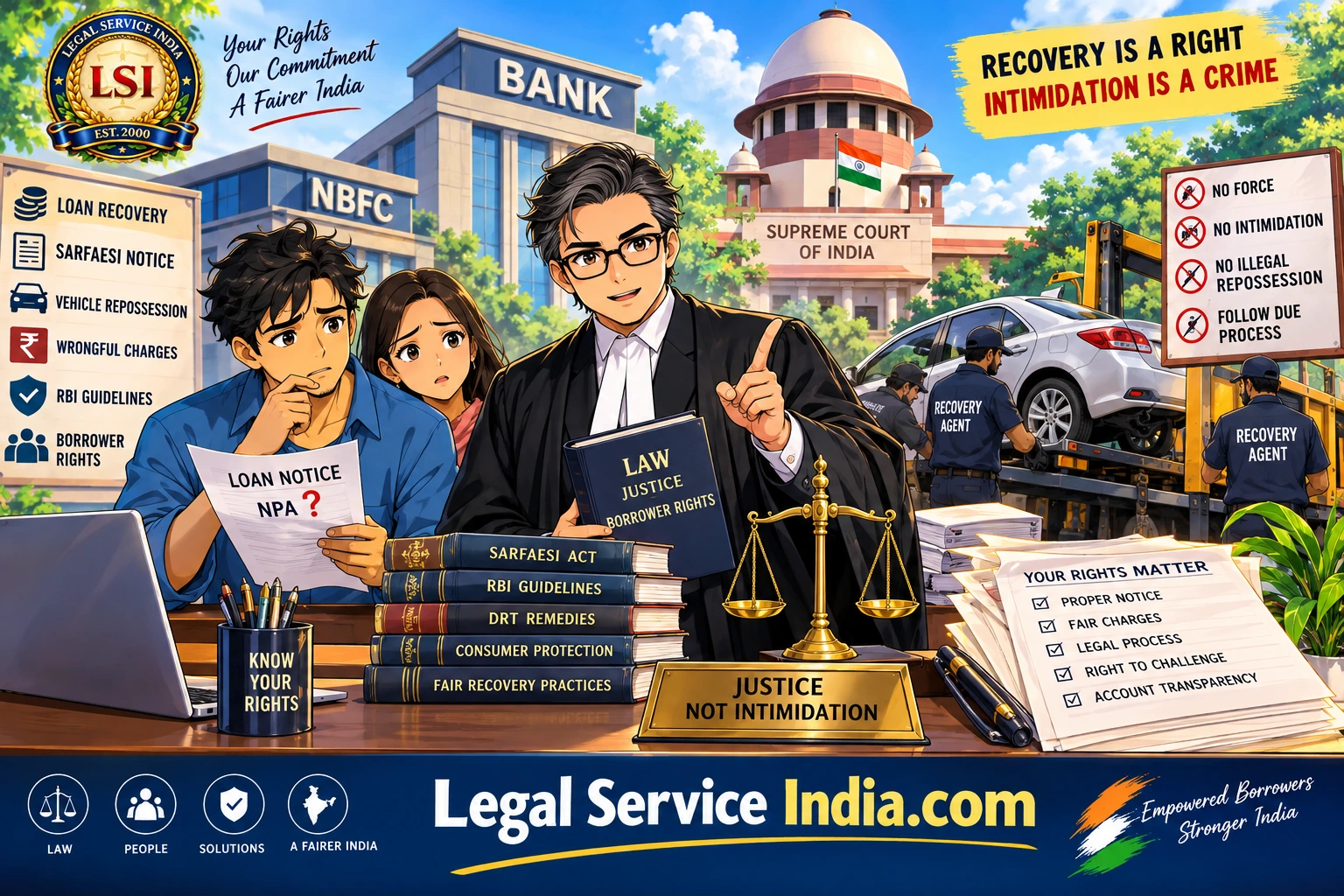
Banking & NBFC Disputes in India: Loan Recovery, SARFAESI, Wrongful Charges and Borrower Rights
Loan recovery is lawful. Recovery by unlawful means is not.
For a borrower facing a bank or NBFC recovery action, the most important question is not simply whether money is outstanding. The real legal questions are often more complicated:
- Was the loan account correctly maintained?
- Were interest, penal charges and other fees lawfully imposed?
- Was the account correctly classified as an NPA?
- Was the statutory notice properly issued?
- Was the borrower’s objection considered?
- Was SARFAESI invoked legally?
- Was possession taken according to law?
- Was a vehicle repossessed peacefully and after proper notice?
- Was the secured property sold through the procedure prescribed by law?
- Was the auction price and appropriation of sale proceeds properly accounted for?
- Did a recovery agent cross the line from lawful collection into intimidation or coercion?
These questions have acquired fresh importance after the Supreme Court’s decision in Hari Dutta Sharma v. State of U.P. & Ors., 2026 INSC 998, decided on 16 September 2026.
The judgment does not abolish the contractual right of a financier to recover its money or, in appropriate cases, repossess secured assets. Instead, it draws a critical distinction between the right to recover and the manner in which recovery is carried out.
The Latest Supreme Court Position: Recovery Cannot Become Coercion
In Hari Dutta Sharma, the borrower had obtained a commercial vehicle loan from Cholamandalam Investment and Finance Company Limited. The vehicle was hypothecated as security.
After defaults, the financier had previously repossessed the vehicle but released it after the borrower made a payment and promised to regularise the account. Further defaults followed.
The central controversy concerned the subsequent repossession. The borrower alleged that, at approximately 1:00 a.m., four unidentified persons broke the vehicle’s steering lock and drove the truck away. He maintained that the vehicle had been taken without the seven-day notice contemplated by his loan agreement.
The financier, on the other hand, relied upon the borrower’s continuing defaults and maintained that notices and recovery-related communications had been issued.
The Supreme Court examined both sides rather than treating the existence of default as the end of the matter. It found that the contractual repossession clause itself required seven days’ notice before repossession. The Court further found that the alleged manner of seizure was inconsistent with the RBI regulatory framework and the contractual safeguards.
The Supreme Court ultimately held that the High Court had erred in rejecting the borrower’s challenge merely on the ground of delay. The Court also took note of the fact that the borrower had complained about the incident on the same day and continued receiving traffic challans relating to the vehicle even after the financier claimed that the vehicle had been sold.
What the Supreme Court Actually Decided
The judgment is important because it does not say that a financier has no right to repossess a financed vehicle.
Quite the opposite: the Court expressly recognised that a contractual right of self-help repossession can be commercially legitimate. Such clauses can facilitate financing for persons who may not possess conventional collateral.
But that right is subject to law.
The Court held that a repossession power operating outside immediate judicial supervision must be exercised with great circumspection. A contractual right cannot become a licence to seize property by force, stealth or at an inappropriate hour.
This distinction is crucial for both sides:
| Lender’s Legal Right | What the Lender Cannot Treat as Automatically Permissible |
|---|---|
| Recover contractual dues | Use physical force or intimidation |
| Invoke a valid security interest | Ignore mandatory statutory procedure |
| Repossession where contract and law permit it | Seize an asset secretly or violently |
| Sell secured assets according to law | Ignore notice and sale safeguards |
| Claim genuine outstanding dues | Impose arbitrary or undisclosed charges |
RBI Rules on Recovery Agents Are Not Merely Decorative
The Supreme Court traced the development of RBI’s borrower-protection framework from the 2003 Fair Practices Code for Lenders through subsequent directions, circulars and clarifications.
The Court specifically noted that RBI’s framework addresses undue harassment, recovery-agent conduct, privacy, outsourcing, repossession clauses, grievance mechanisms and lawful methods of recovery.
Among the principles identified by the Court are that lenders must not resort to harassment or muscle power; vehicle seizure must occur through lawful means; recovery agents must be properly selected and supervised; and repossession clauses must comply with the Indian Contract Act and RBI requirements.
The Court went further in Hari Dutta Sharma. It directed RBI to take effective steps to secure genuine compliance by NBFCs and scheduled commercial banks, observing that regulatory directions had, in its assessment of the case, remained insufficiently implemented.
This gives the judgment significance beyond the individual borrower.
A Loan Agreement Cannot Override the Law
One of the most interesting aspects of the judgment concerns the contractual repossession clause itself.
The agreement contained provisions allowing repossession and included a mechanism for notice. It also gave the financier considerable discretion in relation to possession and sale.
The Supreme Court scrutinised the clause against the RBI framework and the Indian Contract Act.
The Court found several problems, including:
- an apparent conflict between automatic termination of the borrower’s rights and the requirement of notice;
- a broad authorisation allowing recovery agents to enter places where the vehicle might be found;
- absence of a sufficiently defined procedure for possession and sale; and
- a unilateral power to waive notice at the financier’s discretion.
The Court concluded that a contractual provision cannot transform a minimum procedural safeguard into something that the financier can simply waive at will.
This is an important lesson in banking litigation: the borrower does not lose every legal protection merely because he signed the loan agreement.
The Earlier Supreme Court Warning: ICICI Bank v. Prakash Kaur
The reasoning in Hari Dutta Sharma builds upon the Supreme Court’s earlier decision in ICICI Bank Ltd. v. Prakash Kaur, (2007) 2 SCC 711.
In that case, the Court dealt with forcible recovery of a financed vehicle and made the broader point that India is governed by the rule of law. Recovery of a loan cannot be converted into a private exercise of physical power.
The Supreme Court in the 2026 judgment expressly revisited Prakash Kaur and reiterated its principle that banks cannot employ musclemen to take possession of vehicles by force.
The significance is obvious: the principle is not new. What is new is the Supreme Court’s renewed emphasis on actual regulatory enforcement more than a decade after the earlier warning.
But Does a Financier Have a Right to Repossess?
Yes, in appropriate circumstances.
The Supreme Court relied upon Orix Auto Finance (India) Ltd. v. Jagmander Singh, (2006) 2 SCC 598, and Sundaram Finance Ltd. v. T. Thankam, (2015) 14 SCC 444, while recognising the contractual foundation of self-help repossession.
The legal position therefore should not be oversimplified into the proposition that every repossession is illegal.
The more accurate rule is:
A valid contractual right of repossession may exist, but its exercise must remain within the contract, applicable RBI directions and the general law.
This distinction is particularly important in disputes involving vehicle finance, where the lender may possess contractual security over the vehicle but cannot assume unlimited powers of physical enforcement.
SARFAESI: The Statutory Recovery Framework
For secured loans falling within the statutory framework, the principal legislation is the Securitisation and Reconstruction of Financial Assets and Enforcement of Security Interest Act, 2002.
The Act was enacted to facilitate securitisation, reconstruction of financial assets and enforcement of security interests, including recovery of non-performing assets by eligible secured creditors.
Some of the most important provisions for borrowers are:
| Provision | Practical Importance |
|---|---|
| Section 13(2) | Demand notice requiring discharge of liability within the statutory period |
| Section 13(3A) | Borrower’s representation/objection and lender’s obligation to consider and communicate reasons for non-acceptance |
| Section 13(4) | Measures available to the secured creditor after failure to discharge liability |
| Section 14 | Assistance of the Chief Metropolitan Magistrate or District Magistrate for taking possession |
| Section 17 | Remedy before the Debts Recovery Tribunal against measures taken under the Act |
| Section 18 | Appeal to the Debts Recovery Appellate Tribunal subject to statutory requirements |
| Section 34 | Restriction on civil-court jurisdiction in matters falling within the statutory jurisdiction of the DRT/DRAT |
| Section 35 | Overriding effect over inconsistent laws |
| Section 37 | Preservation of other laws to the extent specified |
The statutory text of SARFAESI, including the provisions governing notices and possession, is available through India Code.
Mardia Chemicals: SARFAESI Is Harsh, But Constitutionally Valid
The starting point for understanding borrower litigation under SARFAESI is Mardia Chemicals Ltd. v. Union of India, (2004) 4 SCC 311.
The Supreme Court upheld the constitutional validity of the SARFAESI framework while recognising that some of its provisions could operate harshly against borrowers.
The Court nevertheless regarded speedy recovery of NPAs and improved availability of capital as legitimate public objectives. At the same time, the Court recognised the importance of the statutory remedy before the DRT.
The significance of Mardia Chemicals is that it prevents two opposite misconceptions:
- SARFAESI is not unconstitutional merely because it gives strong recovery powers to secured creditors.
- But the availability of strong statutory recovery powers does not mean that every act of the lender is immune from legal scrutiny.
The Supreme Court has repeatedly treated the DRT mechanism under Section 17 as the principal statutory avenue for challenging measures taken under Section 13(4).
Section 13(3A): Why the Borrower’s Reply Matters
A borrower receiving a Section 13(2) notice should not treat it as a formality.
Section 13(3A) provides a statutory mechanism for making a representation or objection to the demand.
A carefully prepared response may raise issues such as:
- incorrect principal outstanding;
- wrong interest calculation;
- unauthorised charges;
- payments not credited to the account;
- incorrect NPA classification;
- disputed security documents;
- incorrect description of secured assets;
- limitation issues;
- settlement or restructuring arrangements;
- accounting discrepancies; and
- other legal or factual defects in the demand.
A borrower should preserve proof of submission because later proceedings may turn upon what was specifically raised before the lender.
Wrongful Charges: A Separate and Increasingly Important Dispute
Not every amount appearing in a loan statement automatically becomes legally recoverable simply because it has been entered by the lender.
Borrowers increasingly encounter disputes concerning:
- penal charges;
- late-payment charges;
- foreclosure or prepayment charges;
- legal expenses;
- repossession expenses;
- valuation charges;
- inspection charges;
- insurance-related amounts;
- documentation fees;
- collection charges; and
- other miscellaneous debits.
RBI’s framework on penal charges is particularly relevant. RBI states that, where applicable, penal charges for default must be treated as penal charges rather than penal interest; such charges must be reasonable and commensurate with the non-compliance; they should not be capitalised; and the quantum and reason should be disclosed to the borrower in the loan agreement and applicable Key Facts Statement or Most Important Terms and Conditions.
RBI has also clarified that penal charges are not intended to function as a revenue-enhancement mechanism.
Therefore, a borrower challenging a statement of account should not merely argue that the amount “looks excessive.” The stronger legal approach is to identify the contractual, regulatory or accounting basis for each disputed debit.
Key Facts Statement and Transparency in Lending
The regulatory framework has increasingly moved toward greater transparency at the beginning of the lending relationship.
RBI’s Key Facts Statement framework requires important loan information to be disclosed in a standardised manner for covered loans.
This matters in disputes because the borrower may compare the amount originally disclosed with the amount subsequently demanded.
Documents Worth Obtaining in a Contested Account
For a contested account, the documents worth obtaining commonly include:
- sanction letter;
- loan agreement;
- Key Facts Statement;
- statement of account from inception;
- repayment schedule;
- interest-rate reset communications;
- details of penal charges;
- insurance records;
- notices;
- repossession documents;
- valuation reports;
- auction notice;
- sale certificate, where applicable; and
- complete appropriation statement showing how sale proceeds were adjusted.
Auction, Redemption and the Borrower’s Property Rights
Property recovery disputes become particularly complicated once a secured asset reaches auction.
The Supreme Court’s jurisprudence has repeatedly stressed that statutory procedures governing sale cannot be ignored.
In Mathew Varghese v. M. Amritha Kumar, (2014) 5 SCC 610, the Court placed considerable importance on compliance with the statutory requirements governing sale and the borrower’s right of redemption.
Later jurisprudence, including Celir LLP v. Bafna Motors (Mumbai) Pvt. Ltd., clarified the effect of the amended Section 13(8) regime and the stage up to which redemption may be exercised under SARFAESI.
The Supreme Court’s April 2026 decision in E. Muthurathinasabathy v. Sri International again examined the relationship between the borrower’s redemption rights and the statutory auction process. The Court held that where the auction process remained legally incomplete because mandatory Rule 9(4) timelines had not been complied with, the defective process could not be used to defeat the borrower’s right of redemption in the circumstances before the Court.
This illustrates an important principle: an auction is not merely a commercial event; it is a statutory process.
MSME Borrowers Have an Additional Legal Dimension
MSME borrowers require particular attention because the statutory and regulatory framework contains mechanisms concerning revival and rehabilitation of stressed MSMEs.
In Shri Shri Swami Samarth Construction & Finance Solution v. Board of Directors of NKGSB Co-operative Bank Ltd., 2025 INSC 908, the Supreme Court considered the relationship between the MSME framework and SARFAESI.
The Court held that a bank is not necessarily required to identify every MSME borrower as financially stressed before classifying an account as an NPA and issuing a Section 13(2) notice. However, where the borrower asserts MSME status and claims the benefit of the applicable framework with the necessary supporting material, the lender must consider that claim in accordance with the framework.
For an MSME facing SARFAESI action, therefore, the response to the Section 13(2) notice can be especially important.
A Significant 2026 Development: Kotak Mahindra Bank v. Trupti Sanjay Mehta
The Supreme Court’s September 2026 decision in Kotak Mahindra Bank Ltd. v. Trupti Sanjay Mehta addressed an important question concerning loans originally advanced by an NBFC that was not, at the relevant time, a notified financial institution under SARFAESI and subsequently acquired by a bank covered by the Act.
The Court held that, in the circumstances before it, the subsequent acquisition of the loan by a bank to which SARFAESI applied could bring the loan within the statutory recovery framework. The Court relied on earlier decisions including M.D. Frozen Foods Exports Pvt. Ltd. and Indiabulls Housing Finance Ltd..
This is important for borrowers whose loans have been assigned, transferred or acquired by another financial institution.
A change of lender does not necessarily mean that the recovery process has to restart under ordinary civil law. The precise legal status of the debt, the lender and the security must be examined.
Fraud Classification: Another Area Where Borrowers Need Procedural Protection
Banking disputes are not confined to ordinary loan recovery.
Where a bank proposes to classify an account as a fraud account, the consequences can be serious. The Supreme Court’s April 2026 judgment in State Bank of India v. Amit Iron Private Limited considered the requirements of natural justice under the RBI’s fraud-classification framework.
The Court clarified that the procedure under the RBI’s 2024 Master Directions, including notice, opportunity to respond and disclosure of relevant audit material, provides the procedural framework. Importantly, the Court held that where audit or forensic audit reports are relied upon, furnishing those reports to the borrower is generally mandatory, subject to narrowly defined protection of third-party rights.
The Court also distinguished the question of a personal hearing from the borrower’s right to receive the relevant evidentiary material.
This is a useful reminder that procedural fairness in banking litigation is often document-driven.
DRT Is Often the Central Forum in SARFAESI Disputes
A common mistake is to immediately approach a civil court or file a writ petition without analysing the statutory remedy.
Section 17 of SARFAESI provides a mechanism for challenging measures taken by a secured creditor under Section 13(4).
The Supreme Court’s jurisprudence has repeatedly emphasised the importance of this statutory remedy.
At the same time, the availability of a DRT remedy does not convert unlawful conduct into lawful conduct. The precise forum and timing depend upon the nature and stage of the action challenged.
In practical terms, a borrower should identify exactly what has happened:
- Demand notice?
- Objection rejected?
- Possession notice?
- Actual possession?
- Section 14 proceedings?
- Auction notice?
- Auction conducted?
- Sale confirmed?
- Sale certificate issued?
- Possession delivered?
The legal remedy can change dramatically depending upon the answer.
Can a Borrower Simply Go to the High Court?
Not ordinarily as the first choice where an effective statutory remedy exists.
SARFAESI contains a specialised adjudicatory mechanism, and Section 34 restricts the jurisdiction of civil courts over matters which the DRT or DRAT is empowered to determine.
High Courts retain constitutional jurisdiction under Articles 226 and 227, but the existence of an alternative statutory remedy is a significant consideration.
The practical lesson is simple: the forum must be selected after examining the precise stage and nature of the recovery action.
What Should a Borrower Do After Receiving a Recovery Notice?
The worst response is often silence.
A borrower facing a recovery action should immediately preserve the documentary record.
Step 1: Collect the Complete Loan Record
- sanction letter;
- loan agreement;
- KFS/MITC;
- statement of account;
- payment receipts;
- bank statements;
- correspondence;
- restructuring or settlement proposals;
- insurance documents;
- security documents; and
- all recovery communications.
Step 2: Reconcile the Account
Do not merely ask, “How much does the bank say I owe?”
Ask:
- What was the principal?
- What payments were credited?
- What interest rate was applied?
- When did the rate change?
- What penal charges were added?
- Were charges capitalised?
- Were legal and recovery expenses contractually permitted?
- Was any amount duplicated?
- Were insurance or other charges correctly debited?
Step 3: Examine Every Notice
Dates matter.
The date of default, NPA classification, Section 13(2) notice, Section 13(3A) response, Section 13(4) measure, possession notice, auction notice and sale can determine the available remedies.
Step 4: Preserve Evidence of Recovery-Agent Conduct
If recovery agents visit or call, preserve:
- call records;
- messages;
- emails;
- recordings where lawfully obtained;
- CCTV footage;
- witness details;
- photographs;
- vehicle-possession documents; and
- police complaints, if any.
The 2026 Hari Dutta Sharma judgment demonstrates why contemporaneous evidence can become decisive.
What a Borrower Should Not Do
- Do not physically obstruct lawful possession.
- Do not threaten bank officials or recovery agents.
- Do not destroy or conceal secured assets.
- Do not transfer secured property contrary to statutory restrictions.
- Do not ignore a Section 13(2) notice.
- Do not assume that a verbal assurance from a collection agent changes the loan agreement.
- Do not wait until an auction is completed before obtaining legal advice.
A borrower can challenge unlawful recovery without unlawfully resisting lawful recovery.
The Law Seeks a Balance, Not Immunity for Either Side
It would be incorrect to read recent borrower-friendly decisions as saying that banks and NBFCs must surrender their recovery rights whenever a borrower defaults.
Institutional lenders have legitimate interests. Credit ultimately depends upon repayment. Excessive restrictions on recovery can increase credit risk and affect the cost and availability of finance.
That is one reason why the Supreme Court has consistently upheld the basic recovery architecture of SARFAESI and recognised contractual security and repossession rights.
At the same time, the opposite proposition is equally important: default does not place the borrower outside the protection of law.
The emerging jurisprudence therefore reflects a continuing balance:
| Lender’s Interest | Borrower’s Legal Protection |
|---|---|
| Recovery of genuine dues | Correct computation of dues |
| Enforcement of security | Statutory procedure |
| Efficient repossession | Lawful and non-coercive possession |
| Sale of secured asset | Notice and auction safeguards |
| Credit discipline | Fair treatment and regulatory compliance |
| Protection of public funds | Protection against arbitrary action |
Current Legal Position in 2026
Taking the Supreme Court’s recent decisions and the statutory and RBI framework together, the following propositions emerge:
- Loan default does create a genuine recovery right. A borrower cannot avoid a legally payable debt merely by challenging the method of recovery.
- Recovery rights are not unlimited. The lender must operate within the contract, statute and applicable regulatory directions.
- Force is not a lawful substitute for due process. The September 2026 Hari Dutta Sharma judgment reinforces this principle with particular force.
- RBI recovery-agent requirements matter. The Supreme Court treated the regulatory framework as legally significant rather than merely aspirational.
- Contractual clauses are subject to law. A repossession clause cannot authorise conduct inconsistent with mandatory safeguards.
- Wrongful charges can be challenged. The borrower should identify the precise contractual and regulatory basis for each disputed charge.
- SARFAESI is a specialised recovery regime. The DRT remedy under Section 17 is central to challenges against measures taken under Section 13(4).
- Procedural defects can matter. Notice, possession, auction and statutory timelines must be examined rather than treated as technicalities.
- Redemption rights remain an important area of litigation. Recent Supreme Court decisions show that the precise stage and validity of the sale process matter greatly.
- Loan assignment can change the legal landscape. The September 2026 Kotak Mahindra Bank decision illustrates that borrowers must examine the legal status of the loan and successor lender carefully.
- MSME borrowers should specifically examine the applicable revival and rehabilitation framework.
- Banking disputes are increasingly document-intensive. The strongest challenge is generally one supported by the loan agreement, account statements, notices, payment evidence and regulatory provisions.
A Practical Legal Strategy for a Banking or NBFC Dispute
There is rarely a single “banking dispute remedy.” The correct approach depends upon the stage of recovery and the nature of the illegality alleged.
A legal review should ordinarily map the dispute across four levels:
| Level | Question |
|---|---|
| Level 1: Account | Is the amount actually due correctly calculated? |
| Level 2: Contract | What does the loan agreement actually permit? |
| Level 3: Regulation | Has the lender complied with applicable RBI directions and fair-practice requirements? |
| Level 4: Statutory Enforcement | Has the lender complied with SARFAESI, the Security Interest (Enforcement) Rules and other applicable legislation? |
This four-level examination is often more useful than simply asking whether the borrower has “defaulted.”
Conclusion: A Default Is Not a Licence for Either Side
The modern law of banking recovery in India is not a contest between “banks” and “borrowers”. It is a legal framework attempting to reconcile two legitimate interests.
Banks and NBFCs must have effective mechanisms to recover genuine dues. Without enforceability of credit, the lending system itself becomes unstable.
But the power to recover money is not the power to disregard law.
The Supreme Court’s September 2026 decision in Hari Dutta Sharma puts the principle in practical terms: a financier may possess a contractual right to recover and, where legally permitted, repossess; but that right must be exercised within the boundaries of contract, RBI regulation and the rule of law.
For borrowers, the lesson is equally important. A genuine financial difficulty should not be confused with a legal defence. But an incorrect account, unlawful charge, defective notice, improper possession, coercive recovery method or legally defective auction should not be ignored merely because the borrower has fallen into default.
The Central Question in a Banking or NBFC Dispute
The real question in a banking or NBFC dispute is therefore not simply:
“Did the borrower default?”
The deeper question is:
“Has the lender recovered what is legally due, in the manner the law permits?”
Banking & NBFC Dispute Legal Assistance in Delhi/NCR
If you are facing a bank or NBFC dispute involving SARFAESI proceedings, loan recovery, vehicle repossession, wrongful charges, NPA classification, auction of secured property, recovery-agent harassment, disputed loan accounts, DRT proceedings or related High Court/Supreme Court litigation, the first step is to examine the complete loan and recovery record rather than relying solely on the latest recovery notice.
Adv. Tarun Choudhury
Supreme Court Advocate | 25+ Years of Legal Experience
📍 Legal Assistance for Delhi/NCR Banking & NBFC Disputes
📞 Call: 9650499965
💬 WhatsApp: 8851978611
Important: The legal remedy depends upon the facts, documents, lender, nature of security, stage of recovery proceedings and applicable statutory/regulatory framework. A professional review of the loan documents and notices is advisable before taking action.
Key Cases and Authorities
| Case / Authority | Legal Reference / Date |
|---|---|
| Mardia Chemicals Ltd. v. Union of India | (2004) 4 SCC 311 — constitutional validity of SARFAESI and importance of DRT remedy. |
| Orix Auto Finance (India) Ltd. v. Jagmander Singh | (2006) 2 SCC 598 — contractual repossession. |
| ICICI Bank Ltd. v. Prakash Kaur | (2007) 2 SCC 711 — recovery through lawful means and prohibition of forcible vehicle seizure. |
| Mathew Varghese v. M. Amritha Kumar | (2014) 5 SCC 610 — safeguards surrounding sale and redemption. |
| Sundaram Finance Ltd. v. T. Thankam | (2015) 14 SCC 444 — contractual repossession principles. |
| Celir LLP v. Bafna Motors (Mumbai) Pvt. Ltd. | (2024) 2 SCC 1 — effect of amended Section 13(8) and redemption. |
| State Bank of India v. Rajesh Agarwal | (2023) 6 SCC 1 — procedural fairness in fraud classification. |
| State Bank of India v. Amit Iron Private Limited | decided 7 April 2026 — fraud classification, evidentiary material and natural justice. |
| E. Muthurathinasabathy v. Sri International | decided 1 April 2026 — Rule 9(4), auction timelines and redemption. |
| Kotak Mahindra Bank Ltd. v. Trupti Sanjay Mehta | decided 2 September 2026 — applicability of SARFAESI to acquired loan/debt in the circumstances considered by the Court. |
| Hari Dutta Sharma v. State of U.P. & Ors. | 2026 INSC 998 — unlawful/coercive vehicle repossession, RBI recovery norms and compensation. |
Frequently Asked Questions About Banking & NBFC Disputes
Here are 10 SEO keyword-rich FAQs designed around the article and suitable for Google, featured snippets, and AI search results.
1. What are the legal remedies available in a banking or NBFC loan dispute in India?
A borrower facing a banking or NBFC loan dispute may have remedies depending on the nature and stage of the dispute, including responding to recovery notices, challenging wrongful charges, disputing account calculations, approaching the Debt Recovery Tribunal (DRT) in appropriate SARFAESI matters, filing complaints before the appropriate regulatory or consumer forum where legally maintainable, or approaching the High Court or Supreme Court in appropriate cases.
2. Can a bank or NBFC forcibly repossess a vehicle for loan default?
A bank or NBFC may have a contractual right to repossess a financed vehicle, but repossession must be carried out according to the loan agreement, applicable law and RBI regulatory requirements. Force, intimidation, violence or unlawful seizure by recovery agents is not a lawful method of loan recovery.
3. What can I do if a bank or NBFC charges wrongful interest, penal charges or recovery fees?
A borrower can examine the loan agreement, Key Facts Statement, statement of account and applicable RBI rules to determine whether interest, penal charges, foreclosure fees, legal expenses or recovery charges were properly imposed. Disputed or unauthorised charges can be challenged through the appropriate legal or regulatory mechanism.
4. What should I do after receiving a SARFAESI Section 13(2) notice?
A borrower receiving a SARFAESI Section 13(2) demand notice should immediately verify the outstanding amount, NPA classification, interest calculation, payments credited, security details and other allegations. The borrower may submit a detailed representation or objection under Section 13(3A) of the SARFAESI Act within the prescribed framework.
5. Can a borrower challenge SARFAESI possession proceedings before the DRT?
Yes. Section 17 of the SARFAESI Act provides a statutory remedy before the Debt Recovery Tribunal against measures taken by a secured creditor under Section 13(4). The appropriate remedy depends upon the precise stage and nature of the recovery proceedings.
6. Can a bank auction my property without following proper legal procedure?
A secured creditor must comply with the applicable SARFAESI Act, Security Interest (Enforcement) Rules, notice requirements and auction procedure. Defects relating to notice, valuation, auction timelines, sale procedure or redemption rights may become grounds for legal challenge depending upon the facts and stage of the proceedings.
7. Can a borrower stop a bank auction after receiving a SARFAESI auction notice?
A borrower may have legal remedies against a proposed SARFAESI property auction, but the available remedy depends heavily on the stage of the proceedings, compliance with statutory requirements, payment or settlement circumstances and the applicable law on redemption. Immediate legal examination is important because an auction can materially change the borrower’s available remedies.
8. What are the rights of borrowers against bank and NBFC recovery agents?
Borrowers have legal protection against harassment, intimidation, abusive conduct and unlawful recovery practices. Banks and NBFCs remain responsible for recovery agents acting on their behalf and must follow applicable RBI directions concerning fair recovery practices and borrower treatment.
9. Can an MSME borrower challenge SARFAESI recovery proceedings?
An MSME borrower facing SARFAESI proceedings may need to examine additional protections and the applicable MSME revival and rehabilitation framework. However, MSME status does not automatically prevent a bank from taking recovery action. The borrower’s eligibility, financial status, procedural history and applicable statutory framework must be examined.
10. Can a borrower file a case against a bank or NBFC for illegal loan recovery or vehicle repossession?
Yes, where the facts establish unlawful loan recovery, illegal vehicle repossession, coercive recovery practices, wrongful charges or violation of statutory or regulatory requirements, appropriate legal proceedings may be available. The correct forum—such as the DRT, High Court, consumer forum, regulatory grievance mechanism or another competent authority—depends on the nature of the dispute and the relief sought.
Key Takeaways: Banking & NBFC Disputes in India
- Loan default does not give banks or NBFCs unlimited recovery powers. Financial institutions have a legal right to recover genuine dues, but loan recovery must comply with the loan agreement, applicable statutes, RBI regulations and principles of lawful procedure.
- Illegal or coercive vehicle repossession can be challenged. The Supreme Court has made it clear that contractual repossession rights cannot be treated as permission for force, intimidation, violence or unlawful seizure by recovery agents.
- RBI recovery-agent guidelines are important in borrower disputes. Banks and NBFCs are expected to ensure that recovery agents follow applicable RBI requirements and do not resort to harassment or unlawful recovery methods.
- SARFAESI proceedings must follow statutory procedure. Demand notices, borrower objections, possession proceedings, auction notices and sale of secured assets are governed by the SARFAESI Act and the Security Interest (Enforcement) Rules.
- Borrowers can respond to a SARFAESI Section 13(2) notice. Section 13(3A) provides an important opportunity for borrowers to raise objections concerning outstanding dues, account calculations, NPA classification, payments, security and other legal or factual issues.
- Wrongful bank charges and NBFC charges can be disputed. Borrowers should examine interest, penal charges, late-payment charges, foreclosure fees, legal expenses, repossession expenses and other debits against the loan agreement, Key Facts Statement and applicable RBI regulations.
- Penal charges must comply with RBI requirements. Applicable RBI rules require penal charges to be reasonable, appropriately disclosed and treated separately from penal interest rather than being used simply as a revenue-enhancement mechanism.
- DRT is a key forum for challenging SARFAESI recovery measures. A borrower affected by measures taken under Section 13(4) may have a statutory remedy under Section 17 of the SARFAESI Act, subject to the facts and procedural stage of the case.
- Bank property auctions are governed by statutory safeguards. Notice, valuation, auction procedure, sale timelines and redemption rights can become important grounds of dispute where a secured property is being sold under SARFAESI.
- Borrowers should act quickly after receiving recovery notices. Delay can affect available remedies. Loan agreements, statements of account, payment receipts, notices, correspondence, auction documents and evidence concerning recovery-agent conduct should be preserved immediately.
- MSME borrowers should examine additional statutory protections. Where the borrower is an MSME, the applicable revival, rehabilitation and restructuring framework should be examined alongside SARFAESI proceedings.
- Assignment of a loan can affect the recovery process. When a loan is transferred from an NBFC or other lender to a bank or another financial institution, the legal status of the debt, security and successor lender should be carefully examined.
- Fraud classification by banks requires procedural fairness. Where a bank proposes to classify an account as fraud, applicable RBI directions and principles of natural justice can become important, including access to relevant material relied upon by the bank.
- Documentation is central to banking litigation. A strong banking or NBFC dispute is usually built around the loan agreement, Key Facts Statement, complete statement of account, payment history, notices, security documents, RBI requirements and evidence of the lender’s recovery actions.
- The central legal principle is balance. Banks and NBFCs have legitimate rights to recover legally payable debts and enforce valid security, while borrowers retain legal protection against wrongful charges, defective statutory procedure, unlawful repossession and coercive recovery practices.
Supreme Court Banking Dispute Takeaway
The recent Supreme Court jurisprudence reinforces a fundamental principle of Indian banking law: a lender may have the right to recover its money, but the method of recovery must remain within the boundaries of the contract, statute, RBI regulations and the rule of law.
Banking & NBFC Legal Assistance in Delhi/NCR
If you are facing a bank loan dispute, NBFC recovery action, SARFAESI notice, vehicle repossession, wrongful bank charges, NPA dispute, recovery-agent harassment, DRT proceedings or bank property auction, timely examination of the loan documents and recovery proceedings can be critical.
Adv. Tarun Choudhury
Supreme Court Advocate | 25+ Years of Legal Experience
📞 Call: 9650499965
💬 WhatsApp: 8851978611