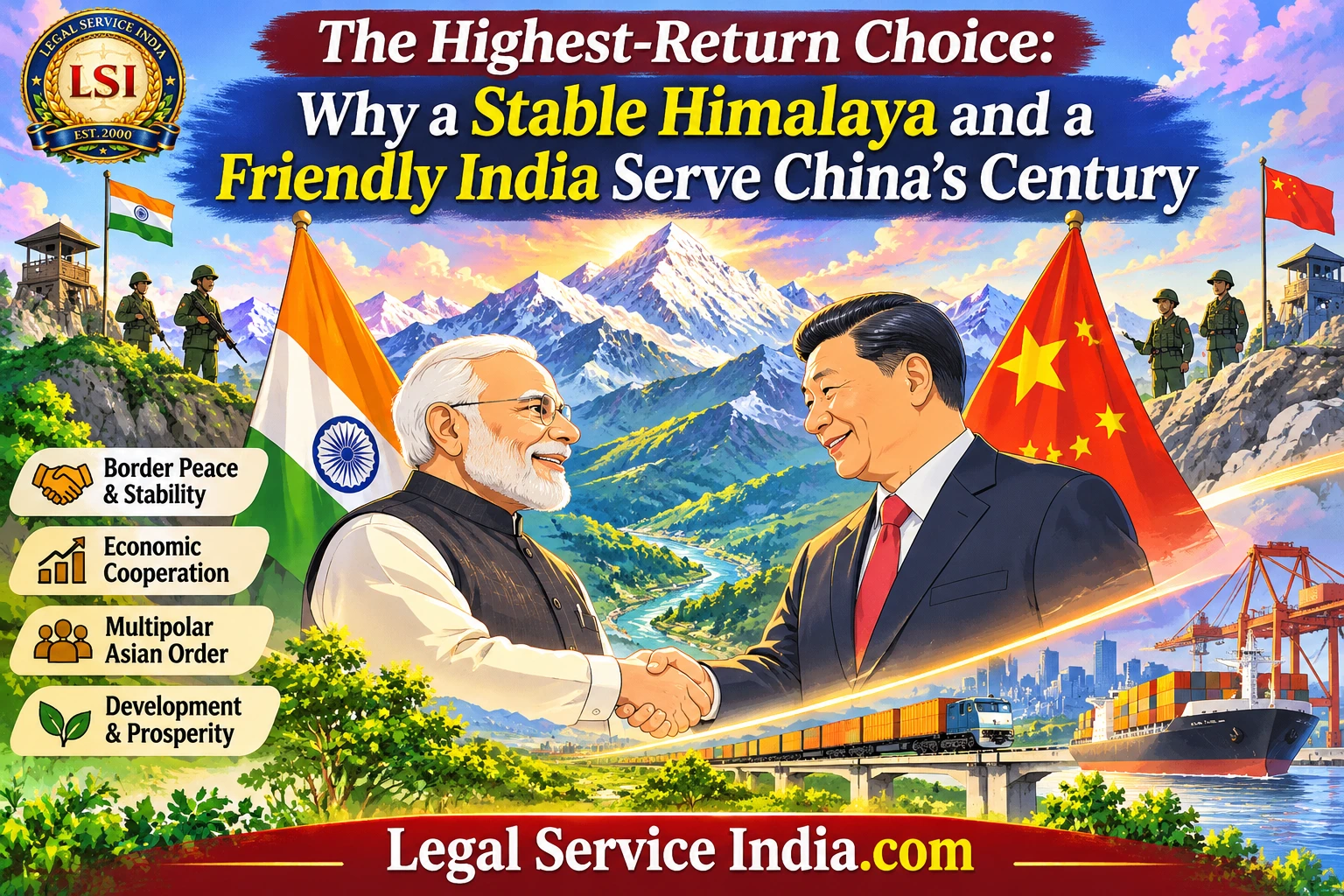
The Highest-Return Choice: Why a Stable Himalaya and a Friendly India Serve China’s Century
A Strategic Opportunity Hidden Behind a Himalayan Dispute
Great powers are often judged by the territories they control, the military capabilities they accumulate and the influence they exercise over neighbouring states. Yet history offers another measure of national greatness: the ability to convert strategic disadvantages into lasting advantages through political judgement.
China Stands at a Strategic Moment
China stands at such a moment.
Its economic transformation has made it one of the principal centres of global manufacturing, technology and trade. Its military modernisation has substantially expanded its strategic capabilities. Its diplomatic influence extends across Asia, Africa, Latin America and international institutions.
The India-China Relationship and the Unresolved Territorial Dispute
Nevertheless, one of its most important neighbouring relationships remains burdened by an unresolved territorial dispute.
India and China are two ancient civilisations, two major developing economies and two increasingly influential participants in shaping the emerging multipolar order. Their relationship should logically be among the most consequential partnerships of the twenty-first century.
Instead, the Himalayan frontier continues to consume political attention, military resources and diplomatic goodwill.
The Strategic Question Beijing Should Consider
The question Beijing should seriously consider is therefore not whether China can maintain its present military advantage along the Line of Actual Control (LAC).
It is whether maintaining that advantage produces greater strategic returns than creating a stable, friendly and economically integrated relationship with India.
The answer deserves serious consideration.
China’s Highest-Return Strategic Choice
China’s highest-return strategic choice may be to restore the complete pre-2020 patrolling arrangements, undertake verified reciprocal military de-escalation and establish a durable political understanding with India.
This would not represent a retreat from national interests. It would represent a more sophisticated understanding of them.
1. The International Environment Has Changed
China’s strategic environment is increasingly complicated.
The United States continues to regard technological leadership, military influence and economic competitiveness in the Indo-Pacific as central national priorities. Trade restrictions, technology controls and supply-chain diversification have become instruments of strategic competition.
Europe is reassessing its economic dependence on China. Several Asian countries are strengthening their security partnerships. Global trade is increasingly influenced by considerations of national security.
Against this background, Beijing must carefully distinguish between relationships that create strategic burdens and relationships that create strategic opportunities.
India as an Independent Centre of Power
India is particularly important.
With approximately 1.4 billion people, a large domestic market, an expanding technological sector and considerable diplomatic influence, India is not simply another neighbouring country.
It is an independent centre of power.
Its strategic autonomy is one of its defining characteristics. India maintains relationships with Washington, Moscow, European capitals and countries across the developing world without automatically subordinating its decisions to any single power.
For China, this presents an opportunity.
A relationship of confidence with India could help preserve a multipolar Asian order in which neither country is compelled to participate in an opposing strategic bloc.
A hostile relationship, however, encourages precisely the opposite outcome.
2. The Himalayan Border: From Cooperation to Strategic Distrust
The India-China boundary has never been formally settled.
Following the 1962 war, both countries gradually developed diplomatic and military mechanisms intended to prevent their territorial disagreement from becoming a permanent source of armed confrontation.
The India-China Border Agreements
The agreements of 1993, 1996 and 2005 were important milestones.
The 1993 Agreement established principles for maintaining peace and tranquillity along the LAC. The 1996 Agreement introduced additional military confidence-building measures. The 2005 agreements strengthened the framework for implementing these arrangements and pursuing a boundary settlement.
The 2013 Border Defence Cooperation Agreement further developed mechanisms for managing incidents.
For several decades, this framework helped prevent a disputed boundary from destroying the broader bilateral relationship.
The Galwan Valley Confrontation of June 2020
The Galwan Valley confrontation of June 2020 fundamentally altered that understanding.
Twenty Indian soldiers lost their lives. China subsequently acknowledged casualties among its personnel.
The consequences extended far beyond the immediate military confrontation.
India reassessed its economic and security relationship with China. Chinese investment faced greater scrutiny, numerous Chinese applications were prohibited, and defence and diplomatic cooperation with other countries acquired additional importance.
The strategic cost was considerably greater than the military significance of the terrain involved.
The important lesson for Beijing is that territorial pressure can produce political consequences that remain long after troops have withdrawn from a particular location.
3. Disengagement Is Not De-escalation
The October 21, 2024 Agreement
The October 21, 2024 agreement on patrolling arrangements in Depsang and Demchok was an important development.
It demonstrated that sustained negotiations could produce practical results even after several years of confrontation.
The subsequent resumption of patrolling under mutually agreed arrangements helped reopen diplomatic space.
High-Level India-China Diplomatic Engagement
The meetings between Prime Minister Narendra Modi and President Xi Jinping at Kazan in October 2024 and Tianjin in August 2025 further supported the process of political normalisation.
Their September 12, 2026 meeting in New Delhi provided another opportunity to reinforce the relationship.
The 25th round of Special Representatives’ talks, held in Beijing on August 25, 2026, also produced an eight-point consensus covering border management, additional military communication channels, boundary negotiations and trans-border cooperation.
These developments should be recognised as genuine diplomatic progress.
Understanding the Difference Between Disengagement and De-escalation
However, an important distinction remains.
Disengagement means separating opposing troops at particular friction points.
De-escalation means reducing the overall military concentration and forward posture that make renewed confrontation possible.
These are not interchangeable concepts.
Buffer arrangements continue to affect access to certain areas, and substantial military deployments remain along the frontier.
Consequently, the diplomatic thaw has not yet acquired the military foundation necessary for lasting confidence.
Restoring Border Confidence and Trust
For China, completing this process should become a strategic priority.
Restoring the full pre-2020 patrolling arrangements, including mutually agreed access to previously accessible patrol areas, would address an important source of Indian distrust.
A phased and verified reduction of forward deployments would then provide the next logical step.
4. The Economic Argument: A Relationship Too Valuable to Waste
India-China Bilateral Trade and Economic Interdependence
The economic relationship offers perhaps the strongest argument for reconsidering China’s strategic approach.
According to India’s Department of Commerce figures, bilateral merchandise trade reached approximately $151.1 billion during FY2025–26.
India imported approximately $131.63 billion in goods from China and exported approximately $19.47 billion.
The resulting trade deficit was approximately $112.16 billion.
China has therefore established a substantial commercial position in the Indian market.
Indian industries depend on Chinese machinery, electronic components, industrial inputs, chemicals and pharmaceutical ingredients.
This relationship provides Chinese manufacturers with access to one of the world’s largest and fastest-growing consumer and industrial markets.
India’s Economic Security and Supply-Chain Diversification
However, commercial strength should not be confused with permanent economic security.
A trade relationship that becomes politically controversial creates incentives for diversification.
India has already demonstrated its willingness to impose restrictions where economic relationships are perceived to create national security vulnerabilities.
Production-linked incentives, domestic manufacturing programmes, investment screening and alternative supply-chain partnerships are all relevant parts of this response.
The Political Sustainability of Economic Dominance
China should therefore recognise an important economic principle:
The most valuable market is not merely the market in which a country currently enjoys commercial dominance. It is the market in which that dominance remains politically sustainable.
The trade imbalance itself also deserves attention.
India’s exports to China remain considerably smaller than its imports.
Improving market access for Indian agricultural products, pharmaceuticals, manufactured goods and services would help create a more sustainable relationship.
China would gain more from a commercially confident India than from an economically dependent but politically dissatisfied neighbour.
A stable border would help create precisely those conditions.
5. The Strategic Cost of Keeping India at a Distance
India’s Strategic Autonomy and Foreign Policy
India has historically resisted formal military alignment with major powers.
Its foreign policy tradition places considerable emphasis on strategic autonomy.
However, strategic autonomy does not mean permanent neutrality.
Countries respond to their security environments.
When India perceives China as a major military challenge, cooperation with other countries becomes more attractive.
The Quad and India’s Strategic Partnerships
The Quad, defence cooperation with the United States, military exercises with Japan and Australia, and expanding strategic relationships with European countries must be understood partly within this broader context.
China should not assume that these relationships are entirely directed against it.
Nevertheless, neither should Beijing ignore the possibility that continued confrontation could strengthen strategic coordination among countries that share concerns about Chinese behaviour.
The Strategic Paradox of India-China Relations
This produces an important paradox.
A policy intended to preserve China’s strategic advantage over India may encourage India to strengthen relationships that complicate China’s regional position.
Conversely, a stable frontier could reduce India’s incentive to participate in balancing arrangements motivated primarily by security concerns.
China’s Influence on India’s Strategic Decisions
China cannot determine India’s foreign policy.
But it can influence the strategic environment in which Indian foreign policy decisions are made.
That distinction is fundamental.
6. Military Resources and the Opportunity Cost of Himalayan Confrontation
Military power is expensive.
High-altitude deployments require specialised equipment, extensive logistical support, road infrastructure, medical facilities, winter accommodation and continuous supply operations.
Maintaining large formations in extreme Himalayan conditions imposes considerable financial and operational costs.
The Alternative Uses of Military Resources
These resources have alternative uses.
China’s long-term military modernisation involves naval capabilities, aerospace systems, cyber operations, artificial intelligence, space technology and advanced defence manufacturing.
The Western Pacific remains a particularly important theatre in China’s strategic calculations.
A permanently militarised Himalayan frontier therefore represents an opportunity cost.
The objective should not be to suggest that China must weaken its national defence.
On the contrary, a country with considerable military capabilities should be able to recognise when a particular deployment produces diminishing strategic returns.
Why Border De-escalation Makes Strategic Sense
A verified reduction of forward forces would not eliminate the need for border security.
It would, however, reduce the probability of accidental escalation and release resources for other national priorities.
For Beijing, this is a question of strategic efficiency.
Military strength is most valuable when it protects national interests without unnecessarily creating new adversarial relationships.
7. Reputation and Leadership in the Global South
China has invested considerably in presenting itself as an important voice of the developing world.
Its engagement through BRICS, the Shanghai Cooperation Organisation and other multilateral institutions reflects its ambition to influence the emerging international order.
India occupies an equally important position in many of these forums.
The two countries do not necessarily share identical political or economic interests. Nor should they be expected to agree on every international question.
Nevertheless, cooperation between them could substantially strengthen their collective influence.
Areas Where China and India Share Common Interests
Consider the issues facing developing countries:
- Reform of international financial institutions.
- Climate finance and technology transfer.
- Development financing.
- Food and energy security.
- International trade rules.
- Sovereign debt restructuring.
- Greater representation in global decision-making.
On several of these issues, China and India possess overlapping interests.
Their disagreement over the Himalayan frontier should not prevent them from exploring cooperation in areas where their interests converge.
Why Peaceful Bilateral Relations Matter for Global Leadership
Indeed, their ability to manage a difficult bilateral relationship peacefully would strengthen the credibility of both countries as responsible international actors.
For China, this would provide reputational benefits that military pressure along a remote frontier cannot deliver.
8. What Should China Actually Do?
A strategic argument becomes meaningful only when translated into policy.
China should consider a six-part agenda.
First: Restore the Pre-2020 Patrolling Position
Both countries should establish mutually agreed arrangements that restore the patrolling access and patterns that existed before the 2020 confrontation, subject to verification and without prejudicing either country’s territorial claims.
Second: Establish a Phased De-escalation Mechanism
Heavy equipment, forward-deployed forces and supporting military infrastructure should be addressed through reciprocal and verifiable arrangements.
Satellite observation, agreed inspections and military communication channels could help establish confidence.
Third: Strengthen Border Management Institutions
The existing agreements of 1993, 1996, 2005 and subsequent mechanisms should become the foundation of an updated border management framework.
Additional military hotlines and regular commander-level consultations should be operational rather than merely symbolic.
Fourth: Expand Economic Reciprocity
China should examine opportunities to improve Indian market access, encourage commercially viable joint ventures and develop predictable arrangements for technology and industrial cooperation.
Fifth: Develop Himalayan Cooperation
Border trade, pilgrimage, tourism and hydrological data-sharing could create shared interests in maintaining peace.
The Brahmaputra deserves particular attention. Regular hydrological cooperation and timely information exchange would help address concerns relating to floods and water security.
Sixth: Establish a Long-Term Political Understanding
The two governments should develop a framework that prevents unresolved territorial questions from repeatedly destabilising the entire bilateral relationship.
A final boundary settlement may take considerable time.
Peaceful management, however, need not wait for that settlement.
9. Answering the Strongest Objections
There will be sceptics in both countries.
Objection 1: Does Military Pressure Give China Strategic Leverage?
Some Chinese strategists may argue that maintaining forward military positions preserves leverage and discourages Indian strategic expansion.
But leverage must be measured by its consequences.
If maintaining a particular military posture strengthens India’s defence partnerships, accelerates its military modernisation and encourages economic diversification away from China, the strategic value of that leverage becomes questionable.
Objection 2: Will India Cooperate With the United States Regardless?
Others may argue that India will continue cooperating with the United States regardless of China’s actions.
That possibility cannot be dismissed.
India will retain independent foreign policy priorities even under conditions of improved relations.
However, there is a substantial difference between India’s normal strategic diversification and security cooperation driven by an immediate perception of military threat.
China should seek to reduce the latter.
Objection 3: Can India Trust Chinese Commitments Without Verification?
Indian sceptics, meanwhile, will reasonably insist that declarations of friendship are insufficient without verifiable changes on the ground.
They will point to the unresolved territorial dispute, buffer arrangements, infrastructure development, the China-Pakistan relationship and concerns about trans-border rivers.
These concerns cannot simply be dismissed.
Why Trust Requires Verifiable Actions
A sustainable relationship requires reciprocity, transparency and demonstrable compliance with agreements.
China should therefore understand that political normalisation cannot substitute for credible border arrangements.
Trust must be built through observable conduct.
Conclusion: The Strategic Choice of the Decade
The twenty-first century will not be shaped exclusively by military strength or economic size.
It will also be shaped by the ability of major powers to build relationships that prevent unnecessary conflicts and expand opportunities for cooperation.
China possesses enormous economic and military capabilities.
Its position in the global economy gives it substantial influence. Its diplomatic reach has expanded considerably. Its technological ambitions are reshaping international competition.
Yet its relationship with India remains an unfinished strategic opportunity.
The Himalayan frontier is important, but it cannot reasonably become the permanent organising principle of China-India relations.
A peaceful border would allow China to protect its commercial interests, reduce military expenditure, preserve strategic flexibility and strengthen its standing among developing countries.
A friendly India would not necessarily become a Chinese ally. Nor would it abandon its independent foreign policy.
That is not the objective.
The objective should be a relationship in which differences are managed without confrontation, economic interests are protected through confidence rather than dependence, and both countries retain the freedom to pursue their national ambitions.
The opportunity now exists.
The 2024 Depsang-Demchok understanding, the subsequent leadership meetings and the August 2026 Special Representatives’ consensus have created diplomatic foundations on which a more ambitious settlement can be built.
China should complete that process.
It should restore the pre-2020 patrolling arrangements, pursue verified reciprocal military de-escalation and establish a long-term economic and political partnership with India.
Great powers demonstrate their strength not merely by holding strategic positions, but by knowing when a different strategic choice produces greater national returns.
The Himalaya may remain a difficult frontier.
It need not remain a permanent strategic obstacle.
For China, a stable and friendly India could prove more valuable than any tactical advantage obtained through continued confrontation along the LAC.
That is the highest-return choice available to Beijing for the decade ahead.
Need Experienced Legal Guidance on Complex Legal Issues?
International developments, geopolitical tensions and evolving legal frameworks can have far-reaching implications for businesses, individuals and institutions. When legal questions become complex, the right professional guidance can make a decisive difference.
Whether you require assistance with constitutional law, international legal issues, civil disputes, commercial matters or strategic legal advice, experienced legal representation can help you understand your rights, assess your options and take informed decisions.
Consult an Experienced Supreme Court Advocate
Adv. Tarun Choudhury
⚖️ Supreme Court Advocate | 25+ Years of Legal Experience
With over 25 years of legal experience, Adv. Tarun Choudhury provides professional legal guidance and representation, helping clients navigate complex legal challenges with clarity and confidence.
Don’t leave important legal questions unanswered. Seek experienced legal guidance before taking your next step.
- 📞 Call: 9891244487
- 💬 WhatsApp: 9891244487
- ✉️ Email: [email protected]
- 🌐 Website: LegalServiceIndia.com
Your legal concerns deserve experienced attention. Connect today for professional legal consultation.
Frequently Asked Questions (FAQs)
1. Why Is a Peaceful India-China Relationship Important for China’s Economic and Strategic Interests?
A peaceful India-China relationship would allow China to protect its economic interests in one of the world’s largest and fastest-growing markets. Stable border conditions could encourage bilateral trade, investment, technology partnerships and supply-chain cooperation. It would also reduce military expenditure along the Himalayan frontier and allow China to concentrate its strategic resources on other international priorities.
2. What Is the Line of Actual Control (LAC), and Why Is the India-China Border Dispute Important?
The Line of Actual Control (LAC) is the disputed boundary separating Indian and Chinese military-controlled territories. Unlike an internationally demarcated border, its alignment has not been mutually agreed upon throughout the entire frontier. The dispute is significant because military confrontations along the LAC affect diplomatic relations, regional security, economic cooperation and the broader geopolitical balance in Asia.
3. What Was the October 2024 India-China Depsang-Demchok Agreement?
The October 21, 2024 agreement established new patrolling arrangements in the Depsang and Demchok areas of eastern Ladakh. It represented an important step towards resolving military tensions that had persisted since 2020. The agreement facilitated disengagement and the resumption of patrolling under mutually agreed arrangements. However, disengagement should not be confused with complete military de-escalation.
4. How Does the India-China Trade Deficit Affect Their Bilateral Relationship?
India’s merchandise imports from China substantially exceed its exports, creating a significant bilateral trade deficit. This reflects India’s dependence on Chinese machinery, electronic components, industrial inputs and pharmaceutical ingredients. However, an excessive trade imbalance can encourage economic diversification and domestic manufacturing initiatives in India. Greater market access for Indian exports could help China build a more sustainable and mutually beneficial economic relationship.
5. Can India and China Become Strategic Partners Despite Their Unresolved Border Dispute?
Yes. India and China can develop economic, diplomatic and multilateral cooperation without necessarily resolving every territorial disagreement immediately. Stronger border-management agreements, reciprocal military de-escalation, trade cooperation, water-resource discussions and diplomatic engagement could create the foundation for a more stable relationship. Both countries could also cooperate on Global South priorities, climate finance, international trade and reform of global institutions.
Key Takeaways: Why a Stable India-China Relationship Is in China’s Strategic Interest
- A Friendly India Is a Strategic Asset for China: Improving India-China relations could reduce geopolitical tensions, strengthen Asian stability and create opportunities for cooperation in a multipolar world.
- Restoring the Pre-2020 LAC Patrolling Position Is Essential: China should pursue mutually agreed restoration of patrolling arrangements and verified reciprocal military de-escalation to rebuild India’s confidence.
- Disengagement Is Not the Same as De-Escalation: Although the October 2024 Depsang-Demchok agreement marked diplomatic progress, forward military deployments and buffer arrangements remain important challenges.
- Border Tensions Carry Significant Economic Costs: Continued confrontation encourages India to diversify supply chains, restrict Chinese investments and strengthen alternative economic partnerships.
- India Is an Important Market for China: India imported approximately $131.63 billion worth of goods from China during FY2025–26, demonstrating the importance of stable bilateral commercial relations.
- The Trade Imbalance Needs Attention: Greater access for Indian agricultural products, pharmaceuticals, manufactured goods and services could create a more balanced and politically sustainable economic partnership.
- Border Stability Can Reduce China’s Military Burden: Reciprocal de-escalation along the Himalayas would reduce the financial and logistical costs of maintaining extensive high-altitude military deployments.
- India’s Strategic Autonomy Presents an Opportunity: A stable relationship could reduce security-driven alignment against China while allowing India to maintain its independent foreign policy.
- China and India Can Strengthen the Global South: Cooperation through BRICS, the Shanghai Cooperation Organisation and other international platforms could advance shared interests in climate finance, development and global institutional reform.
- Economic Cooperation Should Replace Strategic Confrontation: Joint ventures, technology partnerships, border trade, pilgrimage and Brahmaputra hydrological cooperation could create lasting mutual benefits.
- Trust Requires Verifiable Action: Sustainable India-China relations depend on reciprocal commitments, transparent border management, military communication and demonstrable compliance with existing agreements.
- China’s Highest-Return Strategic Choice: Restoring border confidence and building a friendly relationship with India could deliver greater long-term economic, diplomatic and geopolitical benefits than maintaining continued confrontation along the LAC.
The Central Argument
China does not need India to become its ally. It needs India to have fewer strategic reasons to become its adversary.
A peaceful Himalayan frontier, reciprocal economic cooperation and mutual respect for strategic autonomy could transform India-China relations into one of the most consequential partnerships of the twenty-first century.
By Adv. Tarun Choudhury | Supreme Court Advocate | 25+ Years of Legal Experience | LegalServiceIndia.com
Important Factual References and Verification
- FY2025–26 India-China Trade: India’s official Embassy in Beijing publishes the figures of $131.63 billion in imports, $19.47 billion in exports and a $112.16 billion deficit. eoibeijing.gov.in
- September 12, 2026 Modi-Xi Meeting: The Indian Prime Minister’s Office confirms the meeting and the discussions concerning border peace, trade imbalance and supply-chain issues. Prime Minister of India – https://www.pmindia.gov.in/en/news_updates/pms-bilateral-meeting-with-chinese-president-xi-jinping-2/
- August 25, 2026 Special Representatives’ Talks: The Chinese Foreign Ministry published the eight-point consensus, including additional military communication channels, border management and boundary negotiations. Chinese Foreign Ministry – https://www.mfa.gov.cn/eng./wjbzhd/202608/t20260826_12011002.html
- October 2024 Depsang-Demchok Agreement: The Indian government confirmed the agreement and subsequent verification process. Press Information Bureau – https://www.pib.gov.in/PressReleasePage.aspx?PRID=2088180
- Historical Border Agreements: The 1993 agreement and subsequent confidence-building arrangements provide the institutional foundation for the proposed approach. MFA China – https://www.fmprc.gov.cn/eng/gjhdq_665435/2675_665437/2711_663426/2712_663428/202406/t20240607_11407502.html
- Continuing Military Deployments: Carnegie Endowment’s July 2026 analysis discusses the remaining military deployments, unresolved buffer arrangements and the distinction between disengagement and de-escalation. Carnegie Endowment – https://carnegieendowment.org/india/research/2026/07/threading-the-needle-indias-path-forward-with-china