India-China Border Talks 2026: What the New “Early and Substantial Harvest” Really Means
The India-China border question has entered a potentially important, but still highly uncertain, phase.
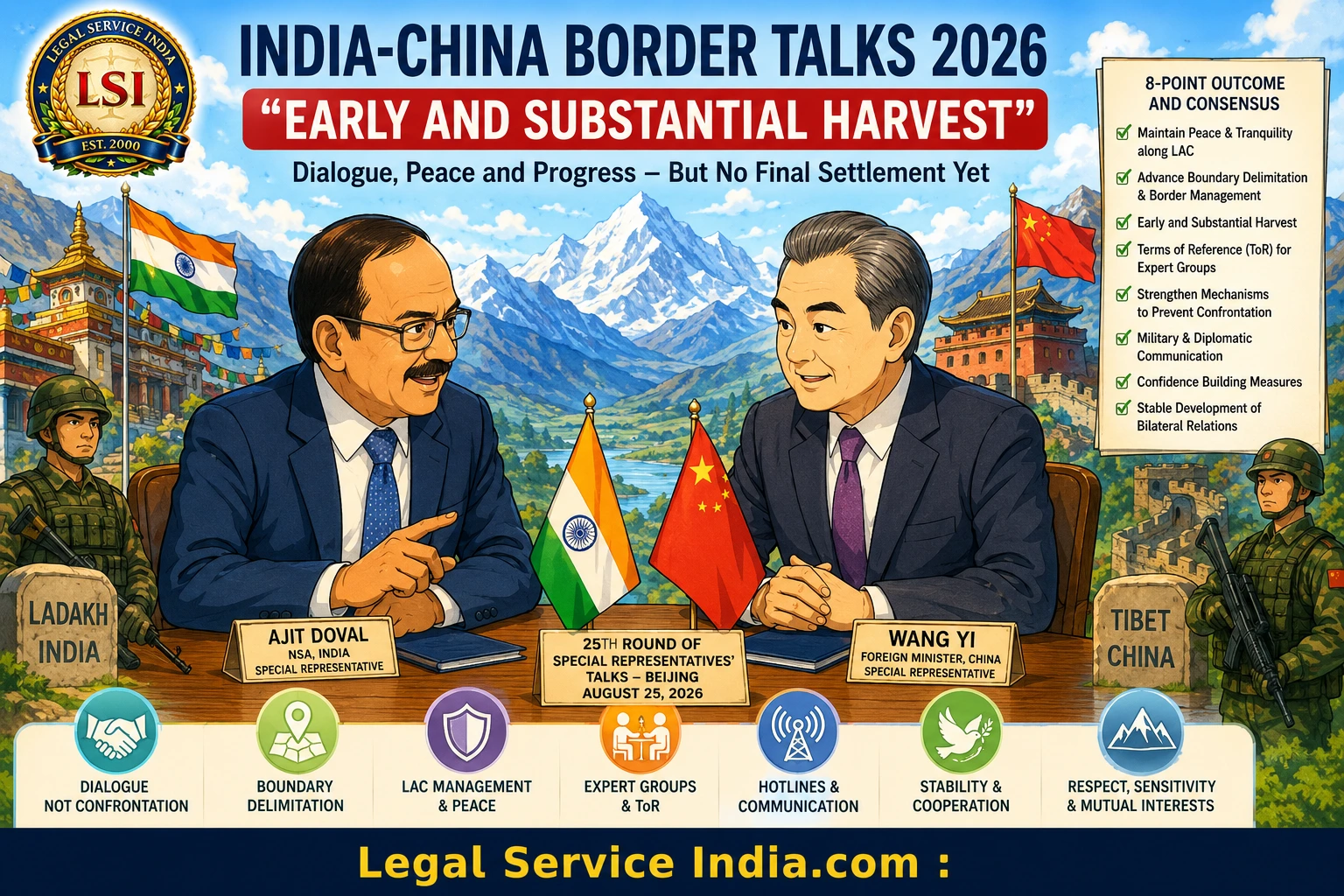
On August 25, 2026, National Security Adviser Ajit Doval, India’s Special Representative on the boundary question, and Chinese Foreign Minister Wang Yi, China’s Special Representative, held the 25th round of Special Representatives’ talks in Beijing.
The talks produced an eight-point outcome and consensus that goes considerably beyond merely agreeing to keep talking. The two countries have agreed to advance discussions on an “Early and Substantial Harvest” of boundary delimitation and border management, while simultaneously strengthening mechanisms designed to prevent misunderstandings and military confrontations along the Line of Actual Control (LAC).
But there is an important legal and diplomatic distinction that must not be lost in the excitement surrounding the announcement.
India and China have not settled their boundary. China has not accepted India’s territorial claims. Nor has either side announced that a permanent border agreement is imminent.
What has happened is nevertheless significant: the two sides have agreed to move from merely managing the consequences of the disputed boundary towards doing more substantive work on where the boundary should ultimately run.
That distinction is the key to understanding the latest development.
The India-China Border Dispute: Why It Has Remained So Difficult
The India-China boundary dispute is not a single disagreement confined to one location.
The disputed frontier extends across the western, middle, and eastern sectors. The western sector principally concerns Ladakh and Aksai Chin, while the eastern sector includes the long-standing dispute concerning Arunachal Pradesh. The middle sector, covering areas of Himachal Pradesh and Uttarakhand, has historically been regarded as comparatively less contentious.
The Line of Actual Control
The Line of Actual Control is not, in itself, a finally demarcated international boundary.
It represents the line up to which the two sides exercise actual control, although India and China have differing perceptions of portions of that line.
That distinction has enormous practical consequences.
Where two countries do not agree on the precise location of a boundary, even patrolling activity can sometimes produce confrontation. The events of 2020, including the violent clash in the Galwan Valley, demonstrated the dangers inherent in such unresolved perceptions.
Two Interconnected Objectives
For years, therefore, India and China have had to pursue two different but interconnected objectives:
- Maintaining peace and tranquillity along the LAC; and
- Negotiating a final settlement of the boundary question.
The latest development is important because the diplomatic process is now attempting to make greater progress on the second objective without abandoning the first.
What Was Agreed on August 25, 2026?
The 25th round of Special Representatives’ talks resulted in eight points of outcome and consensus.
The two sides reaffirmed their commitment to maintaining peace and tranquillity in the border areas and to creating conditions conducive to the stable development of bilateral relations.
More importantly, they reaffirmed their commitment to advancing negotiations on a framework for settlement of the boundary question in accordance with the 2005 Agreement on Political Parameters and Guiding Principles for Settlement of the India-China Boundary Question.
The third major development concerns the Expert Group on Boundary Delimitation and the Working Group on Border Management, functioning under the Working Mechanism for Consultation and Coordination on India-China Border Affairs (WMCC).
The two groups are now expected to advance discussions on an “Early and Substantial Harvest” of boundary delimitation and border management.
Their immediate task, however, is not to draw a new international boundary.
Their first task is to agree upon their respective Terms of Reference (ToR)—in simple words, to determine precisely what these groups will examine, how they will work, and what issues will fall within their mandate.
That is a meaningful diplomatic step, but it is still a step in a much longer process.
What Does “Early Harvest” Mean?
The expression “early harvest” should be understood carefully.
It does not mean that India and China have already agreed to divide the disputed territory.
It also does not mean that the entire border dispute will be resolved immediately.
In diplomatic negotiations, an early-harvest approach generally seeks to identify areas where progress may be possible before the most difficult issues are finally resolved.
For example, if a larger negotiation contains numerous difficult questions, the parties may attempt to make progress on matters where their positions are closer while continuing negotiations on more contentious questions.
Important Caution
However, an important caution is necessary.
The latest official consensus does not identify Sikkim, Himachal Pradesh, Uttarakhand, Ladakh, or Arunachal Pradesh as the specific sector that will constitute the first “early harvest.”
Therefore, it would be incorrect to report as an established fact that India and China have decided to settle Sikkim first.
That may be discussed by analysts because some portions of the boundary are comparatively less contentious, but it is not what the August 2026 official consensus says.
Has India Abandoned Its Earlier Position?
This is another issue that requires careful examination.
The suggestion that India has simply abandoned its previous two-decade position would be an overstatement.
The 2005 Agreement remains extremely important.
That agreement provides that the boundary settlement should be fair, reasonable, and mutually acceptable and should be arrived at through consultations. It also envisages a package settlement covering all sectors of the India-China boundary.
The 2026 consensus expressly refers back to the 2005 Agreement.
Therefore, the latest development should be understood not as abandonment of the existing framework but as an attempt to find a practical mechanism through which some substantive progress can be achieved within that broader diplomatic architecture.
In legal language, there is a difference between changing the governing framework and changing the method or sequencing of negotiations within that framework.
The available evidence presently supports the latter interpretation.
Delimitation and Demarcation Are Not the Same
This distinction is fundamental.
What Is Boundary Delimitation?
Delimitation essentially concerns determining and agreeing upon the course or alignment of the boundary.
In simple language:
Where should the international boundary run?
This involves negotiations concerning maps, geographical features, competing claims, historical material, strategic considerations, and the political parameters agreed upon by the two countries.
What Is Demarcation?
Demarcation is a subsequent physical exercise.
Once the parties have agreed where the boundary runs, the agreed line can be physically marked on the ground and represented accurately on maps.
| Concept | Meaning |
|---|---|
| Delimitation | Deciding where the boundary should be. |
| Demarcation | Physically marking the agreed boundary. |
Thus:
- Delimitation = deciding where the boundary should be.
- Demarcation = physically marking the agreed boundary.
This is why the current announcement should not be interpreted as meaning that India and China have already reached the demarcation stage.
They have not.
The immediate work remains at the negotiation and delimitation level.
Why the 2005 Agreement Still Matters
The 2005 Agreement is not merely historical background.
It remains part of the diplomatic framework expressly referenced in the latest 2026 consensus.
The agreement requires the two sides to seek a fair, reasonable, and mutually acceptable solution and recognizes that a final settlement must cover the entire boundary. It also refers to historical evidence, national sentiments, practical difficulties, strategic interests, and the actual condition of border areas.
This makes the present negotiations extraordinarily complicated.
A boundary dispute of this magnitude cannot be resolved merely by drawing a line on a map.
It involves sovereignty, national security, military positions, geography, historical claims, local populations, political expectations, and strategic interests.
That is why one should resist the temptation to interpret every diplomatic meeting as evidence that a final settlement is around the corner.
The 2025 Development That Prepared the Ground
The current development did not arise overnight.
At the 24th round of Special Representatives’ talks in August 2025, India and China agreed to establish an Expert Group under the WMCC to explore an early harvest of boundary delimitation in appropriate sectors.
They also agreed to establish a Working Group to advance effective border management.
The 2026 talks have now taken that process forward.
Thus, the present announcement can be seen as the next stage of an initiative that began in a more concrete form during the 2025 talks.
The latest consensus gives greater institutional structure to that process.
New Military Communication Mechanisms: An Important Safeguard
Perhaps less attention has been given to another significant component of the August 2026 understanding.
India and China agreed to establish two additional border military hotlines in the eastern and middle sectors and two additional points for meetings between senior military commanders.
From a strategic perspective, this is extremely important.
A boundary dispute becomes particularly dangerous when troops encounter one another without sufficient communication channels.
A hotline does not solve a territorial dispute.
But it can prevent a local incident from escalating into a larger military confrontation.
In that sense, border management and boundary settlement must proceed together.
One cannot realistically expect the two countries to resolve a decades-old territorial dispute overnight. But they can create mechanisms to ensure that disagreements do not automatically become military crises.
What Happened After Galwan?
The 2020 Galwan Valley clash fundamentally altered the India-China relationship.
The immediate diplomatic priority became disengagement and restoration of peace and tranquillity in the border areas.
India and China subsequently reached an agreement on October 21, 2024, concerning patrolling arrangements in Depsang and Demchok, which led to disengagement from the remaining friction points associated with the 2020 confrontation. The Government of India has stated that the arrangements were implemented according to the agreed modalities and timelines.
That development created some diplomatic space for the two countries to restart broader engagement.
The present 2026 discussions should therefore be viewed against this larger background.
Stages Of India-China Border Engagement
The process has gradually moved through several stages:
Confrontation → disengagement → border management → renewed political dialogue → discussion of substantive boundary delimitation.
That does not guarantee a settlement.
But it does represent a change in the character of the dialogue.
Why The Latest Development Is Significant
From a lawyer’s perspective, the most important development is not the headline saying that China has agreed to settle the border.
That headline would go too far.
The real significance lies in the creation and activation of an institutional process aimed at making substantive progress on boundary delimitation.
For years, much of the India-China border engagement necessarily focused on preventing incidents and managing military tensions.
Now, the two sides have expressly agreed to advance discussions on an early and substantial outcome relating to delimitation.
That is diplomatically significant.
But diplomacy is not litigation.
There is no court that can simply pronounce judgment and compel two sovereign states to accept a boundary.
A boundary settlement requires political consent from both sides.
That is why the phrase “mutually acceptable solution” remains crucial.
Is a Permanent India-China Border Settlement Now Near?
In my assessment, it would be premature to say so.
The latest development is encouraging, but several difficult questions remain unanswered.
Among them are
- Which sectors will receive priority?
- What precisely will constitute the “early and substantial harvest”?
- What will the Terms of Reference of the two groups contain?
- Which maps, historical materials, and geographical principles will be used?
- How will the competing territorial claims be reconciled?
- Will progress in one sector affect negotiations in another?
- How will the strategic interests of both countries be accommodated?
- What political compromises will ultimately be acceptable to both governments?
Until these questions are answered, the prospect of a final boundary settlement remains uncertain.
The latest development should therefore be described as progress in the negotiation process, rather than a border settlement.
Also Read: How to File a Medical Negligence Case in India: Procedure, Evidence & Compensation
The Sikkim Question: A Necessary Clarification
Sikkim frequently appears in discussions about an “easy” or comparatively less contentious portion of the India-China boundary.
But that does not mean that the August 2026 talks have announced a Sikkim settlement.
Any article, video, or social media post claiming that India and China have formally agreed to settle Sikkim first should therefore be treated with caution unless supported by an official announcement.
The present official material does not make such a commitment.
This distinction is particularly important because a speculative analytical possibility can quickly become a misleading “breaking news” claim on social media.
What Could Happen Next?
The next phase is likely to be technical as well as diplomatic.
The Expert Group and Working Group first have to settle their respective Terms of Reference.
Once their mandates are established, substantive discussions can proceed.
The process could involve consideration of:
maps, geographical features, historical records, existing agreements, competing perceptions, practical realities, and security concerns.
At the same time, the military communication mechanisms and border-management arrangements will remain essential.
The Two Tracks Of The India-China Border Process
| Track | Focus |
|---|---|
| Track One | Manage the existing border dispute and prevent conflict. |
| Track Two | Negotiate the eventual boundary settlement. |
The success of the second track will depend substantially on the stability achieved through the first.
The Broader India-China Relationship
The border dispute cannot be completely separated from the overall India-China relationship.
The 2005 framework itself recognized that the boundary issue should not be allowed to derail the broader development of bilateral relations.
The 2026 consensus similarly links peace and tranquillity along the border with the healthy and steady development of bilateral relations.
This is strategically understandable.
India and China are major Asian powers with substantial economic, diplomatic, and geopolitical interests.
A permanently unstable border creates costs for both sides.
But at the same time, economic and diplomatic engagement cannot substitute for a satisfactory resolution of territorial claims.
The challenge for both governments is therefore to pursue cooperation where possible while continuing to negotiate their fundamental differences.
My Legal and Strategic Assessment
Having looked at this development from the standpoint of long experience in constitutional and public-law matters, I would describe the August 2026 development as a significant procedural breakthrough, but not yet a substantive settlement.
That distinction is vital.
The real achievement is that India and China have agreed to move the conversation towards an early and substantial outcome in boundary delimitation while retaining the 2005 framework and strengthening mechanisms for border management.
But the difficult part of any negotiation begins after the parties agree that negotiations should move forward.
The actual test will be whether the two countries can convert diplomatic language into mutually acceptable maps, principles, and eventually an agreed boundary.
Until that happens, no responsible observer should declare that the India-China border dispute has been resolved.
Conclusion
The India-China border talks of 2026 mark an important moment in a dispute that has survived wars, diplomatic crises, military confrontations, and decades of negotiations.
The August 25, 2026, Special Representatives’ meeting does not produce a final boundary.
It does something more modest—but potentially more consequential.
It creates a renewed mechanism for discussing boundary delimitation, alongside stronger arrangements for border management, military communication, and prevention of misunderstandings.
The road ahead remains long.
There will undoubtedly be difficult negotiations, competing claims, and moments of disagreement.
But diplomacy is often measured not by the dramatic announcement of a final agreement, but by whether two difficult neighbors can create a process through which the most difficult questions can finally be discussed.
For India and China, the latest development is precisely that.
The border has not been settled. But the conversation about where the border should ultimately run has acquired a new institutional momentum.
And that, in the context of India-China relations, is no small development.
Author’s Note
This analysis is based on the official outcomes of the 25th round of India-China Special Representatives’ talks, the 2005 boundary agreement, the 2025 Special Representatives’ consensus, and subsequent reporting available as of August 28, 2026. Where the official documents do not identify a particular sector or outcome, the article does not present speculation as established fact.
Adv. Tarun Choudhury
Supreme Court Advocate | 25+ Years of Legal Experience
Key Factual Sources
The Government of India’s Ministry of External Affairs has published the official eight-point outcome of the August 25, 2026 talks; the Chinese side has published the corresponding consensus.
- Official MEA — 25th Round: Eight Points of Outcomes and Consensus
- Chinese Foreign Ministry — Eight Points of Outcomes and Consensus
Need Legal Guidance? Consult an Experienced Supreme Court Advocate
If you need professional legal advice, strategic guidance, or assistance in understanding your legal rights and remedies, consult an experienced advocate.
Adv. Tarun Choudhury
Supreme Court Advocate | 25+ Years of Legal Experience
- 📞 Call: 9650499965
- 💬 WhatsApp: 8851978611
For legal consultation and professional guidance, get in touch today.
Frequently Asked Questions
1. What Is the Latest Development in the India-China Border Talks 2026?
The latest development is the agreement reached during the 25th round of India-China Special Representatives’ talks on August 25, 2026, to advance discussions on an “Early and Substantial Harvest” of boundary delimitation and border management. This does not mean that India and China have reached a final border settlement.
2. What Does “Early and Substantial Harvest” Mean in the India-China Border Dispute?
“Early and Substantial Harvest” refers to the effort to achieve meaningful progress on certain aspects of India-China boundary delimitation and border management before a comprehensive final settlement is reached. However, the latest official consensus does not specify that Sikkim, Ladakh, Arunachal Pradesh, or any particular sector will be settled first.
3. Has India and China Agreed to Settle Their Border Dispute Permanently in 2026?
No. The India-China border dispute has not been permanently settled. The 2026 talks represent important diplomatic progress, but the two countries still have to negotiate difficult questions concerning the alignment of the boundary, competing territorial claims, maps, historical material, and strategic interests.
4. What Is the Difference Between Boundary Delimitation and Demarcation in the India-China Border Dispute?
Boundary delimitation means negotiating and deciding where the international boundary should run. Demarcation is the subsequent physical process of marking that agreed boundary on the ground and accurately representing it on maps. The current India-China talks are focused on advancing discussions concerning boundary delimitation, not completing physical demarcation.
5. What Is the Significance of the 2026 India-China Special Representatives Talks?
The 25th Special Representatives talks are significant because India and China agreed to advance discussions on an Early and Substantial Harvest of boundary delimitation and border management while continuing negotiations under the 2005 Agreement on Political Parameters and Guiding Principles. The countries have also agreed to strengthen military communication mechanisms, including additional border hotlines, to help prevent misunderstandings and escalation along the LAC.
Key Takeaways: India-China Border Talks 2026
- India-China border talks in 2026 mark a significant diplomatic development following the 25th round of Special Representatives’ talks between Ajit Doval and Wang Yi in Beijing on August 25, 2026.
- India and China agreed to advance discussions on an “Early and Substantial Harvest” of boundary delimitation and border management. This is progress in negotiations, not a final settlement of the India-China border dispute.
- The 2005 Agreement on Political Parameters and Guiding Principles remains the principal framework referenced for pursuing a fair, reasonable, and mutually acceptable solution to the boundary question.
- The Expert Group on Boundary Delimitation and Working Group on Border Management, functioning under the WMCC, will now advance the respective processes. Their immediate task is to finalize their Terms of Reference (ToR).
- The latest consensus does not announce that Sikkim, Arunachal Pradesh, Ladakh, or any other particular sector will be settled first. Claims about a confirmed Sikkim-first settlement should therefore be treated as speculation unless officially announced.
- India and China agreed to strengthen LAC border management, including two additional military hotline channels in the Eastern and Middle Sectors and two additional meeting points for senior military commander-level discussions.
- The two countries also agreed to address situations on the ground promptly through diplomatic and military mechanisms to reduce the risk of misunderstanding, miscalculation, and escalation along the LAC.
- Cross-border cooperation is also being revived, including the Kailash-Manasarovar Yatra, the reopening of three designated border trading points, and further cooperation in border trade and pilgrimage.
- India and China will hold their next Expert-Level Mechanism meeting on transborder rivers in September 2026, including discussions on hydrological data sharing and relevant MoUs.
- The 26th round of Special Representatives’ talks is scheduled to be held in India in 2027, showing that the diplomatic process is expected to continue.