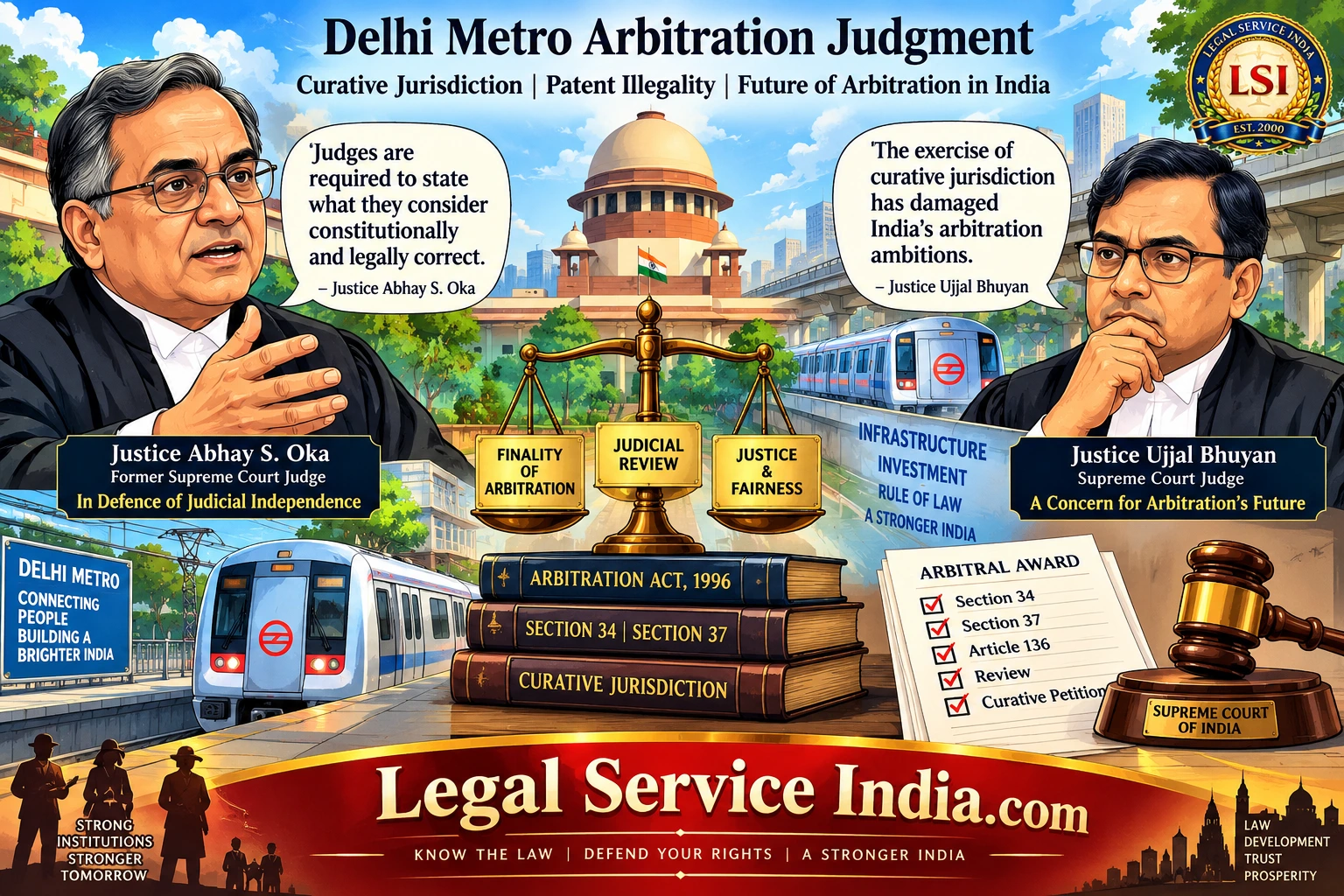
Justice Oka Defends Justice Ujjal Bhuyan’s Criticism of the Delhi Metro Arbitration Judgement: A Deep Legal Analysis of Curative Jurisdiction, Patent Illegality and the Future of Arbitration in India
Introduction: Why the Delhi Metro Controversy Refuses to Disappear
Some judgements settle a dispute. Others continue to generate legal questions long after the courtroom battle is formally over.
The Supreme Court’s judgement in Delhi Metro Rail Corporation Ltd. v. Delhi Airport Metro Express Pvt. Ltd., delivered on 10 April 2024, belongs to the second category.
The judgement arose from a massive public-private infrastructure dispute concerning the Delhi Airport Metro Express. But its importance today is no longer confined to the amount of money involved or the technical defects in the metro project.
The case has become a test of three competing principles:
- Finality of arbitration;
- The constitutional power of the Supreme Court to correct a grave miscarriage of justice; and
- Judicial restraint in reviewing arbitral awards.
The controversy acquired a new dimension in July 2026 when sitting Supreme Court judge Justice Ujjal Bhuyan publicly criticised the 2024 judgement, arguing that the exercise of curative jurisdiction represented an unprecedented level of judicial intervention and had damaged India’s arbitration ambitions.
On 19 September 2026, former Supreme Court judge Justice Abhay S. Oka publicly defended Justice Bhuyan’s right—and, in substance, his judicial duty—to express such a view. Justice Oka said judges are required to state what they consider constitutionally and legally correct and that securing foreign investment is not the judicial function.
This has transformed the Delhi Metro case into something larger than an arbitration dispute.
It has become a debate about how far the Supreme Court itself should go when correcting its own final judgement and whether judicial concern about economic consequences can legitimately influence the exercise of judicial power.
Case: Delhi Metro Rail Corporation Ltd. v. Delhi Airport Metro Express Pvt. Ltd.
Citation: 2024 INSC 292; 2024 SCC OnLine SC 522; (2024) 4 SCR 473
Judgement Date: 10 April 2024
Bench: Dr D.Y. Chandrachud, CJI; Justice B.R. Gavai; Justice Surya Kant
I. The Original Dispute: The Delhi Airport Metro Express Project
The dispute originated in the 2008 Concession Agreement between DMRC and Delhi Airport Metro Express Pvt. Ltd. (DAMEPL).
DAMEPL was a special-purpose vehicle of a consortium involving Reliance Infrastructure and Construcciones y Auxiliar de Ferrocarriles, Spain. The project was structured as a public-private partnership for providing metro connectivity between New Delhi Railway Station and the Indira Gandhi International Airport.
Under the arrangement:
| Party | Responsibility |
|---|---|
| DMRC | Responsible for specified civil structures and land-related obligations |
| DAMEPL | Responsible for railway systems and project operations |
| DAMEPL | To operate and maintain the project for the concession period |
Problems arose concerning alleged defects in the civil structure.
DAMEPL stopped operations in July 2012 and issued a cure notice to DMRC alleging defects that, according to DAMEPL, had a material adverse effect on its ability to perform the concession agreement.
On 8 October 2012, DAMEPL terminated the agreement.
DMRC initiated arbitration.
The three-member arbitral tribunal delivered its unanimous award on 11 May 2017. It awarded DAMEPL approximately ₹2,782.33 crore as termination payment, together with interest and other amounts.
II. The Award’s Extraordinary Journey Through the Courts
The subsequent procedural history is crucial to understanding the controversy.
The award travelled through:
Arbitral Tribunal → Section 34 → Section 37 → Article 136 → Review → Curative Petition
This sequence matters because arbitration law is built around the proposition that an arbitral award should eventually become final.
Stage 1: Section 34
DMRC challenged the award under Section 34 of the Arbitration and Conciliation Act, 1996.
The single judge of the Delhi High Court rejected the challenge.
Stage 2: Section 37
DMRC appealed.
The Division Bench of the Delhi High Court partly interfered with the award.
Stage 3: Article 136
DAMEPL approached the Supreme Court.
On 9 September 2021, a two-judge bench comprising Justice L. Nageswara Rao and Justice S. Ravindra Bhat reversed the Delhi High Court Division Bench and restored the arbitral award.
Stage 4: Review
DMRC sought review.
The review petition was dismissed.
Stage 5: Curative Jurisdiction
DMRC then approached the Supreme Court again through a curative petition.
It was this extraordinary fifth stage which produced the 2024 judgement.
The Supreme Court itself acknowledged that the earlier judgement had survived review before the curative jurisdiction was invoked.
III. What Did the Supreme Court Decide on 10 April 2024?
The three-judge bench allowed DMRC’s curative petitions.
The Court concluded that the earlier Supreme Court decision restoring the award had resulted in a grave miscarriage of justice.
The Court held that the arbitral award suffered from patent illegality.
But this requires careful reading.
The Court did not simply say:
“The arbitrator was wrong.”
Its reasoning was considerably more structured.
The Bench examined:
- The contractual termination clause;
- The meaning of the 90-day cure period;
- The expression “effective steps”;
- The CMRS certification;
- Evidence concerning repairs;
- Material documents placed before the tribunal;
- The tribunal’s framing of issues; and
- Whether the tribunal’s interpretation represented a legally possible view.
The Court ultimately concluded that the tribunal’s reasoning crossed the threshold of patent illegality.
IV. The First Major Legal Question: What Is “Patent Illegality”?
This is where the case becomes doctrinally important.
Section 34(2A), introduced by the 2015 amendment, permits a domestic arbitral award to be set aside if it is vitiated by patent illegality appearing on the face of the award.
But Parliament simultaneously inserted an important limitation:
An award cannot be set aside merely because of:
- An erroneous application of law; or
- Reappreciation of evidence.
The statutory language is critical because it creates a narrow corridor for judicial review.
The Supreme Court reproduced and applied this framework in Delhi Metro.
The basic principle is therefore:
“Patent illegality” is not another word for “wrong”.
There must be something substantially more serious.
V. Associate Builders: The Foundation of the Patent-Illegality Test
The 2024 judgement relied upon Associate Builders v. Delhi Development Authority.
The principle developed there is that interpretation of a contract ordinarily belongs to the arbitrator.
But the arbitrator cannot adopt a construction which no fair-minded or reasonable person could adopt.
A view which is not even a possible view may amount to patent illegality.
The 2024 judgement expressly relied upon this principle.
This is a critical distinction for arbitration practitioners.
The court is not permitted to ask:
“Would I have interpreted the contract differently?”
The question is closer to:
“Is the interpretation legally possible, or has the tribunal crossed the boundary into perversity or irrationality?”
That distinction is what protects arbitral autonomy.
VI. Ssangyong: The Post-2015 Restraint
The Supreme Court also relied upon Ssangyong Engineering & Construction Co. Ltd. v. National Highways Authority of India, (2019) 15 SCC 131.
Ssangyong is one of the important post-2015 authorities because it explained how the 2015 amendments narrowed judicial review.
The expanded pre-2015 conception of public policy had been substantially curtailed.
The post-amendment framework does not permit a court to revisit the merits merely because another interpretation appears preferable.
The statutory proviso to Section 34(2A) expressly prevents setting aside an award merely because of erroneous application of law or reappreciation of evidence.
This is precisely why Delhi Metro has generated debate.
The Court invoked patent illegality while simultaneously conducting a detailed examination of the tribunal’s treatment of evidence and contractual interpretation.
Supporters of the judgement say this was necessary because the tribunal had ignored material evidence and adopted a legally impossible construction.
Critics argue that this risks converting the statutory standard of patent illegality into a merits review.
That disagreement lies at the heart of Justice Bhuyan’s criticism.
VII. Patel Engineering: Perversity Is Not Simply Another Appeal
The 2024 Bench also referred to Patel Engineering Ltd. v. North Eastern Electric Power Corporation Ltd., (2020) 7 SCC 176.
The principle is that a finding based on no evidence, or one which ignores vital evidence, can amount to perversity and consequently patent illegality.
But there remains an important judicial restraint:
The court cannot reassess every piece of evidence merely because the arbitral tribunal reached a different conclusion.
The difference between:
- “The tribunal ignored decisive evidence.”
- “I would have attached greater weight to the evidence.”
is enormous.
Only the former potentially engages patent illegality.
The 2024 judgement relied upon that distinction.
VIII. Why the CMRS Certificate Became Decisive
The technical heart of the dispute concerned the Commissioner of Metro Railway Safety.
The tribunal considered the defects in the metro structure and concluded that the defects had not been cured within the relevant period.
The curative bench took a different view of the significance of the CMRS certification and the contractual expression “effective steps”.
The Court noted that the tribunal had framed the issue too narrowly and had failed adequately to address whether effective steps had been taken during the cure period.
The Supreme Court considered the CMRS certification and related material to be vital evidence which had not been properly dealt with.
This became the factual foundation for the finding of patent illegality.
The Court’s reasoning was essentially that the tribunal’s treatment of the evidence was not merely a permissible disagreement but a failure to engage with material evidence going to the heart of termination.
IX. The Most Important Paragraph of the 2024 Judgement: The Court Itself Recognised the Limits
There is an irony in the case.
The 2024 judgement strongly emphasised judicial restraint.
The Court explained that:
- Section 34 is limited;
- Section 37 is equally constrained;
- Article 136 is discretionary and exceptional; and
- The Supreme Court should be slow to interfere with a Section 37 decision.
The Court expressly stated that under Article 136 it should principally examine whether the Section 37 court exceeded its jurisdiction rather than simply substitute its own view.
This is important.
The judgement cannot fairly be described as announcing a general licence for judicial intervention in arbitration.
Quite the opposite.
The Court repeatedly described the statutory and constitutional boundaries as narrow.
The controversy is therefore not about what the judgement says the law should generally be.
The controversy is about whether the Court itself crossed those boundaries while applying them to this particular case.
That is a much more sophisticated criticism.
X. The Curative Jurisdiction: The Real Constitutional Controversy
The biggest question is not Section 34.
It is Article 142 and curative jurisdiction.
The modern curative jurisdiction originated in:
Rupa Ashok Hurra v. Ashok Hurra, (2002) 4 SCC 388
In Rupa Hurra, the Supreme Court held that after dismissal of a review petition, an extraordinary curative jurisdiction could exist to prevent abuse of the Court’s process and cure a gross miscarriage of justice.
But the Court was exceptionally cautious.
It warned against opening the floodgates to what would effectively become a second review petition.
The Court stated that, except where very strong reasons exist, reconsideration of a final judgement after dismissal of review should not be entertained as a matter of course.
The Supreme Court’s 2013 Rules subsequently incorporated the curative mechanism, requiring specific procedural safeguards, including certification by a senior advocate.
XI. What the 2024 Bench Said About Rupa Hurra
The 2024 Bench did not ignore the restrictive character of curative jurisdiction.
It expressly considered Rupa Hurra.
It noted that the grounds listed in Rupa Hurra were not exhaustive but that the essential principle was that curative jurisdiction is available where the Court’s process has produced a grave miscarriage of justice.
The Court therefore concluded that the present case crossed that threshold.
This is the constitutional justification for reopening the 2021 Supreme Court judgement.
XII. The Strongest Criticism: Was the Curative Petition Really a “Fifth Appeal”?
This is where Justice Ujjal Bhuyan’s criticism becomes legally serious.
Justice Bhuyan pointed out that the award had already passed through:
Section 34 → Section 37 → Article 136 → Review
before the curative stage.
He characterised the 2024 intervention as an unprecedented move and argued that the Court effectively reassessed evidence and merits in what became another layer of scrutiny.
The criticism can be reduced to a fundamental proposition:
If a curative petition can be used to undertake a detailed re-examination of an arbitral award after Section 34, Section 37, Article 136 and review have all been exhausted, what meaningful finality remains in arbitration?
That is not a rhetorical question.
It goes directly to the architecture of the Arbitration and Conciliation Act.
XIII. The Counterargument: What If the Previous Supreme Court Judgement Itself Was Wrong?
There is, however, an equally serious answer.
Suppose an arbitral award is patently illegal.
Suppose the High Court correctly identifies that illegality.
Suppose the Supreme Court subsequently reverses the High Court and restores the award by overlooking decisive material.
Should the Supreme Court be powerless to correct its own error merely because review has failed?
That would undermine the very rationale of curative jurisdiction.
The purpose of Rupa Hurra was precisely to ensure that procedural finality does not become an instrument for perpetuating a gross miscarriage of justice.
The 2024 Bench therefore treated the case as an exceptional constitutional correction rather than ordinary appellate review.
XIV. The Uncomfortable Middle Ground
The most intellectually honest position is that both propositions have force.
| Proposition | Principle |
|---|---|
| Proposition One | Arbitration requires finality. |
| Proposition Two | Finality cannot protect a judgement or award that has produced a grave miscarriage of justice. |
The difficulty is identifying the exceptional boundary.
If the boundary is too narrow, genuine injustice may survive.
If the boundary is too wide, every losing litigant will attempt to convert disagreement into a “grave miscarriage of justice”.
That is precisely what Rupa Hurra warned against.
XV. Why Justice Bhuyan’s Criticism Is Different from Ordinary Criticism of a Judgement
Justice Bhuyan was not merely disagreeing with the result.
His criticism was directed at institutional consequences.
He argued that the 2024 judgement:
- Expanded judicial intervention;
- Undermined arbitration finality;
- Raised doubts about India’s attractiveness as an arbitration jurisdiction; and
- Was followed by a government policy discouraging high-value arbitration.
That makes his intervention important for arbitration law.
He was effectively asking whether a judgement that is constitutionally defensible in an exceptional case may nevertheless have a damaging systemic effect if its reasoning is perceived as weakening the finality of arbitral awards.
XVI. The Finance Ministry’s 3 June 2024 Office Memorandum
The subsequent executive development cannot be ignored.
On 3 June 2024, the Department of Expenditure, Ministry of Finance, issued its Guidelines for Arbitration and Mediation in Contracts of Domestic Public Procurement.
The policy stated that arbitration should not be routinely or automatically included in government procurement contracts, especially large contracts.
As a general norm, arbitration, if included, could be restricted to disputes below ₹10 crore.
For larger disputes, mediation and other mechanisms were encouraged.
The government justified the approach on the basis of its experience with arbitration, including concerns about:
- Expense;
- Delay;
- Repeated litigation;
- Difficulty of obtaining finality; and
- Institutional constraints faced by government departments.
This is an important qualification.
It is not legally accurate to say that the Supreme Court ordered the government to abandon arbitration.
It did not.
The Finance Ministry’s policy was an executive policy response, although Justice Bhuyan has argued that the 2024 judgement materially contributed to that policy shift.
XVII. Did the Delhi Metro Judgement “Cause” the Finance Ministry Policy?
This proposition requires caution.
Justice Bhuyan has publicly connected the two developments.
But causation should not be presented as an established judicial fact.
The Finance Ministry’s memorandum itself set out governmental concerns regarding arbitration and finality.
Therefore, there are three different propositions:
| Category | Proposition |
|---|---|
| Established Fact | The Supreme Court delivered the Delhi Metro curative judgement on 10 April 2024. |
| Established Fact | The Finance Ministry issued its arbitration/mediation memorandum on 3 June 2024. |
| Attributed Interpretation | Justice Bhuyan considers the judicial decision to have directly contributed to the policy reversal. |
That third proposition should remain attributed rather than presented as an independently established causal fact.
XVIII. The Opposing View: Justice Indu Malhotra
The debate has another important voice.
Former Supreme Court judge Justice Indu Malhotra criticised Justice Bhuyan’s public comments.
Her concern, as reported, was institutional and international: strong adverse comments by a sitting Supreme Court judge about a Supreme Court judgement could potentially be relied upon by foreign treaty investors in investment arbitration against India. She described the criticism as an indiscretion.
This creates a fascinating institutional divide.
Justice Bhuyan’s Concern
Judicial intervention should remain within the statutory boundaries of arbitration law.
Justice Malhotra’s Concern
Public criticism by a sitting judge can itself have institutional and international consequences.
Justice Oka’s Response
The judicial duty is to state what the judge considers constitutionally and legally correct; judges are not responsible for securing foreign investment.
This is now an important constitutional conversation in its own right.
XIX. Justice Oka’s Intervention: Why It Matters
Justice Oka’s statement on 19 September 2026 is significant because it shifts the debate from arbitration doctrine to judicial independence and institutional speech.
He reportedly said:
“Our duty is to say and to do what we feel is constitutionally and legally correct.”
The point is conceptually powerful.
- Courts decide according to law.
- They cannot ordinarily alter legal interpretation simply because a particular result might please investors, governments or markets.
At the same time, judicial independence must coexist with institutional responsibility.
A sitting judge criticising a Supreme Court judgement is not equivalent to an academic writing a journal article.
The authority attached to the speaker is fundamentally different.
That tension cannot be wished away.
XX. Article 141 and the Distinction Between Binding Precedent and Criticism
Article 141 provides that the law declared by the Supreme Court is binding on all courts within India.
But Article 141 does not mean that a Supreme Court judgement becomes immune from intellectual criticism.
There is a fundamental distinction between:
- binding force and infallibility.
A later bench cannot casually disregard an applicable precedent.
But judges, academics and lawyers may analyse whether a particular precedent is doctrinally sound.
Indeed, legal development requires such examination.
The danger arises only when public disagreement is confused with the formal judicial process of overruling or distinguishing precedent.
That distinction becomes especially important when the criticism comes from a sitting judge of the same court.
XXI. The 2021 Judgement Itself Is Important
An understanding of the controversy requires reading the judgement which the 2024 bench effectively displaced.
In the 9 September 2021 decision, the Supreme Court had emphasised the disturbing tendency of courts to interfere with arbitral awards by dissecting and reassessing factual aspects.
The Bench held that patent illegality could arise where:
- the arbitrator takes a view that is not even a possible view;
- contractual interpretation is one no fair-minded person could adopt;
- the arbitrator exceeds jurisdiction;
- findings are based on no evidence;
- vital evidence is ignored; or
- The award violates basic procedural requirements.
The 2021 Court nevertheless concluded that the arbitral tribunal’s conclusions did not warrant the High Court’s interference and restored the award.
Thus, the 2024 decision was not merely correcting an arbitral tribunal.
It was also correcting an earlier Supreme Court interpretation of the permissible scope of review.
That makes the curative dimension even more significant.
XXII. The Paradox at the Heart of Delhi Metro
There is a striking paradox.
The 2021 Supreme Court judgement was itself strongly pro-arbitration in its insistence upon limited judicial interference.
The 2024 judgement was also careful to restate limited judicial interference.
Yet the 2024 Court ultimately undertook a detailed reassessment of the record and concluded that the earlier Supreme Court judgement had allowed a patently illegal award to stand.
So the central question becomes:
Can a court preserve arbitration by exceptionally intervening against an exceptionally defective award without weakening the general rule against intervention?
That is the jurisprudential challenge.
XXIII. The Current Statutory Position Under Section 34
The statutory position remains clear.
Section 34 is not an appeal on facts.
The court cannot simply substitute its own assessment of evidence for that of the arbitrator.
For domestic awards, patent illegality is an additional ground.
But the proviso expressly prevents setting aside an award merely for erroneous application of law or reappreciation of evidence.
The legislative design therefore remains:
- minimal intervention + exceptional correction.
XXIV. Section 37 Does Not Create a Wider Appellate Jurisdiction
Section 37 is also constrained.
The Supreme Court’s 2024 judgement expressly noted that Section 37 jurisdiction is essentially tied to the grounds available under Section 34.
There is no unrestricted appellate review of the arbitral award at the Section 37 stage.
This was reaffirmed by the Supreme Court even after Delhi Metro.
In March 2026, in Madhav Infra Projects Ltd v. State of Rajasthan, the Court reiterated that a Section 34 court does not sit in appeal over an arbitral award and that the Section 37 court is equally constrained from substituting a possible view.
This is significant because it demonstrates that the broader arbitration doctrine has not been transformed into a free-ranging review jurisdiction by Delhi Metro.
XXV. The 2026 Supreme Court Position Is Still One of Restraint
The March 2026 Madhav Infra decision is particularly instructive.
The Supreme Court held that:
- Section 34 is not appellate jurisdiction;
- patent illegality must meet the statutory threshold;
- Section 37 is equally constrained; and
- A possible view taken by the arbitrator should not be substituted merely because another view appears preferable.
The Court ultimately restored the arbitral award after finding that the High Court had incorrectly interfered on patent-illegality grounds.
This provides an important answer to one aspect of the current controversy.
The current Supreme Court doctrine does not permit routine merits review of arbitral awards.
XXVI. The September 2025 Supreme Court Ruling Reinforces the Same Principle
In Urban Infrastructure Real Estate Fund v. Neelkanth Realty Pvt. Ltd., 2025 INSC 1255, the Supreme Court again explained that patent illegality is not a licence to undertake ordinary merits review.
The Court reiterated that:
- patent illegality is available for domestic awards;
- it is not available on the same basis for international commercial arbitration;
- the post-2015 framework narrowed the earlier concept of “fundamental policy of Indian law”; and
- “judicial approach” cannot be used as a disguised merits-review ground.
This is extremely important for the current legal position.
The criticism of Delhi Metro has not resulted in a judicial declaration that courts may freely reconsider arbitral awards.
The post-2015 restraint remains firmly embedded in the law.
XXVII. An Important Distinction: Domestic Versus International Commercial Arbitration
The distinction between domestic arbitration and international commercial arbitration must not be overlooked.
Section 34(2A)’s patent-illegality ground is specifically available to awards arising from arbitrations other than international commercial arbitrations.
That means the doctrinal concerns raised by Delhi Metro have particular significance for domestic arbitration.
International commercial arbitration operates under a more restrictive review framework.
The Supreme Court reiterated this distinction in 2025.
XXVIII. The Current Position on Contractual Interpretation
Another principle remains stable.
Construction of a contract is ordinarily for the arbitrator.
A court should not interfere merely because it believes another interpretation is preferable.
The Supreme Court’s later jurisprudence continues to emphasise that contractual interpretation remains principally within the arbitrator’s domain unless the interpretation crosses the threshold of perversity or patent illegality.
This again limits the reach of Delhi Metro.
The 2024 decision should therefore be read as a case-specific application of the patent-illegality doctrine, not as an invitation to appellate review of contractual interpretation.
XXIX. The Contempt Proceedings: The Story Did Not End in April 2024
The aftermath of the judgement has itself generated litigation.
DMRC instituted contempt proceedings connected with the curative judgement.
The proceedings were still active in 2025 and 2026.
On 3 December 2025, the Supreme Court recorded that the contempt matters would be listed on 28 January 2026.
On 28 January 2026, the Court was informed that negotiations between the parties concerning implementation of the arbitral award were continuing, and the matter was adjourned to 19 March 2026.
The proceedings remained on the Supreme Court’s docket thereafter. On 19 August 2026, the matter was again adjourned, this time to 3 September 2026, before a bench comprising the Chief Justice, Justice Joymalya Bagchi and Justice V. Mohana.
Thus, even in 2026, the consequences of the Delhi Metro litigation remain active before the Supreme Court.
XXX. What Justice Bhuyan Is Really Challenging
Justice Bhuyan’s criticism should not be understood as saying that an arbitral tribunal is beyond judicial correction.
His concern is narrower and more fundamental.
The question is:
How extraordinary must “grave miscarriage of justice” actually be before a final Supreme Court judgement concerning an arbitral award can be reopened?
If the answer becomes too broad, the curative petition risks becoming:
- review after review after appeal.
If the answer is too narrow, Article 142 loses its remedial purpose.
That is the constitutional tightrope.
XXXI. What Justice Oka Is Really Defending
Justice Oka’s intervention also needs to be understood carefully.
He is not, merely by defending Justice Bhuyan, setting aside the 2024 judgement.
Nor does his statement alter the binding status of Delhi Metro.
What he is defending is a principle of judicial candour:
A judge should not be expected to suppress a legal view merely because economic or institutional consequences may follow from expressing it.
His intervention therefore moves the debate from:
- “Was Delhi Metro correctly decided?”
- to a second question:
- “Should a sitting Supreme Court judge be permitted to publicly articulate a serious legal criticism of an earlier Supreme Court judgement?”
Those are separate questions.
XXXII. The Strongest Argument in Favour of the 2024 Judgement
The best defence of the 2024 judgement is straightforward.
The Supreme Court cannot permit a patently illegal award to stand merely because procedural finality has been reached.
If the previous Supreme Court judgement itself failed to apply the correct legal standard and allowed an award founded on ignored vital evidence to survive, the constitutional responsibility to correct grave injustice remains.
Otherwise, curative jurisdiction becomes meaningless.
The Court’s reasoning was that this was not an ordinary disagreement but an exceptional failure serious enough to satisfy the curative threshold.
XXXIII. The Strongest Argument Against the 2024 Judgement
The strongest criticism is equally straightforward.
If the Supreme Court itself undertakes a detailed examination of:
- evidence;
- contractual interpretation;
- factual findings;
- arbitral reasoning; and
- statutory standards
After the award has already survived Section 34, Section 37, Article 136 and review, the practical distinction between curative jurisdiction and appellate jurisdiction becomes difficult to maintain.
That is the concern articulated by Justice Bhuyan.
The danger is not confined to one award.
It concerns the expectations of every future commercial party entering an arbitration agreement with an Indian public-sector entity.
XXXIV. The “Fifth Forum” Argument Needs Qualification
It is tempting to call the curative proceeding a “fifth appellate forum”.
Strictly speaking, that is not legally accurate.
A curative petition is not a statutory appeal.
It exists under the Supreme Court’s constitutional/inherent jurisdiction and is governed by the exceptional standard established in Rupa Hurra.
But Justice Bhuyan’s criticism is that its practical effect in Delhi Metro resembled another merits examination.
That is a more precise way of framing the criticism.
XXXV. Does the Delhi Metro Judgement Mean Arbitration in India Is No Longer Final?
No.
That conclusion would go too far.
The post-2024 Supreme Court cases continue to insist that courts cannot function as appellate forums over arbitral awards.
The March 2026 Madhav Infra decision is particularly clear on this point.
Therefore, the current legal position should be stated carefully:
The Delhi Metro judgement represents an exceptional exercise of curative jurisdiction; it does not establish a general rule permitting unrestricted judicial review of arbitral awards.
That is, in my view, the legally safer reading of the current authorities.
XXXVI. But Does the Case Create a Legitimate Concern About Arbitration Finality?
Yes.
Even if Delhi Metro is treated as exceptional, exceptional precedents matter.
Commercial parties do not merely study statutory language.
They study litigation behaviour.
They ask:
- How many times can an award be challenged?
- How long can enforcement remain uncertain?
- Can a final Supreme Court decision later be reopened?
- How predictable is the judicial approach?
These questions influence commercial drafting and the selection of arbitration seats.
That is why the debate has significance beyond the parties.
XXXVII. The Finance Ministry Policy Reveals a Second Problem
The Finance Ministry’s June 2024 policy also demonstrates something else.
If government entities believe that arbitration has become another layer of litigation, the answer could be:
- better institutional arbitration;
- specialist arbitrators;
- tighter case management;
- disciplined government litigation policy;
- better selection of arbitrators;
- stronger internal decision-making; and
- enforcement of statutory timelines.
An alternative is to reduce the use of arbitration itself.
The June 2024 memorandum chose the latter approach for many high-value government procurement disputes.
Justice Bhuyan considers this policy inconsistent with India’s broader arbitration ambitions.
The government, however, has its own institutional experience and public-accountability concerns.
Both considerations deserve recognition.
XXXVIII. Public Money Adds Another Dimension
There is a special difficulty when the disputant is the government.
A private company may accept commercial risk.
A government officer, however, is accountable for public money.
If an arbitral tribunal makes a very large award against the government, officials may be reluctant to accept it without challenge.
This creates what economists and administrators sometimes call an incentive asymmetry.
The official who accepts a large award may later face questions about why the government did not appeal.
Consequently, government arbitration can naturally generate more challenges.
The answer need not necessarily be abolition of arbitration.
A better answer could be a clearer internal framework identifying:
- when an adverse award should be accepted and when it genuinely deserves challenge.
Interestingly, the Finance Ministry’s memorandum itself states that where a decision goes against the government or public-sector enterprise, a challenge should not be made routinely but only where the case genuinely merits it and there are strong prospects of success.
That principle may ultimately prove more important than the ₹10-crore threshold itself.
XXXIX. The Institutional Lesson for Arbitration Drafting
The Delhi Metro dispute also contains lessons for lawyers drafting infrastructure contracts.
A concession agreement should define with precision:
- what constitutes a material breach;
- what constitutes a cure;
- what constitutes effective steps;
- how safety certification affects termination;
- whether regulatory certification is conclusive;
- the evidentiary consequences of safety approvals;
- the consequences of partial remediation;
- termination payments; and
- the standard for demonstrating material adverse effect.
Ambiguous drafting invites arbitration.
Poorly structured arbitration invites judicial intervention.
And unclear judicial review invites further litigation.
The best arbitration strategy therefore begins before the arbitration clause is invoked.
XL. What India Should Learn From the Delhi Metro Controversy
There is a larger policy lesson here.
India does not become an arbitration hub merely by passing arbitration legislation.
A credible arbitration ecosystem requires:
Predictable Law
Parties must know the boundaries of judicial review.
Institutional Confidence
Arbitral institutions must be trusted.
Specialist Judges
Commercial courts must understand the distinction between reviewing an award and retrying a dispute.
Government Discipline
Government departments should not automatically challenge every adverse award.
Arbitrator Quality
Tribunals must produce carefully reasoned awards that engage with material evidence.
Enforcement Certainty
Successful parties must be able to realise awards within a predictable timeframe.
The Delhi Metro litigation exposes weaknesses in several of these areas simultaneously.
XLI. The Deeper Constitutional Lesson
The most interesting aspect of this entire episode may ultimately be constitutional rather than arbitral.
The Supreme Court possesses enormous power.
Article 136 gives it extraordinary appellate discretion.
Article 142 gives it extraordinary powers to do complete justice.
But extraordinary power necessarily demands extraordinary restraint.
The paradox of constitutional adjudication is that the greater the power, the greater the need for self-restraint.
That is why Rupa Hurra is so important.
Curative jurisdiction exists because the Court recognises that even final judgements can, in extraordinary cases, produce grave injustice.
But the very existence of that safety valve creates a danger:
A safety valve must not become another door of appeal.
XLII. The Current Legal Position as of September 2026
After examining the 2024 judgement and the subsequent authorities, the position can be stated in the following manner.
- 1. The 2024 Delhi Metro judgement remains valid law; it has not been overruled. It remains the operative Supreme Court decision in the DMRC-DAMEPL litigation.
- 2. Curative jurisdiction remains exceptional; Rupa Hurra continues to govern the basic framework. A curative petition is not a second review as of right.
- 3. Section 34 remains narrow The court does not sit as an appellate court over the arbitral award.
- 4. Patent illegality remains a domestic-arbitration ground But it cannot be used merely to correct every error of law or to reappreciate evidence.
- 5. Section 37 remains equally constrained The appellate court cannot substitute a possible view merely because it prefers another.
- 6. Article 136 remains exceptional. The Supreme Court itself stated in Delhi Metro that interference with a Section 37 decision should be undertaken sparingly.
- 7. Later cases continue to reinforce restraint The 2025 and 2026 authorities demonstrate that the general doctrine remains one of limited judicial interference.
- 8. The Delhi Metro controversy therefore concerns the exceptional boundary The real unresolved jurisprudential question is not whether courts can review arbitration awards. They can. The question is how exceptional the exceptional case must be when the Supreme Court itself has already adjudicated the dispute.
XLIII. Why Justice Oka’s Defence Matters Historically
Justice Oka’s intervention is significant because it reminds the legal profession of an uncomfortable truth:
Judicial institutions are strengthened not merely by agreement but also by principled disagreement.
A legal system in which every judgement is treated as beyond criticism becomes intellectually stagnant.
But a legal system in which every judge publicly disowns inconvenient precedents risks institutional fragmentation.
The correct balance lies somewhere between those extremes.
Justice Oka has placed the emphasis on constitutional and legal correctness rather than economic consequences. Justice Malhotra has emphasised institutional and international consequences. Justice Bhuyan has emphasised arbitration finality and statutory restraint.
The legal community should examine all three concerns rather than reducing the controversy to personalities.
XLIV. A Final Assessment From the Perspective of an Arbitration Lawyer
After studying the judgement, its predecessors and the subsequent jurisprudence, I would put the matter this way:
The 2024 Delhi Metro judgement is legally defensible as an exceptional curative intervention if—and only if—the Court’s factual and legal findings concerning patent illegality are accepted as satisfying the extraordinarily high threshold of grave miscarriage of justice.
But the judgement also presents a legitimate institutional concern because the Court reached that conclusion after undertaking a detailed examination of the arbitral record despite the award having already survived multiple stages of judicial scrutiny.
That tension should not be hidden.
It should be confronted.
The answer is not to weaken Section 34.
It is not to make arbitration awards immune from judicial correction.
Nor is it to transform curative jurisdiction into another appeal.
The better principle is:
Correct exceptional injustice, but preserve exceptionalism.
If curative jurisdiction becomes routine, arbitration loses finality.
If curative jurisdiction becomes practically unavailable even in cases of genuine grave injustice, the constitutional promise of complete justice loses meaning.
The strength of India’s arbitration regime will ultimately depend upon maintaining that narrow line.
Conclusion
The controversy surrounding Justice Oka’s defence of Justice Ujjal Bhuyan’s criticism of the Delhi Metro arbitration judgement is therefore much larger than an exchange between retired and sitting judges.
At its centre lies a fundamental question about the Indian legal system:
How much judicial intervention is necessary to prevent injustice, and how much intervention destroys the finality that makes arbitration commercially useful?
The 10 April 2024 judgement, Delhi Metro Rail Corporation Ltd. v. Delhi Airport Metro Express Pvt. Ltd., 2024 INSC 292, answered that question in favour of exceptional intervention. The Court concluded that the earlier Supreme Court judgement had allowed a patently illegal award to stand and thereby caused a grave miscarriage of justice.
Justice Ujjal Bhuyan later questioned whether the Court had stretched curative jurisdiction too far and whether the decision had contributed to a retreat from India’s ambition to become a major arbitration jurisdiction.
Justice Indu Malhotra raised the countervailing concern that such public criticism by a sitting Supreme Court judge could have institutional and international consequences.
Justice Abhay Oka has now defended Justice Bhuyan’s position, emphasising that the judicial duty is to say what is constitutionally and legally correct rather than to decide cases according to anticipated foreign-investment consequences.
Meanwhile, the subsequent Supreme Court authorities in 2025 and 2026 continue to reaffirm that Section 34 is not appellate jurisdiction, patent illegality is not a licence for reappreciation of evidence, and Section 37 courts cannot simply substitute their preferred view for a possible arbitral view.
That is perhaps the most important point emerging from the controversy.
The Delhi Metro judgement should not be read as a general abandonment of minimal judicial intervention in arbitration.
But neither should its exceptional use of curative jurisdiction be treated as an ordinary model for future cases.
The law must preserve both principles:
- finality where the law requires finality, and correction where the Constitution demands correction.
For India’s arbitration future, that balance may prove more important than the outcome of the original ₹2,800-crore dispute.
Important Cases And Authorities
| Case | Authority / Significance |
|---|---|
| Delhi Metro Rail Corporation Ltd. v. Delhi Airport Metro Express Pvt. Ltd., 2024 INSC 292; 2024 SCC OnLine SC 522. | |
| Delhi Airport Metro Express Pvt. Ltd. v. Delhi Metro Rail Corporation Ltd., (2022) 1 SCC 131 | Supreme Court’s earlier decision restoring the arbitral award. |
| Rupa Ashok Hurra v. Ashok Hurra, (2002) 4 SCC 388 | Foundational authority on curative jurisdiction. |
| Associate Builders v. Delhi Development Authority, (2015) 3 SCC 49 | Patent illegality/public policy principles. |
| Ssangyong Engineering & Construction Co. Ltd. v. National Highways Authority of India, (2019) 15 SCC 131 | Post-2015 limits on Section 34 review. |
| Patel Engineering Ltd. v. North Eastern Electric Power Corporation Ltd., (2020) 7 SCC 176 | Patent illegality and perversity. |
| MMTC Ltd v. Vedanta Ltd., (2019) 4 SCC 163 | Section 37’s restricted jurisdiction. |
| Madhav Infra Projects Ltd. v. State of Rajasthan, Civil Appeal No. 3229 of 2026, order dated 10 March 2026 | Reaffirming restrained Section 34/37 review. |
| Urban Infrastructure Real Estate Fund v. Neelkanth Realty Pvt. Ltd., 2025 INSC 1255 | Reaffirming the post-2015 limits of patent illegality and public-policy review. |
Primary Source
Supreme Court of India — Delhi Metro Rail Corporation Ltd. v. Delhi Airport Metro Express Pvt. Ltd., 2024 INSC 292
Read the official Supreme Court judgement – https://api.sci.gov.in/supremecourt/2022/23751/23751_2022_1_1501_52296_Judgement_10-Apr-2024.pdf
Current contempt proceedings: The Supreme Court’s 19 August 2026 order records that the connected contempt matters remained pending and were adjourned to 3 September 2026.
⚖️ Need Expert Legal Guidance On Arbitration Or A Supreme Court Matter?
When a high-value arbitration dispute reaches the courts, the difference often lies in understanding the law, the precedent and the strategy before taking the next step.
If you are facing a commercial arbitration dispute, arbitral award challenge, Section 34 or Section 37 proceedings, curative petition, Supreme Court matter, contractual dispute or government arbitration issue, professional legal guidance can help you understand your available remedies and the legal strategy relevant to your case.
👨⚖️ Consult an experienced Supreme Court advocate.
Adv. Tarun Choudhury
Supreme Court Advocate | 25+ Years of Legal Experience
- ✔️ Arbitration & Commercial Disputes
- ✔️ Supreme Court Litigation
- ✔️ Section 34 & Section 37 Arbitration Matters
- ✔️ Contract & Infrastructure Disputes
- ✔️ Constitutional & Civil Litigation
- ✔️ Legal Strategy & Case Analysis
📞 Call: 9650499965
💬 WhatsApp: 8851978611
Your legal problem deserves more than a generic answer. Discuss the facts of your matter with an experienced advocate and understand your legal options before taking the next step.
📲 Speak To Adv. Tarun Choudhury Today
Call or WhatsApp for a preliminary discussion regarding your legal matter.
Legal advice depends on the specific facts, documents and applicable law. No particular outcome is guaranteed.
Frequently Asked Questions (FAQs)
1. What Is The Delhi Metro Arbitration Judgement Of 2024?
The Delhi Metro arbitration judgement of 2024 refers to Delhi Metro Rail Corporation Ltd. v. Delhi Airport Metro Express Pvt. Ltd., 2024 INSC 292, decided by the Supreme Court on 10 April 2024. The Supreme Court allowed DMRC’s curative petitions and set aside the earlier Supreme Court decision that had restored the arbitral award in favour of DAMEPL. The Court held that the earlier decision had resulted in a grave miscarriage of justice and that the arbitral award suffered from patent illegality.
2. Why Did Justice Ujjal Bhuyan Criticise The Supreme Court’s Delhi Metro Arbitration Judgement?
Justice Ujjal Bhuyan criticised the Delhi Metro arbitration judgement primarily on the ground that the Supreme Court’s use of curative jurisdiction represented an exceptionally high degree of judicial intervention in an arbitral dispute. He questioned whether reopening an award after Section 34, Section 37, Article 136 and review proceedings were exhausted was consistent with the principle of finality of arbitration and India’s objective of developing itself as an arbitration-friendly jurisdiction.
3. What Did Justice Abhay Oka Say About Justice Ujjal Bhuyan’s Criticism Of The Delhi Metro Judgement?
Justice Abhay Oka defended Justice Ujjal Bhuyan’s criticism of the Delhi Metro arbitration judgement, emphasising that judges have a duty to state what they consider constitutionally and legally correct. The discussion also raised the question of whether concerns about foreign investment should influence judicial reasoning. Justice Oka’s position, as reported, was that the primary responsibility of a judge is to uphold constitutional and legal principles rather than decide according to anticipated economic consequences.
4. What Is The Significance Of Curative Jurisdiction In The Delhi Metro Arbitration Case?
Curative jurisdiction under Article 142 is an extraordinary remedy designed to prevent a grave miscarriage of justice after ordinary remedies, including review, have been exhausted. The Supreme Court’s power to entertain a curative petition was recognised in Rupa Ashok Hurra v. Ashok Hurra, (2002) 4 SCC 388. In the Delhi Metro arbitration case, the Supreme Court invoked this exceptional jurisdiction and concluded that the earlier decision restoring the arbitral award had resulted in a grave miscarriage of justice. A curative petition is not intended to function as an ordinary second appeal or another round of merits review.
5. Does the Delhi Metro Judgement Allow Courts To Routinely Interfere With Arbitral Awards Under Section 34?
No. The Delhi Metro judgement does not create a general right of judicial interference with arbitral awards. Under Section 34 of the Arbitration and Conciliation Act, 1996, courts have limited grounds for setting aside domestic arbitral awards. Although patent illegality is a statutory ground under Section 34(2A), an award cannot be set aside merely because the court disagrees with the arbitrator’s interpretation of law or wishes to reappreciate the evidence. Subsequent Supreme Court decisions have continued to emphasise that Section 34 and Section 37 proceedings are not ordinary appellate proceedings and that judicial intervention must remain within the statutory framework.
🔑 Key Takeaways: Delhi Metro Arbitration Judgement & Justice Oka’s Defence Of Justice Bhuyan
| Key Point | Explanation |
|---|---|
| Delhi Metro Arbitration Judgement 2024 | In Delhi Metro Rail Corporation Ltd. v. Delhi Airport Metro Express Pvt. Ltd., 2024 INSC 292, the Supreme Court allowed DMRC’s curative petitions and overturned its earlier 2021 decision restoring the arbitral award. |
| ₹2,800-Crore Arbitration Dispute | The case arose from the Delhi Airport Metro Express project, involving an arbitral award of approximately ₹2,782 crore plus interest in favour of DAMEPL. |
| Supreme Court Curative Jurisdiction | The 10 April 2024 judgment is significant because the Supreme Court exercised its extraordinary curative jurisdiction after the dispute had already gone through arbitration, Section 34, Section 37, Article 136 and review proceedings. |
| Grave Miscarriage Of Justice | The Supreme Court held that the earlier decision restoring the arbitral award had resulted in a grave miscarriage of justice and found the award affected by patent illegality. |
| Patent Illegality and Arbitration | The judgement reinforces the importance of the patent illegality test under Section 34(2A) of the Arbitration and Conciliation Act, 1996, while also illustrating the difficult boundary between legitimate judicial review and impermissible reappreciation of evidence. |
| Justice Ujjal Bhuyan’s Criticism | Justice Ujjal Bhuyan subsequently criticised the Delhi Metro arbitration judgement, particularly the extent of judicial intervention and its implications for finality of arbitral awards and India’s arbitration regime. |
| Justice Abhay Oka Defends Justice Bhuyan | Justice Abhay Oka publicly defended Justice Bhuyan’s criticism, emphasising that judges have a responsibility to state what they consider constitutionally and legally correct. |
| Judicial Duty vs Economic Consequences | The controversy raises an important institutional question: should concerns about foreign investment and India’s commercial reputation influence judicial reasoning, or should courts focus exclusively on constitutional and legal principles? |
| Rupa Ashok Hurra and Curative Jurisdiction | The Supreme Court’s curative jurisdiction originates from Rupa Ashok Hurra v. Ashok Hurra, (2002) 4 SCC 388. A curative petition is an exceptional remedy, not an ordinary second appeal or routine review. |
| Section 34 Is Not An Appeal | Courts cannot ordinarily reassess the merits of an arbitral award under Section 34 merely because they prefer another interpretation of the evidence or contract. |
| Section 37 Has Limited Scope | A Section 37 appellate court is similarly restricted and cannot routinely substitute its own interpretation for a legally possible view taken by the arbitral tribunal. |
| Subsequent Supreme Court Jurisprudence | Later Supreme Court decisions in 2025 and 2026 have continued to emphasise limited judicial interference, reinforcing that the Delhi Metro case should not be interpreted as permitting routine merits review of arbitral awards. |
| Government Arbitration Policy | Following the judgement, the Union Finance Ministry issued guidelines in June 2024 concerning arbitration and mediation in government procurement contracts, including restrictions concerning high-value disputes. The policy has become part of the wider debate over India’s arbitration strategy. |
| Opposing Legal Views | The controversy involves competing concerns—arbitral finality and minimal judicial intervention on one side, and the constitutional responsibility to correct grave injustice on the other. |
| Key Legal Issue | The central jurisprudential question is whether the Supreme Court can correct an exceptional miscarriage of justice through curative jurisdiction without turning that extraordinary remedy into another layer of appellate review. |
| Current Legal Position | The 2024 Delhi Metro judgement remains operative, but it should be understood as an exceptional exercise of curative jurisdiction. Subsequent Supreme Court decisions continue to maintain that Section 34 and Section 37 do not permit unrestricted judicial review of arbitral awards. |
| Why The Judgement Matters | The case has implications for arbitration law in India, commercial contracts, infrastructure disputes, government contracts, judicial review, curative petitions, patent illegality and India’s position as an arbitration-friendly jurisdiction. |