





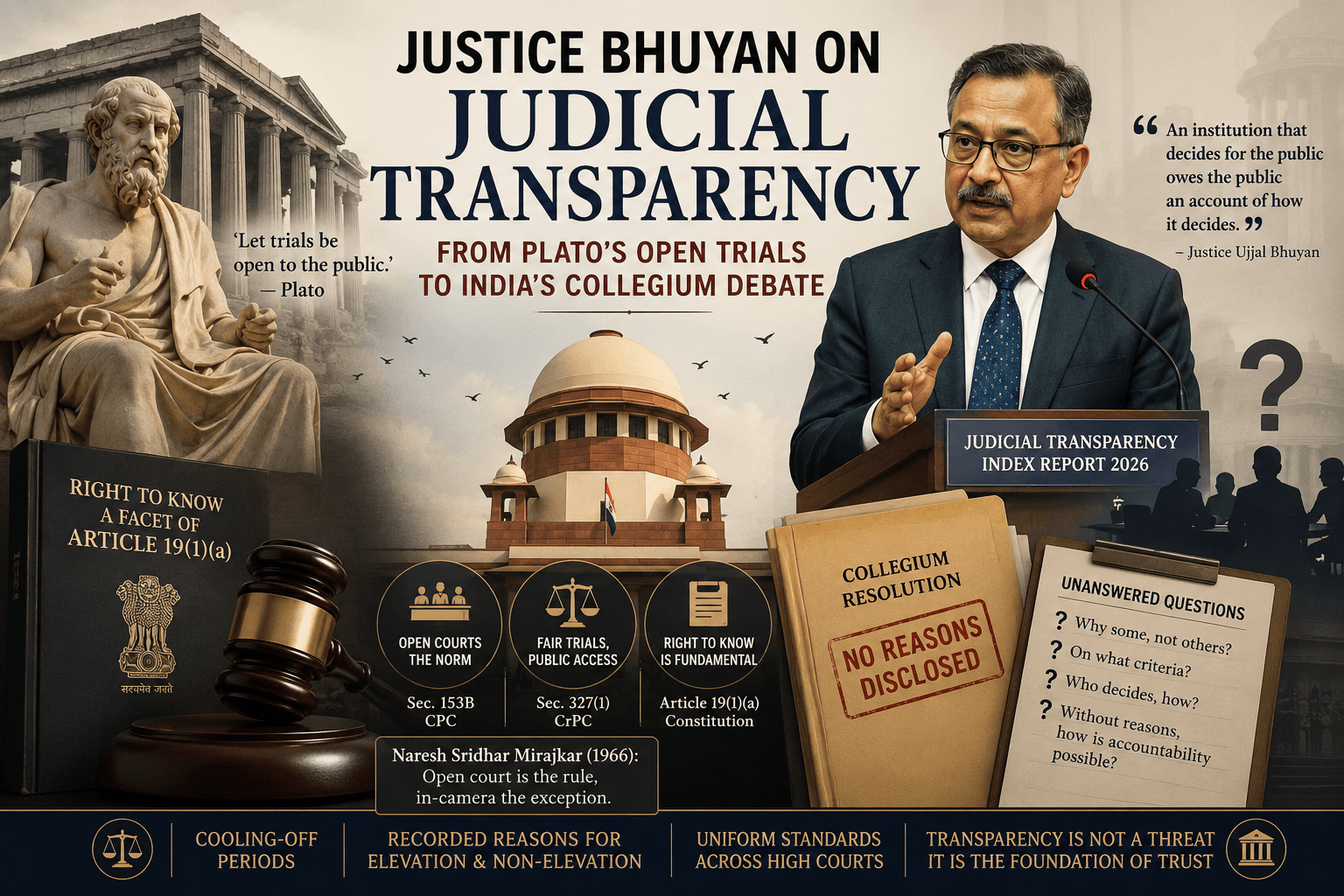
Justice Bhuyan on Judicial Transparency: From Plato’s Open Trials to India’s Collegium Debate
At the release of the Judicial Transparency Index Report in Delhi on August 1, 2026, Supreme Court judge Hon’ble Mr. Justice Ujjal Bhuyan took his audience from Plato’s Athens to the doors of India’s collegium. Between the two lay one consistent argument: an institution that decides for the public owes the public an account of how it decides, and nowhere is that owed more and delivered less than in how judges themselves are appointed.
Judicial Transparency Index Report and Open Justice
The report, jointly brought out by the Vidhi Centre for Legal Policy and JALDI (Justice, Access, and Lowering Delays in India), assesses how much information the Supreme Court and High Courts actually disclose to the public.
Justice Bhuyan began philosophically, tracing the idea of open justice back to Plato, who argued that citizens must be allowed to attend trials, and to Jeremy Bentham, who saw the publicity of judgments as a precondition of the common law tradition itself.
Every legal system that claims to dispense justice, he said, must also be answerable for how it does so. Public spaces of adjudication, in his words, have to remain wide open.
Transparency in Indian Jurisprudence
Justice Bhuyan was careful to note that transparency is not some imported, modern virtue; it is embedded in Indian jurisprudence itself.
He pointed to Section 153B of the CPC and analogous provisions in the CrPC (Section 327(1) of the CrPC), which mandate open court hearings in civil and criminal matters, respectively, allowing a judge to restrict access only for good and sufficient reason.
Open Court Hearings And The Right To Know
He also invoked the 1966 case of Naresh Sridhar Mirajkar, where a witness’s request to keep his evidence from being published was challenged before the Bombay High Court and later the Supreme Court.
The Court’s observation, then, that all cases, whether civil, criminal, or constitutional, must ordinarily be heard in open court, with in-camera proceedings as the exception, not the rule, remains the guiding principle even today, he said.
The right to know, he added, is itself a facet of Article 19(1)(a).
| Issue | Principle Highlighted By Justice Bhuyan |
|---|---|
| Open Justice | Public spaces of adjudication have to remain wide open. |
| Open Court Hearings | Open court hearings are the ordinary rule, while in-camera proceedings are the exception. |
| Right To Know | The right to know is itself a facet of Article 19(1)(a). |
| Judicial Transparency | An institution that decides for the public owes the public an account of how it decides. |
Judicial Appointments And The Transparency Debate
The address turned candid and stayed there longest on judicial appointments, which Justice Bhuyan called perhaps the most complex facet of transparency.
He invoked the Subhash Chandra Agarwal case, where the Central Information Commission had directed the Supreme Court to disclose correspondence between the collegium and government over the appointment of three judges (Justices HL Dattu, AK Ganguly, and RM Lodha) elevated ahead of more senior colleagues (Justices AP Shah, AK Patnaik, and VK Gupta).
Subhash Chandra Agarwal Case
The Constitution Bench’s 2019 verdict held that judicial independence and transparency are not in conflict but left what gets disclosed to be decided case by case, weighing interests such as privacy each time.
That unresolved discretion, Justice Bhuyan suggested, is why collegium resolutions still go unexplained: in three recent appointments, he noted, no reasoning had accompanied the recommendations at all.
Justice Bhuyan on Reasons for Collegium Recommendations
He remarked,
“I have noticed that the last three collegium resolutions of the Supreme Court, including the latest one in 2025, do not contain any reasons at all for recommending elevations. This is in contrast to the earlier resolutions, where every recommendation was supported by some reasons. They may not have been exhaustive. Some may even say they were somewhat formulaic or copy-paste in nature. But at least some reasons were given to justify the recommendations.”
Criticism Of The Supreme Court Collegium System
Justice Bhuyan criticized the opaqueness of the Supreme Court Collegium system.
He said:
“By not giving reasons, you are actually doing a disservice to judges who have done tremendous work. By not doing this, we are allowing some kinds of people who come inside the judiciary who will later go on to describe a group of people as ‘ants’ and this and that. It’s completely unconstitutional. To prevent entry of such people, there should be some discussion; there should be some reasons given. What harm is caused by discussion in public?”
He made these remarks in reference to a comment made by the then sitting judge of the Allahabad High Court, Justice Shekhar Kumar Yadav, at an event organized by the Vishva Hindu Parishad (VHP) legal cell in Prayagraj.
Proposed Reforms for Judicial Transparency
He closed on a note that tied the evening together: cooling-off periods after retirement, recorded reasons for both elevating and not elevating candidates, and uniform standards across High Courts, since the right to information is, after all, a pan-India fundamental right.
- Cooling-off periods after retirement.
- Recorded reasons for elevating candidates.
- Recorded reasons for not elevating candidates.
- Uniform standards across high courts.
One Principle Behind The Proposed Reforms
These are not competing reforms but different expressions of the same principle.
An institution that decides for the public, he seemed to be saying, owes the public an account of how it makes its decisions.
End Notes:
- https://jaldi-vidhilegalpolicy.in/overview-projects/capacity-performance/report?id=377&title=The-Judicial-Transparency-Index:-Assessing-disclosure-of-information-by-the-Supreme-Court-and-the-High-Courts
- https://indiankanoon.org/doc/1218090/
- https://www.scobserver.in/cases/central-public-information-officer-supreme-court-subash-chandra-agarwal-rti-and-judicial-independence-background/
- https://www.indiacode.nic.in/show-data?actid=AC_CEN_3_20_00051_190805_1523340333624§ionId=33498§ionno=153B&orderno=166
- https://devgan.in/crpc/section/327/
- https://www.scconline.com/
Key Takeaways: Justice Bhuyan on Judicial Transparency
| Key Issue | Key Takeaway |
|---|---|
| Judicial Transparency | Judicial transparency is essential to public trust: Justice Ujjal Bhuyan emphasized that institutions exercising public power should explain how important decisions are made. |
| Open Justice | Open justice has deep historical roots: the principle of open trials can be traced from Plato’s Athens to Jeremy Bentham’s emphasis on public judgments and accountability. |
| Open Courts in India | Open courts are an established Indian legal principle: Section 153B of the CPC and Section 327(1) of the CrPC support the principle that court proceedings should ordinarily remain open to the public. |
| Right to Know | The right to know is linked to Article 19(1)(a): Justice Bhuyan highlighted the connection between judicial transparency and the constitutional right to freedom of speech and expression. |
| Judicial Appointments | Judicial appointments remain a major transparency challenge: The Supreme Court Collegium system was identified as one of the most complex areas where greater transparency is required. |
| Collegium Recommendations | Reasons for collegium recommendations matter: Justice Bhuyan questioned the absence of reasons in recent collegium resolutions and stressed that reasoned decisions can strengthen accountability. |
| Judicial Independence | Transparency and judicial independence can coexist: The discussion surrounding the Subhash Chandra Agarwal case demonstrates that judicial independence and transparency need not necessarily be competing principles. |
| Privacy and Transparency | Privacy must be balanced with transparency: Disclosure in judicial matters may require a case-by-case assessment where privacy and other legitimate interests are involved. |
| Reasoned Judicial Appointments | Reasoned appointments can protect judicial standards: Recording reasons for both elevating and not elevating candidates could make the judicial appointment process more accountable. |
| Uniform Transparency Standards | Uniform transparency standards are important: Justice Bhuyan advocated consistent standards across High Courts because the right to information is a pan-India fundamental right. |
| Cooling-Off Periods | Cooling-off periods are part of the proposed reforms: Restrictions after judicial retirement were also identified as an important transparency-related reform. |
Judicial Transparency and Public Trust
Judicial transparency is essential to public trust: Justice Ujjal Bhuyan emphasized that institutions exercising public power should explain how important decisions are made.
Historical Roots of Open Justice
Open justice has deep historical roots: the principle of open trials can be traced from Plato’s Athens to Jeremy Bentham’s emphasis on public judgments and accountability.
Open Courts as an Indian Legal Principle
Open courts are an established Indian legal principle: Section 153B of the CPC and Section 327(1) of the CrPC support the principle that court proceedings should ordinarily remain open to the public.
Right to Know and Article 19(1)(a)
The right to know is linked to Article 19(1)(a): Justice Bhuyan highlighted the connection between judicial transparency and the constitutional right to freedom of speech and expression.
Judicial Appointments and Transparency
Judicial appointments remain a major transparency challenge: The Supreme Court Collegium system was identified as one of the most complex areas where greater transparency is required.
Why Reasons for Collegium Recommendations Matter
Reasons for collegium recommendations matter: Justice Bhuyan questioned the absence of reasons in recent collegium resolutions and stressed that reasoned decisions can strengthen accountability.
Transparency and Judicial Independence
Transparency and judicial independence can coexist: The discussion surrounding the Subhash Chandra Agarwal case demonstrates that judicial independence and transparency need not necessarily be competing principles.
Privacy and Judicial Transparency
Privacy must be balanced with transparency: Disclosure in judicial matters may require a case-by-case assessment where privacy and other legitimate interests are involved.
Reasoned Appointments and Judicial Standards
Reasoned appointments can protect judicial standards: Recording reasons for both elevating and not elevating candidates could make the judicial appointment process more accountable.
Uniform Transparency Standards Across High Courts
Uniform transparency standards are important: Justice Bhuyan advocated consistent standards across High Courts because the right to information is a pan-India fundamental right.
Cooling-Off Periods After Judicial Retirement
Cooling-off periods are part of the proposed reforms: Restrictions after judicial retirement were also identified as an important transparency-related reform.

