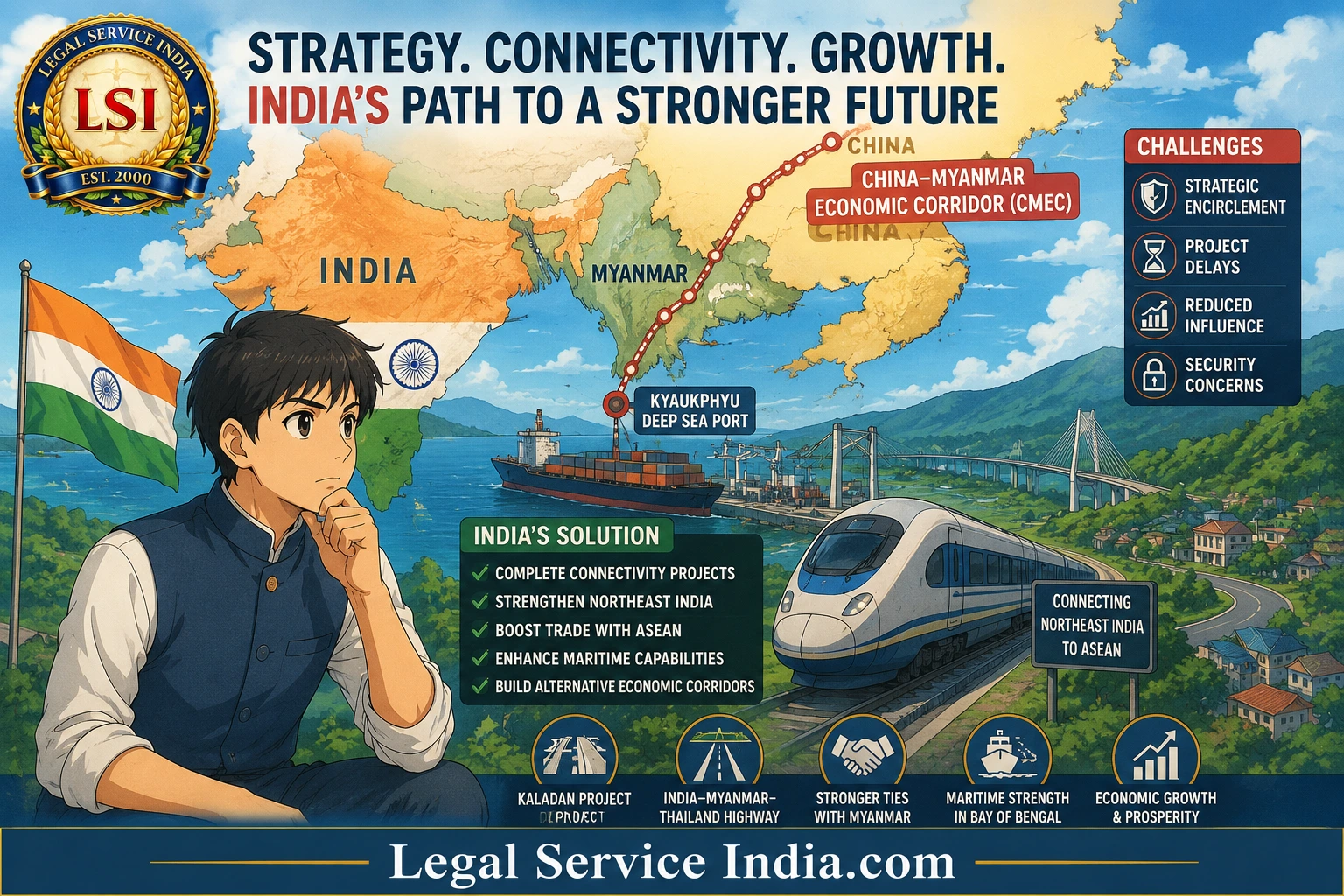
China–Myanmar Economic Corridor (CMEC) and India’s Strategic Challenge
The China–Myanmar Economic Corridor (CMEC) is one of the most strategically important components of China’s Belt and Road Initiative (BRI). It connects China’s landlocked Yunnan Province to the Bay of Bengal through Myanmar, giving Beijing direct access to the Indian Ocean. The corridor’s centrepiece is the deep-sea port of Kyaukphyu Deep Sea Port, linked by highways, railways, industrial zones, and existing oil and gas pipelines running to Yunnan.
Why CMEC Is So Important to China
1. Bypassing the Malacca Strait
Nearly 80% of China’s energy imports traditionally pass through the vulnerable Malacca Strait. CMEC provides an alternative route via Myanmar, reducing China’s dependence on a maritime chokepoint that could be disrupted during geopolitical tensions.
2. Direct Access to the Indian Ocean
Through Kyaukphyu, China gains a strategic foothold on the Bay of Bengal, shortening transportation routes between western China and global markets.
3. Expanding Chinese Influence
The corridor strengthens China’s economic, political, and potentially military influence in Myanmar and the wider Indian Ocean Region.
How India Is Losing Out
1. Strategic Encirclement in the Bay of Bengal
Indian strategists worry that Chinese-funded ports and infrastructure projects around India’s periphery form part of the so-called “String of Pearls” strategy. Kyaukphyu adds another major Chinese presence close to India’s eastern seaboard and the Andaman & Nicobar Islands.
2. Delays in India’s Connectivity Projects
India’s answer to CMEC is the Kaladan Multimodal Transit Transport Project and the India–Myanmar–Thailand Highway. However, these projects have faced repeated delays, cost overruns, security issues, and bureaucratic hurdles, allowing China to move faster in establishing influence.
3. Reduced Influence in Myanmar
For decades Myanmar acted as a strategic buffer between India and China. Following political instability and international sanctions, Myanmar became increasingly dependent on Chinese investment, giving Beijing greater leverage than New Delhi.
4. Economic Opportunity Lost for Northeast India
India’s Act East Policy envisioned Northeast India becoming a gateway to Southeast Asia. If CMEC becomes the dominant trade route, much of the trade and logistics traffic may flow through Chinese-controlled networks rather than through India’s northeastern states.
5. Security Concerns
Although China officially describes Kyaukphyu as a commercial project, Indian security analysts worry that dual-use infrastructure could eventually support Chinese naval operations, similar to concerns previously raised regarding other Chinese-backed ports.
CMEC vs India’s Connectivity Strategy
| Aspect | China (CMEC) | India |
|---|---|---|
| Major Project | China–Myanmar Economic Corridor | Kaladan Project & India–Myanmar–Thailand Highway |
| Strategic Objective | Access to Indian Ocean | Act East Connectivity |
| Current Progress | Advanced but facing challenges | Delayed due to multiple hurdles |
| Regional Influence | Strong economic footprint | Relatively limited influence |
| Security Impact | Potential strategic presence | Defensive and connectivity focused |
Is China Really Winning?
Not entirely.
Myanmar’s civil conflict has slowed many CMEC projects. Several major investments have faced delays due to security risks, local opposition, environmental concerns, and political instability. Progress at Kyaukphyu has been much slower than originally envisioned.
Myanmar has also previously scaled back the size of the Kyaukphyu project due to concerns about excessive dependence and debt.
What India Must Do
- Complete the Kaladan Project without further delay.
- Accelerate the India–Myanmar–Thailand Trilateral Highway.
- Strengthen economic engagement with Myanmar regardless of political transitions.
- Increase investment in Northeast India as a logistics and manufacturing hub.
- Expand maritime capabilities in the Bay of Bengal and the Andaman & Nicobar Islands.
- Deepen cooperation with ASEAN countries under the Act East Policy.
Future Geopolitical Balance in the Bay of Bengal
The China–Myanmar Economic Corridor is not merely an infrastructure project; it is a geopolitical corridor that gives China access to the Indian Ocean while expanding its strategic footprint on India’s eastern flank. India is losing ground primarily because Chinese projects have advanced faster and at a larger scale, while India’s connectivity initiatives have suffered delays. However, Myanmar’s instability means the contest is far from over. The country that delivers infrastructure, trade, and development most effectively over the next decade will shape the future strategic balance in the Bay of Bengal.
The Best Solution for India: Lessons from Global Strategic Corridors
After studying comparable situations worldwide—China’s Gwadar strategy in Pakistan, the East-West Economic Corridor in Southeast Asia, Indonesia’s response to Chinese infrastructure investments, the Chabahar strategy in Iran, and the China–Myanmar Economic Corridor (CMEC)—the conclusion is clear:
India should not try to stop CMEC. India should make CMEC strategically irrelevant.
History shows that countries which tried to block major economic corridors generally failed. Countries that built superior alternatives succeeded.
What Other Countries Did
| Country/Region | Approach | Key Lesson for India |
|---|---|---|
| Vietnam | Manufacturing growth, foreign investment, logistics development | Become the preferred economic partner |
| Indonesia | Selective engagement with China while maintaining autonomy | Focus on strategic sectors |
| Iran (Chabahar) | Built an alternative trade gateway | Create alternative connectivity routes |
| Greater Mekong Region | Shared economic benefits through regional integration | Economic integration beats zero-sum competition |
1. Vietnam’s Approach to China
Vietnam could not match China’s economic power. Instead it:
- Built manufacturing dominance.
- Attracted Japanese, Korean and Western investment.
- Strengthened ports and logistics.
- Increased military deterrence.
Result: Vietnam became a major beneficiary of global supply-chain diversification despite China’s proximity.
Lesson for India: Become the preferred economic partner rather than merely opposing China.
2. Indonesia’s Approach
Indonesia accepted selective Chinese investments but maintained strategic autonomy.
When one Chinese-backed corridor underperformed, Jakarta redirected investments into sectors such as nickel processing and domestic industrialisation.
Lesson for India: Focus on strategic sectors instead of reacting project-by-project.
3. Iran’s Chabahar Strategy
When China developed Gwadar in Pakistan, India invested in Chabahar to create an alternative route to Central Asia. India’s broader strategic response to BRI has included alternative connectivity initiatives rather than direct confrontation.
Lesson for India: Build alternative gateways.
4. Greater Mekong Corridor
The East-West Economic Corridor succeeded because multiple countries shared benefits rather than creating a zero-sum geopolitical contest.
Lesson for India: Economic integration often beats geopolitical competition.
India’s Biggest Mistake
India’s strategic debate has focused too much on:
- Chinese influence.
- String of Pearls theory.
- Military implications.
And too little on:
- Trade flows.
- Industrial zones.
- Border economies.
- Logistics competitiveness.
China’s real advantage is not ports.
China’s advantage is that ports are connected to highways, railways, industrial parks, supply chains and manufacturing clusters.
The Optimal Indian Strategy (2026–2035)
India’s long-term response to the China–Myanmar Economic Corridor (CMEC) should focus on economic competitiveness, connectivity, strategic partnerships, and regional integration. Rather than attempting to block emerging economic corridors, India can strengthen its own position through targeted investments and effective execution.
Pillar 1: Make Northeast India the Gateway to ASEAN
This is the most important step.
Create a special economic belt covering:
- Assam
- Tripura
- Meghalaya
- Mizoram
- Manipur
- Nagaland
- Arunachal Pradesh
with:
- 10-year tax incentives
- Logistics parks
- Semiconductor assembly
- Electronics manufacturing
- AI data centers
- Renewable energy clusters
The Northeast should become India’s equivalent of Shenzhen.
If successful, Myanmar would need India as much as China.
| Strategic Objective | Expected Outcome |
|---|---|
| Industrial Development | Manufacturing-led economic growth |
| Technology Infrastructure | Expansion of AI and semiconductor ecosystems |
| Regional Connectivity | Stronger trade integration with ASEAN |
| Economic Influence | Increased strategic leverage in Myanmar |
Pillar 2: Complete Connectivity Projects Within 3 Years
India’s greatest weakness is execution.
Priority projects:
- Kaladan Multimodal Project
- India–Myanmar–Thailand Highway
- Border logistics hubs
- Rail connectivity to the Northeast
Experts consistently note that delays have reduced India’s influence relative to China.
| Priority Project | Strategic Importance |
|---|---|
| Kaladan Multimodal Project | Alternative access to Northeast India |
| India–Myanmar–Thailand Highway | Land connectivity with Southeast Asia |
| Border Logistics Hubs | Trade facilitation and supply-chain efficiency |
| Rail Connectivity | Economic integration of the Northeast |
Pillar 3: Build a Bay of Bengal Economic Alliance
India should create a framework including:
- India
- Bangladesh
- Sri Lanka
- Thailand
- Indonesia
- Vietnam
focused on:
- Shipping
- Supply chains
- Digital trade
- Energy security
China’s strength is regional integration.
India needs its own regional economic architecture.
Key Focus Areas of the Alliance
- Strengthening maritime trade routes
- Building resilient supply chains
- Promoting cross-border digital commerce
- Enhancing regional energy cooperation
Pillar 4: Win Myanmar Through Development, Not Pressure
A major opportunity has emerged.
Myanmar itself seeks to avoid excessive dependence on China and periodically balances between Beijing and New Delhi. Recent diplomatic engagement shows Myanmar still values India as a counterweight.
India should offer:
- Hospitals
- Digital infrastructure
- Power projects
- Educational institutions
- Skill development centers
This creates durable influence.
| Development Initiative | Strategic Benefit |
|---|---|
| Hospitals | Public goodwill and healthcare cooperation |
| Digital Infrastructure | Technology integration and connectivity |
| Power Projects | Long-term economic engagement |
| Educational Institutions | Human capital development |
| Skill Development Centers | Workforce enhancement |
Pillar 5: Secure Rare Earth Minerals
This is perhaps the most underappreciated opportunity.
Myanmar contains strategically important rare-earth deposits. India has already explored ways to diversify rare-earth access through Myanmar as China tightens export controls.
India should:
- Invest in mining partnerships
- Establish refining facilities in Northeast India
- Build magnet manufacturing capacity
- Create a strategic rare-earth reserve
The country that controls rare earths will influence future EV, AI, semiconductor and defence industries.
Strategic Value of Rare Earths
- Electric Vehicle (EV) manufacturing
- Artificial Intelligence infrastructure
- Semiconductor production
- Defence and aerospace technologies
Pillar 6: Andaman & Nicobar as India’s Singapore
This may be India’s single biggest untapped strategic asset.
Develop:
- Transshipment ports
- Ship repair hubs
- Logistics centers
- Undersea cable hubs
- Free trade zones
The islands sit near one of the world’s most important maritime chokepoints.
Rather than worrying about Kyaukphyu, India should make the Andamans indispensable to global shipping.
| Infrastructure Asset | Strategic Advantage |
|---|---|
| Transshipment Ports | Regional maritime hub |
| Ship Repair Hubs | Support for global shipping fleets |
| Logistics Centers | Supply-chain efficiency |
| Undersea Cable Hubs | Digital connectivity leadership |
| Free Trade Zones | Investment attraction and trade growth |
Pillar 7: Use Soft Power Aggressively
China builds infrastructure.
India can build relationships.
Focus on:
- Buddhist diplomacy
- Education
- Healthcare
- Cultural ties
- Digital public infrastructure
Myanmar, Thailand, Sri Lanka, Cambodia and Vietnam have strong civilisational links with India that China cannot easily replicate.
The Single Best Solution
If I had to recommend only one national strategy, it would be:
Create a “Northeast–Bay of Bengal Growth Corridor”
Connecting:
- Kolkata
- Haldia
- Northeast India
- Bangladesh
- Myanmar
- Thailand
- Vietnam
through roads, railways, ports, digital infrastructure, manufacturing zones and energy networks.
This would transform India’s eastern frontier from a security burden into an economic powerhouse.
Strategic Conclusion
China’s CMEC is not fundamentally a military challenge—it is a connectivity challenge.
The global evidence shows that nations rarely succeed by blocking economic corridors. They succeed by building more attractive economic ecosystems around them.
For India, the winning strategy is not to compete with every Chinese port or railway. The winning strategy is to:
- Industrialise Northeast India.
- Complete delayed connectivity projects.
- Secure Myanmar’s cooperation.
- Dominate Bay of Bengal trade.
- Become the manufacturing and logistics hub linking South Asia and Southeast Asia.
If India executes these five steps over the next decade, CMEC could evolve from a strategic threat into a corridor that ultimately benefits Indian trade and regional influence rather than undermining it.
Key Takeaways
- The China–Myanmar Economic Corridor (CMEC) enhances China’s access to the Indian Ocean, bypasses the Malacca Strait, and expands its influence in Myanmar.
- India faces challenges from CMEC, such as strategic encirclement, delays in connectivity projects, and a loss of influence in Myanmar.
- India must focus on completing key projects like the Kaladan Multimodal Project and strengthening ties with ASEAN to counter Chinese influence.
- Developing Northeast India as a manufacturing hub and enhancing the Bay of Bengal Economic Alliance could improve India’s strategic position.
- India’s best strategy involves creating a Northeast–Bay of Bengal Growth Corridor to transform its eastern frontier into an economic powerhouse.
The China–Myanmar Economic Corridor (CMEC) is a major infrastructure and connectivity project under China’s Belt and Road Initiative (BRI). It connects China’s Yunnan Province to Myanmar’s Kyaukphyu Deep Sea Port on the Bay of Bengal through roads, railways, industrial zones, and energy pipelines, providing China direct access to the Indian Ocean.
CMEC strengthens China’s presence in Myanmar and the Bay of Bengal, a region of significant strategic importance to India. The development of the Kyaukphyu Port and related infrastructure raises concerns about China’s growing influence near India’s eastern coastline and the Andaman & Nicobar Islands, potentially affecting India’s regional influence and security interests.
India’s Act East Policy aims to improve connectivity and trade with Southeast Asia through projects such as the Kaladan Multimodal Transit Transport Project and the India–Myanmar–Thailand Highway. Delays in these initiatives have allowed China to advance CMEC more rapidly, potentially reducing the economic opportunities envisioned for Northeast India as a gateway to ASEAN markets.
Experts suggest that India should focus on accelerating connectivity projects, industrializing Northeast India, strengthening trade and development partnerships with Myanmar, expanding maritime capabilities in the Bay of Bengal, and creating a Northeast–Bay of Bengal Growth Corridor linking India with ASEAN economies.
Yes. If India successfully develops its infrastructure, logistics networks, manufacturing ecosystem, and regional trade partnerships, CMEC could complement broader regional economic integration. By becoming a major manufacturing and connectivity hub between South Asia and Southeast Asia, India can transform the challenge posed by CMEC into a strategic economic opportunity.