





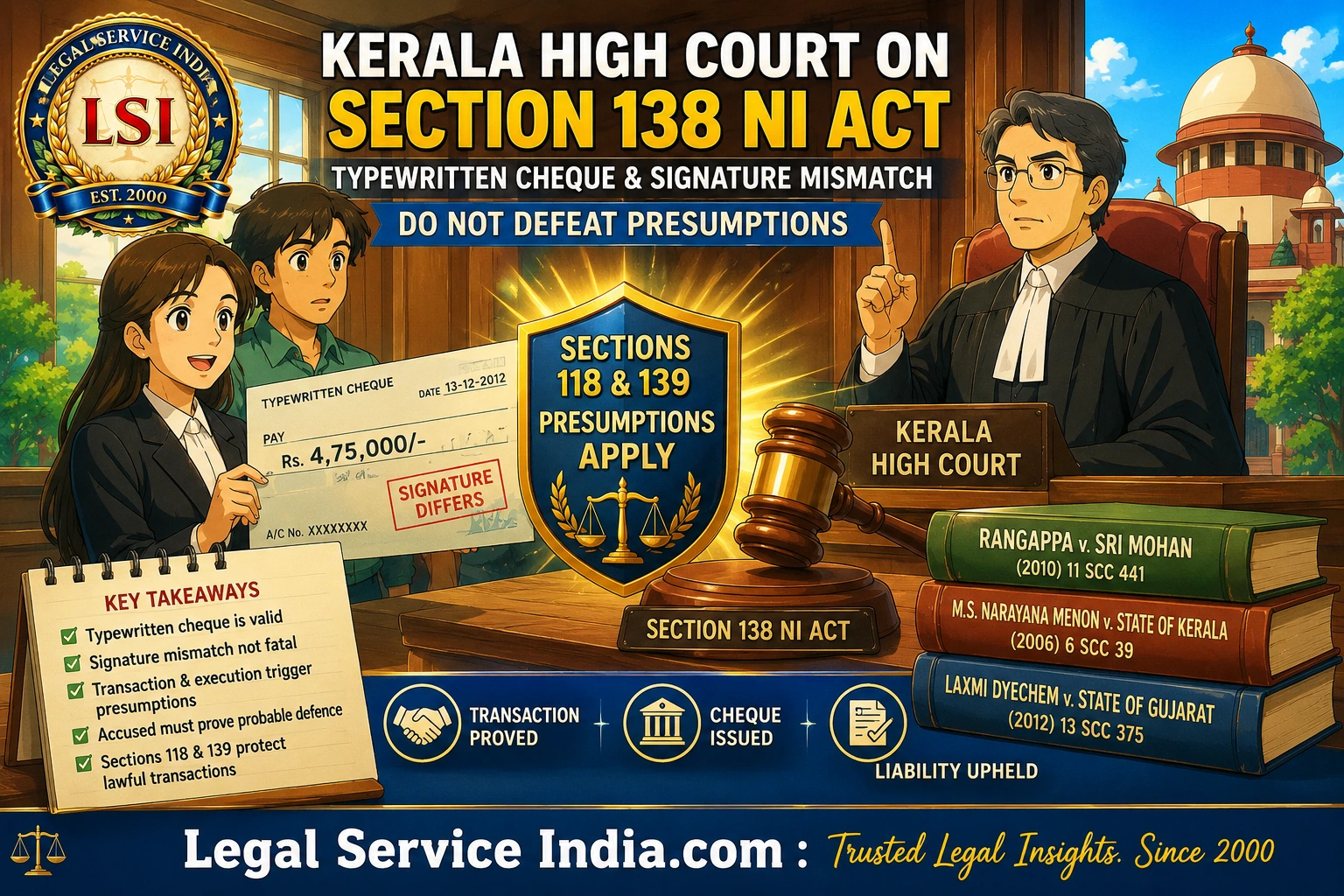
Kerala High Court on Presumptions and Section 138 Liability
An Analysis of Shiny S. Nair v. State of Kerala and Ors.
The Kerala High Court, in Shiny S. Nair v. State of Kerala and Ors. in Criminal Appeal No. 705 of 2015 [2026:KER:52634], decided on 16/07/2026 and reaffirmed that the mere fact a check is typewritten does not, by itself, furnish a legally sustainable ground to doubt its genuineness or to withhold the statutory presumptions under the Negotiable Instruments Act, 1881.
Delivered by Justice A. Badharudeen in a criminal appeal against acquittal under Section 138, the ruling sits within a well-settled line of Supreme Court authority holding that a dishonor endorsement of “drawer’s signature differs” does not, without more, defeat prosecution once the transaction, execution, and dishonor of the check are otherwise proved.
This article elucidates the Kerala High Court’s reasoning against that Supreme Court framework and sets out the practical implications for check-dishonor litigation.
Case Snapshot
The appeal arose from C.C. No. 38 of 2014, in which the trial magistrate had acquitted the accused notwithstanding evidence that a check for Rs. 475,000 had been issued towards repayment of a loan transaction between relatives.
The High Court found that the trial court had taken an unduly suspicious view of the complainant’s case merely because a second loan was advanced while an earlier liability remained outstanding and accordingly reversed the acquittal and convicted the accused under Section 138.
| Particular | Details |
|---|---|
| Case | Shiny S. Nair v. State of Kerala and Ors. |
| Case Number | Criminal Appeal No. 705 of 2015 |
| Citation | 2026:KER:52634 |
| Date of Decision | 16 July 2026 |
| Judge | Justice A. Badharudeen |
| Subject | Section 138, Negotiable Instruments Act, 1881 |
Core Facts
The complainant’s case was that she advanced Rs. 175,000 on 14 June 2012 and a further Rs. 300,000 on 12 November 2012, following which the accused issued Ext. P1 cheque dated 13 December 2012.
The check was returned dishonored with the endorsement “Drawer’s signature differs,” and though statutory notice was issued, payment was not made.
PW1’s testimony was corroborated by PW2, PW3, and PW4, and the bank records confirmed insufficiency of funds in the accused’s account on the relevant date.
The accused had also admitted borrowing Rs. 200,000 in 2010 and claimed to have paid interest on it—an admission the High Court treated as strengthening, rather than undermining, the complainant’s version of a continuing financial relationship between the parties.
Legal Reasoning
Once the complainant established the transaction and the execution of the check, the twin presumptions under Sections 118 and 139 of the NI Act operated in her favor.
The Court rejected the trial court’s reasoning that it was inherently improbable for a complainant to advance a further sum while an earlier loan remained unpaid, particularly where the parties were relatives and the gap between the two transactions was only about five months.
The Court further held that a typewritten check is not prohibited by law and that this feature alone could not discredit the complainant’s case.
On the facts, the defense version was found insufficient to rebut the statutory presumptions.
The complainant succeeded in proving that the transaction led to the execution of Ext. P1 check.
The court categorically held that issuance of a typewritten check, though not common, is not prohibited by law.
Fortifying Authority: The Supreme Court Framework
1. The Twin Presumptions — Rangappa v. Sri Mohan
The Kerala High Court’s invocation of Sections 118 and 139 tracks the three-judge bench holding in Rangappa v. Sri Mohan, (2010) 11 SCC 441, where the Supreme Court held that the presumption under Section 139 extends to the existence of a legally enforceable debt or liability and is a rebuttable presumption that the accused must displace on a standard short of proof beyond reasonable doubt.
The court there also clarified that once execution of the check is admitted or proved, the evidentiary burden shifts to the accused to raise a probable defense.
2. Standard of Rebuttal — M.S. Narayana Menon @ Mani v. State of Kerala
The complementary authority on the accused’s burden is M.S. Narayana Menon @ Mani v. State of Kerala, (2006) 6 SCC 39, where the Supreme Court held that the standard of proof required of an accused seeking to rebut the Section 139 presumption is preponderance of probabilities, not proof beyond reasonable doubt, and that the accused may discharge this burden even through material elicited from the complainant’s own evidence.
The Kerala High Court’s finding that the defense version was insufficient to create a credible doubt is consistent with this framework: the accused, Shiny S. Nair, neither cross-examined effectively nor placed on record any material capable of displacing the presumption.
3. Signature-Mismatch Endorsements Do Not Defeat Section 138 — Laxmi Dyechem v. State of Gujarat
The most directly fortifying authority for the Kerala High Court’s treatment of the “drawer’s signature differs” endorsement is Laxmi Dyechem v. State of Gujarat and Ors., (2012) 13 SCC 375.
There, a two-judge bench (T.S. Thakur and Gyan Sudha Misra, JJ.) held that the phrase “amount of money is insufficient” in Section 138 is a genus of which reasons such as “account closed,” “payment stopped,” or “signature mismatch” are species and that a dishonor on account of signature discrepancy attracts the penal provision provided the other statutory ingredients are satisfied.
The Court reasoned that there is no qualitative difference between a drawer closing an account and a drawer altering his specimen signature to defeat encashment—in both cases the check returns unpaid by the drawer’s own act or omission.
This squarely supports the Kerala High Court’s holding that the endorsement on Ext. P1 did not, by itself, take the case outside Section 138.
It is pertinent that in Laxmi Dyechem v. State of Gujarat (supra), the Honorable Supreme Court categorically held that there is no qualitative difference between a situation where the dishonor takes place on account of the substitution of a new specimen signature and a situation where the drawer closes the account or stops payment.
Combined Legal Position
Read together, Rangappa, Narayana Menon, and Laxmi Dyechem supply the doctrinal scaffolding for the Kerala High Court’s three propositions:
- Proof of the transaction and execution of the check is sufficient to trigger the statutory presumptions.
- A probable defense, not a mere denial, is required to rebut those presumptions.
- The particular wording of a bank’s dishonor memo—whether “signature differs,” “account closed,” or “funds insufficient”—does not control the applicability of Section 138 so long as the substantive ingredients of the offense are made out.
Citations
| Case | Citation | Legal Principle |
|---|---|---|
| Shiny S. Nair v. State of Kerala and Ors. | 2026 LiveLaw (Ker) 384 (Ker HC, 20.07.2026, Badharudeen, J.) | A typewritten check and signature-mismatch endorsement do not defeat Section 138 where other ingredients are proved. |
| Rangappa v. Sri Mohan | (2010) 11 SCC 441; AIR 2010 SC 1898 | Section 139 presumption extends to the existence of a legally enforceable debt; it is rebuttable, not beyond reasonable doubt. |
| M.S. Narayana Menon @ Mani v. State of Kerala | (2006) 6 SCC 39; AIR 2006 SC 3366 | The standard for rebutting the Section 139 presumption is a preponderance of probabilities. |
| Laxmi Dyechem v. State of Gujarat and Ors. | (2012) 13 SCC 375 | Dishonor for signature mismatch attracts Section 138 liability. |
Practitioner’s Checklist
- Do not treat a “signature differs” or similarly worded dishonor memo as fatal to a Section 138 complaint at the drafting stage—plead the transaction and execution of the check affirmatively and rely on Laxmi Dyechem, (2012) 13 SCC 375.
- Lead evidence of the underlying transaction (dates, amounts, mode of advance, any partial repayment, or interest admissions) to trigger the Sections 118/139 presumptions under Rangappa, (2010) 11 SCC 441.
- Anticipate a defense built on relational proximity or a prior unpaid loan—courts have declined to treat successive loans between relatives as inherently improbable.
- Where the defense disputes signature genuineness, be prepared to meet a bare denial with the Narayana Menon standard: the accused must raise a probable defense, not merely assert doubt.
- On appeal against acquittal, marshal the trial court’s specific findings that ignored or misapplied the statutory presumptions—this is the ground on which the Kerala High Court intervened in Shiny S. Nair.
- A typewritten check, without independent evidence of tampering or forgery, does not by itself impair the presumption of genuineness.
Key Legal Principles at a Glance
| Issue | Position of Law |
|---|---|
| Typewritten check | Not prohibited by law. |
| Signature differs endorsement | Does not automatically defeat a Section 138 complaint. |
| Sections 118 & 139 | Statutory presumptions arise once execution is proved. |
| Burden on accused | Must raise a probable defense on a preponderance of probabilities. |
| Relationship between parties | Successive loans between relatives are not inherently improbable. |
Conclusion
Shiny S. Nair v. State of Kerala is a useful addition to the appellate jurisprudence confirming that trial courts must apply, rather than speculate around, the statutory presumptions under Sections 118 and 139 of the NI Act.
Read with Rangappa, Narayana Menon, and Laxmi Dyechem, the judgment confirms that once the transaction and execution of a check are proved, neither the typewritten form of the instrument nor the specific wording of the bank’s dishonor endorsement will, without more, defeat a complaint under Section 138.
Important Links
Important Links:
- Lawyers in India
- Copyright Registration in India
- Caveat Filing in Supreme Court of India
- Mutual Consent Divorce in Delhi/ NCR: WhatsApp 9650499965
Quick Reference Table
| Legal Service | Link |
|---|---|
| Lawyers in India | View Directory |
| Copyright Registration in India | Learn More |
| Caveat Filing in Supreme Court of India | Read More |
| Mutual Consent Divorce in Delhi/NCR | Get Details — WhatsApp: 9650499965 |

