Introduction
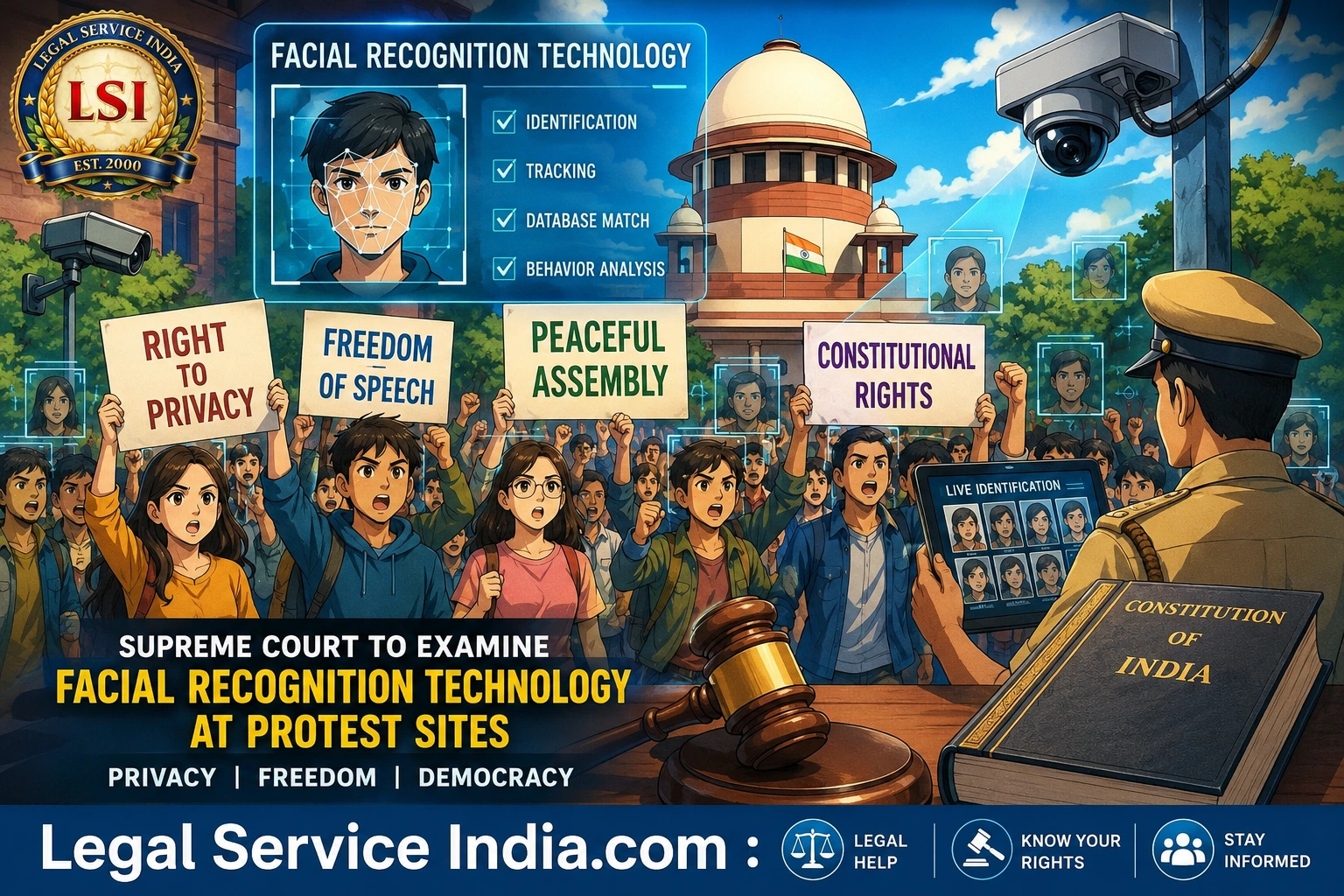
The constitutional debate surrounding facial recognition technology at protest sites has now reached the Supreme Court of India in what could become one of the most significant public law cases of the digital era. A Member of Parliament has invoked the Court’s jurisdiction under Article 32 of the Constitution, challenging the alleged use of facial recognition systems (FRS), biometric identification, and AI-enabled surveillance by police authorities during public protests and demonstrations.
The petition goes far beyond questioning a policing technique. It compels the Supreme Court to determine whether the State can collect, analyse, retain, and potentially share the biometric identities of citizens merely because they choose to exercise their constitutional right to dissent. At its heart lies a conflict between national security and constitutional liberty, between technological capability and legal accountability, and between executive convenience and fundamental rights.
The case raises profound issues relating to the Right to Privacy under Article 21, Freedom of Speech and Expression under Article 19(1)(a), Freedom of Peaceful Assembly under Article 19(1)(b), and the constitutional guarantee against arbitrary State action under Article 14. Equally important, it exposes a legislative vacuum: India presently lacks a dedicated law comprehensively regulating police deployment of facial recognition technology.
If the Supreme Court lays down detailed constitutional principles governing AI-based surveillance, the judgment may become the digital-era equivalent of Justice K.S. Puttaswamy (Retd.) v. Union of India, (2017) 10 SCC 1, which recognised privacy as a fundamental right. It may also shape future regulation of artificial intelligence, predictive policing, biometric databases, and algorithmic governance in India.
Case Background
The petition challenges the reported deployment of facial recognition technology at protest sites by police authorities to identify participants attending demonstrations, political rallies, student movements, farmers’ protests, and other public gatherings.
Unlike ordinary CCTV systems that merely record events, facial recognition technology converts a person’s facial characteristics into a unique biometric template capable of being matched against extensive databases. The concern is not only that individuals are identified but also that their participation in constitutionally protected activities may be digitally catalogued, analysed, and retained for future use.
The petitioner contends that such surveillance lacks statutory backing, independent oversight, procedural safeguards, and transparency, thereby violating fundamental constitutional rights.
Key Allegations in the Petition
- Use of facial recognition technology at protest sites.
- Biometric identification of protest participants.
- AI-enabled surveillance during public demonstrations.
- Absence of statutory authority governing deployment.
- Lack of procedural safeguards and independent oversight.
- Potential violation of fundamental constitutional rights.
What is facial recognition technology?
Facial Recognition Technology (FRT) is an artificial intelligence-based biometric identification system that analyses facial features and converts them into mathematical templates capable of uniquely identifying individuals.
How Facial Recognition Technology Works
The technology generally follows five stages:
- Image capture through cameras or drones.
- Detection of human faces.
- Extraction of biometric facial markers.
- Generation of digital facial templates.
- Matching against government or law enforcement databases.
Capabilities of Modern FRT Systems
Modern systems can perform:
- Real-time identification.
- Crowd scanning.
- Automated watchlist matching.
- Movement tracking.
- Cross-location surveillance.
- Behavioural profiling.
- Integration with criminal databases.
The constitutional concern arises because biometric identifiers differ fundamentally from ordinary personal information. A face cannot simply be changed like a password once compromised.
Why Facial Recognition Technology at Protest Sites Raises Constitutional Concerns
Peaceful protest is one of the most visible manifestations of democracy.
The Constitution protects not only the right to vote but also the right to publicly criticise government policies, organise demonstrations, and participate in peaceful assemblies.
If every protest participant is automatically identified through AI-driven facial recognition, individuals may reasonably fear:
- Future police scrutiny.
- Political profiling.
- Employment consequences.
- Travel restrictions.
- Social repercussions.
- Permanent government records of lawful political participation.
Such apprehensions may discourage citizens from exercising constitutionally guaranteed freedoms. Constitutional law describes this phenomenon as the “chilling effect”.
Constitutional Framework
Article 21: Right to Privacy
The foundation of the petition is the landmark nine-judge bench decision in:
Justice K.S. Puttaswamy (Retd.) v. Union of India
(2017) 10 SCC 1
The Court unanimously held that privacy is intrinsic to:
- Life.
- Dignity.
- Liberty.
- Autonomy.
- Informational self-determination.
The judgement recognised informational privacy as deserving the highest constitutional protection because technological advances permit unprecedented collection and processing of personal data.
Facial recognition directly concerns informational privacy because biometric identifiers are permanent and uniquely linked to an individual.
The Four-Part Proportionality Test
Puttaswamy established that any restriction upon privacy must satisfy four constitutional requirements.
| Requirement | Constitutional Standard | Issue Raised in the Present Case |
|---|---|---|
| Legality | The interference must have a valid legal basis. | Whether executive instructions or police manuals can authorise biometric surveillance without comprehensive legislation enacted by Parliament. |
| Legitimate Aim | The State must pursue a constitutionally legitimate objective. | Whether surveillance of every protest participant is genuinely necessary for maintaining law and order, preventing crime, and ensuring public safety. |
| Necessity | Less intrusive alternatives must be unavailable. | Whether conventional policing, video recording, intelligence gathering, or targeted investigation can adequately serve public safety without collecting biometric identities of all attendees. |
| Proportionality | The invasion of privacy must be proportionate to the objective pursued. | Whether mass identification of peaceful demonstrators is constitutionally justified when only a small number may be suspected of unlawful activity. |
1. Legality
The interference must have a valid legal basis.
A significant issue before the Supreme Court is whether executive instructions or police manuals can authorise biometric surveillance in the absence of comprehensive legislation enacted by Parliament.
2. Legitimate Aim
The State must pursue a constitutionally legitimate objective.
Maintenance of law and order, crime prevention, and public safety undoubtedly qualify as legitimate governmental purposes.
The constitutional question is whether surveillance of every protest participant is genuinely necessary for achieving these objectives.
3. Necessity
The State must establish that less intrusive alternatives are unavailable.
Could conventional policing, video recording, intelligence gathering, or targeted investigation adequately serve public safety without capturing biometric identities of all attendees?
The Court may require convincing evidence that indiscriminate biometric surveillance is indispensable.
4. Proportionality
The invasion of privacy must be proportionate to the objective pursued.
Mass identification of thousands of peaceful demonstrators may be constitutionally disproportionate if only a handful are suspected of unlawful activity.
Article 19: Freedom of Speech and Peaceful Assembly
The petition also invokes:
- Article 19(1)(a)
- Article 19(1) (b)
Peaceful demonstrations occupy a privileged position in democratic societies because they enable citizens to directly communicate grievances to the government.
The Supreme Court has repeatedly held that constitutional freedoms cannot be rendered illusory through indirect governmental action.
If surveillance discourages participation in protests, the interference may extend beyond privacy and directly burden freedom of expression.
The Chilling Effect Doctrine
One of the strongest constitutional arguments likely to emerge concerns the chilling effect.
A democracy depends not only upon formal legal rights but also upon citizens feeling sufficiently secure to exercise those rights.
If individuals believe their biometric identities will be permanently stored whenever they attend a peaceful protest, many may choose silence over participation.
The Supreme Court has recognised in several free speech decisions that governmental actions capable of discouraging lawful expression deserve careful constitutional scrutiny.
Article 14 and Arbitrary Exercise of Power
The petition also raises concerns under Article 14.
Without statutory standards governing facial recognition deployment:
- Which protests are monitored?
- Who authorises surveillance?
- Which database is searched?
- How long is data retained?
- Who reviews misuse?
Unstructured executive discretion increases the risk of arbitrary and discriminatory application, something Article 14 seeks to prevent.
| Constitutional Concern | Issue Raised |
|---|---|
| Selection of Protests | Which protests are monitored? |
| Authorisation | Who authorises surveillance? |
| Database Access | Which database is searched? |
| Data Retention | How long is data retained? |
| Oversight | Who reviews misuse? |
The Missing Legal Framework
One of the most significant aspects of this litigation is what is absent rather than what exists.
India currently has no dedicated parliamentary legislation specifically regulating:
- Police facial recognition systems
- Biometric watchlists
- Real-time facial identification
- Retention limits
- Independent audit mechanisms
- Deletion procedures
- Notice requirements
- Judicial authorisation
| Areas Without Specific Parliamentary Regulation |
|---|
| Police facial recognition systems |
| Biometric watchlists |
| Real-time facial identification |
| Retention limits |
| Independent audit mechanisms |
| Deletion procedures |
| Notice requirements |
| Judicial authorisation |
The petition therefore asks whether executive agencies can employ one of the most intrusive surveillance technologies without clear legislative sanction.
Interaction with the Digital Personal Data Protection Act, 2023
Although the Digital Personal Data Protection Act, 2023 (DPDP Act), establishes a framework for processing digital personal data, its application to law enforcement surveillance is limited because processing undertaken for certain sovereign functions and statutory exemptions may fall outside the ordinary consent-based regime.
Consequently, the existence of the DPDP Act does not by itself answer the constitutional questions surrounding biometric surveillance by police authorities.
The Supreme Court may therefore have to determine whether constitutional safeguards operate independently of statutory data protection provisions.
Artificial Intelligence and Constitutional Governance
This litigation is not confined to facial recognition alone.
It represents India’s first major constitutional examination of AI-assisted policing.
Modern AI systems can:
- Identify individuals
- Detect behavioural patterns
- Predict movement
- Correlate multiple databases
- Generate risk profiles
- Automate investigative processes
These capabilities create constitutional risks unknown when earlier surveillance laws were enacted.
The Court’s observations may therefore influence future regulation of:
- Predictive policing
- Automated decision-making
- Algorithmic profiling
- AI-enabled public surveillance
| AI Capability | Potential Constitutional Impact |
|---|---|
| Identify individuals. | Privacy and personal liberty |
| Detect behavioural patterns | Profiling concerns |
| Predict movement. | Mass surveillance implications |
| Correlate multiple databases. | Data aggregation risks |
| Generate risk profiles. | Potential discrimination |
| Automate investigative processes. | Due process concerns |
Accuracy, Bias and Algorithmic Fairness
An aspect deserving greater constitutional attention is algorithmic error.
Globally, independent studies have shown that facial recognition systems may produce:
- False positives
- False negatives
- Demographic bias
- Reduced accuracy across varying lighting conditions
- Lower performance for certain age groups or skin tones
| Potential Algorithmic Errors | Possible Constitutional Concern |
|---|---|
| False positives | Wrongful police scrutiny |
| False negatives | Investigative reliability |
| Demographic bias | Equality under Article 14 |
| Reduced accuracy in varying lighting | Reliability of evidence |
| Lower performance for certain age groups or skin tones | Potential discriminatory outcomes |
A mistaken match can expose an innocent citizen to police scrutiny, questioning, or even criminal investigation.
From a constitutional perspective, such errors implicate Articles 14 and 21, particularly where there is no mechanism to challenge automated identification.
The Supreme Court may therefore examine whether decisions affecting liberty can safely rely upon opaque AI systems without independent verification.
Comparative International Jurisprudence
Courts and regulators worldwide have grappled with similar questions.
Several jurisdictions have either suspended or tightly regulated live facial recognition due to concerns over privacy, proportionality, and mass surveillance.
International human rights bodies have consistently emphasised that biometric surveillance must satisfy strict standards of:
- Legality
- Necessity
- Proportionality
- Transparency
- Accountability
- Effective remedies
| International Principles for Biometric Surveillance |
|---|
| Legality |
| Necessity |
| Proportionality |
| Transparency |
| Accountability |
| Effective remedies |
While comparative jurisprudence is not binding, the Supreme Court has frequently relied upon international constitutional principles in developing Indian fundamental rights jurisprudence.
Important Supreme Court Precedents
The following landmark Supreme Court decisions provide the constitutional framework relevant to the present challenge involving Facial Recognition Technology (FRT), biometric surveillance, privacy, and the right to protest.
| Case | Citation | Key Principle |
|---|---|---|
| Justice K.S. Puttaswamy (Retd.) v. Union of India | (2017) 10 SCC 1 | Recognised privacy as a fundamental right and formulated the proportionality doctrine. |
| People’s Union for Civil Liberties (PUCL) v. Union of India | (1997) 1 SCC 301 | Held that surveillance affecting privacy requires legal safeguards against arbitrary exercise of power. |
| Anuradha Bhasin v. Union of India | (2020) 3 SCC 637 | Reaffirmed that restrictions upon fundamental rights must satisfy necessity and proportionality. |
| Mazdoor Kisan Shakti Sangathan v. Union of India | (2018) 17 SCC 324 | Recognised the constitutional importance of public protest while balancing competing public interests. |
Issues the Supreme Court May Decide
The Court’s eventual judgement may answer several questions of lasting constitutional significance.
- Can facial recognition technology be deployed at peaceful protests without specific legislation?
- Does biometric identification constitute an invasion of informational privacy?
- Does AI-enabled surveillance discourage lawful democratic participation?
- Should judicial or independent authorisation precede deployment of facial recognition?
- What safeguards are constitutionally mandatory regarding storage, sharing, retention, and deletion of biometric data?
- Can executive instructions alone authorise such intrusive surveillance?
Possible Constitutional Safeguards
The Court may consider directing that any future use of facial recognition technology at protest sites be subject to safeguards such as:
- Clear statutory authorisation.
- Narrowly defined purposes.
- Prior approval by a competent authority.
- Independent oversight.
- Periodic audits.
- Strict retention limits.
- Transparency reports.
- Data minimisation.
- Rights of review and correction.
- Accountability for misuse.
Such principles would align Indian constitutional law with globally recognised standards governing intrusive surveillance technologies.
Why This Case Could Become a Landmark Judgement
Several factors distinguish this litigation.
- It is India’s first major constitutional challenge specifically targeting police use of AI-powered facial recognition during protests.
- It directly tests the application of the Puttaswamy proportionality framework to emerging technologies.
- It may define constitutional limits on biometric surveillance.
- It could establish judicial standards for responsible AI governance.
- It may influence future legislation regulating artificial intelligence, digital policing, and biometric databases.
Like Justice K.S. Puttaswamy (Retd.) v. Union of India, the judgement may extend beyond the immediate dispute and become a foundational precedent for India’s digital constitutional jurisprudence.
Key Reasons the Case Is Significant
| Aspect | Potential Constitutional Impact |
|---|---|
| Privacy Rights | May clarify constitutional limits on biometric surveillance. |
| Artificial Intelligence | Could establish judicial standards for AI governance. |
| Police Powers | May define permissible use of facial recognition technology during protests. |
| Future Legislation | Likely to influence laws governing AI, digital policing, and biometric databases. |
Conclusion
The challenge to facial recognition technology at protest sites presents the Supreme Court with an opportunity to reconcile technological innovation with constitutional freedoms. As artificial intelligence becomes deeply embedded in policing, governance, and public administration, the Constitution must remain the primary safeguard against excessive state power.
This case is not about resisting technology. It is about ensuring that technology operates within the limits of constitutional democracy. The State undoubtedly has a legitimate duty to maintain public order and prevent violence. Equally, citizens possess an inviolable right to privacy, dignity, free expression, and peaceful assembly. The constitutional task before the Supreme Court is to balance these competing interests through principles of legality, necessity, proportionality, and accountability.
Whatever the final verdict, the decision is likely to become a defining precedent for facial recognition technology at protest sites, AI-enabled policing, and digital surveillance in India. Much as Justice K.S. Puttaswamy (Retd.) v. Union of India, (2017) 10 SCC 1, reshaped privacy jurisprudence, this case has the potential to establish the constitutional architecture governing artificial intelligence and biometric surveillance for decades to come. For lawyers, policymakers, civil liberties advocates, and law enforcement agencies alike, the judgement will be one of the most closely watched constitutional decisions of the coming years.
Need Expert Legal Assistance from the Supreme Court of India?
Whether you are planning to file a Special Leave Petition (SLP), Writ Petition, Civil Appeal, Criminal Appeal, Transfer Petition, Review Petition, Curative Petition, or require expert legal advice on any matter before the Supreme Court of India, experienced legal guidance can make all the difference.
Adv. Tarun Choudhury
Supreme Court Advocate | 25+ Years of Legal Experience
📞 Call: 9891244487
💬 WhatsApp: 9891244487
Get trusted legal advice, strategic case evaluation, expert drafting, and dedicated representation before the Supreme Court of India and other courts.
Contact today for a confidential consultation and protect your legal rights with experienced Supreme Court representation.