





I. Introduction
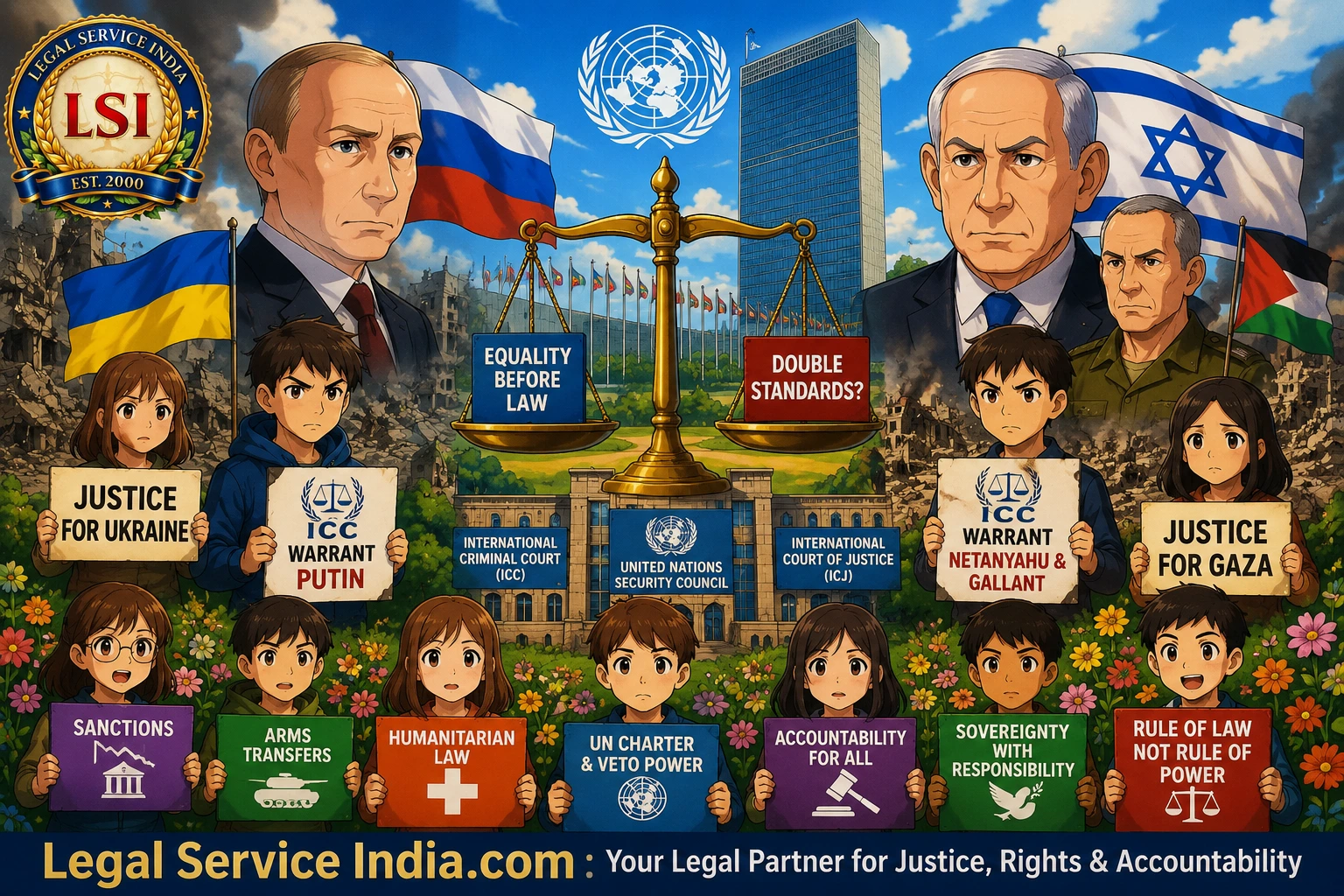
International law presents itself as a universal architecture — a body of rules that binds states irrespective of power, alliance, or geography. Two conflicts of the current decade, Russia’s invasion of Ukraine and Israel’s military campaign in the Gaza Strip, offer a rare natural experiment to test that claim.
Both conflicts have produced credible findings of mass civilian death, forced displacement, and violations of international humanitarian law. Both have drawn the attention of the International Court of Justice (ICJ), the International Criminal Court (ICC), and United Nations human rights bodies.
Yet the diplomatic, legal, and economic responses of Western states to these two conflicts diverge sharply. This divergence is not a matter of differing facts; it is a matter of differing interests.
This article examines that divergence across four axes:
- International criminal accountability
- The United Nations Security Council
- Sanctions and arms transfers
- Institutional rhetoric
It argues that the pattern reveals less about the content of international law than about who is permitted to invoke it.
II. International Criminal Accountability: Two Warrants, Two Receptions
ICC Arrest Warrant Against Vladimir Putin
In March 2023, the ICC issued an arrest warrant against Russian President Vladimir Putin for the unlawful deportation of Ukrainian children, the first warrant issued by the Court against the head of state of a permanent member of the Security Council.
Western capitals responded with near-unanimous approval. The United States, though not a party to the Rome Statute, praised the warrant, and the United Kingdom’s then Labour leader described it as a message that there would be no hiding place for Mr. Putin and his associates.
ICC Arrest Warrants Against Benjamin Netanyahu and Yoav Gallant
In November 2024, the same court issued arrest warrants against Israeli Prime Minister Benjamin Netanyahu and former defense minister Yoav Gallant for alleged war crimes and crimes against humanity in Gaza, including the intentional deprivation of civilians of food, water, medicine, and fuel.
The reception could not have been more different. The United States rejected the warrants outright and later moved to sanction ICC officials involved in the decision. France, having criticized Mongolia only months earlier for failing to arrest Mr. Putin, indicated that Mr. Netanyahu might enjoy immunity as the leader of a non-party state—an argument it had explicitly rejected in Russia’s case. Germany suggested that the “rule of law” credentials of a democratic ally warranted a different posture altogether.
Comparative International Response
| Issue | Russia (Putin) | Israel (Netanyahu & Gallant) |
|---|---|---|
| ICC Arrest Warrants | Welcomed by most Western governments | Rejected or questioned by several Western governments |
| United States Position | Praised the warrant despite not being an ICC member | Rejected the warrants and sanctioned ICC officials |
| France’s Position | Criticised Mongolia for failing to arrest Mr Putin | Suggested possible immunity for Mr Netanyahu |
| Germany’s Position | Supported accountability | Suggested a different approach due to Israel’s democratic credentials |
The “Democratic Exception” Theory
Legal scholars have described this as the emergence of an unwritten “democratic exception” to ICC jurisdiction: a state’s classification as a liberal democracy, or as a strategically important partner, appears to function as an informal shield against accountability that the Rome Statute nowhere provides for.
The doctrinal position—that Rome Statute obligations bind states parties irrespective of the alleged perpetrator’s regime type—has not changed.
What has changed is the willingness of Western governments to honor it when the accused is their own ally.
III. The Security Council: Whose Vetoes Count
Ukraine: Structural Limitation
The UN Security Council’s structural design already privileges the five permanent members, but the pattern of veto use in these two conflicts illustrates a further layer of selectivity.
When Russia invaded Ukraine, Western states rallied the General Assembly to adopt resolutions such as ES-11/1 and ES-11/6 condemning the aggression and demanding withdrawal since Russia’s own veto foreclosed Security Council action—a structural limitation, not a policy choice, given that the aggressor itself sat on the Council.
Gaza: Repeated Use of the Veto
Gaza presents a different picture: the obstruction has come not from the party to the conflict but from its principal external patron.
The United States vetoed Security Council resolutions demanding a ceasefire in Gaza at least seven times between October 2023 and September 2025, including a resolution considered at the Council’s symbolically significant 10,000th meeting, held against the backdrop of a UN-confirmed famine.
Fourteen of the Council’s fifteen members supported that resolution.
Comparison of Security Council Dynamics
| Aspect | Ukraine | Gaza |
|---|---|---|
| Primary Obstruction | Russia’s own veto | United States veto |
| Nature of Obstruction | Structural limitation | Discretionary policy choice |
| General Assembly Action | Resolutions ES-11/1 and ES-11/6 adopted | Repeated ceasefire efforts blocked in the Security Council |
| International Humanitarian Context | Condemnation of aggression | UN-confirmed famine and ceasefire resolutions |
Key Observation
In Ukraine’s case, the obstruction was intrinsic to the structure of the Council; in Gaza’s case, it was a discretionary choice repeatedly exercised by a state professing support for international humanitarian law.
IV. Sanctions and Arms: Following the Money and the Materiel
Perhaps the starkest divergence lies in economic and military policy. Within weeks of the 2022 invasion, the United States and European Union froze Russian central bank assets, banned major Russian banks from SWIFT, and imposed sweeping restrictions on Russian energy exports. The scale and speed of this response were unprecedented for peacetime sanctions.
Against Israel, comparable measures never materialized at the state level. A handful of countries—the Netherlands, Spain, Canada, Belgium, Italy, and Japan among them—suspended specific arms contracts or components following the ICJ’s January 2024 finding that genocide against Palestinians in Gaza was ‘plausible.’ But the United States, Israel’s principal arms supplier, continued large-scale transfers, including a package worth roughly USD 20 billion approved in August 2024, even as the humanitarian toll mounted. No comprehensive sanctions regime, asset freeze, or banking restriction was imposed on Israel by any major Western government.
The result is a genuine asymmetry: the state found by the ICJ’s interim measures to plausibly be committing genocide faced markedly lighter economic consequences than the state facing allegations of aggression and war crimes in Ukraine.
Comparison of Economic and Military Response
| Issue | Russia (Ukraine Conflict) | Israel (Gaza Conflict) |
|---|---|---|
| Financial Sanctions | Russian central bank assets frozen; major banks removed from SWIFT. | No comparable sanctions imposed by major Western governments. |
| Energy Restrictions | Sweeping restrictions on Russian energy exports. | No equivalent restrictions. |
| Arms Transfers | Military and economic restrictions imposed. | Limited suspensions by a few countries; continued large-scale U.S. arms transfers, including an approximately USD 20 billion package approved in August 2024. |
| Overall Economic Impact | Comprehensive sanctions regime. | No comprehensive sanctions, banking restrictions, or asset freezes. |
Humanitarian Access: Contrasting Approaches
Humanitarian access tells a parallel story. Ukraine’s Black Sea grain corridor was actively protected and later supplemented by EU ‘Solidarity Lanes’ once Russia withdrew from the original arrangement.
Gaza, by contrast, saw aid convoys averaging far below the volumes humanitarian agencies deemed necessary to avert starvation, with deliveries frequently delayed or restricted even after binding ICJ orders addressed the humanitarian situation directly.
- Ukraine’s grain exports received active international protection.
- EU “Solidarity Lanes” supplemented alternative export routes.
- Aid deliveries into Gaza remained significantly below humanitarian requirements.
- Restrictions and delays reportedly continued despite binding ICJ orders.
V. Institutional Rhetoric and the Language of Legitimacy
The language used by Western officials to describe each conflict has diverged as sharply as the material response. Ukraine’s president has been received in Western capitals as a wartime statesman defending the rules-based order; his government’s actions are framed, almost without qualification, as lawful self-defense.
Palestinian and allied advocates argue that Gaza has instead been framed through a lens of moral equivalence or outright denial. Israeli officials have dismissed the findings of the UN Commission of Inquiry chaired by Justice S. Muralidhar, including its September 2025 conclusion that genocidal acts were being committed, as politically motivated. Some Western governments have echoed that characterization rather than engaging with the underlying evidentiary record.
Differences in Political and Diplomatic Framing
| Aspect | Ukraine | Gaza |
|---|---|---|
| Political Narrative | Rules-based order and lawful self-defense. | Moral equivalence or denial, according to Palestinian and allied advocates. |
| International Reception | The president was widely received as a wartime statesman. | UN findings challenged by Israeli officials as politically motivated. |
| Response to International Findings | Broad reliance on international legal narratives. | Disagreement over UN Commission of Inquiry findings and evidentiary conclusions. |
Legal Distinctions and Shared Principles
This is not to suggest that the two conflicts are legally identical—they differ in origin, in the identity of the parties, and in the applicable legal framework (an interstate war of aggression in one case; an occupying power’s conduct in a territory it controls in the other).
But the doctrines said to be at stake—the prohibition on targeting civilians, the prohibition on collective punishment, the customary and treaty law of genocide, and the jurisdiction of the ICC over states parties and situations referred to it—are not, in principle, conflict-specific. Their invocation, however, has been.
Key Legal Principles Discussed
- Prohibition on targeting civilians.
- Prohibition on collective punishment.
- Customary and treaty law relating to genocide.
- Jurisdiction of the ICC over States Parties and referred situations.
- Application of international humanitarian law across different conflicts.
Why the Divergence: Interest, Not Doctrine
The explanation most consistent with the evidence is not a legal one. Ukraine occupies a position in Western strategic thinking as a frontline state against Russian expansion into Europe; its defense is bound up with the security architecture of NATO and the EU. Israel occupies an equally central position as the West’s principal security partner in the Middle East, reinforced by decades of military, intelligence, and economic integration with the United States in particular.
When the accused party is a strategic adversary, Western states invoke international law with vigor, mobilizing courts, sanctions, and diplomatic isolation in tandem. When the accused party is a strategic partner, the same instruments are questioned, delayed, or quietly set aside, often through legal arguments—immunity, self-defense, and institutional bias—that would not survive scrutiny if raised on behalf of the adversary in the other conflict.
Comparing Western Responses to Similar Legal Issues
| Situation | Observed Response |
|---|---|
| Strategic Adversary | International law is invoked vigorously through courts, sanctions, and diplomatic isolation. |
| Strategic Partner | Legal mechanisms are questioned, delayed, or limited through arguments such as immunity, self-defense, and institutional bias. |
This pattern is not new to international law, nor unique to these two conflicts; the post-1945 international order has long been criticized for treating powerful states and their allies differently from weaker ones.
What Gaza and Ukraine offer, unusually, is a controlled comparison—two conflicts, overlapping in time, each producing findings from the same institutions (the ICJ, the ICC, and UN human rights mechanisms), tested against materially similar legal standards, and met with materially different responses by the same group of Western governments.
VII. Conclusion
None of this argues that Russia’s conduct in Ukraine should be judged less harshly or that accountability mechanisms invoked against Moscow were wrongly deployed.
The claim is narrower and, for that reason, more troubling: that the same mechanisms, invoked with comparable evidentiary support against a Western ally, have been resisted, delayed, or denied.
A rules-based international order that applies its rules selectively is not, in any meaningful sense, rules-based—it is power dressed in legal language.
If international law is to retain legitimacy, particularly in the eyes of the Global South, where this asymmetry is most keenly observed, its principal custodians must be prepared to apply it against their own allies with the same rigor they demand of their adversaries.
Until then, the gap between the doctrine and its application will remain the central, unresolved question of contemporary international law.
Key Conclusions at a Glance
- The divergence in responses is presented as being driven primarily by strategic interests rather than legal doctrine.
- Ukraine and Gaza provide a rare comparative framework involving the same international legal institutions.
- Comparable legal standards have allegedly produced materially different political and diplomatic responses.
- The credibility of a rules-based international order depends upon the consistent application of international law.
- The perceived asymmetry is particularly significant from the perspective of the Global South.
Select Sources
- International Criminal Court, Arrest Warrant Applications and Decisions, Situation in Ukraine and Situation in the State of Palestine (2023–2024).
- International Court of Justice, South Africa v. Israel, Order on Provisional Measures (26 January 2024).
- UN Independent International Commission of Inquiry on the Occupied Palestinian Territory, Conference Room Paper A/HRC/60/CRP.3 (September 2025) and subsequent reports (2026).
- UN Security Council meeting records and press releases, S/PV.10000 and related records (2023–2025).
- Stockholm International Peace Research Institute (SIPRI), How Top Arms Exporters Have Responded to the War in Gaza (2024).
- Wikipedia, Arms Embargoes on Israel Since 2023 and International Criminal Court Arrest Warrants for Russian Leaders (accessed July 2026), for chronology cross-referencing only—primary sources above should be cited in the final draft.
Written By: Sahil Najar, Final Year Law Student At Central University Of Kashmir, Ganderbal.
