Introduction
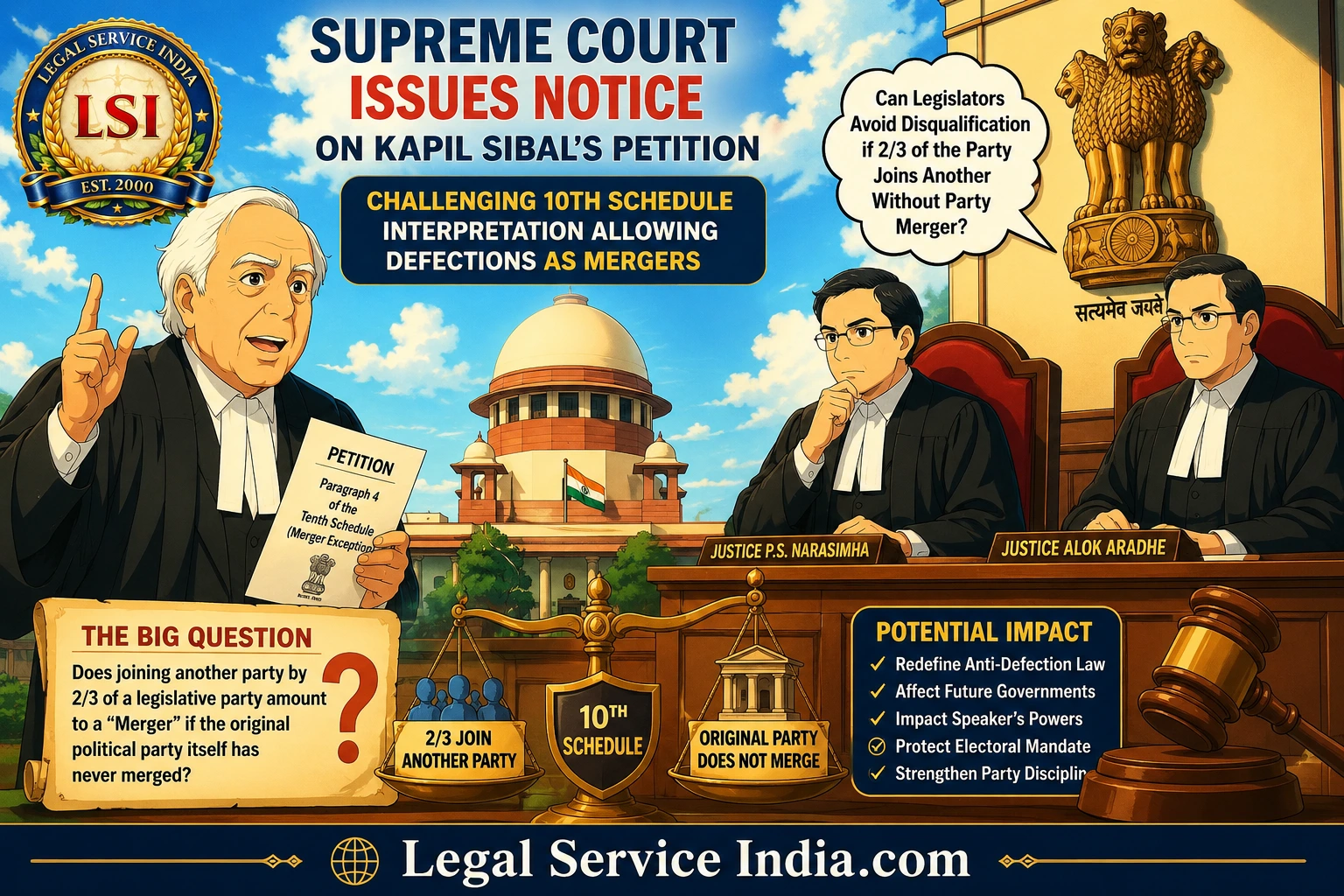
Supreme Court Issues Notice On Kapil Sibal’s Petition Challenging 10th Schedule Interpretation Allowing Defections As mergers, this development could become one of the most significant constitutional milestones in India’s anti-defection jurisprudence since the Supreme Court upheld the validity of the Tenth Schedule in Kihoto Hollohan v. Zachillhu (1992 Supp. (2) SCC 651). At the heart of the controversy lies a fundamental question: Can legislators escape disqualification merely because two-thirds of a legislative party decide to join another political formation, even when the original political party itself has never merged?
The petition, filed by Senior Advocate and Rajya Sabha Member Kapil Sibal, invites the Supreme Court to revisit the interpretation of Paragraph 4 of the Tenth Schedule, popularly known as the “merger exception”. According to the petitioner, judicial interpretation over the years has transformed what was intended to be a narrow constitutional safeguard into a mechanism that allegedly legitimises mass defections under the guise of mergers. If accepted, the challenge could substantially reshape the constitutional understanding of party discipline, legislative loyalty, and representative democracy.
A bench comprising Justice P.S. Narasimha and Justice Alok Aradhe has issued notice to the union government, observing during the preliminary hearing that there are “enormous issues” concerning the functioning of the Tenth Schedule while recognizing that the provision itself represents Parliament’s legislative choice. The Court has not expressed any opinion on the merits, but the issuance of notice itself reflects the constitutional significance of the questions raised.
The outcome of this litigation will have implications far beyond the immediate parties. It may determine how future governments are formed, the extent of protection available to elected representatives claiming the benefit of a merger, the scope of the Speaker’s powers under the Tenth Schedule, and ultimately whether the anti-defection law continues to fulfill its original constitutional purpose of preserving the electorate’s mandate.
Key Highlights of the Case
| Aspect | Details |
|---|---|
| Petitioner | Senior Advocate and Rajya Sabha Member Kapil Sibal |
| Issue | Challenge to the interpretation of Paragraph 4 of the Tenth Schedule (Merger Exception) |
| Bench | Justice P.S. Narasimha and Justice Alok Aradhe |
| Primary Constitutional Question | Whether legislators can avoid disqualification solely because two-thirds of a legislative party joins another political formation without the original political party merging. |
| Potential Impact | May redefine the constitutional interpretation of anti-defection law, mergers, party discipline, and legislative loyalty. |
Background: Why Was the Anti-Defection Law Introduced?
To appreciate the significance of the present petition, it is necessary to understand why the anti-defection law came into existence.
Before 1985, Indian politics witnessed frequent instances of legislators changing political allegiance after elections. Such defections often resulted in the collapse of elected governments and raised serious concerns regarding political morality. The phenomenon became synonymous with the expression “Aaya Ram, Gaya Ram”, coined after Haryana legislator Gaya Lal reportedly changed political parties multiple times within a single day in 1967. That episode came to symbolise an era of political instability in which governments were vulnerable to shifting legislative loyalties rather than electoral verdicts.
The Constitution originally contained no restrictions preventing members of Parliament or state legislatures from changing political parties after their election. While legislators enjoyed complete freedom to switch political affiliations, repeated defections led to allegations of political opportunism, horse-trading, and the subversion of democratic mandates.
Recognising the need to restore stability, Parliament enacted the Constitution (Fifty-Second Amendment) Act, 1985, introducing the Tenth Schedule into the Constitution. The anti-defection law sought to strike a balance between individual legislative freedom and the collective responsibility owed to the political party on whose ticket a representative was elected.
Principal Objectives of the Tenth Schedule
The principal objectives of the Tenth Schedule were:
- to discourage political defections motivated by personal or political gain;
- to preserve stable governments;
- to protect the mandate given by voters to political parties;
- to strengthen party discipline within legislatures; and
- to reduce political corruption arising from inducements to defect.
Objectives at a Glance
| Objective | Purpose |
|---|---|
| Discourage Defections | Prevent legislators from switching parties for personal or political gain. |
| Ensure Stable Governments | Reduce the likelihood of governments collapsing due to shifting political loyalties. |
| Protect the Electoral Mandate | Respect the choice made by voters in favour of a particular political party. |
| Strengthen Party Discipline | Maintain cohesion and accountability within legislative parties. |
| Reduce Political Corruption | Limit horse-trading and inducements encouraging legislators to defect. |
The legislation reflected Parliament’s view that while dissent within political parties was permissible, changing party allegiance after an election without legitimate constitutional justification undermined representative democracy itself.
Understanding the Tenth Schedule
The Tenth Schedule provides for the disqualification of Members of Parliament and Members of State Legislatures in specified circumstances.
Broadly, a legislator may incur disqualification if:
- The member voluntarily gives up membership of the political party on whose ticket he or she was elected
- the member votes or abstains from voting contrary to the party whip without obtaining prior permission; or
- An independent member joins a political party after being elected.
The authority to decide questions of disqualification ordinarily rests with the Speaker or Chairman of the concerned House, although those decisions remain subject to judicial review.
Since its introduction, the anti-defection law has generated extensive constitutional litigation, particularly regarding the meaning of the expression “voluntarily giving up membership”, the role of the Speaker, judicial review, and the scope of the merger exception contained in Paragraph 4.
Key Features of the Tenth Schedule
| Aspect | Explanation |
|---|---|
| Purpose | Provides for disqualification of legislators in specified circumstances. |
| Grounds for Disqualification | Voluntarily giving up party membership, violating the party whip, or an independent member joining a political party are all examples of actions that can lead to expulsion. |
| Decision-Making Authority | Speaker or Chairman of the concerned House, subject to judicial review. |
| Major Constitutional Issue | Interpretation of Paragraph 4 dealing with the merger exception. |
The Merger Exception Under Paragraph 4
The present litigation revolves around Paragraph 4 of the Tenth Schedule, which creates an exception to disqualification.
Paragraph 4 provides that a legislator shall not incur disqualification where
- the original political party has merged with another political party; and
- At least two-thirds of the members of the legislature party agree to such a merger.
This provision was intended to recognise genuine political reorganisations occurring at the organisational level rather than penalise legislators participating in bona fide mergers of political parties.
The constitutional assumption underlying Paragraph 4 was that political parties may occasionally merge because of ideological convergence, organisational restructuring, or broader political developments. Parliament therefore considered it inappropriate to disqualify legislators merely because they continued with the merged political entity.
However, over time, disputes emerged regarding the interpretation of this provision. The principal controversy concerns whether the merger exception applies only when the original political party itself merges or whether a legislative party may independently claim the protection of Paragraph 4 merely because two-thirds of its members decide to join another political formation.
It is precisely this interpretation that Kapil Sibal now asks the Supreme Court to reconsider.
Conditions for the Merger Exception
| Requirement | Constitutional Condition |
|---|---|
| Original Political Party | The original political party must merge with another political party. |
| Legislature Party | At least two-thirds of the members of the legislature party must agree to the merger. |
What Exactly Has Kapil Sibal Challenged?
A notable feature of the petition is that it does not challenge the constitutional validity of the Tenth Schedule.
Instead, it challenges the judicial interpretation of Paragraph 4.
According to the petition, previous interpretations have effectively allowed legislators to avoid disqualification by engineering mergers confined only to the legislative wing, even where the original political party continues to exist independently.
The petitioner argues that such an interpretation is inconsistent with both the language and purpose of the Constitution.
Principal Contentions of the Petition
- The Constitution speaks of the merger of the original political party, not merely the legislature party;
- The legislative wing cannot act independently of the political organisation for the purpose of claiming constitutional protection
- permitting legislative parties alone to merge defeats the objective of the anti-defection law;
- the present interpretation encourages defections rather than preventing them; and
- Electoral mandates are undermined when governments change because of post-election political realignments rather than fresh elections.
The petition therefore seeks a constitutional interpretation that restores the anti-defection law to what is described as its original legislative purpose.
Summary of the Challenge
| Issue | Petitioner’s Position |
|---|---|
| Challenge | Judicial interpretation of Paragraph 4. |
| Not Challenged | Constitutional validity of the Tenth Schedule. |
| Core Argument | Only the original political party can merge for Paragraph 4 protection to apply. |
| Objective | Restore the anti-defection law to its original legislative purpose. |
Proceedings Before the Supreme Court
The writ petition was listed before a bench comprising Justice P.S. Narasimha and Justice Alok Aradhe.
During the hearing, the bench observed that the functioning of the Tenth Schedule raises “enormous issues” while simultaneously pointing out that the Schedule itself reflects Parliament’s constitutional policy choice. The Court also questioned the maintainability of invoking Article 32 directly for the relief sought.
Senior Advocate Kapil Sibal argued that the challenge was directed not against Parliament’s legislative wisdom but against an interpretation that allegedly frustrates the constitutional object underlying the anti-defection law. He submitted that where judicial interpretation creates consequences inconsistent with constitutional purpose, constitutional courts possess both the authority and the obligation to reconsider the legal position.
After hearing preliminary submissions, the Supreme Court issued notice to the union government and indicated that the matter may be considered alongside connected issues already pending before the Court concerning the operation of the Tenth Schedule.
Importantly, the issuance of notice does not imply that the Supreme Court has accepted the petitioner’s arguments. It merely signifies that the constitutional questions raised deserve consideration after hearing all affected parties.
Key Developments Before the Court
- The matter was heard by Justice P.S. Narasimha and Justice Alok Aradhe.
- The Bench observed that the Tenth Schedule raises “enormous issues”.
- The Court questioned the maintainability of the Article 32 petition.
- A notice was issued to the Union Government.
- The matter may be heard along with connected Tenth Schedule cases.
Why the 91st Constitutional Amendment Makes This Petition Even More Significant
An important constitutional development often overlooked in discussions on the anti-defection law is the Constitution (Ninety-First Amendment) Act, 2003.
Originally, the Tenth Schedule recognised two exceptions:
- Paragraph 3, dealing with “splits” in political parties where one-third of legislators broke away; and
- Paragraph 4, dealing with mergers.
Experience soon demonstrated that the split provision itself had become a convenient device for encouraging defections. Legislators frequently invoked Paragraph 3 to justify political realignments that bore little resemblance to genuine ideological divisions.
Recognising the misuse, Parliament abolished Paragraph 3 altogether through the Ninety-First Amendment. The intention was clear: to make defections significantly more difficult and strengthen political stability.
Only the merger exception under Paragraph 4 survived.
The present petition gains particular constitutional significance because it argues that although Parliament deliberately abolished the split exception in 2003, subsequent judicial interpretation of Paragraph 4 has effectively recreated a similar avenue for avoiding disqualification. If that contention is accepted, the Court may be required to determine whether the existing interpretation is consistent with Parliament’s objective in strengthening the anti-defection framework.
Impact of the 91st Constitutional Amendment
| Before the Amendment | After the Amendment |
|---|---|
| Paragraph 3 recognised splits involving one-third of legislators. | Paragraph 3 was abolished. |
| Paragraph 4 recognised mergers. | Paragraph 4 continues to remain in force. |
| Both split and merger exceptions existed. | Only the merger exception survives. |
| Greater scope for legislators to avoid disqualification. | Parliament intended to strengthen the anti-defection framework. |
Landmark Supreme Court Decisions That Shape the Present Controversy
The constitutional questions raised in the present petition cannot be examined in isolation. Over the past three decades, the Supreme Court has delivered several landmark judgements interpreting different aspects of the Tenth Schedule. Collectively, these decisions have shaped India’s anti-defection jurisprudence and provide the legal backdrop against which Kapil Sibal’s challenge will be decided.
Overview of Key Supreme Court Judgements
| Case | Year | Key Constitutional Principle |
|---|---|---|
| Kihoto Hollohan v. Zachillhu | 1992 | Upheld validity of the Tenth Schedule and allowed judicial review of the Speaker’s decisions. |
| Rajendra Singh Rana v. Swami Prasad Maurya | 2007 | Held that constitutional exceptions must not defeat the purpose of the anti-defection law. |
| Keisham Meghachandra Singh v. Speaker, Manipur Legislative Assembly | 2020 | Directed that disqualification petitions should ordinarily be decided within three months. |
| Subhash Desai v. Principal Secretary, Governor of Maharashtra | 2023 | Clarified the distinction between a political party and its legislative wing. |
1. Kihoto Hollohan v. Zachillhu (1992 Supp. (2) SCC 651)
This remains the foundational judgement on the anti-defection law.
A Constitution Bench upheld the constitutional validity of the Tenth Schedule, rejecting the argument that it violated democratic principles. However, the Court simultaneously held that although the Speaker acts as the adjudicatory authority under the Tenth Schedule, the Speaker’s decisions are subject to judicial review after they are rendered.
The judgement established two important constitutional principles:
- The anti-defection law is constitutionally valid.
- The Speaker’s decisions are not beyond judicial scrutiny.
The court recognised that the anti-defection law sought to balance two competing constitutional values—legislative freedom and political stability.
Constitutional Significance
- Confirmed the constitutional validity of the Tenth Schedule.
- Recognised judicial review over decisions of the Speaker.
- Balanced legislative independence with political stability.
2. Rajendra Singh Rana v. Swami Prasad Maurya (2007) 4 SCC 270
This decision reinforced the principle that the anti-defection law should not be interpreted mechanically.
The Supreme Court emphasised that speakers must carefully determine whether legislators have genuinely attracted constitutional protection before declining disqualification. The judgment reflected the Court’s concern that constitutional exceptions should not become instruments for frustrating the purpose of the Tenth Schedule.
Key Takeaways
- Speakjudgement carefully evaluate claims for constitutional protection.
- Exceptions under the Tenth Schedule cannot undermine its objective.
- The anti-defection law must be interpreted purposively.
3. Keisham Meghachandra Singh v. Speaker, Manipur Legislative Assembly (2020) 2 SCC 677
One of the recurring criticisms of the anti-defection framework has been the delay by speakers in deciding disqualification petitions.
In this landmark judgement, the Supreme Court observed that disqualification proceedings should ordinarily be decided within three months, except in extraordinary circumstances.
The Court also suggested that Parliament may consider establishing an independent tribunal to adjudicate anti-defection disputes instead of leaving such questions exclusively to the Speaker.
Although Parliament has not yet enacted such reforms, the judgement reflects judicial concern regarding delays that often allow political controversies to outlive constitutional adjudication.
Why This Judgement Matters
- Recognised delays in deciding disqualification petitions.
- Recommended disposal within three months in ordinary cases.
- Suggested the creation of an independent adjudicatory tribunal.
4. Subhash Desai v. Principal Secretary, Governor of Maharashtra (2023) 7 SCC 633
The Maharashtra political crisis generated one of the most important constitutional decisions in recent years.
The Supreme Court examined complex questions concerning the following:
- The relationship between the political party and the legislative party.
- The powers of the governor.
- Recognition of party leadership.
- Constitutional morality.
Although the present petition concerns Paragraph 4 rather than the issues directly decided in Subhash Desai, the Maharashtra judgement underscores the constitutional importance of distinguishing between the organisational structure of a political party and its legislative wing.
That distinction now lies at the heart of Kapil Sibal’s challenge.
Constitutional Impact
- Distinguished the political party from the legislative party.
- Examined constitutional morality in political disputes.
- Provided an important backdrop for interpreting Paragraph 4 of the Tenth Schedule.
The Real Constitutional Question Before the Supreme Court
The present litigation is not merely about interpreting one paragraph of the Tenth Schedule.
It raises a deeper constitutional question concerning the nature of representative democracy in India.
The issue may be framed as follows:
Can a legislative party claim the protection of Paragraph 4 merely because two-thirds of its members decide to join another political formation, even if the original political party has never merged?
This question involves the interpretation of:
- Paragraph 4 of the Tenth Schedule.
- Articles 102 and 191 of the Constitution.
- Constitutional morality.
- Representative democracy.
- The objective underlying the anti-defection law.
Core Constitutional Issues
| Constitutional Issue | Question Before the Supreme Court |
|---|---|
| Paragraph 4 of the Tenth Schedule | Whether legislative numbers alone can constitute a valid merger. |
| Articles 102 & 191 | Whether disqualification protection extends without an actual political party merger. |
| Representative Democracy | Whether elected representatives can override the political party’s organisational identity. |
| Constitutional Morality | Whether allowing legislative mergers without party mergers defeats the anti-defection law. |
Constitutional Issue at the Heart of the Case
In essence, the Court must determine whether constitutional protection depends upon the merger of the political party or whether numerical strength within the legislature is, by itself, sufficient.
Landmark Supreme Court Decisions That Shape the Present Controversy
The constitutional questions raised in the present petition cannot be examined in isolation. Over the past three decades, the Supreme Court has delivered several landmark judgements interpreting different aspects of the Tenth Schedule. Collectively, these decisions have shaped India’s anti-defection jurisprudence and provide the legal backdrop against which Kapil Sibal’s challenge will be decided.
Overview of Key Supreme Court Judgements
| Case | Year | Key Constitutional Principle |
|---|---|---|
| Kihoto Hollohan v. Zachillhu | 1992 | Upheld validity of the Tenth Schedule and allowed judicial review of the Speaker’s decisions. |
| Rajendra Singh Rana v. Swami Prasad Maurya | 2007 | Held that constitutional exceptions must not defeat the purpose of the anti-defection law. |
| Keisham Meghachandra Singh v. Speaker, Manipur Legislative Assembly | 2020 | Directed that disqualification petitions should ordinarily be decided within three months. |
| Subhash Desai v. Principal Secretary, Governor of Maharashtra | 2023 | Clarified the distinction between a political party and its legislative wing. |
1. Kihoto Hollohan v. Zachillhu (1992 Supp. (2) SCC 651)
This remains the foundational judgement on the anti-defection law.
A Constitution Bench upheld the constitutional validity of the Tenth Schedule, rejecting the argument that it violated democratic principles. However, the Court simultaneously held that although the Speaker acts as the adjudicatory authority under the Tenth Schedule, the Speaker’s decisions are subject to judicial review after they are rendered.
The judgement established two important constitutional principles:
- The anti-defection law is constitutionally valid.
- The Speaker’s decisions are not beyond judicial scrutiny.
The court recognised that the anti-defection law sought to balance two competing constitutional values—legislative freedom and political stability.
Constitutional Significance
- Confirmed the constitutional validity of the Tenth Schedule.
- Recognised judicial review over decisions of the Speaker.
- Balanced legislative independence with political stability.
2. Rajendra Singh Rana v. Swami Prasad Maurya (2007) 4 SCC 270
This decision reinforced the principle that the anti-defection law should not be interpreted mechanically.
The Supreme Court emphasised that speakers must carefully determine whether legislators have genuinely attracted constitutional protection before declining disqualification. The judgment reflected the Court’s concern that constitutional exceptions should not become instruments for frustrating the purpose of the Tenth Schedule.
Key Takeaways
- Speakjudgement carefully evaluate claims for constitutional protection.
- Exceptions under the Tenth Schedule cannot undermine its objective.
- The anti-defection law must be interpreted purposively.
3. Keisham Meghachandra Singh v. Speaker, Manipur Legislative Assembly (2020) 2 SCC 677
One of the recurring criticisms of the anti-defection framework has been the delay by speakers in deciding disqualification petitions.
In this landmark judgement, the Supreme Court observed that disqualification proceedings should ordinarily be decided within three months, except in extraordinary circumstances.
The Court also suggested that Parliament may consider establishing an independent tribunal to adjudicate anti-defection disputes instead of leaving such questions exclusively to the Speaker.
Although Parliament has not yet enacted such reforms, the judgement reflects judicial concern regarding delays that often allow political controversies to outlive constitutional adjudication.
Why This Judgement Matters
- Recognised delays in deciding disqualification petitions.
- Recommended disposal within three months in ordinary cases.
- Suggested the creation of an independent adjudicatory tribunal.
4. Subhash Desai v. Principal Secretary, Governor of Maharashtra (2023) 7 SCC 633
The Maharashtra political crisis generated one of the most important constitutional decisions in recent years.
The Supreme Court examined complex questions concerning the following:
- The relationship between the political party and the legislative party.
- The powers of the governor.
- Recognition of party leadership.
- Constitutional morality.
Although the present petition concerns Paragraph 4 rather than the issues directly decided in Subhash Desai, the Maharashtra judgement underscores the constitutional importance of distinguishing between the organisational structure of a political party and its legislative wing.
That distinction now lies at the heart of Kapil Sibal’s challenge.
Constitutional Impact
- Distinguished the political party from the legislative party.
- Examined constitutional morality in political disputes.
- Provided an important backdrop for interpreting Paragraph 4 of the Tenth Schedule.
The Real Constitutional Question Before the Supreme Court
The present litigation is not merely about interpreting one paragraph of the Tenth Schedule.
It raises a deeper constitutional question concerning the nature of representative democracy in India.
The issue may be framed as follows:
Can a legislative party claim the protection of Paragraph 4 merely because two-thirds of its members decide to join another political formation, even if the original political party has never merged?
This question involves the interpretation of:
- Paragraph 4 of the Tenth Schedule.
- Articles 102 and 191 of the Constitution.
- Constitutional morality.
- Representative democracy.
- The objective underlying the anti-defection law.
Core Constitutional Issues
| Constitutional Issue | Question Before the Supreme Court |
|---|---|
| Paragraph 4 of the Tenth Schedule | Whether legislative numbers alone can constitute a valid merger. |
| Articles 102 & 191 | Whether disqualification protection extends without an actual political party merger. |
| Representative Democracy | Whether elected representatives can override the political party’s organisational identity. |
| Constitutional Morality | Whether allowing legislative mergers without party mergers defeats the anti-defection law. |
Constitutional Issue at the Heart of the Case
In essence, the Court must determine whether constitutional protection depends upon the merger of the political party or whether numerical strength within the legislature is, by itself, sufficient.
The Competing Constitutional Interpretations
The controversy may be understood more clearly through the following comparison.
| Petitioner’s Interpretation | Existing Interpretation Under Challenge |
|---|---|
| The original political party must actually merge. | Two-thirds of the legislative party may claim merger protection. |
| Paragraph 4 applies only to genuine organisational mergers. | Numerical strength within the legislature is treated as sufficient. |
| The electoral mandate remains protected. | Governments may change without fresh elections through legislative realignment. |
| The anti-defection law is strengthened. | Critics argue that a constitutional loophole is created. |
This table illustrates why the present petition is not merely procedural but concerns the very architecture of India’s anti-defection regime.
Why Article 32 Has Been Invoked
During the preliminary hearing, the bench questioned why the petitioner had approached the Supreme Court directly under Article 32.
Ordinarily, Article 32 is invoked for the enforcement of fundamental rights.
Kapil Sibal’s argument, however, is that the issue transcends an individual disqualification dispute. According to the petition, the challenge concerns the constitutional interpretation of the Tenth Schedule itself and raises questions affecting democratic governance throughout the country.
The petition therefore seeks constitutional clarification from the Supreme Court rather than adjudication of any single legislative dispute.
Whether Article 32 is the appropriate procedural vehicle may itself become an important issue during the proceedings.
The Role of the Basic Structure Doctrine
Although the petition does not directly challenge the constitutional validity of the Tenth Schedule, the issues raised inevitably touch upon principles that form part of the Constitution’s basic structure.
The Supreme Court has consistently recognised that certain constitutional values cannot be diluted even by constitutional amendment.
Among these are:
- Democracy;
- The rule of law;
- Representative government;
- Constitutional governance;
- Judicial review; and
- Free and fair elections.
If the interpretation of Paragraph 4 permits widespread defections that substantially alter electoral outcomes without returning to the electorate, the Court may have to examine whether such an interpretation advances—or undermines—these constitutional principles.
Accordingly, while the litigation is formally one of statutory and constitutional interpretation, it also raises broader questions concerning the preservation of India’s democratic framework.
Comparative Constitutional Perspective
India’s anti-defection law is unusual when compared with many established parliamentary democracies.
United Kingdom
Members of Parliament are generally free to resign from their political parties or join another party without losing their parliamentary seats. Political accountability is primarily enforced through elections rather than constitutional disqualification.
United States
Similarly, legislators in the United States may change party affiliation during their tenure. The Constitution does not impose anti-defection restrictions, leaving such matters to political accountability before the electorate.
| Country | Approach to Party Defection |
|---|---|
| United Kingdom | MPs may change political parties without losing their parliamentary seats. Accountability is determined through elections. |
| United States | Legislators may change party affiliation during their tenure. The Constitution does not provide anti-defection restrictions. |
| India | The Tenth Schedule provides constitutional safeguards against political defections to promote governmental stability. |
Why India Chose a Different Model
India adopted a different constitutional approach because of its unique political experience during the decades following independence. Repeated defections resulted in unstable governments, political bargaining, and frequent changes in legislative majorities.
The Tenth Schedule therefore represents a conscious constitutional choice balancing legislative independence against governmental stability.
The present petition does not seek to dismantle that balance. Rather, it argues that the balance has been disturbed by an interpretation that allegedly permits the very instability Parliament intended to prevent.
Why This Case Matters Beyond Constitutional Lawyers
Although the litigation concerns constitutional interpretation, its consequences extend to every citizen.
The Supreme Court’s eventual decision may determine the following:
- How future coalition governments are formed;
- Whether mass political defections continue to receive constitutional protection;
- The powers of speakers while deciding disqualification petitions;
- The relationship between political parties and legislative parties;
- The future scope of Paragraph 4 of the Tenth Schedule; and
- The stability of elected governments across the country.
Every election is conducted on the basis of political party symbols, manifestos, and leadership. If elected representatives can subsequently alter those political alignments through constitutional interpretations that permit post-election mergers without organisational consent, the question inevitably arises whether the electorate’s mandate continues to receive meaningful constitutional protection.
For that reason, the present petition is likely to be watched not only by constitutional lawyers but also by political parties, legislators, election scholars, and citizens concerned with democratic accountability.
Possible Outcomes of the Supreme Court Proceedings
Since the Supreme Court has only issued notice, it would be premature to predict the final outcome. However, from a constitutional law perspective, four broad possibilities emerge.
1. The Supreme Court Upholds the Existing Interpretation
The Court may conclude that the present interpretation of Paragraph 4 correctly reflects the constitutional scheme and that any change should come from Parliament rather than judicial reinterpretation.
If this view prevails, the existing position concerning the merger exception will continue to govern anti-defection disputes.
2. The Court Narrows the Scope of the Merger Exception
The court may hold that the protection under Paragraph 4 is available only where the original political party itself has genuinely merged with another political party and not merely because two-thirds of the legislators have decided to join another political formation.
Such an interpretation would significantly strengthen the anti-defection law and reduce the scope for legislators to avoid disqualification through engineered political realignments.
3. Reference to a Larger Constitution Bench
Since the petition questions the correctness of earlier judicial interpretations having far-reaching constitutional consequences, the bench may consider referring the matter to a larger bench if it concludes that authoritative reconsideration is necessary.
Given the constitutional importance of the issues involved, this possibility cannot be ruled out.
4. Judicial Guidelines Pending Legislative Reform
Even without altering the interpretation of Paragraph 4, the Supreme Court may issue guidelines clarifying:
- the distinction between a political party and a legislature party;
- the evidentiary requirements for establishing a genuine merger;
- the obligations of speakers while deciding merger claims; and
- procedural safeguards to ensure that anti-defection proceedings are decided expeditiously.
Such guidelines could substantially improve the functioning of the Tenth Schedule until Parliament considers further legislative reforms.
Summary of the Four Possible Outcomes
| Possible Outcome | Potential Constitutional Impact |
|---|---|
| Existing Interpretation Upheld | The current merger exception continues to apply. |
| Narrow Interpretation of Paragraph 4 | Stronger anti-defection safeguards and reduced scope for political realignments. |
| Reference to Larger Constitution Bench | Fresh constitutional examination of earlier precedents. |
| Judicial Guidelines | Greater procedural clarity pending legislative reforms. |
Recent Political Developments That Have Revived This Debate
The constitutional issues raised in the present petition are not merely theoretical.
In recent years, India has witnessed several political controversies involving claims of protection under the merger provisions of the Tenth Schedule.
Political developments in states such as Maharashtra, Goa, Karnataka, Arunachal Pradesh, Madhya Pradesh, and Manipur have repeatedly brought the anti-defection law into public debate. In many of these instances, governments were formed or altered following defections by substantial groups of legislators, leading to prolonged litigation before constitutional courts.
The petitioner contends that these recurring disputes illustrate how the present interpretation of Paragraph 4 has assumed enormous practical significance. According to the petition, constitutional protection intended for genuine mergers should not become a mechanism for legitimising post-election political realignments that alter the electorate’s mandate without returning to the voters.
The Supreme Court’s eventual decision is therefore expected to influence not only future litigation but also the conduct of political parties and legislators across the country.
States Where the Debate Has Intensified
| State | Constitutional Issue Highlighted |
|---|---|
| Maharashtra | Merger and anti-defection disputes |
| Goa | Legislative realignments |
| Karnataka | Defections affecting government formation |
| Arunachal Pradesh | Political instability and merger claims |
| Madhya Pradesh | Government change following defections |
| Manipur | Interpretation of anti-defection provisions |
A Critical Constitutional Analysis
From the perspective of constitutional jurisprudence, the present case raises issues extending well beyond the interpretation of a single provision of the Tenth Schedule.
The anti-defection law was enacted to preserve political stability and protect the mandate of the electorate. It represented Parliament’s response to decades of political instability caused by frequent defections and the collapse of elected governments.
The central constitutional issue is not whether legislators should enjoy freedom of political association. Legislators undoubtedly retain political beliefs and ideological convictions. The real question is whether, after securing election on the symbol and manifesto of one political party, they may fundamentally alter that mandate through an interpretation of Paragraph 4 that permits the legislative party to function independently of the original political party.
A textual reading of Paragraph 4 appears to refer to the “original political party”. This choice of language assumes significance because the Constitution deliberately distinguishes between the political organisation and its legislative wing. If constitutional protection were intended to depend solely upon the numerical strength of legislators within the House, Parliament could have expressly adopted such language.
The petitioner argues that earlier judicial interpretations have blurred this distinction, thereby allowing legislators to invoke constitutional protection even where the parent political organisation continues to exist separately. Whether that interpretation correctly reflects the constitutional text and legislative intent will now fall for consideration before the Supreme Court.
Equally significant is the legislative history of the Tenth Schedule. By deleting Paragraph 3 through the Ninety-First Constitutional Amendment, Parliament consciously removed the “split” exception because it had become susceptible to abuse. The present petition suggests that if Paragraph 4 is interpreted too broadly, it may recreate, in substance, the very loophole that Parliament deliberately abolished.
At the same time, constitutional adjudication demands restraint. Courts do not legislate. The Supreme Court’s task is not to rewrite the Tenth Schedule but to interpret it consistently with its language, purpose, and constitutional context. Any interpretation adopted by the Court must balance competing constitutional values, including legislative independence, political stability, democratic accountability, and the electorate’s right to have its mandate respected.
The case therefore presents an opportunity for the Supreme Court to clarify the relationship between constitutional text and constitutional purpose. The decision may ultimately determine whether the merger exception remains a narrowly tailored constitutional safeguard or evolves into a broader protection capable of fundamentally reshaping legislative majorities after elections.
Key Constitutional Questions Before the Supreme Court
- Should Paragraph 4 be interpreted strictly or broadly?
- Can a legislative party act independently of the original political party?
- Does the current interpretation align with the constitutional text?
- Did Parliament intend to abolish loopholes through the Ninety-First Constitutional Amendment?
- How should constitutional courts balance democratic accountability with legislative independence?
Why Every Citizen Should Follow This Case
Although the proceedings involve technical questions of constitutional interpretation, their impact extends to every voter.
The Supreme Court’s eventual ruling may influence:
- the stability of elected governments;
- coalition politics at both the Union and State levels;
- the powers of the Speaker under the Tenth Schedule;
- the future interpretation of the merger exception;
- the effectiveness of India’s anti-defection law; and
- public confidence in representative democracy.
When citizens vote, they ordinarily cast their ballots not merely for an individual candidate but also for a political party, its leadership, and its manifesto. If post-election political realignments substantially alter that mandate, the constitutional framework governing defections inevitably becomes a matter of public importance rather than an issue confined to legislators alone.
For constitutional scholars, political parties, legislators, and ordinary citizens alike, this litigation represents one of the most significant constitutional debates concerning democratic accountability in recent years.
Why This Case Matters at a Glance
| Area | Potential Impact |
|---|---|
| Democracy | Protection of the electoral mandate |
| Political Stability | Future of coalition governments and defections |
| Constitutional Law | Interpretation of Paragraph 4 of the Tenth Schedule |
| Legislative Procedure | Role and powers of the Speaker |
| Future Litigation | Precedent for anti-defection disputes across India |
Conclusion
The Supreme Court Issues Notice On Kapil Sibal’s Petition Challenging 10th Schedule Interpretation Allowing Defections As mergers mark the beginning of what could become a landmark chapter in India’s constitutional history. While the issuance of notice does not reflect any view on the merits of the petition, it indicates that the Supreme Court considers the questions raised to be substantial enough to warrant a detailed examination.
At its core, the case is not merely about the interpretation of Paragraph 4 of the Tenth Schedule. It concerns the broader constitutional principles of representative democracy, political accountability, constitutional morality, and the sanctity of the electoral mandate. The Court will have to determine whether the merger exception should remain confined to genuine organisational mergers of political parties or whether it can continue to protect legislative realignments based primarily on numerical strength within the House.
Whatever the eventual outcome, the judgement is likely to have a profound impact on India’s constitutional landscape. It may redefine the contours of the anti-defection law, clarify the relationship between political parties and their legislative wings, and establish guiding principles for future disputes involving defections and mergers.
From a constitutional law perspective, Kapil Sibal v. Union of India & Ors. has the potential to stand alongside Kihoto Hollohan, Keisham Meghachandra Singh, and Subhash Desai as one of the leading authorities on the Tenth Schedule. For lawyers, legislators, political parties, and citizens alike, the case deserves close attention because its outcome may shape the future of parliamentary democracy and constitutional governance in India for years to come.
Key Takeaways
- The Supreme Court has issued notice but has not decided the constitutional questions raised in the petition.
- The petition challenges the existing interpretation of Paragraph 4 of the Tenth Schedule relating to mergers.
- The case focuses on representative democracy, constitutional morality, and political accountability.
- The final judgement could significantly reshape India’s anti-defection jurisprudence.
- The decision may clarify the constitutional relationship between political parties and their legislative wings.
Frequently Asked Questions (FAQs)
1. What is the Tenth Schedule of the Constitution?
The Tenth Schedule, introduced by the Constitution (Fifty-Second Amendment) Act, 1985, contains India’s anti-defection law. It provides for the disqualification of legislators who voluntarily give up the membership of their political party or violate the party whip, subject to certain constitutional exceptions.
2. What is Paragraph 4 of the Tenth Schedule?
Paragraph 4 creates an exception to disqualification in cases of a merger. It protects legislators where the original political party has merged with another political party and the statutory conditions prescribed under the Constitution are satisfied.
3. Why has Kapil Sibal approached the Supreme Court?
Kapil Sibal has challenged the judicial interpretation of Paragraph 4, contending that it permits legislators to avoid disqualification through mergers involving only the legislature party, even where the original political party has not merged. According to the petition, this interpretation defeats the purpose of the anti-defection law.
4. Has the Supreme Court decided the case?
No. The Supreme Court has only issued notice to the union government. The Court has not expressed any opinion on the merits of the petition, and the constitutional questions will be decided after hearing all concerned parties.
5. Why is this case important?
The case could redefine the scope of the merger exception under the Tenth Schedule, influence future anti-defection disputes, clarify the relationship between political parties and legislative parties, and significantly affect the stability of governments and the protection of the electorate’s mandate across India.
Quick FAQ Summary
| Question | Short Answer |
|---|---|
| What is the Tenth Schedule? | India’s constitutional anti-defection law was introduced in 1985. |
| What does Paragraph 4 provide? | A constitutional exception for disqualification in cases of qualifying mergers. |
| Why has Kapil Sibal filed the petition? | To challenge the existing interpretation of the merger exception under Paragraph 4. |
| Has the Supreme Court ruled? | No. The Court has only issued notice and will decide the issues after hearing all parties. |
| Why does the case matter? | It could reshape India’s anti-defection law and constitutional jurisprudence on political defections. |
Key Takeaways
- The Supreme Court has issued notice on Kapil Sibal’s petition; it has not decided the merits of the challenge.
- The petition does not challenge the constitutional validity of the Tenth Schedule. Instead, it questions the judicial interpretation of Paragraph 4 (the merger exception).
- The central constitutional issue is whether only the original political party can merge or whether two-thirds of the legislature party alone can claim the protection of the merger exception.
- The outcome could significantly influence anti-defection jurisprudence, coalition politics, the Speaker’s powers, and the stability of elected governments.
- The judgement may become one of the most important constitutional rulings on the Tenth Schedule since Kihoto Hollohan v. Zachillhu.
Constitutional Issues at a Glance
| Issue | What the Case Examines | Potential Constitutional Impact |
|---|---|---|
| Scope of Paragraph 4 | Whether only the original political party can merge or whether two-thirds of the legislature party alone can claim protection. | May redefine the merger exception under the Tenth Schedule. |
| Judicial Interpretation | The petition questions existing judicial interpretation rather than constitutional validity. | Could reshape future anti-defection jurisprudence. |
| Political Stability | Impact on coalition governments and legislative defections. | May influence government stability and legislative accountability. |
| Speaker’s Powers | Interpretation of disqualification provisions. | Could affect the speaker’s role in deciding defection cases. |
Author’s Note
The issues raised in this case go beyond the fortunes of individual legislators or political parties. They strike at the constitutional balance between legislative freedom and party discipline, between political pragmatism and constitutional morality, and, most importantly, between post-election political realignments and the mandate given by the electorate.
Whatever view the Supreme Court ultimately adopts, its decision is likely to serve as the definitive guide for interpreting Paragraph 4 of the Tenth Schedule. The ruling may also prompt Parliament to reconsider whether the existing anti-defection framework adequately addresses contemporary political realities.
For constitutional lawyers and students of public law, this litigation is a reminder that constitutional interpretation is not merely an exercise in textual analysis. It requires courts to reconcile constitutional language with constitutional purpose while ensuring that democratic institutions continue to function in accordance with the values embedded in the Constitution.
Also Read:
- The Tenth Schedule and India’s Anti-Defection Law: A Complete Guide
- Kihoto Hollohan v. Zachillhu: Landmark Judgement Explained
- Keisham Meghachandra Singh v. Speaker: Three-Month Rule Explained
- Basic Structure Doctrine under the Indian Constitution
- Article 32 of the Constitution of India: Scope and Jurisdiction
- Role and Powers of the Speaker in Disqualification Proceedings
- Election Laws and Constitutional Governance in India
Final Verdict
From a constitutional perspective, this litigation has the potential to become a watershed moment in India’s anti-defection jurisprudence. The Supreme Court is being asked to answer a question that has repeatedly surfaced in political crises across the country: Does the Constitution protect genuine mergers of political parties, or can the merger exception also shield legislative defections that do not reflect an actual merger of the original political party?
The answer will shape not only the interpretation of Paragraph 4 of the Tenth Schedule but also the future of coalition governments, legislative accountability, and constitutional governance. If the Court revisits the existing interpretation, its ruling may become the leading authority on the merger exception for decades to come, influencing both constitutional litigation and political practice throughout India.
Need Expert Legal Assistance from the Supreme Court of India?
Whether you are planning to file a Special Leave Petition (SLP), Writ Petition, Civil Appeal, Criminal Appeal, Transfer Petition, Review Petition, or Curative Petition or require expert legal advice on any matter before the Supreme Court of India, experienced legal guidance can make all the difference.
Adv. Tarun Choudhury
Supreme Court Advocate | 25+ Years of Legal Experience
📞 Call: 9891244487
💬 WhatsApp: 9891244487
Get trusted legal advice, strategic case evaluation, expert drafting, and dedicated representation before the Supreme Court of India and other courts.
Contact today for a confidential consultation and protect your legal rights with experienced Supreme Court representation.