





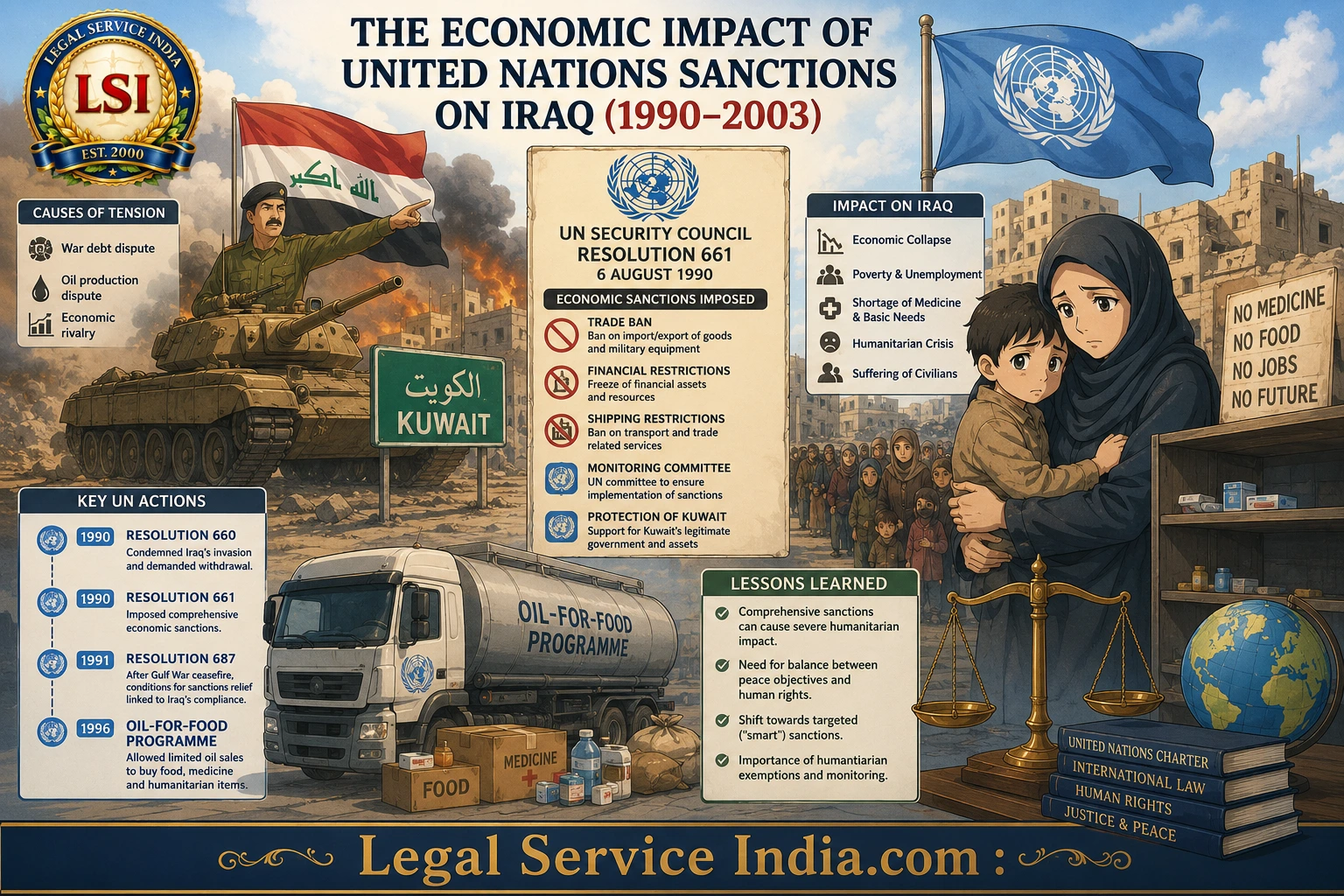
The Economic Impact of United Nations Sanctions on Iraq (1990–2003)
Introduction
The United Nations (UN), established in 1945 in the aftermath of World War II. The United Nations serves as a principal international organisation tasked with maintaining global peace, security, and cooperation among states.
For the implementation of global peace and security, the United Nations uses one of the most important tools known as “sanctions”.
As per Article 41 of the United Nations Charter, the Security Council may invoke non-military measures to enforce its decisions, which include interrupting economic, transport, and communication links, as well as breaking diplomatic relations.
Till now there are many countries and individuals on whom the different types of sanctions were imposed. Some of the sanctions have successfully achieved their goals, and many have failed due to many reasons.
One of the most controversial and landmark cases of sanctions is that of Iraq (1990). In this case, Iraq has faced many serious problems like economic collapse, humanitarian crises, international isolation and many more.
Although the objective of sanctions was successful in the eyes of the United Nations, for the Iraqis it was more dangerous than the sanctions. It is one of the landmark cases that developed the concept of imposition of sanctions.
In this assignment it is going to discuss the effectiveness of sanctions in the case of Iraq (1990) on both levels (paper as well as ground).
Reasons for Tension Between Iraq and Kuwait
The Iran-Iraq War lasted for nearly eight years. Due to this war, the financial condition of Iraq was very bad, and there were many loans that were taken from Saudi Arabia, Kuwait and other Gulf States by Iraq during the time of the Iran-Iraq War.
At this time there was the regime of Saddam Hussein, and he argued that:
- Kuwait and the UAE should consider the loans as payments to Iraq for protecting the Arabian Peninsula from Iranian expansionism, but they refused to forgive the debt.
- Accused Kuwait for overproducing crude oil for export and depressing prices and also alleged that Kuwait was slant drilling crude oil from the oil reserve of Iraq.
These were these 2 main reasons that increased the tension between Iraq and Kuwait.
Key Causes of the Dispute
| Issue | Description |
|---|---|
| War Debt Dispute | Kuwait and the UAE refused to forgive the loans taken by Iraq during the Iran-Iraq War despite Iraq’s claim that it had protected the Arabian Peninsula from Iranian expansionism. |
| Oil Production Dispute | Iraq accused Kuwait of overproducing crude oil, lowering international oil prices, and allegedly engaging in slant drilling from Iraqi oil reserves. |
Summary of the Background
- The Iran-Iraq war lasted nearly eight years and severely damaged Iraq’s economy.
- Iraq accumulated substantial debts from Kuwait, Saudi Arabia, and other Gulf States.
- Saddam Hussain sought debt forgiveness, arguing Iraq had defended the region against Iranian expansionism.
- Kuwait and the UAE rejected Iraq’s demand for debt cancellation.
- Iraq also accused Kuwait of oil-related economic aggression.
- These disputes significantly increased tensions between Iraq and Kuwait.
Iraq Invasion of Kuwait
The tension between Iraq and Kuwait was increasing; as a result, on 2 August 1990, Iraq entered the territory of Kuwait with military forces, and within 2 days of the invasion, Iraq captured Kuwait. The UN passed resolution 660 [1] on 2 August 1990, and as per the resolution, this was a clear violation of international law and direct threat to peace and security in the Middle East region.
The UN Security Council considered this act a breach of international peace and security, and the UN demanded Iraq pull back all its military forces. Iraq ignored the UN resolution 660 and didn’t withdraw its forces; in response to this, the UN passed another resolution, 661 [2], on 6 August 1990.
UN Security Council Resolution 661 and Economic Sanctions
As per resolution 661, there were some strict economic sanctions that were imposed by the United Nations Security Council:
Trade Ban
All the countries were forbidden from buying any goods or products coming from Iraq or Kuwait, as well as no country was allowed to sell or supply any products or goods to Iraq, including weapons and military equipment. The only exceptions allowed were medicines for strictly medical purposes and in humanitarian situations and food supplies.
Freeze of Financial Assets
No country was allowed to provide any financial resources to the Iraqi government or to any business in Iraq or Kuwait.
Shipping and Trade Promotion Ban
Countries were also forbidden from allowing their ships or citizens to help transport or promote any trade involving Iraqi or Kuwaiti goods. Transferring funds related to such trade was strictly prohibited.
Monitoring Committee
The UN also set up a special committee made up of all Security Council members to monitor whether countries are following these sanctions properly.
Protection of Kuwait
The resolution clarified that these sanctions did not stop assistance from being given to the legitimate government of Kuwait. Countries were also asked to protect the assets of Kuwait and to refuse recognition of any government set up by Iraq.
Summary of Resolution 661 Sanctions
| Sanction Measure | Description |
|---|---|
| Trade Ban | Restriction on imports and exports involving Iraq and Kuwait, including military equipment. |
| Financial Restrictions | Prohibition on providing financial resources to Iraq and related businesses. |
| Shipping Restrictions | Ban on transport, promotion, and financing of trade involving Iraqi or Kuwaiti goods. |
| Monitoring Committee | UN committee established to supervise implementation of sanctions. |
| Protection of Kuwait | Support for Kuwait’s legitimate government and protection of Kuwaiti assets. |
All these sanctions were among the most comprehensive ever imposed by the United Nations at that time. Instead of withdrawing the military forces of Iraq and complying with resolution 661, Iraq completely defied the UN demands as mentioned in resolution 661 and declared Kuwait the 19th province of Iraq.
UN Resolution 678 and Authorisation of Force
There were many resolutions passed by the UN Security Council against Iraq to leave the Kuwaiti land, but Iraq refused to comply. Finally, on 29 November 1990, the UN Security Council passed resolution 678 [1], giving Iraq a last chance to avoid military forces’ consequences and demanding that Iraq fully comply with all the previous resolutions.
The UN-authorised member stated they would cooperate with Kuwait to use “all necessary means” if Iraq failed to comply by the deadline of 15 January 1991. Here, “all necessary means” means use of military forces.
Iraq rejected the ultimatum and didn’t leave Kuwait. In response, there was the use of military forces to send back Iraqi military from the land of Kuwait. The war lasted approximately 42 days, and as a result Iraq left Kuwait.
Resolution 687: “The Mother of All Resolutions”
On 3 April 1991, the UN passed resolution 687 [2] and named it “The Mother of All Resolutions”. Iraq formally accepted the terms, and the war officially ended.
The UN imposed extraordinarily harsh conditions on Iraq; the most important condition was the destruction and disarmament of weapons of mass destruction, and also Iraq is financially liable to compensate for the damages due to Iraq’s invasion of Kuwait.
Key Obligations Under Resolution 687
- Destruction and disarmament of weapons of mass destruction.
- Elimination of prohibited military capabilities.
- Acceptance of international monitoring and inspections.
- Financial liability for damages caused by the invasion of Kuwait.
- Compliance with post-war obligations imposed by the United Nations.
The Continuation of Sanctions After the Ceasefire
There were many reasons for which the sanctions against Iraq were continued after the formal ceasefire with Kuwait in 1991. The main reasons behind the sanctions are the following:
To Destroy the Weapon of Mass Destruction
This is the primary reason for the extension of sanction. This meant that Iraq had to dismantle all its chemical, biological, and nuclear weapons programmes, and it also included long-range ballistic missiles.
Persistent Noncompliance
Iraq repeatedly obstructed UN weapons inspectors and did not provide a full report on its weapons capabilities.
Iraq Responsibilities Towards the Compensation
Iraq was required to pay compensation for war damages, environmental destruction and losses caused by its occupation of Kuwait.
Return of Kuwaiti Property and Nations
Iraq was responsible for returning the stolen property and also for cooperating in accounting for missing Kuwaiti citizens.
Desire for Regime Change
The UN desired to remove Saddam Hussein from power because as long as Saddam Hussein remained in power, Iraq was a threat to regional peace and security.
Reasons for Continuing Sanctions at a Glance
| Reason | Purpose |
|---|---|
| Weapons of Mass Destruction | Eliminate chemical, biological, nuclear, and missile programmes. |
| Persistent Noncompliance | Address Iraq’s refusal to fully cooperate with UN inspectors. |
| Compensation Obligations | Ensure payment for war-related damages and losses. |
| Return of Property and Nationals | Recover stolen property and account for missing Kuwaiti citizens. |
| Regime Change Concerns | Reduce perceived threats to regional peace and security. |
Impact of the Sanctions on Iraq
All these sanctions were comprehensive, not individual; that means not only an individual but the whole nation has to pay the price for whatever destructions had been done by the decision taken by the leader (Saddam Hussein).
These sanctions lasted for 13 years and directly impacted the citizens, especially the children of Iraq.
The Impact of the UN Sanctions on the People of Iraq
The Number of Deaths
The most shocking and widely debated consequences of the sanctions were the extraordinary number of civilian deaths, particularly the children, that were the results of the combined effects of economic collapse, failure of the healthcare system, and infrastructure destruction.
As per Denis J. Halliday in his article “The Impact of the UN Sanctions on the People of Iraq”, it was stated that:
“The World Health Organization (WHO) and UNICEF acknowledge that the death rate (directly attributable to the impact of sanctions) of Iraqi children under five ranges from 5,000 to 7,000 per month.”
Many deaths were often not registered immediately.
The Inadequacy of the Oil-for-Food Program
The UN Security Council, in its Resolution 986 [2] in 1995, introduced the “Oil-for-Food Program”, which permitted Iraq to sell oil for food, medicine, and humanitarian needs to mitigate the impact of international sanctions on civilians.
The provisions of basic foodstuffs and medicines have not been sufficient to make an effective impact on levels of malnutrition.
Denis J. Halliday stated:
“Malnutrition levels for children under five years have remained at approximately 30 per cent – of which about 25 per cent is chronic – for several years despite the expenditures by the government on foodstuffs and basic medicines under the Oil-for-Food Program.”
The Collapse of Iraq’s Economy
There was almost the complete destruction of the formal economy of Iraq. The economic isolation resulted in hyperinflation and a massive devaluation of the national currency.
Restriction of Oil Export
Oil export is Iraq’s primary source of revenue; the export of oil was restricted to a very small quantity because of imports of only necessary food and medicines as per the Oil-for-Food Program.
Major Effects of the UN Sanctions on Iraq
| Impact Area | Effect on Iraq |
|---|---|
| Civilian Deaths | Thousands of deaths, especially among children under five. |
| Healthcare System | Failure of healthcare infrastructure and reduced access to medicines. |
| Malnutrition | Persistent high levels of child malnutrition despite humanitarian programmes. |
| Economy | Near destruction of the formal economy, hyperinflation, and currency devaluation. |
| Oil Revenue | Severe restrictions on oil exports, reducing national income. |
These were the major impacts of the UN sanctions on Iraq. These sanctions broke the backbone of Iraq’s economy that directly affected the citizens of Iraq. Wrong decisions made by the leaders of Iraq as well as the UN crushed the innocent civilians of Iraq. These all were the results of the comprehensive sanctions.
Introduction to the Targeted Sanctions (Smart Sanctions)
Iraq was one of the most accurate examples of the comprehensive sanction. As I have discussed in my work about the consequences of the comprehensive sanctions with reference to the case of Iraq.
The Iraq case was the turning point for the evolution of targeted sanctions because targeted sanctions are designed to put maximum pressure on the specific decision-maker and exclude the innocent citizens, which minimises the collateral damage to the general civilian population and the national economy.
Types of Smart Sanctions
- Asset Freezes: Blocking the foreign bank account and financial assets of specific individuals.
- Travel Bans: Prohibiting designated individuals from entering other countries. (for example: Putin)
- Arms Embargoes: Stopping the flow of weapons and military technology to specific groups rather than a total trade ban. (example: Al-Qaeda).
Comparison: Comprehensive Sanctions vs Targeted Sanctions
| Comprehensive Sanctions | Targeted (Smart) Sanctions |
|---|---|
| Affect the entire economy. | Target specific individuals, groups, or entities. |
| Can severely impact civilians. | Aim to minimise civilian suffering. |
| Broad trade and economic restrictions. | Focused measures such as asset freezes and travel bans. |
| Higher risk of humanitarian consequences. | Lower collateral damage to the national economy. |
Conclusion
Iraq is a clear example of how a nation can be devastated by the impositions of sanctions. This case also shows how sanctions without proper calculations or understanding their consequences can crush a nation.
Furthermore, this case also tells us how the decision of the leader of any nation can totally destroy the nation. These sanctions set Iraq back by a few decades, which directly not only restricted the development but also destroyed the progress that had been achieved by Iraq before the sanctions.
These comprehensive sanctions violated many human rights of the citizens of Iraq (discussed above), and the Human Rights Council must take this case seriously. The sanctions changed the economy of the Middle East.
Although the result of the sanctions against Iraq was positive in the eyes of the UN and the western countries, when it comes to the ground reality of Iraqi citizens, it is totally different.
People have different opinions regarding this case:
- Some support the UN.
- Some stand with Iraq.
After analysing this issue one can form their own opinion.
Key Takeaways
- UN sanctions on Iraq (1990-2003) aimed at enforcing international law but led to severe humanitarian crises and economic collapse.
- Key reasons for the Iraq-Kuwait tension included war debt disputes and oil production conflicts, escalating to Iraq’s invasion of Kuwait.
- The UN imposed comprehensive sanctions under Resolutions 661 and 678, which included trade bans, financial restrictions, and military force authorisation.
- Sanctions continued post-ceasefire due to Iraq’s noncompliance, obligations for compensation, and the goal of regime change.
- The impact of these sanctions devastated Iraq’s economy, leading to widespread civilian suffering and loss of life, highlighting the complexities of such actions.

