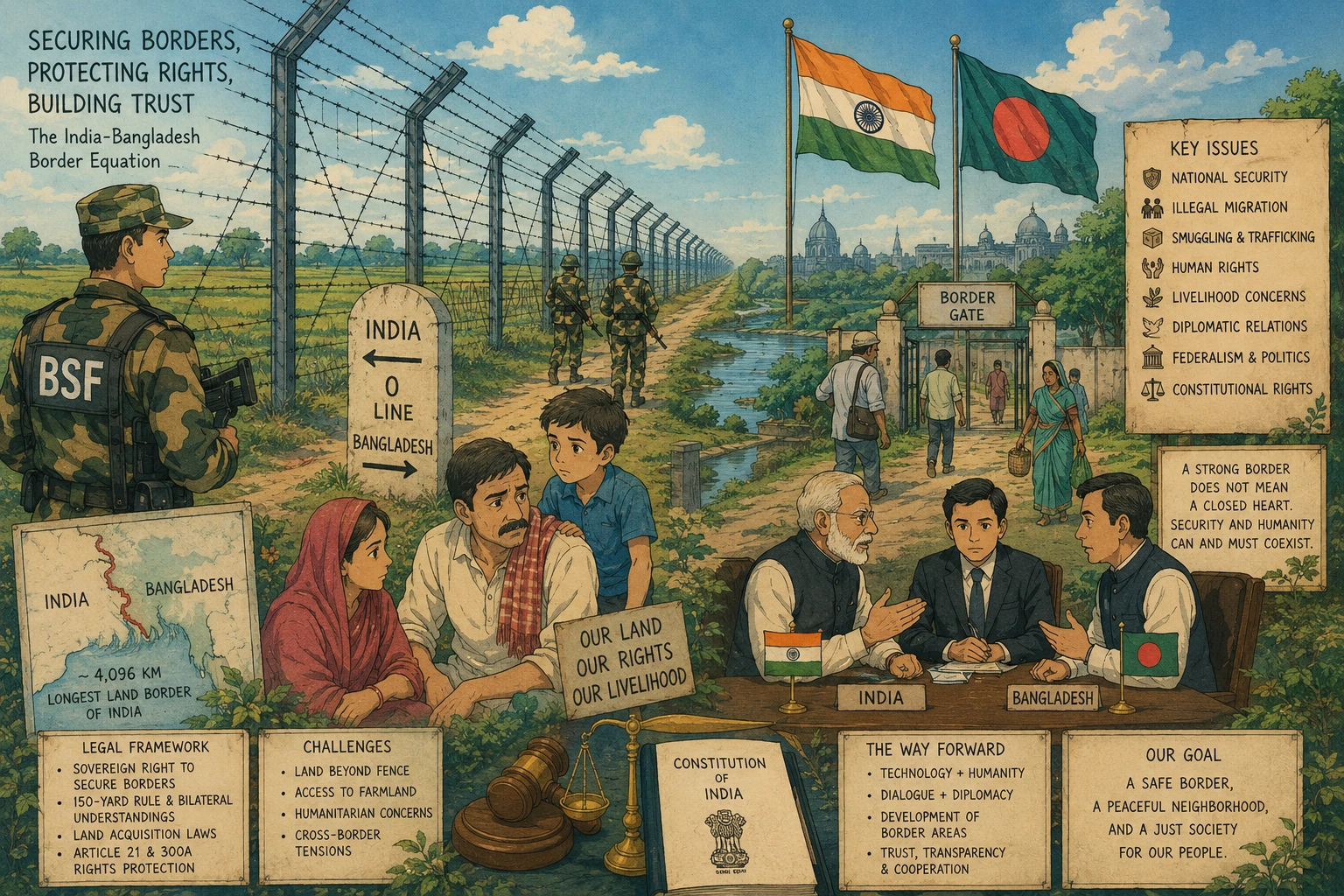
India’s Border, Bangladesh’s Objections and West Bengal’s Politics: The Constitutional and Legal Battle Behind the BSF Fencing Project
Introduction
Few contemporary issues illustrate the intersection of constitutional law, national security, federal governance, international relations, migration policy and electoral politics as vividly as the ongoing effort to complete fencing along the India-Bangladesh border in West Bengal.
What appears at first sight to be a straightforward security project has evolved into one of the most complex legal and political controversies in modern India. The debate now extends far beyond the installation of barbed wire and border infrastructure. It encompasses questions of sovereignty, citizenship, demographic change, federalism, human rights, diplomatic relations and constitutional accountability.
Recent developments have once again brought the issue into national focus. Significant stretches of land required for fencing projects have reportedly been handed over to the Border Security Force (BSF) after years of administrative delays. Simultaneously, Bangladesh has expressed concerns regarding certain aspects of India’s border management practices, while political parties in India continue to treat migration and border security as major electoral issues.
The controversy, therefore, is no longer merely about a fence.
It is about how a democratic nation secures its borders while preserving constitutional values, maintaining federal harmony, protecting human rights and sustaining strategic relations with one of its most important neighbours.
The question is profound:
Can India simultaneously uphold sovereignty, security, liberty and diplomacy?
The answer may shape the future of India-Bangladesh relations and significantly influence the constitutional trajectory of the Indian Republic in the twenty-first century.
Why the India-Bangladesh Border Matters More Today Than Ever Before
The India-Bangladesh border stretches for approximately 4,096 kilometres, making it one of the longest and most densely populated international borders in the world.
Unlike many international boundaries, this frontier passes through the following:
- Villages;
- Agricultural fields;
- Rivers;
- Wetlands;
- Forests;
- Markets;
- Historical communities;
- Family networks established long before Partition.
The border is therefore not merely a geographical line. It is a living socio-economic zone where national security concerns intersect with everyday civilian life.
Unlike the India-Pakistan border, which is primarily viewed through a military and strategic lens, the India-Bangladesh border presents a different set of challenges.
Major Border Security Challenges
These include:
- Illegal migration;
- Human trafficking;
- Cattle smuggling;
- Narcotics trafficking;
- Counterfeit currency operations;
- Arms smuggling;
- Cross-border criminal syndicates;
- Potential extremist infiltration;
- Demographic pressures in border districts.
For decades, governments led by different political parties have reached a broadly similar conclusion:
A porous border creates vulnerabilities that no responsible sovereign state can afford to ignore.
The debate therefore concerns not whether border security is necessary, but how it should be implemented within constitutional limits.
The Legal Foundation: Does India Have the Right to Fence Its Border?
From the perspective of international law, India’s legal position is exceptionally strong.
The principle of territorial sovereignty is among the oldest doctrines recognised by international jurisprudence.
Every sovereign state possesses the inherent right to:
- Control entry into its territory;
- Protect territorial integrity;
- Prevent illegal immigration;
- Construct border infrastructure;
- Regulate movement across international boundaries;
- Combat transnational crime.
Accordingly, there is no rule of international law that prohibits India from constructing a fence within its own territory.
Numerous democratic states have adopted similar measures.
International Border Security Models
| Country | Border Security Measure |
|---|---|
| United States | Barriers along portions of the Mexico border |
| Israel | Security barrier and border fencing |
| Hungary | Migration-control fencing |
| Greece | Enhanced border barriers |
| Poland | Border security infrastructure |
International law generally permits border barriers provided that:
- They remain within sovereign territory;
- They comply with treaty obligations;
- They do not unlawfully displace populations;
- They respect fundamental human rights standards.
Thus, the legality of fencing itself is not seriously disputed.
The controversy concerns implementation.
The Forgotten Legal Problem: The 150-Yard Rule
One of the least understood aspects of the India-Bangladesh border concerns the historical practice of constructing major border fencing approximately 150 yards inside Indian territory in sensitive sectors.
The arrangement was intended to avoid practical and diplomatic complications near the zero line.
However, this practice created a peculiar legal consequence.
Thousands of acres of Indian territory now lie between the international boundary and the fence.
As a result:
- Indian farmers often cultivate land located outside the fence;
- Residents require permissions to access their own property;
- Agricultural activities may be subject to restrictions;
- Security checkpoints affect daily life.
This creates a constitutional paradox.
The State seeks to strengthen sovereignty, yet some citizens experience limitations upon access to portions of their own land.
The challenge is therefore not merely external.
It is constitutional and internal.
The Constitutional Dimension: Security Versus Liberty
The Constitution of India does not permit the state to disregard civil liberties merely by invoking national security.
Border fencing inevitably affects:
- Property rights;
- Freedom of movement;
- Livelihoods;
- Access to land;
- Agricultural activities.
Two constitutional provisions become especially relevant.
Article 21
Article 21 guarantees the right to life and personal liberty.
Judicial interpretation has expanded this protection to include the following:
- Dignity;
- Livelihood;
- Fair procedure;
- Freedom from arbitrary state action.
Article 300A
Article 300A protects property from deprivation except by authority of law.
Though no longer a fundamental right, property remains a constitutional right.
Consequently, fencing projects affecting landowners require the following:
- Lawful acquisition procedures;
- Due process;
- Fair compensation;
- Administrative transparency.
The Constitution therefore demands a balance between national security and individual rights.
Key Constitutional and Legal Issues at a Glance
| Issue | Constitutional Concern | Legal Principle Involved |
|---|---|---|
| Border Fencing | National Security | Territorial Sovereignty |
| Land Acquisition | Property Rights | Article 300A |
| Movement Restrictions | Personal Liberty | Article 21 |
| Access to Farmland | Livelihood Rights | Due Process |
| Border Administration | Federal Coordination | Constitutional Governance |
| Human Rights Concerns | Dignity and Fair Treatment | Rule of Law |
Supreme Court Jurisprudence: Security Must Remain Constitutional
Indian constitutional jurisprudence provides important guidance.
In the landmark case of Maneka Gandhi v. Union of India, the Supreme Court held that state action affecting liberty must be fair, just and reasonable.
This principle continues to influence judicial review of security-related measures.
Similarly, in K.S. Puttaswamy v. Union of India, the Court recognised privacy as a fundamental right and emphasised the doctrine of proportionality.
Proportionality Review: Constitutional Standards
Under proportionality review:
- Government action must pursue a legitimate aim;
- The measure must be necessary;
- Less restrictive alternatives should be considered;
- Rights restrictions must not be excessive.
| Constitutional Requirement | Judicial Standard |
|---|---|
| Legitimate Aim | Government action must pursue a valid public objective |
| Necessity | The measure must be necessary to achieve the objective |
| Least Restrictive Means | Less restrictive alternatives should be considered |
| Proportionality | Rights restrictions must not be excessive |
Future disputes involving smart surveillance systems, AI monitoring and biometric border controls are likely to be tested against these constitutional standards.
The Most Important Constitutional Conflict: Centre Versus State
The border fencing controversy is fundamentally a dispute about Indian federalism.
The Constitution places the following:
- Defence;
- Foreign affairs;
- National security;
- International borders;
within the Union’s domain.
However, land administration, local governance and implementation mechanisms often depend upon state authorities.
This creates a recurring constitutional tension.
Division of Powers in Border Governance
| Union Government | State Government |
|---|---|
| Border Policy Formulation | Local Administration |
| National Security | Implementation Support |
| International Borders | Land Administration |
| Defence and Foreign Affairs | Local Governance Mechanisms |
The union government formulates border policy.
The state government controls significant aspects of local administration necessary for implementation.
West Bengal therefore occupies a uniquely influential position in border governance.
The legal authority may rest primarily with New Delhi.
The practical capacity to execute that authority frequently depends upon cooperation from Kolkata.
The BSF Jurisdiction Controversy
The federal debate intensified after the union government expanded BSF operational jurisdiction in certain border states.
The move generated political opposition in West Bengal.
Arguments Against Expanded BSF Powers
Critics argued that:
- Policing remains primarily a state subject;
- Expanded BSF powers could dilute state authority.
Arguments Supporting Expanded BSF Powers
Supporters argued that the following:
- Cross-border crime requires stronger central coordination;
- National security concerns justify enhanced operational capacity.
The controversy reflects a broader constitutional question:
How should federal power be distributed when internal administration intersects with external security?
Border Security and Citizenship Politics: The CAA-NRC Connection
No contemporary analysis of the India-Bangladesh border is complete without discussing citizenship politics.
The Citizenship Amendment Act (CAA), debates surrounding the National Register of Citizens (NRC), and allegations of illegal migration have fundamentally transformed the political significance of border security.
Supporters’ View on Border Control
Supporters contend:
- Effective citizenship policy requires effective border control;
- Illegal migration undermines demographic and administrative stability;
- Border fencing is essential to enforcing immigration laws.
Critics’ View on Citizenship Verification
Critics argue:
- Citizenship verification processes must avoid discrimination;
- Security concerns should not compromise constitutional equality;
- Vulnerable populations require procedural safeguards.
As a result, the border fence has evolved into a symbol of competing visions of nationhood, citizenship and constitutional identity.
Human Trafficking: The Humanitarian Argument for Border Security
Public debate frequently focuses on migration while overlooking a critical humanitarian issue.
The India-Bangladesh border has historically been exploited by human trafficking networks.
Categories of Trafficking Victims
Victims often include:
- Women;
- Children;
- Forced labourers;
- Victims of sexual exploitation;
- Trafficked brides.
| Humanitarian Concern | Impact |
|---|---|
| Human Trafficking | Cross-border exploitation of vulnerable individuals |
| Forced Labour | Economic and physical exploitation |
| Sexual Exploitation | Violation of human dignity and rights |
| Child Trafficking | Serious threat to child welfare and safety |
Organised criminal groups exploit porous borders for profit.
Consequently, border security serves not merely a sovereign function but also a humanitarian one.
Effective enforcement can protect vulnerable populations from transnational exploitation.
This dimension significantly complicates simplistic narratives portraying border security solely as a restrictive measure.
Bangladesh’s Concerns: The Diplomatic Dimension
Bangladesh’s concerns are often misunderstood.
Dhaka is generally not disputing India’s sovereign right to secure its territory.
Rather, Bangladesh worries that intensified enforcement measures could transform a historically interconnected frontier into a heavily securitised zone.
Key Concerns Raised by Bangladesh
Particular concerns have emerged regarding:
- Alleged push-back operations;
- Treatment of migrants;
- Impact upon border communities;
- Bilateral perceptions.
Importance of India-Bangladesh Relations
These concerns matter because India and Bangladesh share one of South Asia’s most strategically important partnerships.
Cooperation extends to the following:
- Trade;
- Energy;
- River-water management;
- Counter-terrorism;
- Connectivity projects;
- Regional diplomacy.
| Area of Cooperation | Strategic Significance |
|---|---|
| Trade | Economic integration and growth |
| Energy | Regional energy security |
| River-Water Management | Shared resource governance |
| Counter-Terrorism | Regional security cooperation |
| Connectivity Projects | Infrastructure and regional integration |
| Regional Diplomacy | Strengthening bilateral ties |
Border disputes therefore possess consequences extending far beyond the frontier itself.
The Political Transformation in Bangladesh After Sheikh Hasina
For many years, India maintained exceptionally close relations with the government led by Sheikh Hasina.
Period of Enhanced Cooperation
During this period:
- Security cooperation expanded significantly;
- Counter-terrorism coordination improved;
- Border management became more collaborative.
Changing Strategic Landscape
Political changes in Bangladesh have altered the strategic landscape.
Nationalist sentiment regarding border issues has become increasingly visible.
Consequently, actions that once attracted limited diplomatic attention now receive far greater scrutiny.
Border fencing is therefore no longer merely an engineering project.
It is also a geopolitical signal.
Why Fencing Alone Cannot Solve the Problem
A common misconception is that fencing can completely secure the border.
Geography makes such expectations unrealistic.
Large sections of the frontier consist of:
- Rivers;
- Floodplains;
- Marshlands;
- Char islands;
- Seasonal waterways.
Physical fencing is often impossible in these regions.
Consequently, India increasingly relies upon the following:
- Floating Border Outposts;
- River patrol units;
- Surveillance technology;
- Sensor networks;
- Drone monitoring.
Alternative Border Management Measures
| Border Management Tool | Purpose |
|---|---|
| Floating Border Outposts | Monitoring riverine border areas |
| River patrol units | Securing waterways and preventing infiltration |
| Surveillance technology | Real-time monitoring of sensitive zones |
| Sensor networks | Detection of unauthorized movement |
| Drone monitoring | Aerial surveillance and rapid response |
The future of border management lies beyond barbed wire.
The Human Rights Questions
Supporters of stronger enforcement must confront difficult questions.
Could intensified border control result in the following?
- Excessive use of force?
- Restrictions upon movement?
- Family separation?
- Livelihood disruptions?
The answer is potentially yes.
However, critics must acknowledge an equally uncomfortable reality.
Unregulated borders also generate human suffering through:
- Trafficking;
- Criminal exploitation;
- Smuggling networks;
- Violence against vulnerable communities.
Security Versus Human Rights
| Human Rights Concerns | Security Concerns |
|---|---|
| Excessive use of force | Trafficking |
| Restrictions upon movement | Criminal exploitation |
| Family separation | Smuggling networks |
| Livelihood disruptions | Violence against vulnerable communities |
The challenge is therefore not choosing between security and human rights.
The challenge is ensuring both.
The Future: From Border Fencing to Smart Borders
The next generation of border management will be technology-driven.
Emerging tools include:
- Artificial Intelligence;
- Facial recognition systems;
- Smart surveillance networks;
- Drone swarms;
- Predictive analytics;
- Thermal imaging systems;
- Integrated command centres.
Emerging Border Technologies
| Technology | Primary Function |
|---|---|
| Artificial Intelligence | Automated threat detection and analysis |
| Facial recognition systems | Identity verification |
| Smart surveillance networks | Continuous monitoring |
| Drone swarms | Wide-area reconnaissance |
| Predictive analytics | Risk forecasting |
| Thermal imaging systems | Night-time surveillance |
| Integrated command centres | Coordinated decision-making |
The most secure border of the future may not be the tallest fence.
It may be the smartest.
Yet these technologies raise significant constitutional questions.
Emerging Legal Challenges
- Privacy protection;
- Data governance;
- Algorithmic accountability;
- Surveillance oversight;
- Transparency standards;
- Judicial review mechanisms.
Future constitutional litigation may focus less on physical fencing and more on digital surveillance.
The Strategic Future of India-Bangladesh Relations
The border question ultimately reflects broader regional realities.
India’s Strategic Objectives
India seeks:
- Security;
- Stability;
- Migration control;
- Strategic depth.
Bangladesh’s Strategic Objectives
Bangladesh seeks:
- Sovereign equality;
- Respectful engagement;
- Economic cooperation;
- Regional influence.
Shared Pathway Forward
Neither side benefits from prolonged tension.
The long-term solution therefore requires a combination of:
- Security cooperation;
- Diplomatic engagement;
- Technological innovation;
- Human rights safeguards;
- Federal coordination.
| Priority Area | Long-Term Objective |
|---|---|
| Security cooperation | Reduce cross-border threats |
| Diplomatic engagement | Strengthen bilateral relations |
| Technological innovation | Enhance border management efficiency |
| Human rights safeguards | Protect affected communities |
| Federal coordination | Improve Centre-State cooperation |
Conclusion: A Fence That Defines a Nation’s Constitutional Character
The controversy surrounding BSF fencing along the India-Bangladesh border is ultimately not about steel, concrete or barbed wire.
It is about the character of the Indian state.
At stake are five competing imperatives:
- Sovereignty;
- Security;
- Constitutionalism;
- Federalism;
- Diplomacy.
Balancing Competing Constitutional Priorities
| Imperative | Constitutional Significance |
|---|---|
| Sovereignty | Protection of territorial integrity |
| Security | National safety and border management |
| Constitutionalism | Preservation of democratic values |
| Federalism | Centre-State balance |
| Diplomacy | Regional stability and cooperation |
A sovereign state unquestionably possesses the right to secure its borders.
A constitutional democracy simultaneously bears the obligation to protect liberty.
A federal republic must balance national priorities with state participation.
A regional power must preserve strategic relations with its neighbours.
The India-Bangladesh border dispute therefore illustrates one of the defining dilemmas of modern constitutional democracies: how to remain open without becoming vulnerable, and how to remain secure without becoming illiberal.
The ultimate success of India’s border policy will not be measured merely by the kilometres of fencing erected. It will be measured by whether India can harmonise national security, constitutional freedoms, cooperative federalism and regional diplomacy within a single coherent framework.
If it succeeds, the border fence may become a model of lawful statecraft.
If it fails, it risks becoming a symbol of unresolved tensions between security, politics and liberty.
The outcome will shape not only the future of West Bengal and Bangladesh, but also the constitutional identity of the Indian Republic in the decades ahead.