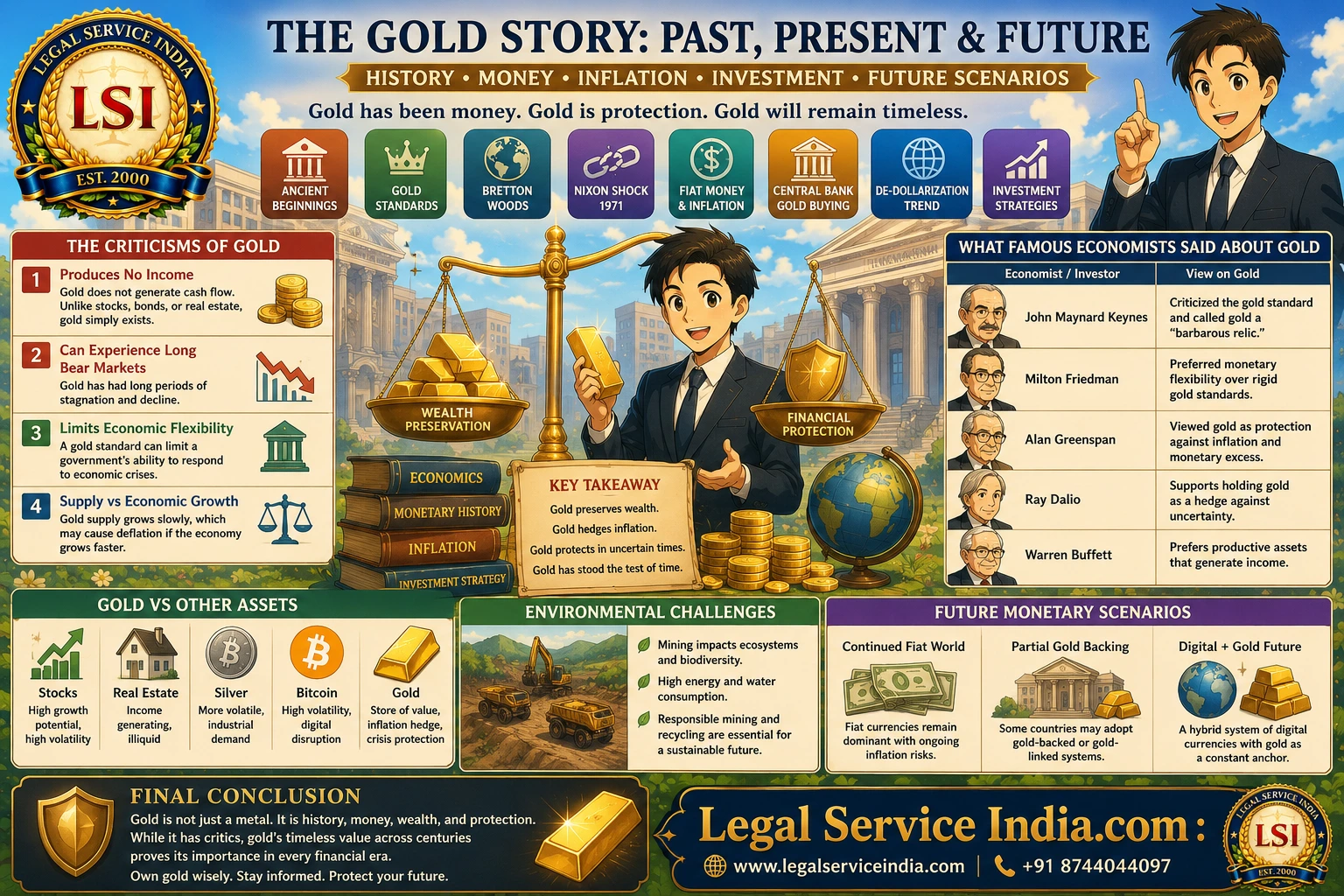
Part 5: Criticisms of Gold, Environmental Challenges, Future Monetary Scenarios, Expert Views, FAQs, and Final Conclusion
Introduction
Throughout this series, we have explored gold’s remarkable journey from ancient civilisations to the modern financial system.
We examined:
- Why gold became money.
- The rise and fall of the gold standard.
- The Bretton Woods system.
- The Nixon Shock of 1971.
- Fiat currencies and inflation.
- Central bank gold accumulation.
- De-dollarisation.
- Gold ownership strategies.
- Gold versus stocks, real estate, silver, and Bitcoin.
However, a truly comprehensive analysis requires more than understanding gold’s strengths.
It also requires examining its weaknesses, criticisms, and challenges.
Gold has passionate supporters, but it also has respected critics.
Understanding both perspectives allows readers to reach informed conclusions rather than relying on ideology or financial marketing.
The Criticisms of Gold
Gold’s historical significance is undeniable.
Nevertheless, many economists argue that gold is not a perfect monetary system nor a perfect investment.
Several criticisms deserve serious consideration.
Criticism 1: Gold Produces No Income
Perhaps the most common criticism is that gold does not generate cash flow.
Unlike:
- Stocks, which produce earnings.
- Bonds, which pay interest.
- Real estate, which generates rent.
Gold simply exists.
An ounce of gold today remains an ounce of gold tomorrow.
For this reason, critics argue that gold preserves wealth but does not actively create it.
This distinction is important.
Historically, productive businesses have generated greater long-term returns than precious metals.
Criticism 2: Gold Can Experience Long Bear Markets
Many people assume gold always rises in value.
History proves otherwise.
Gold has experienced lengthy periods of stagnation and decline.
After reaching highs in 1980, gold spent nearly two decades underperforming many other assets.
Similarly, periods of strong economic growth often reduce demand for safe-haven assets.
Gold may therefore underperform stocks during economic expansions.
Criticism 3: A Gold Standard Limits Economic Flexibility
Many economists argue that gold standards can create problems during recessions.
Under a gold-backed system, governments have limited ability to expand the money supply during emergencies.
Critics contend that this restriction can worsen:
- Financial crises
- Banking panics
- Economic contractions
Supporters of fiat currency argue that modern central banks need flexibility to respond to changing economic conditions.
Criticism 4: Gold Supply Does Not Necessarily Match Economic Growth
The global economy can grow rapidly.
Gold production typically grows slowly.
Some economists argue that linking money to gold could create deflationary pressures if economic activity expands faster than the gold supply.
This issue was frequently debated during the nineteenth and early twentieth centuries.
What Famous Economists Said About Gold
| Economist / Investor | View on Gold |
|---|---|
| John Maynard Keynes | Criticised the gold standard and called gold a “barbarous relic”. |
| Milton Friedman | Preferred monetary flexibility over rigid gold standards. |
| Alan Greenspan | Viewed gold as protection against inflation and monetary excess. |
| Ray Dalio | Supports holding gold as a hedge against uncertainty. |
| Warren Buffett | Prefers productive assets that generate income. |
The Case Against Gold
John Maynard Keynes
Keynes famously described gold as a “barbarous relic”.
He believed modern economies required flexible monetary policies that gold standards could not provide.
According to Keynes, governments needed tools to combat unemployment and economic downturns.
Milton Friedman
Although critical of excessive government intervention, Friedman generally preferred monetary systems that allowed greater flexibility than rigid gold standards.
He argued that economic stability depended more on responsible monetary management than on precious metals.
The Case for Gold
Alan Greenspan
Before becoming chairman of the Federal Reserve, Greenspan wrote extensively about gold.
He argued that gold historically protected savers from inflation and government monetary excesses.
Ray Dalio
Dalio frequently advocates diversification and has repeatedly emphasised the importance of holding some gold as a hedge against uncertainty.
“If you don’t own gold, you know neither history nor economics.”
Warren Buffett
Buffett has generally favoured productive assets over gold.
He argues that businesses generate wealth, whereas gold remains largely passive.
His perspective highlights the distinction between wealth creation and wealth preservation.
Gold and the Environment
A modern discussion of gold would be incomplete without addressing environmental concerns.
Gold mining provides employment and economic benefits in many regions.
However, it also creates environmental challenges.
Environmental Concerns
| Concern | Description |
|---|---|
| Land Disturbance | Large-scale mining operations often alter landscapes significantly. |
| Water Consumption | Gold extraction can require substantial water resources. |
| Chemical Usage | Some mining methods historically relied on chemicals such as mercury and cyanide. |
| Waste Management | Mining generates large quantities of waste material that require careful management. |
Responsible Mining Initiatives
In recent years, governments, regulators, and mining companies have adopted stricter environmental standards.
Many modern operations emphasise the following:
- Sustainability
- Water conservation
- Environmental rehabilitation
- Worker safety
- Community engagement
Investors increasingly evaluate environmental, social, and governance (ESG) factors when assessing mining companies.
Historical Gold Performance During Major Crises
One reason gold continues to attract attention is its behaviour during periods of uncertainty.
| Historical Event | Gold’s Role |
|---|---|
| The Great Depression | Gold retained value while many financial assets suffered severe losses. |
| World War II | Governments accumulated gold reserves as strategic assets. |
| The Inflation Crisis of the 1970s | Gold performed exceptionally well as inflation accelerated. |
| The Dot-Com Crash | Gold helped diversify portfolios during technology-sector declines. |
| The 2008 Global Financial Crisis | Demand for gold increased as confidence in financial institutions weakened. |
| The COVID-19 Pandemic | Massive monetary stimulus and uncertainty contributed to renewed interest in gold. |
These examples help explain why gold continues to be viewed as a crisis hedge.
Four Possible Future Scenarios
No one can predict the future with certainty.
However, several plausible monetary scenarios deserve consideration.
Scenario One: The Current System Continues
The most likely near-term outcome is that fiat currencies remain dominant.
Central banks continue managing monetary policy while gold remains a reserve asset.
Scenario Two: Higher Inflation Becomes Persistent
Governments facing rising debt may tolerate higher inflation.
In such an environment, demand for gold could remain strong.
Scenario Three: A Multipolar Financial World Emerges
Economic power is increasingly distributed across multiple regions.
Future reserve systems may become more diversified.
Gold could play a larger role as a neutral reserve asset.
Scenario Four: A Partial Return to Asset-Backed Money
Some analysts speculate that future monetary systems could incorporate gold or other hard assets in limited ways.
While a full return to the classical gold standard appears unlikely, hybrid systems cannot be completely ruled out.
Gold’s Most Important Lesson
Perhaps the greatest lesson gold teaches is not about investing.
It is about understanding money.
Gold forces us to ask:
- What gives money value?
- Can purchasing power be preserved indefinitely?
- How much trust should be placed in governments and central banks?
- What role should hard assets play in personal financial security?
These questions remain just as relevant today as they were centuries ago.
Frequently Asked Questions (FAQs)
1. Why has gold been considered money for thousands of years?
Because it is durable, divisible, portable, scarce, and widely accepted across cultures.
2. Is gold an investment?
Gold is generally considered a store of value rather than a traditional income-generating investment.
3. Why did the United States abandon the gold standard?
Growing fiscal pressures and declining confidence in gold convertibility led President Richard Nixon to suspend dollar-to-gold conversion in 1971.
4. What is fiat currency?
Fiat currency derives value from government authority and public confidence rather than a physical commodity such as gold.
5. Why are central banks buying gold today?
To diversify reserves, reduce geopolitical risk, and hedge against uncertainty.
6. Is gold a hedge against inflation?
Historically, gold has often preserved purchasing power over long periods, although short-term results can vary.
7. Is gold better than stocks?
Not necessarily. Stocks generally create wealth through earnings growth, while gold primarily preserves wealth.
8. What is the difference between physical gold and gold ETFs?
Physical gold provides direct ownership, while ETFs provide price exposure through financial markets.
9. Is Bitcoin replacing gold?
Bitcoin and gold serve different purposes. Bitcoin is a relatively new digital asset, whereas gold has a monetary history spanning thousands of years.
10. How much gold exists in the world?
All the gold ever mined could fit into approximately three and a half Olympic-sized swimming pools.
Conclusion: Gold and the 50-Year Monetary Experiment
For more than 5,000 years, gold served humanity as a store of value, a medium of exchange, and a symbol of wealth.
Empires rose and fell.
Wars were fought.
Currencies disappeared.
Yet gold endured.
The modern fiat monetary system has existed for only a small fraction of that history.
Since 1971, the world has operated under an unprecedented experiment in which major currencies are no longer backed by precious metals.
The system has delivered extraordinary economic growth, technological innovation, and financial development.
At the same time, it has produced recurring debates about inflation, debt, monetary expansion, and financial stability.
Whether one views gold as money, insurance, a hedge, or merely a commodity, its continued importance cannot be ignored.
Perhaps gold’s greatest strength is not that it predicts the future.
Its greatest strength is that it provides perspective.
It reminds us that money is ultimately built on trust.
Governments can create currencies.
Central banks can influence interest rates.
Financial systems can evolve.
But trust remains the foundation upon which all monetary systems rest.
For thousands of years, gold has served as one of humanity’s most enduring measures of that trust.
And that may explain why, despite every innovation and every monetary experiment, the world continues to pay attention whenever gold speaks.