





I. Introduction
The Hon’ble Supreme Court of India, in K. Ranganayakulu v. State of Telangana & Ors., 2026 INSC 555 (decided recently on May 12, 2026), delivered a judgement that marks a significant and controversial departure from a settled line of precedent concerning the liability of authorised signatories under Section 138 of the Negotiable Instruments Act, 1881 (“NI Act”). The court held that an authorised signatory who signed cheques on an NGO’s behalf may be deemed the “drawer” of those cheques and personally convicted for their dishonour.
While the Court’s intention to strengthen commercial accountability is understandable, this article respectfully dissents from the dictum that an authorised signatory automatically becomes the “drawer” by virtue of being authorised to sign negotiable instruments. The judgement, it is humbly submitted, in my considered opinion, conflates administrative authority with substantive liability, introduces an extra-statutory “front face” doctrine, and undermines the corporate veil principle that has been firmly established in over two decades of Indian jurisprudence from S.M.S. Pharmaceuticals (2005) to Bijoy Kumar Moni (2024).
Key Issues Arising from the Judgment
- Personal liability of authorised signatories under Section 138 of the NI Act.
- Interpretation of the term “drawer” in cheque dishonour cases.
- Impact on the corporate veil and separate legal entity doctrine.
- Departure from established judicial precedents.
- Potential consequences for NGOs, charitable organisations, and social institutions.
Core Concern of the Article
The article examines, with due respect to the Hon’ble Bench of the Apex Court, the ratio of Ranganayakulu, analyses its incompatibility with settled precedent, and respectfully urges reconsideration by a larger bench considering the cascading impact in such matters.
Such a precedent would be a deterrent to ‘ease of doing business’ and would deter social man from taking honorary posts in Social & Charitable Organizations and NGO’s.
Overview of the Discussion
| Topic | Focus of Analysis |
|---|---|
| Supreme Court Judgment | K. Ranganayakulu v. State of Telangana & Ors., 2026 INSC 555 |
| Statutory Provision | Section 138 of the Negotiable Instruments Act, 1881 |
| Primary Issue | Whether an authorized signatory becomes the “drawer” of a cheque |
| Judicial Concern | Departure from settled precedent and corporate veil principles |
| Practical Impact | Implications for NGOs, charitable bodies, and ease of doing business |
II. Factual Matrix and the Ratio in K. Ranganayakulu
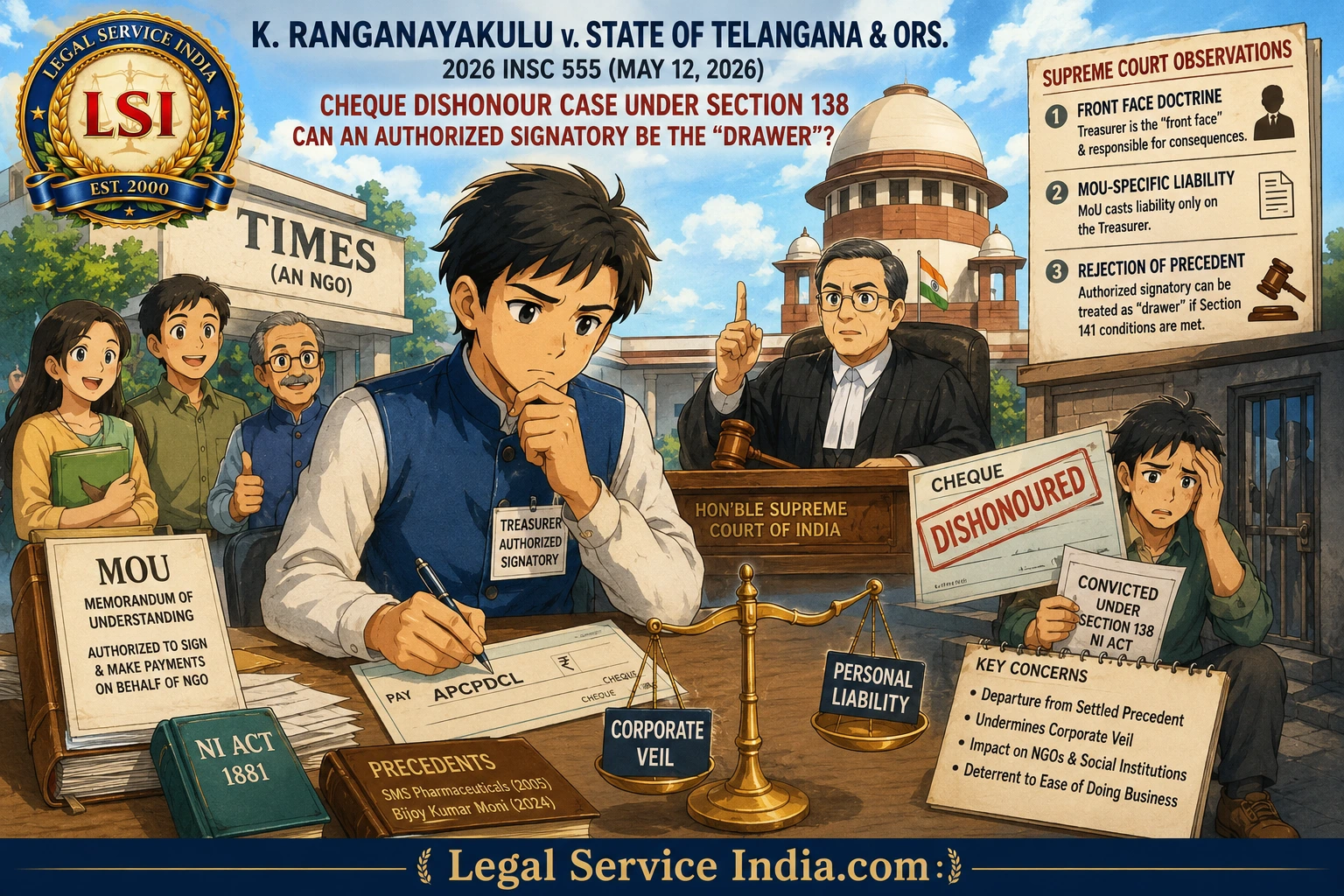
The appellant, the Treasurer of a society called “TIMES” (an NGO), was authorised under a Memorandum of Understanding (“MoU”) with APCPDCL (Andhra Pradesh Central Power Distribution Company Ltd.) to sign all negotiable instruments and to make payments through cheques/RTGS on behalf of the NGO. The cheques issued by the Treasurer were dishonoured, and he was convicted under Section 138.
His principal defence was that he, being merely an authorized signatory and not the “drawer” within the meaning of Section 138, could not be personally convicted. He relied on Shri Gurudatta Sugars Marketing Pvt. Ltd. v. Prithviraj Sayajirao Deshmukh & Ors., (2024) 7 SCR 1211, wherein the Supreme Court had held that an authorized signatory is not a “drawer” under the NI Act.
A. The Court’s Three-Fold Reasoning
| Ground | Court’s Reasoning |
|---|---|
| (i) The “Front Face” Doctrine | The Court held that since the NGO authorised the Treasurer as its “front face” to deal with the power company, he alone was responsible for all consequences. |
| (ii) MoU-Specific Liability | The Court noted that the MoU cast no liability on any other office-bearer of the NGO except the Treasurer, and therefore he was the only person responsible. |
| (iii) Rejection of Gurudatta Sugars Precedent | The Court rejected the appellant’s reliance on Shri Gurudatta Sugars Marketing, holding that authorised signatories may be categorised as a “drawer” when the conditions stipulated under Section 141 of the NI Act are fulfilled. |
i. The “Front Face” Doctrine
The Court held that since the NGO authorised the Treasurer as its “front face” to deal with the power company, he alone was responsible for all consequences. The Court observed:
“If the NGO i.e. TIMES has made the appellant as its front face by authorizing him to sign all the negotiable instruments and to make payment of the account to APCPDCL (Presently Telangana CPDCL) through cheque/RTGS online transaction, it is only the appellant who shall be responsible for all the consequences thereof.”
ii. MoU-Specific Liability
The Court noted that the MoU cast no liability on any other office-bearer of the NGO except the Treasurer, and therefore he was the only person responsible.
iii. Rejection of Gurudatta Sugars Precedent
The Court rejected the appellant’s reliance on Shri Gurudatta Sugars Marketing, holding that:
“the authorised signatories of the company may be categorised as a ‘drawer’ of cheque, when the conditions stipulated under Section 141 of the NI Act gets fulfilled.”
III. The Statutory Framework: Sections 7, 138, and 141
Before examining the doctrinal objections, it is necessary to set out the precise statutory provisions at play.
A. Section 7 — The Definition of “Drawer”
Section 7 of the NI Act defines the maker of a bill of exchange:
“The maker of a bill of exchange or cheque is called the ‘drawer’.”
In the context of a corporate entity, this statutory definition is decisive. The Supreme Court in Jai Balaji Industries Ltd. v. M/s HEG Ltd., 2025 INSC 1362, while dealing with jurisdictional questions, authoritatively enunciated:
“Corporate persons like companies, which are mere legal entities and have no soul, mind or limb to work physically, discharge their functions through some human agency recognised under the law to work. Therefore, if some function is discharged by such human agency for and on behalf of the company it would be an act of the company and not attributable to such human agent… However, such authorisation would not render the authorised signatory as the maker of those cheques. It is the company alone which would continue to be the maker of these cheques, and thus also the drawer within the meaning of Section 7.”
B. Section 138 — The Drawer’s Liability
Section 138 creates a criminal offence where a cheque is drawn “on an account maintained by” the person who draws it and the cheque is dishonoured. The phrase “account maintained by him” is the critical statutory anchor of liability.
The Supreme Court in Bijoy Kumar Moni v. Paresh Manna, 2024 INSC 1024, held expressly:
“An authorised signatory acting on behalf of the principal cannot be said to be the ‘drawer’ of the cheque ‘on an account maintained by him with a banker’ under Section 138.”
C. Section 141 — The Mechanism for Vicarious Liability
Section 141(1) provides that if the person committing an offence under Section 138 is a company, every person who at the time of the offence was in charge of and responsible to the company for the conduct of its business shall be deemed guilty.
Section 141(2) extends this to directors who consented or connived in the commission of the offence.
These provisions create a structured, carefully conditioned mechanism for vicarious liability that cannot be short-circuited by judicial innovation.
Key Statutory Provisions at a Glance
| Provision | Subject Matter | Key Principle |
|---|---|---|
| Section 7 | Definition of Drawer | The maker of the cheque is the drawer. |
| Section 138 | Dishonour of Cheque | Liability arises when a cheque is drawn on an account maintained by the drawer. |
| Section 141(1) | Vicarious Liability | Persons in charge of and responsible for the conduct of business may be deemed guilty. |
| Section 141(2) | Consent or Connivance | Directors or officers who consented to or connived in the offence may also be liable. |
IV. Grounds For Honourable Dissent
A. The Statutory Definition of “Drawer” Excludes Authorized Signatories
The most fundamental objection to Ranganayakulu lies in the plain language of Section 138 read with Section 7. The Supreme Court in Shri Gurudatta Sugars Marketing Pvt. Ltd. v. Prithviraj Sayajirao Deshmukh & Ors., 2024 INSC 551, (2024) 7 SCR 1211, categorically declared:
“In conclusion, the High Court’s decision to interpret ‘drawer’ strictly as the issuer of the cheque, excluding authorized signatories, is well-founded… The primary liability for an offence under Section 138 lies with the company, and the company’s management is vicariously liable only under specific conditions provided in Section 141.”
The Court in Gurudatta Sugars further laid down the governing principles in five propositions:
| Proposition | Principle Laid Down |
|---|---|
| First | The general rule against vicarious liability in criminal law underscores that individuals are not typically held criminally liable for acts committed by others unless specific statutory provisions extend such liability. |
| Second | Liability under Section 141 arises from the conduct or omission of the individual involved, not merely their position within the company. |
| Third | The distinction between legal entities and individuals acting as authorized signatories is crucial. |
| Fourth | Authorized signatories can bind the company through their actions, but they do not merge their legal status with that of the company. |
| Fifth | The ‘drawer’ under Section 143A refers specifically to the issuer of the cheque, not the authorized signatory. |
The Ranganayakulu Court dismissed this precedent as “misplaced,” yet offered no distinguishing analysis of these five governing propositions. With respect, a coordinate bench cannot brush aside a binding precedent without identifying the legal basis for the distinction.
B. Violation of the Corporate Veil Principle — The Agency Law Foundation
The principle that an authorized signatory acts as agent of the company—and not in its own right—is foundational to both corporate law and agency law. The Supreme Court in Bijoy Kumar Moni v. Paresh Manna, 2024 INSC 1024, held:
“A catena of decisions of this Court have settled the position of law that in case of a cheque issued on behalf of a company by its authorised signatory, prosecution cannot proceed against such authorised signatory or other post-holders of the company as described under Section 141 of the NI Act, unless the company who is the drawer of the cheque is arraigned as an accused in the complaint case filed before the magistrate. Further, vicarious liability can only be affixed against the directors, authorised signatories, etc. of the company after the company is held liable for the commission of offence under Section 138.”
This ruling flows directly from the doctrine in Salomon v. Salomon & Co. Ltd., (1897) AC 22 (HL), which established the distinct legal personality of a corporate entity. A company or a registered society is a juristic person distinct from its officers and Treasurers. When a Treasurer acts under a resolution of the Board, he acts for and on behalf of the society, not in his personal capacity.
The Court in Bijoy Kumar Moni also reinforced this principle explicitly:
“A person who signs a cheque as an authorized signatory is acting on behalf of the company, not in their individual capacity. The account on which the cheque is drawn is the company’s account, not the signatory’s personal account.”
C. The Aneeta Hada Imperative: Arraigning The Company Is Non-Negotiable
A three-Judge Bench of the Supreme Court in Aneeta Hada v. Godfather Travels & Tours Pvt. Ltd., (2012) 5 SCC 661 (AIR 2012 SC 2795), authoritatively settled the constitutional requirement for prosecuting company officers under Section 141:
“In view of our aforesaid analysis, an irresistible conclusion was arrived at, that for maintaining the prosecution under Section 141 of the Act, arraigning a company as an accused is imperative. The other categories of offenders can only be brought in the dragnet on the touchstone of vicarious liability as the same has been stipulated in the provision itself.”
The Court in Aneeta Hada in para 39 further emphasized the penal nature of the provision:
“There has to be strict observance of the provisions regard being had to the legislative intendment because it deals with penal provisions and a penalty is not to be imposed affecting the rights of persons whether juristic entities or individuals, unless they are arrayed as accused. It is to be kept in mind that the power of punishment is vested in the legislature and that is absolute in Section 141 of the Act which clearly speaks of commission of offence by the company.”
The Ranganayakulu judgment circumvents the Aneeta Hada imperative by the expedient of converting the signatory into the “drawer” itself—thereby eliminating the very need to arraign the company as the principal offender. This is, with respect, not a permissible course under the NI Act.
D. The S.M.S. Pharmaceuticals Standard: Role, Not Designation, Governs Liability
In the Constitution Bench decision of S.M.S. Pharmaceuticals Ltd. v. Neeta Bhalla, (2005) 8 SCC 89, the Supreme Court enunciated the governing test for fixing liability under Section 141:
“Every person connected with the company shall not fall within the ambit of the provision. It is only those persons who were in charge of and responsible for conduct of business of the company at the time of commission of an offence, who will be liable for criminal action. The liability arises from being in charge of and responsible for the conduct of business of the company at the relevant time when the offence was committed and not on the basis of merely holding a designation or office in a company.”
The treasurer in Ranganayakulu was a subordinate officer executing a specific treasury function. The S.M.S. Pharmaceuticals standard requires an inquiry into whether he was “in charge of and responsible for the conduct of the business of the company”—a factual inquiry that was bypassed by the application of the novel “front-face” doctrine.
E. Aparna A. Shah: Penal Statutes Require Strict Construction
The Supreme Court in Mrs Aparna A. Shah v. M/s Sheth Developers Pvt. Ltd & Anr., (2013) 8 SCC 71 (AIR 2013 SC 3210), speaking through Sathasivam and Khehar, JJ., reiterated the foundational principle:
“This Court reiterates that it is only the drawer of the cheque who can be made an accused in any proceeding under Section 138 of the Act. The culpability attached to dishonour of a cheque can, in no case ‘except in case of Section 141 of the N.I. Act’ be extended to those on whose behalf the cheque is issued.”
The court further held that penal statutes must be strictly construed and that extending liability to a non-drawer would amount to judicial legislation. The “front face” doctrine in Ranganayakulu, which converts an authorised signatory into a drawer by non-statutory reasoning, is precisely the form of judicial extension warned against in Aparna Shah.
F. Section 143A And The Gurudatta Sugars Contradiction
Perhaps the most glaring internal inconsistency in Ranganayakulu relates to Section 143A of the NI Act (interim compensation). The Supreme Court in Shri Gurudatta Sugars Marketing (supra) held that because the drawer under Section 143A means only the issuer of the cheque,
“Consequently, the conditions of depositing amounts under Sections 143A and 148 of NIA, which are to be paid exclusively by the drawer of the cheque, should not be imposed on such an officer who was merely authorised to sign the cheque.”
It is logically untenable to hold that an authorised signatory is not a “drawer” for the purpose of interim compensation under Section 143A (as held in Gurudatta Sugars) and yet is a “drawer” for the purpose of the substantive offence under Section 138. The word “drawer” appears in both sections and must receive a consistent interpretation. Different constructions for different subsections of the same Act violate the principle of harmonious construction.
G. The “Front Face” Doctrine: An Extra-Statutory Creation Without Precedent
The concept of a “front face” as the determinant of criminal liability appears nowhere in the NI Act, nor in any prior judicial decision construing it. By introducing this doctrine, the Ranganayakulu bench has the following:
- Created a new, fact-specific test that has no statutory foundation.
- Made criminal liability dependent on the internal governance documents of an organisation (the MoU), rather than on the statute.
- Introduced commercial uncertainty: any officer authorised to sign instruments may now face personal criminal liability, irrespective of whether the company is prosecuted.
- Effectively repealed the requirements of Section 141(1) by bypassing them through the back door of the “drawer” definition.
As the Supreme Court cautioned in Aparna A. Shah (2013) 8 SCC 71:
“The proceedings filed under Section 138 cannot be used as an arm-twisting tactic to recover the amount allegedly due from the appellant.”
A doctrine that makes a treasurer personally liable for institutional debts that the institution itself has not been prosecuted for creates precisely such an imbalance.
H. The Bijoy Kumar Moni Catena: A Settled Position Of Law
In Bijoy Kumar Moni v. Paresh Manna, 2024 INSC 1024, Justice J.B. Pardiwala, speaking for the bench, surveyed the entire line of precedent and enunciated:
“The aforesaid discussion makes it clear that as per the legislative scheme it is only the drawer of the cheque who is sought to be made liable for the offence punishable under Section 138 of the NI Act. Thus, the next question that requires consideration is whether a director of a company, who is also the authorised signatory, to sign and issue cheques on its behalf could be said to be the drawer of a cheque drawn upon the bank account held in the name of the company.”
The answer the Court gave in Bijoy Kumar Moni was an emphatic no: such a director/authorised signatory cannot be the drawer under Section 138. The Ranganayakulu bench, without expressly overruling or distinguishing Bijoy Kumar Moni, has reached the diametrically opposite conclusion—a doctrinal rupture that demands resolution by a larger bench.
V. Analysis: Why The Court’s Reasoning Does Not Withstand Scrutiny
A. The MoU Cannot Override The Statute
The Court in Ranganayakulu placed heavy reliance on the fact that the MoU cast no liability on any other office-bearer. However, a private contractual document between an NGO and a power company cannot determine or enlarge criminal liability under a penal statute. Section 138 of the NI Act confers liability on the “drawer” as statutorily defined, not on the person designated as responsible under a private MoU. The source of criminal liability is the statute alone.
As S.M.S. Pharmaceuticals held the following:
“If being a director or management or secretary was enough to cast criminal liability, the Section would have said so.”
Similarly, if being designated as the signatory in an MoU were enough, the legislature would have said so. It has not.
B. Section 141 Is Not A Mechanism To Convert Signatories Into Drawers
The court’s observation that “authorised signatories of the company may be categorised as a ‘drawer’ of a cheque when the conditions stipulated under Section 141 of the NI Act get fulfilled” is, with respect, a legal solecism. Section 141 is a vicarious liability provision: it makes persons other than the drawer (i.e., company officers) liable for the company’s offence. It does not, and cannot, convert those persons into the primary drawer. The drawer and persons made vicariously liable under Section 141 are two distinct categories; equating them conflates the primary offence with secondary liability.
C. The Treasurer Was Not The Contracting Party
The commercial obligation under the MoU was between the NGO (TIMES) and APCPDCL. The Treasurer signed cheques as a ministerial act in furtherance of the NGO’s contractual obligation. The debt was the NGO’s; the account was the NGO’s; the contract was the NGO’s. Holding the Treasurer personally liable for the NGO’s contractual default under a criminal statute—without the NGO itself being prosecuted—offends every principle of legal logic.
VI. Practical Concerns And Policy Implications
A. Chilling Effect On Non-Profit Governance
Registered societies, NGOs, and charitable trusts depend on willing professionals to discharge specific functions such as treasurer, secretary, or authorised officer. If the Ranganayakulu doctrine is applied universally:
- Qualified professionals will decline to serve societies as authorised signatories, knowing that they face personal criminal liability for institutional defaults.
- Non-profit organisations will face an acute governance crisis.
- The social sector, which depends heavily on volunteers and part-time officers, will be severely and adversely impacted.
B. Injustice To Subordinate Officers
The treasurer in Ranganayakulu executed the board’s decision—he did not decide to enter the contractual obligation with APCPDCL, did not decide to issue the cheques as a commercial matter, and did not decide that the NGO would default on its liability. Making him the sole criminal defendant while the institution and its governing board escape all criminal accountability violates the constitutional principle of equal treatment and the criminal law’s demand for proportionate accountability.
C. Commercial Uncertainty In Corporate Transactions
Virtually every large corporate transaction involves authorized signatories who sign cheques, demand drafts, and other negotiable instruments on behalf of their organizations. If authorisation to sign is sufficient to make one a “drawer”, the consequences extend far beyond NGOs into the entire corporate sector. CFOs, company secretaries, and branch managers who sign cheques routinely will face exposure that the legislature never intended.
VII. A Call For Judicial Reconsideration By A Larger Bench
The following scenario now confronts Indian courts: Bijoy Kumar Moni (December 2024, two-judge bench) holds that an authorised signatory is not the drawer and cannot be convicted under Section 138 without the company being arraigned. Ranganayakulu (May 2026, two-judge bench) holds that an authorised signatory is the drawer if he is the “front face”. These are irreconcilable positions on the same statutory question.
The resolution of this conflict demands a larger bench. The Supreme Court has itself acknowledged, in the context of Section 138 jurisprudence, the need for clarity. In Aneeta Hada v. Godfather Travels & Tours Pvt. Ltd, (2012) 5 SCC 661, a three-judge bench was convened precisely because of conflicting two-judge bench opinions. The same remedy is warranted here.
The article respectfully submits that the reconsideration must restore the following settled propositions:
Settled Propositions Requiring Restoration
- The word “drawer” in Sections 138 and 143A of the NI Act refers exclusively to the entity or person in whose name the bank account is maintained. An authorised signatory acting on behalf of that entity is not the drawer. (Bijoy Kumar Moni; Gurudatta Sugars; Jai Balaji Industries)
- Arraigning the company as the principal accused is a condition precedent, not a mere procedural formality. Prosecution of company officers under Section 141 is derivative and cannot precede or bypass prosecution of the company. (Aneeta Hada)
- The test for liability under Section 141 is the S.M.S. Pharmaceuticals standard: was the person in charge of and responsible for the conduct of the company’s business at the time of the offence? Designation, title, or authorisation to sign is not sufficient.
- Private contractual documents such as an MoU cannot expand criminal liability beyond what the statute provides. (Aparna A. Shah)
- Extra-statutory doctrines such as “front face” have no place in penal law, which must be strictly construed in favour of the accused.
Summary Of Settled Legal Principles
| Legal Issue | Settled Position | Key Authority |
|---|---|---|
| Meaning of “Drawer” | The drawer is the entity or person maintaining the bank account. | Bijoy Kumar Moni; Gurudatta Sugars; Jai Balaji Industries |
| Authorized Signatory Liability | An authorised signatory is not automatically the drawer. | Bijoy Kumar Moni |
| Company as Accused | Arraignment of the company is mandatory. | Aneeta Hada |
| Section 141 Liability Test | A person must be in charge of and responsible for the company’s business. | S.M.S. Pharmaceuticals |
| Effect of MoU or Private Agreements | Private contracts cannot enlarge criminal liability. | Aparna A. Shah |
| “Front Face” Doctrine | No statutory basis under penal law. | Article’s Submission |
VIII. Conclusion
The Supreme Court’s judgement in K. Ranganayakulu v. State of Telangana & Ors., 2026 INSC 555, is a well-intentioned but legally problematic ruling that introduces doctrinal confusion into a previously settled area of law. It contravenes the statutory definition of “drawer”, violates the corporate veil doctrine, circumvents the Aneeta Hada imperative, ignores the S.M.S. Pharmaceuticals standard, creates an irreconcilable conflict with the recent coordinate bench ruling in Bijoy Kumar Moni, and introduces an extra-statutory “front face” doctrine that has no basis in the NI Act.
authorisedThe consequences for civil society organisations, corporate governance, and the settled rights of authorized signatories are serious. The law must remain certain, predictable, and rooted in statutory text—not in extra-statutory doctrines, however well-intentioned.
It is respectfully submitted that the matter merits urgent reference to a larger bench of the Supreme Court so that the law on the personal liability of authorised signatories under Section 138 NI Act may be settled once and for all, in a manner consistent with the statutory scheme, the corporate veil principle, and the long line of precedent that this Court has carefully built over two decades.
Key Takeaway
“The law must remain certain, even when it seeks to be compassionate.”
Table of Cases Cited
The following judicial precedents and authorities were cited and relied upon in the judgement. For ease of reference and improved readability, the cases are categorised into Supreme Court of India decisions and Foreign Judgements.
Supreme Court of India Cases
| Sl. No. | Case Name | Citation |
|---|---|---|
| 1 | K. Ranganayakulu v. State of Telangana & Ors. | 2026 INSC 555 |
| 2 | Bijoy Kumar Moni v. Paresh Manna & Anr. | 2024 INSC 1024 | (2025) 2 Supreme 109 |
| 3 | Shri Gurudatta Sugars Marketing Pvt. Ltd. v. Prithviraj Sayajirao Deshmukh & Ors. | 2024 INSC 551 | (2024) 7 SCR 1211 |
| 4 | Jai Balaji Industries Ltd. v. M/s HEG Ltd. | 2025 INSC 1362 |
| 5 | Aneeta Hada v. Godfather Travels & Tours Pvt. Ltd. | (2012) 5 SCC 661 | AIR 2012 SC 2795 |
| 6 | S.M.S. Pharmaceuticals Ltd. v. Neeta Bhalla & Ors. | (2005) 8 SCC 89 | AIR 2005 SC 3512 |
| 7 | Mrs Aparna A. Shah v. M/s Sheth Developers Pvt. Ltd. & Anr. | (2013) 8 SCC 71 | AIR 2013 SC 3210 |
| 8 | Aneeta Aggarwal v. Dr Natarajan | (2012) 5 SCC 659 |
Foreign Judgments
| Sl. No. | Case Name | Citation |
|---|---|---|
| 1 | Salomon v. Salomon & Co. Ltd. | (1897) AC 22 (HL) |
Foreign Authority Relied Upon
- Salomon v. Salomon & Co. Ltd. — (1897) AC 22 (HL)
Author’s Note:
This article is written in the spirit of constructive legal discourse, honouring the Supreme Court’s wisdom while respectfully identifying doctrinal inconsistencies that merit reconsideration.
Written By: Inder Chand Jain
Phone no.: +8279945021, Email: [email protected]

