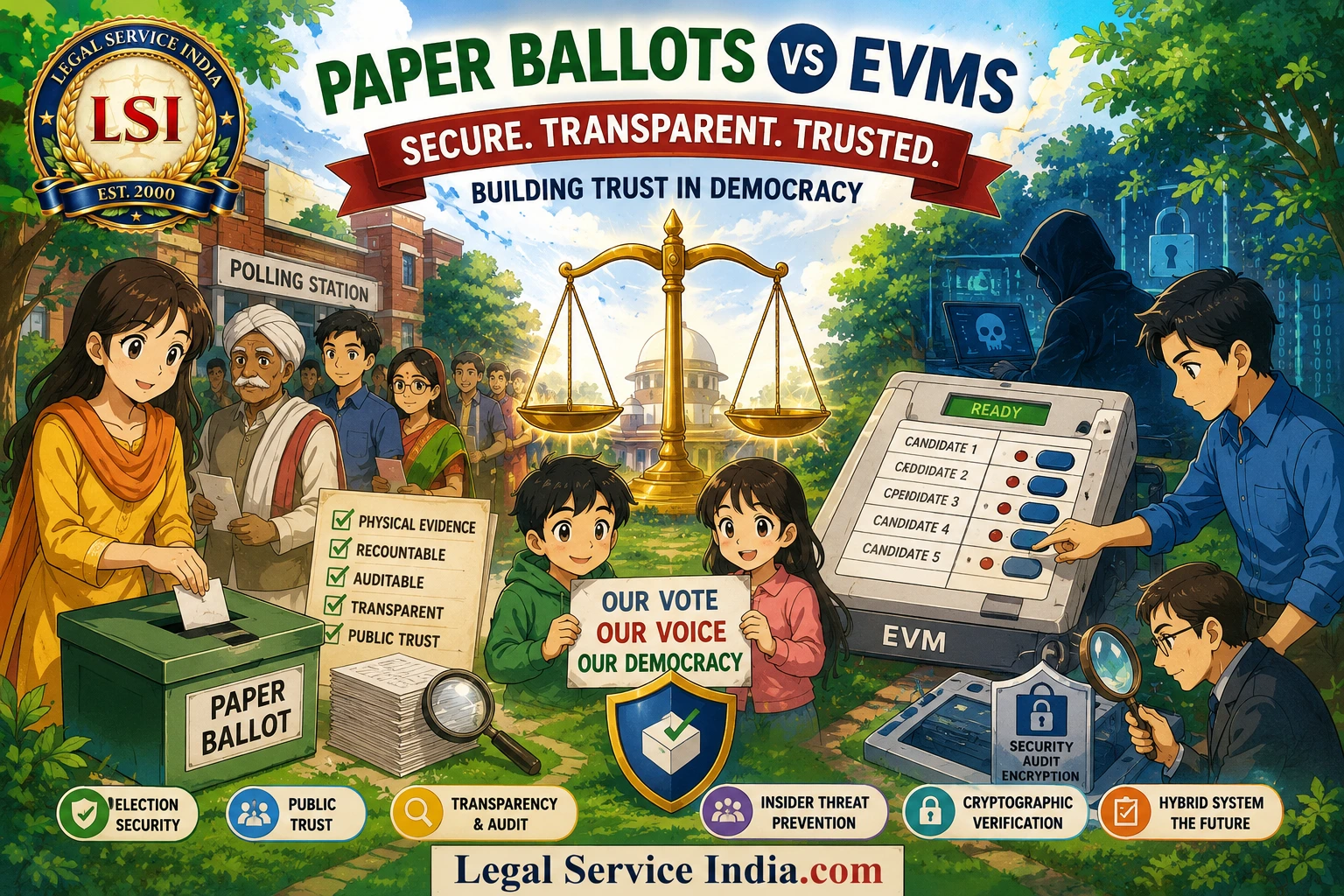
Introduction
Every democracy faces a fundamental question: how can citizens be certain that their vote has been recorded and counted exactly as cast?
For centuries, paper ballots served as the principal mechanism through which democratic societies expressed the will of the people. In recent decades, however, technological advances have led many nations to adopt electronic voting machines (EVMs) and other forms of electronic voting.
Supporters of electronic voting argue that technology has modernised elections, accelerated counting, reduced invalid votes, and minimised traditional forms of electoral malpractice. Critics counter that paper ballots remain superior because they provide tangible proof, facilitate recounts, and inspire greater public confidence.
The debate is often portrayed as a clash between tradition and technology. In reality, it is a much deeper discussion about transparency, accountability, institutional trust, cybersecurity, constitutional legitimacy, and public confidence.
The central issue is not merely whether votes are counted correctly. It is whether citizens believe they are counted correctly.
Democracy depends not only upon accuracy but also upon trust.
The Evolution of Voting Systems
The earliest democratic elections relied entirely on physical voting methods.
Ballots were handwritten, manually counted, and stored as physical records. As populations grew and elections became increasingly complex, governments searched for methods that could reduce errors and improve efficiency.
Electronic voting emerged as a solution.
Countries around the world experimented with various forms of electronic voting:
- India adopted EVMs on a massive scale.
- Brazil embraced nationwide electronic voting.
- Several European nations experimented with electronic systems.
- The United States adopted a mixture of paper and electronic technologies.
Yet the global experience has been mixed.
While some countries expanded electronic voting, others later reintroduced paper-based verification mechanisms after concerns regarding transparency and public trust emerged.
The international experience reveals a crucial lesson:
The challenge is not simply counting votes accurately. It is convincing citizens that the counting process is trustworthy.
Understanding Paper Ballots
A paper ballot allows voters to physically mark their preferred candidate or party and deposit the ballot into a secured ballot box.
The system is straightforward and understandable.
Every vote exists as a physical document.
If disputes arise, ballots can be
- inspected,
- recounted,
- audited,
- and preserved as evidence.
This physicality forms the foundation of the paper ballot’s enduring appeal.
Key Characteristics of Paper Ballots
| Feature | Description |
|---|---|
| Physical Evidence | Every vote exists as a tangible record. |
| Recount Capability | Ballots can be manually recounted when disputes arise. |
| Auditability | Election authorities can conduct audits using original ballots. |
| Transparency | The process is easy for ordinary citizens to understand. |
Understanding Electronic Voting Machines (EVMs)
Electronic voting machines replace traditional paper ballots with electronic recording systems.
Votes are entered electronically and stored digitally.
The primary objectives of EVMs include:
- reducing counting time,
- reducing invalid votes,
- improving efficiency,
- simplifying election logistics,
- minimising certain traditional forms of fraud.
In countries with hundreds of millions of voters, these advantages are significant.
However, EVMs introduce a new challenge:
The vote becomes invisible.
The voter can see the button being pressed but cannot directly observe how the vote is processed internally.
This creates what many experts call the “black box problem”.
Main Objectives of EVMs
| Objective | Expected Benefit |
|---|---|
| Faster Counting | Rapid declaration of results. |
| Reduced Invalid Votes | Fewer ballot-marking errors. |
| Operational Efficiency | Simplified election administration. |
| Improved Logistics | Reduced handling of large volumes of paper ballots. |
| Fraud Reduction | Minimisation of certain traditional malpractices. |
Why Paper Ballots Inspire Greater Public Trust
The strongest argument for paper ballots is not technological.
It is psychological.
Humans instinctively trust what they can see.
A paper ballot can be:
- touched,
- observed,
- stored,
- examined,
- recounted.
Citizens require no specialised knowledge to understand the process.
An elderly farmer, a university professor, a shopkeeper, and a judge can all independently understand how a paper ballot works.
That simplicity generates trust.
The Psychology of Democratic Legitimacy
Election systems are not merely technical mechanisms.
They are instruments of public legitimacy.
A crucial distinction exists between the following:
Technical Trust
Trust based on expert assurances, software verification, and cybersecurity protocols.
Public Trust
Trust based on visibility, transparency, and personal understanding.
EVMs often perform strongly in the first category.
Paper ballots often perform strongly in the second.
The challenge for democracies is balancing both.
Technical Trust vs Public Trust
| Type of Trust | Foundation | Typically Associated With |
|---|---|---|
| Technical Trust | Expert validation, software verification, cybersecurity safeguards | EVMs |
| Public Trust | Visibility, transparency, and personal understanding | Paper Ballots |
Why Many Citizens Remain Suspicious of EVMs
Regardless of official assurances, ordinary citizens frequently raise concerns such as the following:
- Can software be manipulated?
- Can hardware be altered before polling?
- Can insiders influence outcomes?
- Can hidden programming errors affect results?
- How can a voter independently verify what occurred inside the machine?
Importantly, these concerns often exist even in the absence of evidence of fraud.
The concern is not always that manipulation occurred.
The concern is that citizens cannot independently prove that it did not occur.
This distinction is fundamental.
Core Public Concerns About EVMs
| Concern | Underlying Issue |
|---|---|
| Software Manipulation | Fear of unauthorised changes to voting logic. |
| Hardware Tampering | Concerns regarding physical access before elections. |
| Insider Influence | Potential misuse by individuals with privileged access. |
| Programming Errors | Possibility of hidden technical faults. |
| Lack of Independent Verification | Difficulty for voters to personally verify internal processes. |
Conclusion of the Central Debate
The debate between paper ballots and electronic voting machines extends beyond technology.
It touches the very foundations of democratic legitimacy, transparency, accountability, and public confidence.
While EVMs may offer efficiency and speed, paper ballots continue to derive strength from their visibility and auditability.
Ultimately, the question is not only whether elections are accurate but also whether citizens are convinced that they are accurate.
In every democracy, public trust remains as important as technical correctness.
The Strongest Arguments in Favor of EVMs
A balanced discussion must acknowledge that EVMs offer substantial advantages.
| Advantage | Explanation |
|---|---|
| Faster Counting | Results that once required days can often be produced within hours. |
| Reduction of Invalid Votes | Paper ballots frequently generate invalid votes due to improper markings. EVMs substantially reduce this problem. |
| Administrative Efficiency | Large-scale elections involving millions of voters become easier to manage. |
| Reduced Traditional Fraud | Certain historical abuses such as ballot stuffing and mass invalidation become more difficult. |
| Environmental Considerations | Electronic systems may significantly reduce paper consumption in large elections. |
These are genuine benefits and explain why many democracies continue exploring electronic solutions.
The Weaknesses of Paper Ballots
Paper ballots are often romanticised.
However, they possess serious vulnerabilities.
Ballot Box Stuffing
Fraudulent ballots may be inserted into ballot boxes.
Human Counting Errors
Manual counting inevitably introduces the possibility of mistakes.
Slow Results
Large-scale recounts can take days or weeks.
Logistical Challenges
Transporting, securing, and storing millions of ballots requires extensive resources.
Physical Destruction
Ballots may be lost, damaged, stolen, or destroyed.
Paper ballots are transparent but not inherently secure.
The Weaknesses of EVMs
Electronic systems introduce different risks.
Software Vulnerabilities
No software system can ever be declared completely error-free.
Hardware Vulnerabilities
Electronic components can fail unexpectedly.
Supply Chain Risks
Questions may arise regarding manufacturing, maintenance, and component sourcing.
Dependence on Experts
Citizens must rely upon technical specialists to evaluate system integrity.
The Black Box Problem
The inability of ordinary citizens to observe internal operations remains the most persistent criticism.
The Greatest Threat: Insider Collusion
Public debate often focuses on hackers.
Election-security experts increasingly focus on something else:
Insiders.
History shows that many institutional failures result not from external attacks but from trusted individuals abusing legitimate access.
Potential Insiders in Election Systems
Potential insiders include:
- Election officials
- Software engineers
- Storage managers
- Transportation personnel
- Counting officers
- Contractors
- Administrators
If a small group gains control over multiple stages of the process, opportunities for manipulation increase.
This challenge affects both paper ballots and EVMs.
How Democracies Can Reduce Insider Collusion
The solution is not simply better technology.
The solution is better institutional design.
Distributed Trust
No single authority should control:
- Software
- Hardware
- Transportation
- Storage
- Counting
- Auditing
Responsibilities should be distributed among independent institutions.
Open-Source Verification
Election software should be publicly inspectable.
Transparency strengthens confidence.
Public Cryptographic Verification
Independent experts should be capable of confirming that machines run approved software.
Randomized Deployment
Machine allocation should occur through publicly verifiable random processes.
Independent Audits
Audits should be mandatory rather than discretionary.
Citizen Oversight
Ordinary citizens should participate in election observation wherever feasible.
Summary Comparison
| Issue | Paper Ballots | EVMs |
|---|---|---|
| Transparency | High | Often questioned due to the black box problem |
| Counting Speed | Slow | Fast |
| Invalid Votes | Higher possibility | Substantially reduced |
| Logistics | Resource-intensive | More efficient |
| Software Risks | Not applicable | Present |
| Hardware Risks | Minimal | Present |
| Insider Collusion Risk | Possible | Possible |
Lessons from Around the World
Different democracies have adopted different approaches. Some nations prioritise technological efficiency. Others prioritise visible transparency. Many countries increasingly embrace hybrid systems that combine electronic counting with paper verification mechanisms.
The emerging international trend is not necessarily a return to pure paper ballots. Instead, it is a movement toward systems that combine the following:
- Electronic efficiency
- Physical verification
- Public transparency
- Independent auditing
The Future Threat: Artificial Intelligence and Deepfakes
The next generation of election threats may have little to do with voting machines.
Artificial intelligence can generate the following:
- Fake videos
- Fabricated speeches
- Synthetic audio
- Manipulated images
Future elections may be influenced more by information warfare than by ballot manipulation. Protecting democracy therefore requires safeguarding not only vote counting but also public information.
Emerging AI Risks to Democracy
| Threat | Potential Impact on Elections |
|---|---|
| Fake Videos | Misleading voters through fabricated visual content |
| Fabricated Speeches | Creating false political narratives |
| Synthetic Audio | Impersonating public figures and candidates |
| Manipulated Images | Spreading misinformation rapidly across digital platforms |
Beyond Paper Ballots and EVMs: The Triple Verification Democratic System
The future may belong to hybrid systems.
Imagine a voting process where every vote exists simultaneously in three forms:
Physical Record
A voter verifies a paper record that is securely stored.
Digital Record
A digital tally enables rapid counting.
Cryptographic Record
A mathematical audit trail allows independent verification.
Manipulating all three systems simultaneously would be extraordinarily difficult.
This approach seeks to combine:
- The transparency of paper
- The efficiency of electronics
- The security of modern cryptography
Three-Layer Verification Model
| Verification Layer | Primary Purpose | Key Benefit |
|---|---|---|
| Physical Record | Voter verification and recount capability | Tangible evidence |
| Digital Record | Fast vote tabulation | Operational efficiency |
| Cryptographic Record | Independent audit verification | Enhanced security |
The Real Question Democracies Must Ask
The debate is often framed incorrectly.
The question is not
“Which system is perfect?”
No voting system is perfect.
The real question is the following:
“Which system creates the greatest public confidence while maintaining security, transparency, efficiency, and accountability?”
That is the standard by which all election systems should be judged.
Key Evaluation Criteria for Election Systems
- Security
- Transparency
- Efficiency
- Accountability
- Public Confidence
- Auditability
Conclusion
The debate between paper ballots and EVMs ultimately reflects a deeper tension between technological efficiency and public verifiability.
Paper ballots offer visibility, physical evidence, and recountability. EVMs offer speed, efficiency, and protection against several traditional forms of election fraud.
Both systems possess strengths.
Both systems possess vulnerabilities.
The future of election integrity is unlikely to lie at either extreme. Instead, the strongest democracies will likely adopt hybrid systems that combine paper verification, electronic efficiency, independent audits, cryptographic safeguards, citizen oversight, and distributed institutional accountability.
Future Foundations of Election Integrity
- Paper verification
- Electronic efficiency
- Independent audits
- Cryptographic safeguards
- Citizen oversight
- Distributed institutional accountability
Democracy does not survive merely because votes are counted correctly.
Democracy survives because citizens believe that votes are counted correctly.
In the final analysis, the most secure election system is not the one that counts votes the fastest.
It is the one that inspires confidence among both the winners and the losers.
That remains the ultimate test of democratic legitimacy.