





Introduction
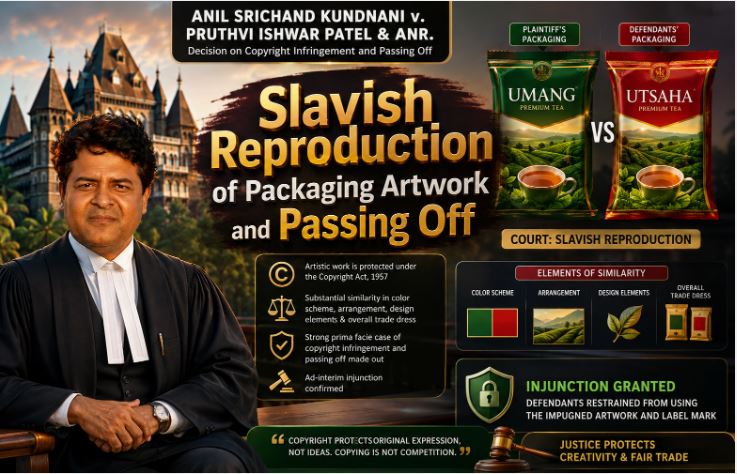
The protection of packaging, labels, and overall trade dress has become increasingly important in modern commerce, particularly in the food and consumer goods industry where visual appearance significantly influences consumer choice. The decision of the Bombay High Court in Anil Srichand Kundnani, Proprietor of Bhagyalaxmi Tea Centre v. Pruthvi Ishwar Patel, Proprietor of Maa Bahucharaji Sales & Anr., is an important ruling dealing with copyright in artistic labels and the law of passing off.
The case involved allegations that the defendants had copied the overall packaging and artistic features of the plaintiff’s well-known “UMANG” tea products and marketed their own tea under the label “UTSAHA”. Apart from issues relating to copyright infringement and passing off, the dispute also raised interesting questions concerning the interplay between the Copyright Act, 1957, and the Trade Marks Act, 1999, the effect of refusal of trademark applications, ownership of artistic works, and the relevance of copyright registrations obtained by rival parties.
The judgement is significant for businesses dealing with packaged goods, intellectual property practitioners, and brand owners because it reiterates that copyright protection extends not merely to ideas but to the manner in which those ideas are expressed through distinctive artistic arrangements and trade dress.
Factual And Procedural Background
The plaintiff, proprietor of Bhagyalaxmi Tea Centre, claimed to have adopted the mark “UMANG” in 2009 for manufacturing and marketing premium packaged tea and related products. Over the years, several trademark registrations and applications relating to “UMANG”, “UMANGAM”, and associated device marks were obtained. The plaintiff also secured copyright registration in respect of one of the artistic labels.
According to the plaintiff, the label and artwork had been conceived and created by him and had acquired substantial goodwill through continuous use and extensive sales. Sales turnover for the period from 2021 to 2024 was stated to be approximately ₹19.58 crores.
In January 2024, the plaintiff allegedly discovered tea products marketed under the label “UTSAHA”. A complaint was lodged, and a cease-and-desist notice dated 15 February 2024 was issued to the defendants. Investigation revealed that the first defendant had applied for registration of the “UTSAHA” device mark on 27 June 2023.
Commercial IP Suit No. 434 of 2025 was instituted before the Commercial Division of the Bombay High Court, seeking remedies for copyright infringement and passing off. On 14 June 2024, the Court granted ex parte ad interim protection restraining the defendants from using the impugned label and directed disclosure by the defendants.
The defendants thereafter filed affidavits opposing continuation of the interim order. They alleged suppression of material facts by the plaintiff and contended that the plaintiff’s copyright registration itself was invalid.
Key Events Timeline
| Year/Date | Event |
|---|---|
| 2009 | Plaintiff adopted the “UMANG” mark for tea products. |
| 2021–2024 | Sales turnover is claimed to be approximately ₹19.58 crores. |
| 27 June 2023 | Defendant applied for registration of the “UTSAHA” device mark. |
| January 2024 | Plaintiff discovered “UTSAHA” tea products in the market. |
| 15 February 2024 | Cease-and-desist notice issued by the plaintiff. |
| 14 June 2024 | The Bombay High Court granted ex parte ad interim protection. |
| 2025 | Commercial IP Suit No. 434 of 2025 was instituted. |
Dispute Before The Court
The principal issue before the court was whether the defendants had copied the plaintiff’s original artistic work embodied in the “UMANG” tea label and whether such copying amounted to copyright infringement and passing off.
The plaintiff contended that the impugned “UTSAHA” packaging was a slavish reproduction of its own label and that the overall colour combination, arrangement of features, depiction of tea cups and cardamom, stylised fonts and trade dress had been copied.
The defendants argued that the plaintiff had concealed material facts, including refusal of an earlier trademark application. They further submitted that the plaintiff was not the owner of copyright because the registration certificate mentioned another person as the author of the artistic work and no assignment deed had been produced.
It was also argued that the plaintiff’s copyright registration was invalid in view of Section 45 of the Copyright Act, 1957. According to the defendants, the common features such as green colour, teacups and cardamom were generic elements ordinarily used in tea packaging, and, therefore, no monopoly could be claimed over them.
Plaintiff Contentions
- The “UTSAHA” label copied the overall packaging and artistic features of the “UMANG” label.
- The colour combination, trade dress, stylised fonts, teacups, and cardamom imagery were substantially reproduced.
- The plaintiff had acquired substantial goodwill through continuous use and extensive sales.
- The defendants’ conduct amounted to copyright infringement and passing off.
Defendants’ Contentions
- The plaintiff had suppressed material facts, including refusal of an earlier trademark application.
- The plaintiff was not the owner of the copyright because another person was shown as the author of the artistic work.
- No assignment deed had been produced to establish ownership.
- The copyright registration was allegedly invalid under Section 45 of the Copyright Act, 1957.
- Features such as green colour, tea cups, and cardamom were generic elements commonly used in tea packaging.
- No monopoly could be claimed over common packaging elements.
Core Legal Issues
| Issue | Question Before The Court |
|---|---|
| Copyright Infringement | Whether the “UTSAHA” label copied the plaintiff’s original artistic work. |
| Passing Off | Whether the defendants’ packaging was likely to mislead consumers. |
| Ownership of Copyright | Whether the plaintiff could claim ownership despite authorship objections. |
| Validity of Registration | Whether the copyright registration suffered from legal defects. |
| Generic Features | Whether common tea-packaging elements could receive protection when arranged in a distinctive manner. |
Reasoning and Analysis of the Court
Upon comparing the rival products, the Court found striking similarities between the competing labels. It observed that the background consisting of shaded green colour, the bed of cardamoms, the placement of the teacup, the stylised font, the colour arrangement and the positioning of various elements were almost identical. The court concluded that the dispute was not confined merely to common features such as teacups or cardamom but involved copying the entire trade dress.
Court Findings on Trade Dress Similarity
- Shaded green background
- Bed of cardamoms
- Placement of the tea cup
- Stylized font design
- Colour arrangement
- Positioning of visual elements
The Court held that copyright protects the expression of an idea and not the idea itself. While the concept of depicting tea and cardamom may be common, the particular manner in which those elements had been arranged and expressed constituted protectable artistic expression.
Admission Through Trademark Opposition
An important circumstance noticed by the Court was that the defendants themselves had opposed registration of the plaintiff’s “UMANGAM” label by alleging deceptive similarity with their own label. According to the Court, such opposition amounted to an implicit admission that the rival artworks were deceptively similar.
Ownership and Assignment Deed Objection
The defendants had argued that the copyright certificate showed a third party as the author and no assignment deed had been produced. The Court rejected this argument on the ground that such a defence had not been pleaded in the affidavits and could not be raised for the first time during oral arguments. Since ownership pleaded by the plaintiff had never been specifically denied, the defendants could not advance an entirely new case at the hearing stage.
Application of Rule 70(3) of the Copyright Rules, 2013
The court referred to Rule 70(3) of the Copyright Rules, 2013, which permits an owner of copyright to seek registration upon furnishing a no objection certificate from the author. Since registration had been granted, the court presumed, at the interlocutory stage, that all necessary documents had been produced before the registrar.
Similar Defect in Defendants’ Copyright Registration
Interestingly, the court noticed that the defendants’ own copyright certificate also showed a third party as author, and no assignment deed had been placed on record. Therefore, the same objection raised against the plaintiff would equally affect the defendants.
Interpretation of Section 45(1) of the Copyright Act, 1957
The Court then examined Section 45(1) of the Copyright Act, 1957, which requires a certificate from the Registrar of Trade Marks certifying that no identical or deceptively similar trademark application has been made by a third party. The Court held that the purpose of the proviso is to avoid conflict between competing claims over identical artistic works.
According to the court, the expression used in Section 45 focuses on the similarity of artistic works and applications made by third parties. Since the trademark applications in question had been filed by the plaintiff itself and the objection raised by the Trade Marks Registry concerned the word mark “UMANG” under Section 11(1) of the Trade Marks Act, 1999, the copyright registration could not be regarded as invalid.
Substantial Similarity Test for Copyright Infringement
The court emphasised that copyright infringement is determined by applying the substantial similarity test. A lay observer examining both products would immediately notice the resemblance between them. The Court held that the defendants had failed to explain how such extensive similarities had arisen.
Cropped Artwork and Packaging Discrepancies
The Court also observed that the defendants had obtained copyright registration only in respect of a cropped version of the artwork and not for the entire packaging actually used by them. Several features appearing on the actual packaging and resembling the plaintiff’s artwork were absent from the registered artwork. The absence of any explanation for this discrepancy persuaded the Court to infer dishonest conduct.
Goodwill, Reputation and Misrepresentation
The Court further held that the plaintiff had established goodwill and reputation in the market since 2009 and had demonstrated substantial sales figures. Consequently, use of deceptively similar artwork by the defendants constituted misrepresentation likely to cause damage to the plaintiff’s business.
Key Legal Principles Applied by the Court
| Issue | Court’s Finding |
|---|---|
| Trade Dress Similarity | The entire trade dress was copied, not merely common elements. |
| Copyright Protection | Protects expression of an idea, not the idea itself. |
| Trademark Opposition | Opposition by defendants indicated admission of similarity. |
| Ownership Challenge | Cannot be raised for the first time during oral arguments. |
| Rule 70(3) | Registration is presumed valid at the interlocutory stage. |
| Section 45(1) | Designed to prevent conflicts regarding identical artistic works. |
| Infringement Test | Substantial similarity test applied. |
| Defendants’ Packaging | Discrepancies suggested dishonest conduct. |
| Passing Off | Goodwill and reputation of plaintiff established. |
Precedents Relied Upon by the Court
While considering authorities cited by the parties, the court referred to the following:
- Sanjay Soya Private Limited v. Narayani Trading Company, IA (L) No. 5011 of 2020, decided on 9 March 2021
- Hiralal Prabhudas v. Ganesh Trading Co., 1983 SCC OnLine Bom 284
- ITC Limited v. Britannia Industries Limited, 2023 SCC OnLine Mad 6972
- Colgate Palmolive Company v. Anchor Health and Beauty Care Pvt. Ltd, 2003 SCC OnLine Del 1005
- Xotik Frujus Pvt. Ltd. v. Bubalus Beverages
- Marico Ltd v. Zee Hygiene Products Pvt. Ltd, IA(L) No. 24055 of 2021, decided on 25th November, 2022, by Bombay High Court
- Hugo Boss Trademark Management GmbH v. Sandeep Arora, 2023:DHC:8930
- Jagdish Gopal Kamath v. Lime & Chilli Hospitality Services Pvt. Ltd., MANU/MH/0384/2015
- Corn Products Refining Co. v. Shangrila Food Products Ltd., AIR 1960 SC 142
- Hygienic Research Institute Pvt. Ltd v. Chandan and Shah Trading LLP, (2025) 1 HCC (Bom) 25
Defendants’ Reliance on Abdul Cadur Allibhoy Case
The defendants had relied upon Abdul Cadur Allibhoy v. Mahomedally Hyderally, Vol. III Bombay Law Reporter 218. The Court held that the principles laid down therein were not applicable to the facts of the present case.
Final Decision of the Court
The Bombay High Court held that the plaintiff had established a strong prima facie case of copyright infringement and passing off. It found that the impugned “UTSAHA” label constituted a substantial and slavish reproduction of the plaintiff’s original “UMANG” artwork.
The Court confirmed the ad interim injunction granted on 14 June 2024 and made the interim application absolute in terms of prayer clauses (a), (b) and (c). Consequently, the defendants were restrained from using the impugned label and from infringing the plaintiff’s artistic work and passing off their products as those of the plaintiff.
Point of Law Settled
The judgement reiterates that copyright protects the expression of an idea rather than the underlying idea itself. Common elements may individually be incapable of protection, but their distinctive arrangement and overall trade dress can constitute protectable artistic expression.
The decision also clarifies that refusal of a trademark application does not automatically invalidate copyright registration under Section 45 of the Copyright Act, 1957. The proviso to Section 45 is concerned with conflicting claims by third parties and not with applications filed by the same applicant.
The ruling further emphasises the importance of the substantial similarity test and the perspective of an ordinary observer in determining copyright infringement. It reinforces that dishonest imitation of overall packaging and trade dress can give rise to both copyright infringement and passing off even where individual features are commonly used in the trade.
Key Legal Principles Emerging from the Judgment
- Copyright protects the expression of an idea, not the idea itself.
- A distinctive arrangement of common elements may qualify for copyright protection.
- Overall trade dress and artistic presentation can constitute protectable expression.
- Trademark refusal does not automatically invalidate copyright registration under Section 45 of the Copyright Act, 1957.
- The substantial similarity test remains central to determining copyright infringement.
- The perspective of an ordinary observer is relevant in assessing infringement.
- Dishonest imitation of packaging and trade dress may amount to both copyright infringement and passing off.
Case Details
| Particulars | Details |
|---|---|
| Title of the Case | Anil Srichand Kundnani v. Pruthvi Ishwar Patel & Anr. |
| Date of Judgment/Order | 08 June 2026 |
| Case Number | Interim Application (L) No. 13908 of 2024 in Commercial IP Suit No. 434 of 2025, along with Interim Application No. 5393 of 2025 |
| Neutral Citation | 2026:BHC-OS:12554 |
| Name of Court | High Court of Judicature at Bombay |
| Name of the Honourable Judge | Justice Sharmila U. Deshmukh |

