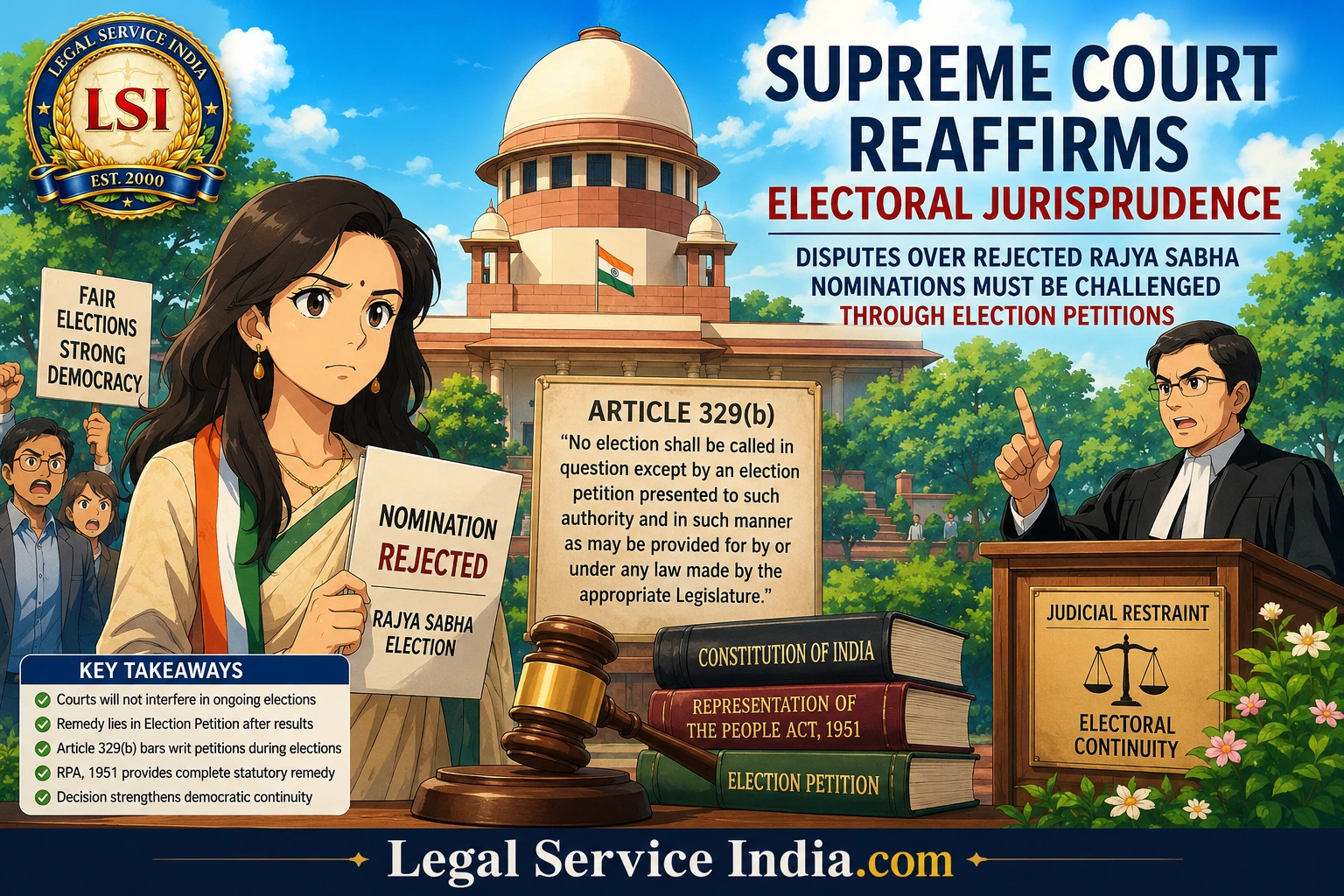
Supreme Court Dismisses Meenakshi Natarajan’s Plea Against Rajya Sabha Nomination Rejection: A Landmark Reaffirmation of India’s Electoral Jurisprudence
(Decision concerning the rejection of nomination papers in a Rajya Sabha election and the maintainability of a writ petition during an ongoing electoral process.)
Introduction
The Supreme Court’s recent refusal to interfere with the rejection of Congress leader Meenakshi Natarajan’s nomination for a Rajya Sabha election is far more than a routine procedural order. Although the controversy emerged from a specific electoral dispute, the judgement touches upon some of the most fundamental principles governing India’s democratic framework.
At its core, the case required the Court to answer a recurring constitutional question:
Can a candidate whose nomination has been rejected during an ongoing election approach the Supreme Court directly through a writ petition, or must the challenge await the conclusion of the election process through an election petition?
The Court’s answer was unequivocal. Reaffirming decades of settled constitutional jurisprudence, it held that electoral disputes arising during an ongoing election should ordinarily be addressed through the statutory mechanism of an election petition after the election process concludes.
The ruling strengthens the constitutional doctrine that courts should avoid interrupting elections midstream and that electoral grievances must generally be resolved through the specialised remedies provided under election laws.
For constitutional lawyers, election law practitioners, political parties, and candidates alike, the judgement is an important reminder of the delicate balance between judicial review and electoral continuity.
| Case | Subject Matter |
|---|---|
| Meenakshi Natarajan v. Election Authorities & Others (2026) | Rejection of Rajya Sabha nomination papers and maintainability of writ petition during an ongoing election process |
Background of the Dispute
The controversy arose during the process of election to the Rajya Sabha, the Upper House of Parliament.
Congress leader Meenakshi Natarajan submitted her nomination papers for contesting the election. During scrutiny, the Returning Officer rejected her nomination.
Aggrieved by the rejection, she approached the Supreme Court, seeking immediate intervention and questioning the legality of the Returning Officer’s decision.
The petition effectively requested the court to exercise its extraordinary constitutional jurisdiction during the pendency of the election process itself.
The challenge therefore raised a larger constitutional issue extending beyond the individual facts of the case.
The Core Legal Question
The principal issue before the Supreme Court was the following:
Whether a writ petition under Articles 32 or 226 can be entertained against the rejection of a nomination paper after the election process has commenced, or whether the aggrieved candidate must await completion of the election and pursue an election petition under election laws?
This question has repeatedly arisen before Indian courts over the last seven decades.
The answer lies in the constitutional architecture governing elections.
Constitutional Framework: Article 329(b)
The cornerstone of the Court’s reasoning is Article 329(b) of the Constitution of India.
The provision states:
“No election shall be called in question except by an election petition presented to such authority and in such manner as may be provided for by or under any law made by the appropriate legislature.”
This provision was consciously inserted by the framers of the Constitution to prevent elections from being stalled through endless litigation.
The constitutional philosophy behind Article 329(b) is straightforward:
- Elections must proceed uninterrupted.
- Democratic governance requires certainty.
- Courts should not become arenas for political contests during elections.
- Election disputes should be resolved through specialised mechanisms after the electoral process concludes.
The Supreme Court has consistently treated Article 329(b) as creating a constitutional bar against judicial interference during the electoral process.
Key Objectives of Article 329(b)
| Objective | Purpose |
|---|---|
| Electoral Continuity | Ensures elections are completed without judicial interruption |
| Democratic Stability | Prevents uncertainty in representative institutions |
| Judicial Restraint | Limits court intervention during ongoing elections |
| Specialized Adjudication | Channels disputes to election petition mechanisms |
Statutory Framework: Representation of the People Act, 1951
The constitutional scheme is complemented by the Representation of the People Act, 1951.
The Act provides an exhaustive mechanism for challenging elections through election petitions.
Grounds include:
- Improper rejection of nomination papers.
- Improper acceptance of nomination papers.
- Corrupt practices.
- Non-compliance with constitutional provisions.
- Violations of election laws.
- Material irregularities affecting election results.
Importantly, Parliament has already contemplated situations involving wrongful rejection of nomination papers and has provided a remedy.
This was a significant consideration supporting judicial restraint in the present case.
Grounds for Election Petition Under the Act
| Ground | Description |
|---|---|
| Improper Rejection | Wrongful rejection of nomination papers |
| Improper Acceptance | Acceptance of invalid nomination papers |
| Corrupt Practices | Electoral misconduct affecting the election |
| Constitutional Violations | Non-compliance with constitutional requirements |
| Election Law Violations | Breach of statutory election provisions |
| Material Irregularities | Procedural defects affecting election outcomes |
Key Takeaways From the Decision
- The Supreme Court reaffirmed the constitutional bar against judicial interference during an ongoing election process.
- Rejection of nomination papers ordinarily must be challenged through an election petition after the election concludes.
- Article 329(b) continues to serve as a cornerstone of India’s electoral jurisprudence.
- The Representation of the People Act, 1951, provides a complete statutory remedy for such disputes.
- The judgement reinforces judicial restraint and protects the continuity of democratic processes.
Why the Supreme Court Declined Intervention
The Court held that once the election process has commenced, judicial intervention should ordinarily be avoided.
Several considerations appear to have guided the decision.
1. Constitutional Bar Under Article 329(b)
The Court reiterated that electoral disputes are generally insulated from judicial interruption until the election process concludes.
2. Availability of an Alternative Remedy
Election petitions exist specifically to adjudicate such disputes.
Where Parliament has created a specialised mechanism, courts are generally reluctant to bypass it.
3. Preservation of Electoral Timelines
Permitting judicial challenges at every stage of nomination scrutiny would make elections vulnerable to repeated delays.
4. Institutional Restraint
The judgement reflects a recognition that election management primarily belongs to election authorities and tribunals designated under law.
Landmark Precedents Supporting the Decision
The ruling is firmly rooted in a long line of constitutional precedents.
| Case | Year | Key Principle Established |
|---|---|---|
| N.P. Ponnuswami v. Returning Officer | 1952 | Electoral disputes after commencement of the election process should ordinarily be challenged only through election petitions. |
| Mohinder Singh Gill v. Chief Election Commissioner | 1978 | Elections should not be interrupted through piecemeal litigation. |
| Election Commission of India v. Ashok Kumar | 2000 | Judicial intervention during elections is permissible only in extremely limited circumstances. |
N.P. Ponnuswami v. Returning Officer (1952)
This landmark Constitution Bench judgement remains the foundation of Indian election law.
The Court held that electoral disputes arising after commencement of the election process should ordinarily be challenged only through election petitions.
The decision established the doctrine that courts should not interfere mid-election.
Mohinder Singh Gill v. Chief Election Commissioner (1978)
The Supreme Court further strengthened the principle of electoral autonomy.
The court emphasised that elections should not be interrupted through piecemeal litigation.
judgementThe judgment remains one of the most cited authorities in election jurisprudence.
Election Commission of India v. Ashok Kumar (2000)
The Court clarified that judicial intervention during elections is permissible only in extremely limited circumstances where intervention does not obstruct or delay the election process.
This case remains the leading authority on the narrow exceptions to the rule of non-interference.
Collectively, these judgements form the jurisprudential foundation supporting the Court’s approach in the Meenakshi Natarajan matter.
Are There Exceptions to the Rule?
An important question often asked by election lawyers is whether Article 329(b) creates an absolute bar.
The answer is no.
The Supreme Court has recognised limited exceptions.
Situations Where Courts May Intervene
- The dispute does not actually challenge an election.
- The election process has not yet commenced.
- Fundamental constitutional violations occur.
- The challenge concerns matters wholly collateral to the election.
- Judicial intervention would not disrupt the electoral process.
However, courts exercise such powers sparingly.
The present dispute involved nomination scrutiny—a matter directly connected with the conduct of the election itself.
Consequently, the Court found no compelling basis to depart from the established rule.
The Significance of Nomination Scrutiny
Nomination scrutiny is among the most critical stages in any election.
A returning officer performs a quasi-judicial function while scrutinising nominations.
The officer must determine whether:
- Statutory requirements are satisfied.
- Necessary declarations have been filed.
- Qualifications exist.
- Disqualifications are absent.
- Procedural compliance has been maintained.
Key Responsibilities During Nomination Scrutiny
| Area of Examination | Purpose |
|---|---|
| Statutory Compliance | Ensures all legal requirements prescribed by election law are fulfilled. |
| Declarations and Forms | Verifies submission of mandatory disclosures and documentation. |
| Candidate Qualifications | Confirms eligibility to contest the election. |
| Disqualification Checks | Determines whether any legal disqualification exists. |
| Procedural Compliance | Ensures adherence to election rules and prescribed procedures. |
Because rejection at this stage effectively excludes a candidate from the contest, scrutiny decisions frequently become contentious.
The present case highlights the immense legal significance attached to this stage of the electoral process.
Judicial Review Versus Electoral Continuity
One of the most fascinating constitutional dimensions of this case is the balance between two competing principles.
Principle One: Judicial Review
The Constitution guarantees access to courts and judicial scrutiny of governmental action.
Principle Two: Electoral Continuity
Democratic elections cannot function if every administrative decision is immediately subjected to judicial intervention.
The Supreme Court has repeatedly sought to reconcile these principles by postponing judicial review rather than eliminating it.
a reviewIn other words, review remains available—but at the appropriate stage through an election petition.
The Meenakshi Natarajan ruling is a textbook example of this constitutional balancing exercise.
Broader Implications for Future Elections
The judgement will likely influence future disputes involving:
- Rajya Sabha elections.
- Legislative Council elections.
- Parliamentary elections.
- State Assembly elections.
- Nomination scrutiny proceedings.
Political parties and candidates must recognise that nomination-related grievances are unlikely to receive immediate judicial relief once the election process has formally commenced.
Instead, they must be prepared to pursue post-election remedies.
This ensures predictability and stability within India’s electoral framework.
Why This Judgment Matters Beyond Politics
Although the case involves a prominent Congress leader, its true significance lies in the principles it reinforces.
The judgement strengthens:
- Constitutional discipline.
- Electoral certainty.
- Institutional restraint.
- Democratic continuity.
- Respect for statutory remedies.
The ruling also serves as a reminder that election law is a specialised branch of constitutional jurisprudence governed by unique procedural rules.
Not every administrative or legal grievance arising during elections can immediately become a constitutional challenge.
Conclusion
The Supreme Court’s dismissal of Meenakshi Natarajan’s challenge to the rejection of her Rajya Sabha nomination represents a powerful reaffirmation of India’s settled election law jurisprudence.
Far from being a mere procedural ruling, the judgement reinforces the constitutional vision underlying Article 329(b): elections must be allowed to run their course without judicial interruption, and disputes must ordinarily be resolved through election petitions after the electoral process concludes.
By refusing to intervene at the nomination stage, the Court has preserved the delicate balance between judicial review and democratic continuity. The ruling draws strength from some of the most influential precedents in Indian constitutional law, including N.P. Ponnuswami, Mohinder Singh Gill, and Ashok Kumar, while simultaneously reinforcing the integrity of the electoral framework established under the Constitution and the Representation of the People Act, 1951.
For lawyers, election administrators, political parties, candidates, and constitutional scholars, the judgement is a significant reminder that democracy depends not only on free and fair elections but also on adherence to the procedural discipline designed to protect them. In that sense, the decision stands as an important contribution to the continuing evolution of Indian electoral jurisprudence and constitutional governance.
Key Takeaways for Election Lawyers and Candidates
The judgement provides valuable guidance for election lawyers, candidates, political parties, and election administrators dealing with nomination disputes and election-related litigation.
| Issue | Supreme Court’s Position |
|---|---|
| Rejection of Nomination | Challenge generally through election petition |
| Writ During Election Process | Ordinarily not maintainable |
| Article 329(b) | Constitutional bar on election challenges during process |
| Judicial Review | Deferred, not excluded |
| Appropriate Remedy | Election Petition under RPA, 1951 |
| Leading Precedents | Ponnuswami, Mohinder Singh Gill, Ashok Kumar |
Constitutional Significance of the Ruling
- Reaffirms the constitutional scheme governing election disputes.
- Strengthens the doctrine of non-interference during an ongoing electoral process.
- Preserves democratic continuity and electoral stability.
- Recognises election petitions as the primary statutory remedy.
- Maintains the balance between judicial review and electoral autonomy.
Impact on Future Election Litigation
The decision is likely to be cited in future disputes involving nomination scrutiny, election procedures, and challenges brought during ongoing electoral processes. It reinforces the long-established principle that courts should ordinarily refrain from interrupting elections and instead allow statutory mechanisms under election law to operate after the electoral process is complete.
As a result, candidates and political parties must carefully evaluate the timing and nature of any legal challenge arising during elections and remain mindful of the constitutional limitations imposed by Article 329(b).