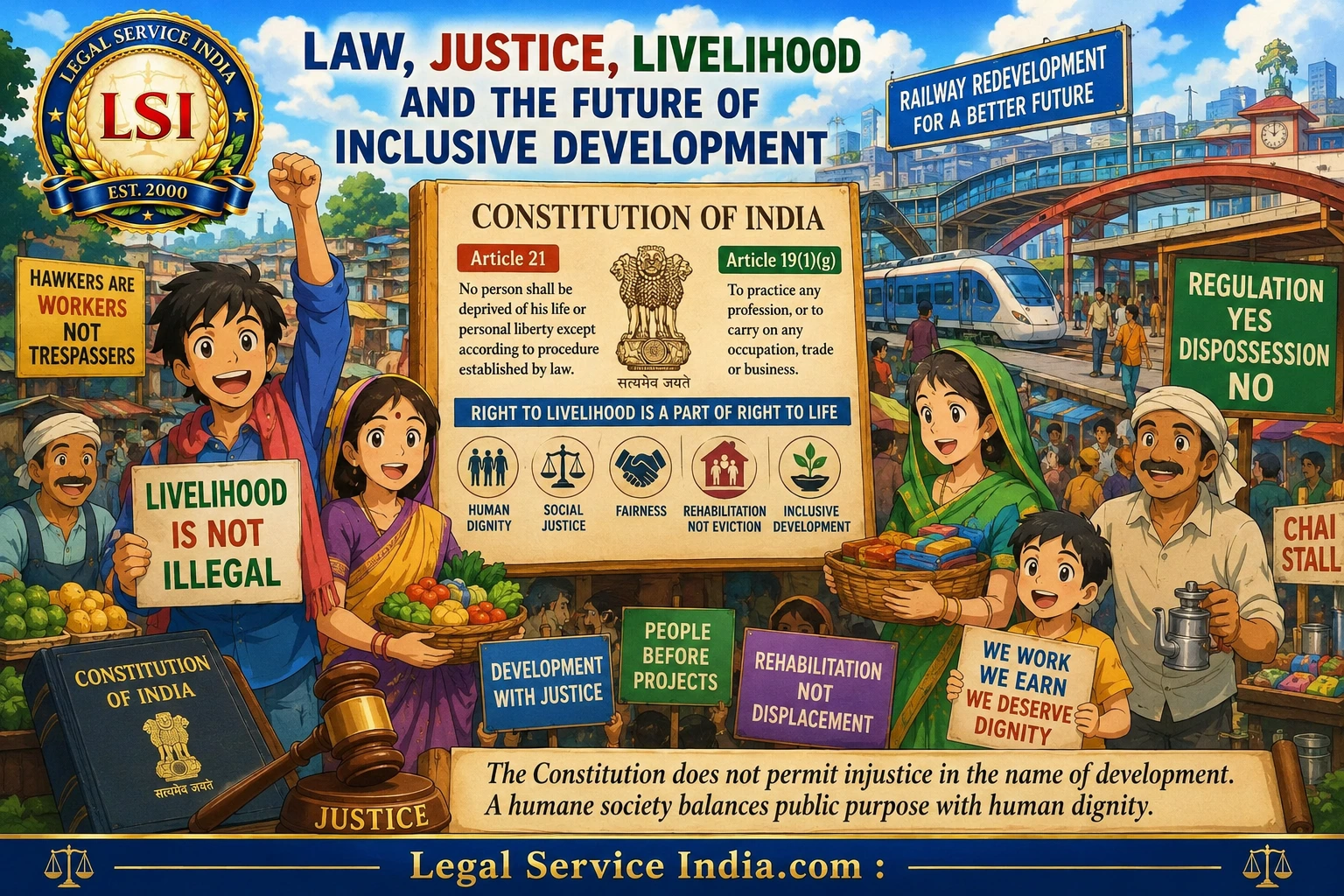
Hawker Evictions, Railway Redevelopment and the Constitution of India: Law, Justice, Livelihood and the Future of Inclusive Development
Introduction
The ongoing eviction of hawkers, street vendors, slum dwellers, and informal traders from railway lands across India has reignited one of the oldest constitutional debates in modern democracies: What happens when the State’s power to develop public infrastructure collides with a citizen’s right to survive?
Supporters of railway redevelopment argue that public land cannot remain under unauthorised occupation indefinitely. Railway stations must be modernised, passenger safety must be ensured, and public assets must be utilised efficiently.
Opponents of the eviction drives argue that millions of poor Indians survive through small-scale trading and informal economic activities conducted around railway premises. They contend that eviction without rehabilitation amounts to destroying livelihoods and pushing already vulnerable populations further into poverty.
This debate is not merely political. It raises profound constitutional questions concerning the relationship between law and justice, property and livelihood, and development and human dignity.
The interview with AIKS General Secretary Shankar Ghosh captures these tensions in sharp terms. Although many of the views expressed are political opinions and remain matters of public debate, the issues raised deserve serious constitutional examination because they touch upon some of the most fundamental rights guaranteed by the Constitution of India.
The Historical Question: How Was Railway Land Acquired?
One of the most striking aspects of the interview is its challenge to the conventional understanding of railway ownership.
The speaker argues that a significant portion of railway land was originally acquired during British colonial rule through coercive acquisition processes that displaced villages, markets, homes, and agricultural communities. According to the interview, compensation was either inadequate or nonexistent in many instances.
Historically, there is no doubt that railway expansion under British rule was facilitated through colonial land acquisition laws that prioritised imperial and commercial interests over the wishes of local populations.
The question raised by the speaker is therefore not whether acquisition was legal under colonial law. Rather, it is whether legality alone can establish moral legitimacy.
This distinction between legality and legitimacy remains relevant even today.
Many actions throughout history have been legally authorised while simultaneously being viewed as unjust by later generations.
The Constitution of India itself emerged partly as a response to such historical injustices.
Consequently, discussions concerning railway land cannot be entirely divorced from the historical circumstances under which much of that land entered governmental control.
Key Historical Issues Raised
- Colonial-era land acquisition practices.
- Displacement of villages and local communities.
- Questions regarding adequacy of compensation.
- Difference between legal authority and moral legitimacy.
- Continuing relevance of historical land acquisition debates.
Law Versus Justice: The Core Constitutional Question
Perhaps the most important philosophical question raised in the interview is:
Which is greater—law or justice?
A constitutional democracy cannot afford to treat these concepts as opposites.
- Law without justice becomes mechanical and oppressive.
- Justice without law becomes uncertain and arbitrary.
- The Constitution seeks to harmonise both.
The Supreme Court has repeatedly held that constitutional interpretation must advance substantive justice rather than merely enforce technical legality.
This principle has influenced judicial decisions involving:
- Slum demolitions
- Pavement dwellers
- Street vendors
- Land acquisition
- Environmental displacement
- Rehabilitation of project-affected persons
The judiciary’s role is not merely to determine whether authorities possess legal power. It must also examine how that power is exercised.
The Right to Livelihood Under Article 21
The strongest constitutional dimension of the hawker debate arises from Article 21.
Article 21
“No person shall be deprived of his life or personal liberty except according to procedure established by law.”
The Supreme Court has transformed this seemingly simple provision into one of the most expansive human rights guarantees in the world.
Olga Tellis v. Bombay Municipal Corporation (1985) 3 SCC 545
This landmark judgement remains the foundation of Indian livelihood jurisprudence.
The court held the following:
- The right to livelihood is an integral component of the right to life.
The Court observed that deprivation of livelihood effectively deprives a person of life itself because survival becomes impossible without means of sustenance.
Although the court did not grant a permanent right to occupy public land, it recognised the harsh reality that poor people often migrate to cities because of economic compulsion rather than personal choice.
The judgement remains directly relevant to the present debate concerning railway hawkers.
Constitutional Significance of Olga Tellis
| Issue | Court’s Position |
|---|---|
| Right to Life | Includes the right to livelihood. |
| Evictions | Cannot ignore livelihood consequences. |
| Public Land | No absolute right to occupy public property. |
| Human Dignity | Central to constitutional protection. |
Article 19(1)(g): The Right to Carry on Trade
The Constitution guarantees every citizen the right to the following:
Article 19(1)(g)
“To practise any profession, or to carry on any occupation, trade or business.”
Street vending and hawking fall within this constitutional protection.
The State may regulate such activities in the interests of public order and convenience.
However, regulation cannot become disguised prohibition.
This principle was emphasised repeatedly by the Supreme Court.
Sodan Singh v. NDMC (1989) 4 SCC 155
The Supreme Court recognised that hawkers possess a constitutional right to carry on trade in public spaces subject to reasonable regulation.
The Court observed that streets are intended not only for movement but also for commercial activity compatible with public convenience.
This judgement fundamentally altered the legal perception of hawkers from “encroachers” to participants in legitimate economic activity.
Key Principles from Sodan Singh
| Principle | Legal Position |
|---|---|
| Street Vending | Protected under Article 19(1)(g). |
| Public Streets | Can be used for regulated commercial activity. |
| Government Regulation | Permissible if reasonable. |
| Complete Prohibition | Constitutionally suspect. |
The Street Vendors Act, 2014: Parliament’s Recognition of Informal Workers
The enactment of the Street Vendors (Protection of Livelihood and Regulation of Street Vending) Act, 2014, represented a significant legislative milestone.
The law recognises that:
- Street vending provides employment.
- It supplies affordable goods to consumers.
- It contributes substantially to urban economies.
The Act seeks to balance competing interests:
| Public Interest | Vendor Rights |
|---|---|
| Passenger safety | Livelihood |
| Urban planning | Economic survival |
| Traffic management | Business continuity |
| Public order | Social justice |
The legislation reflects a constitutional shift from exclusion to inclusion.
The objective is regulation, not eradication.
Article 14 and the Principle of Equality
The interview repeatedly alleges that poor hawkers are being removed while large corporate entities are being invited into redeveloped railway stations.
Whether such allegations are factually correct in every instance requires project-specific evidence.
However, from a constitutional perspective, Article 14 remains relevant.
Article 14 prohibits arbitrary state action.
If similarly situated groups are treated differently without reasonable justification, constitutional questions arise.
Courts may examine:
- Whether small vendors are excluded while larger commercial actors are favoured.
- Whether rehabilitation opportunities are provided equitably.
- Whether policy decisions disproportionately burden economically weaker sections.
The constitutional guarantee of equality extends beyond formal classifications and increasingly addresses substantive fairness.
Directive Principles and Social Justice
The Constitution does not view economic rights as secondary concerns.
Several Directive Principles directly support the concerns raised in the interview.
Article 38
Directs the state to promote social welfare and reduce inequalities.
Article 39(a)
Requires that citizens have adequate means of livelihood.
Article 41
Encourages the state to secure the right to work and public assistance.
Although these provisions are not directly enforceable in court, they significantly influence constitutional interpretation.
The Supreme Court has repeatedly relied upon directive principles when expanding the scope of Article 21.
Development Versus Displacement: A False Choice
One of the most important errors often committed in public discourse is the assumption that development and rehabilitation are mutually exclusive.
They are not.
The real constitutional challenge is not whether railway stations should be modernised.
The real question is the following:
Can modernisation occur without destroying livelihoods?
International experience suggests that the answer is yes.
Many countries have successfully integrated:
- Informal markets
- Small vendors
- Community enterprises
- Local businesses
within modern transportation hubs.
The constitutional vision of development is inclusive rather than exclusionary.
Rehabilitation: The Missing Constitutional Link
The strongest legal criticism that can be made against mass eviction policies is not necessarily that eviction itself is unlawful.
Rather, it is the failure to provide meaningful rehabilitation.
The Supreme Court has increasingly emphasised rehabilitation in cases involving:
- Slum demolitions
- Infrastructure projects
- Land acquisition
- Environmental displacement
Modern constitutional jurisprudence recognises that rehabilitation is often an essential component of procedural fairness.
A humane policy would involve:
- Comprehensive surveys.
- Public consultation.
- Identification of affected families.
- Alternative vending spaces.
- Affordable housing solutions.
- Phased implementation.
Such measures preserve both development goals and constitutional values.
The Economics of Informality
The interview correctly highlights a reality often overlooked by policymakers.
India’s informal sector supports hundreds of millions of people either directly or indirectly.
Many hawkers are:
- Refugees.
- Rural migrants.
- Landless labourers.
- Small farmers displaced by economic distress.
- Workers excluded from the formal labour market.
For such individuals, a tea stall, fruit cart, snack counter, or small kiosk is not merely a commercial enterprise.
It is a mechanism of survival.
The destruction of such enterprises can produce cascading consequences:
- Loss of income.
- Loss of housing.
- Increased indebtedness.
- Child labour.
- Educational disruption.
- Urban homelessness.
These consequences cannot be ignored when assessing public policy.
What Would a Constitutionally Balanced Solution Look Like?
A legally sustainable and morally defensible solution would involve:
Key Elements of a Balanced Constitutional Framework
| Step | Constitutional Requirement |
|---|---|
| First | Recognising the railways’ legitimate ownership and management interests. |
| Second | Recognising the constitutional rights of affected citizens. |
| Third | Creating designated vending zones within or around redeveloped stations. |
| Fourth | Providing rehabilitation before displacement. |
| Fifth | Ensuring transparent public consultation. |
| Sixth | Establishing independent grievance mechanisms. |
- Recognising the railways’ legitimate ownership and management interests.
- Recognising the constitutional rights of affected citizens.
- Creating designated vending zones within or around redeveloped stations.
- Providing rehabilitation before displacement.
- Ensuring transparent public consultation.
- Establishing independent grievance mechanisms.
Such an approach would align development with constitutional morality.
Conclusion
The controversy surrounding railway hawker evictions ultimately transcends the question of land ownership.
At its heart lies a deeper constitutional inquiry:
How should a democratic state treat its most vulnerable citizens while pursuing economic modernisation?
No serious constitutional scholar would deny the importance of railway redevelopment, passenger convenience, or infrastructure modernisation.
Equally, no constitutional democracy can ignore the plight of millions whose survival depends upon informal economic activity.
The Constitution of India does not require a choice between development and dignity.
It demands both.
Constitutional Principles Guiding Inclusive Development
- The right to life includes the right to livelihood.
- Economic modernisation must be balanced with social justice.
- Governance must remain rooted in fairness, equality, and human dignity.
- Development policies should protect vulnerable communities from arbitrary displacement.
- Constitutional morality requires inclusive and participatory governance.
The Supreme Court’s jurisprudence—from Olga Tellis to Sodan Singh and beyond—consistently demonstrates that the right to life includes the right to livelihood and that governance must remain rooted in fairness, equality, and human dignity.
The future of Indian development will not be judged solely by the number of stations modernised, malls constructed, or commercial complexes built.
It will be judged by whether progress includes those standing at the margins of society.
A truly constitutional vision of development is one in which modernisation does not erase the poor but empowers them to participate in the nation’s growth.
That is the real challenge before policymakers, courts, and citizens alike.
Need Legal Assistance?
If you have received an eviction notice, are facing municipal action, or wish to challenge an unlawful demolition before the High Court or Supreme Court, timely legal advice is essential.
Adv. Tarun Choudhury
Supreme Court Lawyer
📞 Phone: 9891244487
📧 Email: [email protected]
For legal consultation, litigation support, writ petitions, stay applications, and constitutional remedies relating to property rights, demolition notices, municipal disputes, and land laws, professional legal assistance can help protect your rights and ensure due process is followed.