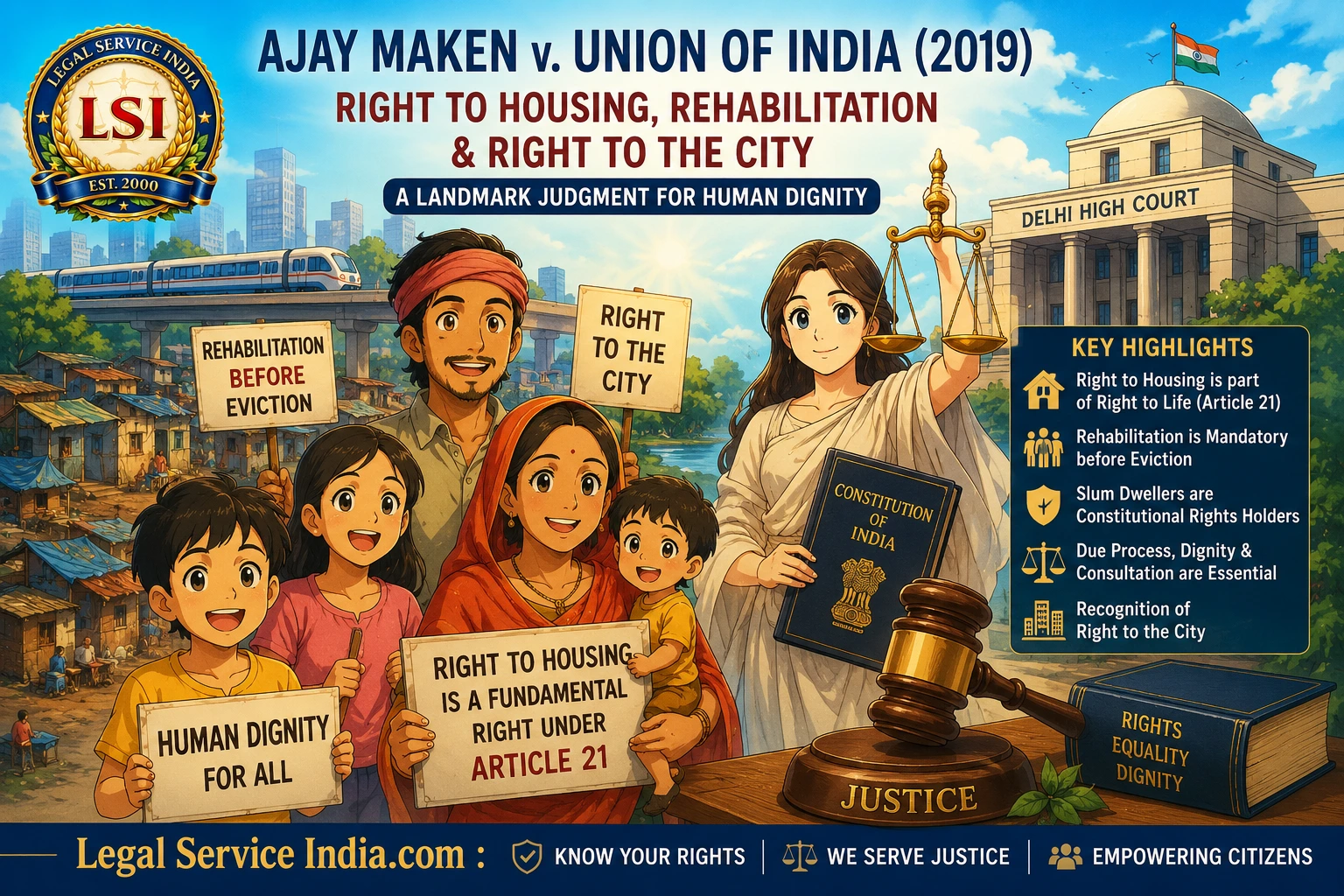
Ajay Maken v. Union of India (2019): The Delhi High Court’s Landmark Recognition of the Right to Housing, Rehabilitation, and the “Right to the City”
Introduction
Few judicial decisions in contemporary India have reshaped the discourse on housing rights as profoundly as the Delhi High Court’s judgement in Ajay Maken v. Union of India.
The case arose from the demolition of approximately 1,200 jhuggis at Shakur Basti, Delhi, in December 2015, resulting in the displacement of nearly 5,000 residents during the harsh winter season. What initially appeared to be a challenge against a demolition drive ultimately evolved into a constitutional examination of the relationship between urban development, human dignity, housing rights, and the obligations of the state.
The Division Bench comprising Justice S. Muralidhar and Justice Vibhu Bakhru delivered a pathbreaking judgement that elevated the legal status of slum dwellers from mere occupants of public land to constitutional rights holders entitled to protection under Articles 14, 19, and 21 of the Constitution.
The judgement is significant not only because it condemns forced evictions without rehabilitation but also because it develops an Indian jurisprudence on the “Right to the City”, integrates international human rights law into constitutional interpretation, and establishes procedural safeguards that must precede any eviction of informal settlements.
In many respects, Ajay Maken represents the most comprehensive judicial exposition on housing rights delivered by an Indian constitutional court.
Case Citation
| Case Name | Ajay Maken & Ors. v. Union of India & Ors. |
|---|---|
| Case Number | W.P.(C) No. 11616/2015 |
| Date of Decision | 18 March 2019 |
| Court | Delhi High Court |
| Citation | AIRONLINE 2019 DEL 523 |
The Background: Shakur Basti Demolition
The litigation arose following the demolition of the Shakur Basti jhuggi cluster on 12 December 2015.
The demolition was carried out by the railways with assistance from the Delhi Police. Thousands of residents were rendered homeless. Families lost not only their shelters but also personal belongings, documents, educational materials, and access to essential civic services.
The matter acquired national attention when reports emerged regarding the death of a six-month-old child during the demolition exercise.
A public interest litigation was filed before the Delhi High Court challenging the legality of the eviction and seeking immediate rehabilitation of the affected residents.
As the proceedings unfolded, the court discovered that the authorities had failed to conduct a mandatory survey of residents and had not prepared any rehabilitation plan before carrying out the demolition.
This failure became the focal point of the litigation.
Key Facts at a Glance
- Approximately 1,200 jhuggis were demolished.
- Nearly 5,000 residents were displaced.
- The demolition took place on 12 December 2015.
- The operation was conducted by the railways with Delhi Police assistance.
- No comprehensive survey of residents was conducted beforehand.
- No rehabilitation plan was prepared prior to eviction.
- The matter reached the Delhi High Court through public interest litigation.
The Constitutional Question Before the Court
The central issue before the Court was not whether the land belonged to the railways.
The real constitutional question was:
Can the State evict thousands of economically vulnerable citizens without first identifying them, consulting them, and providing rehabilitation merely because they occupy public land?
The Court answered this question in the negative.
The judgement emphatically held that constitutional protections do not disappear merely because a citizen is poor or occupies informal housing.
Core Constitutional Issue
| Issue | Court’s Approach |
|---|---|
| Occupation of Public Land | Does not extinguish constitutional protections. |
| Eviction of Slum Dwellers | Must comply with constitutional safeguards. |
| Rehabilitation | Cannot be ignored before large-scale displacement. |
| Human Dignity | Forms an essential component of Article 21. |
From Encroachers to Rights Holders
One of the most transformative aspects of the judgement is its rejection of the traditional administrative approach that labels slum residents as “encroachers”.
The Court observed that many jhuggi dwellers are migrant workers, construction labourers, domestic workers, sanitation workers, street vendors, drivers, and daily wage earners who sustain the urban economy.
The city depends upon their labour.
Yet urban planning often treats them as invisible.
The judgement rejects this contradiction.
The court recognised that the urban poor possess constitutional rights that cannot be sacrificed in the name of development.
This marks a significant shift from a property-centric approach to a rights-centric approach.
Significance of the Shift
- Recognises slum dwellers as constitutional rights holders.
- Moves beyond a purely property-based legal framework.
- Strengthens the protection of dignity under Article 21.
- Highlights the contribution of informal workers to urban development.
- Places rehabilitation and due process at the centre of eviction proceedings.
- Advances the concept of the “Right to the City” in Indian constitutional jurisprudence.
Housing as a Fundamental Right Under Article 21
The Court reaffirmed that the right to housing is an inseparable component of the right to life guaranteed under Article 21.
Importantly, the judgement emphasises that housing is not merely a structure made of bricks and cement.
What Housing Encompasses
Housing encompasses:
- Security of tenure
- Access to employment
- Access to education
- Healthcare facilities
- Water supply
- Sanitation
- Transportation
- Community networks
- Human dignity
The Court therefore viewed housing as a bundle of interconnected rights.
Loss of shelter often results in simultaneous deprivation of multiple constitutional entitlements.
Consequently, eviction without rehabilitation constitutes a direct assault on human dignity.
Key Elements of the Right to Housing
| Component | Significance |
|---|---|
| Security of Tenure | Protection against arbitrary displacement |
| Employment Access | Ensures livelihood opportunities |
| Education Access | Supports children’s development and future prospects |
| Healthcare Facilities | Promotes health and well-being |
| Water and Sanitation | Essential for a dignified life |
| Transportation | Facilitates social and economic participation |
| Community Networks | Preserves social support systems |
| Human Dignity | Core constitutional value protected under Article 21 |
The Evolution of Indian Housing Rights Jurisprudence
The judgement did not emerge in isolation.
It represents the culmination of decades of constitutional development.
Olga Tellis v. Bombay Municipal Corporation
In Olga Tellis (1985), the Supreme Court recognised that eviction of pavement dwellers affects their right to livelihood.
The Court acknowledged that survival and livelihood are inseparable.
Chameli Singh v. State of Uttar Pradesh
In Chameli Singh (1996), the Supreme Court held that the right to shelter forms an integral component of Article 21.
The judgement expanded the meaning of life beyond mere animal existence.
Sudama Singh v. Government of Delhi
The Delhi High Court’s decision in Sudama Singh (2010) represented a major advance.
It held that before any eviction, authorities must
- Conduct a survey;
- Determine eligibility;
- Identify vulnerable residents; and
- Explore rehabilitation measures.
Ajay Maken: The Next Constitutional Step
Ajay Maken builds upon these precedents and converts them into a detailed framework for urban governance.
The judgement effectively operationalises housing rights by prescribing mandatory procedures before displacement.
Landmark Housing Rights Cases
| Case | Year | Key Contribution |
|---|---|---|
| Olga Tellis v. Bombay Municipal Corporation | 1985 | Recognized the link between eviction and livelihood |
| Chameli Singh v. State of Uttar Pradesh | 1996 | Declared shelter an integral part of Article 21 |
| Sudama Singh v. Government of Delhi | 2010 | Mandated surveys and rehabilitation before eviction |
| Ajay Maken | — | Created a structured framework for urban displacement and rehabilitation |
International Human Rights Law and Housing Rights
An extraordinary feature of the judgement is its extensive reliance on international human rights law.
The Court examined:
- International Covenant on Economic, Social and Cultural Rights (ICESCR);
- General Comment No. 4 (Right to Adequate Housing);
- General Comment No. 7 (Forced Evictions).
The Court observed that India ratified the ICESCR in 1979 and therefore bears obligations to progressively realise housing rights.
The judgement reiterates that forced eviction without adequate safeguards violates internationally recognised human rights standards.
International Standards Considered
| Instrument | Purpose |
|---|---|
| ICESCR | Recognizes socio-economic rights, including housing |
| General Comment No. 4 | Defines the right to adequate housing |
| General Comment No. 7 | Provides safeguards against forced evictions |
The Right Against Forced Evictions
The Court held that forced eviction is not merely a property dispute.
It is fundamentally a human rights issue.
Accordingly, the state must ensure the following:
- Genuine consultation;
- Prior notice;
- Transparent decision-making;
- Availability of legal remedies;
- Compensation where necessary;
- Rehabilitation before displacement.
The court emphasised that forced eviction without these safeguards is incompatible with constitutional morality and human dignity.
Mandatory Safeguards Before Eviction
| Safeguard | Objective |
|---|---|
| Genuine Consultation | Ensures participation of affected residents |
| Prior Notice | Provides adequate preparation time |
| Transparent Decision-Making | Promotes fairness and accountability |
| Legal Remedies | Protects access to justice |
| Compensation | Addresses losses where applicable |
| Rehabilitation | Prevents homelessness and social exclusion |
The Revolutionary Concept of the “Right to the City”
Perhaps the most innovative contribution of the judgement is its recognition of the concept known globally as the “Right to the City”.
The Court acknowledged that cities are not exclusive spaces reserved for economically privileged residents.
Urban spaces belong equally to those who build, clean, maintain, and service them.
The judgement recognises that urban poor communities possess a legitimate stake in the city.
This idea shifts the discourse from ownership to participation.
The Court essentially held that development cannot be designed in a manner that excludes those whose labour sustains urban life.
This is one of the first major Indian judicial pronouncements to meaningfully engage with the global concept of the Right to the City.
Core Principles of the Right to the City
- Inclusive urban development
- Equal participation in city life
- Recognition of informal workers’ contributions
- Protection against exclusionary development policies
- Preservation of dignity and social belonging
The DUSIB Act and Statutory Rehabilitation
The Court extensively examined the Delhi Urban Shelter Improvement Board Act, 2010.
It held that the statutory framework requires authorities to prioritise rehabilitation and resettlement.
The DUSIB Act is not merely an administrative statute.
It is welfare legislation intended to protect vulnerable populations.
The Court clarified that rehabilitation obligations must be treated as mandatory and not discretionary.
Significance of the DUSIB Act
| Aspect | Court’s Interpretation |
|---|---|
| Nature of the Legislation | Welfare-oriented statute |
| Primary Objective | Protection of vulnerable populations |
| Rehabilitation Requirement | Mandatory obligation |
| Resettlement Measures | Must be prioritized before displacement |
Applicability to Railway and Central Government Lands
An important issue before the Court was whether the DUSIB framework applies to land owned by central government agencies such as
- Railways;
- DDA;
- CPWD;
- Central government departments.
The Court held that constitutional obligations cannot be defeated by technical ownership claims.
Whether land belongs to the state government or the central government, authorities remain bound by constitutional principles.
The judgement therefore prevents public agencies from bypassing rehabilitation requirements merely by asserting ownership rights.
The Court’s Protocol for Future Evictions
One of the most enduring contributions of the judgement is the requirement of a detailed eviction protocol.
The court directed that future removals must include the following:
Before Eviction
- Socio-economic surveys;
- Identification of eligible residents;
- Public notice;
- Hearing of objections;
- Rehabilitation planning.
During Eviction
- Humane treatment;
- Protection of vulnerable groups;
- Presence of responsible officials;
- Transparency.
After Relocation
- Housing;
- Water supply;
- Sanitation;
- Electricity;
- Schools;
- Healthcare;
- Transportation facilities.
Summary of the Court-Mandated Eviction Protocol
| Stage | Requirements |
|---|---|
| Before Eviction | Socio-economic surveys, identification of eligible residents, public notice, hearing of objections, rehabilitation planning |
| During Eviction | Humane treatment, protection of vulnerable groups, presence of responsible officials, transparency |
| After Relocation | Housing, water supply, sanitation, electricity, schools, healthcare, transportation facilities |
This framework has become a crucial reference point for housing rights litigation across India.
Why the judgement matters beyond Delhi
The significance of Ajay Maken extends far beyond the National Capital Territory.
Indian cities continue to witness the following:
- Slum redevelopment projects;
- Metro rail expansions;
- Highway construction;
- Smart city projects;
- Urban beautification drives.
Each of these projects involves the risk of displacement.
The principles articulated in Ajay Maken provide constitutional safeguards applicable across India.
The judgement reminds governments that development and human rights are not mutually exclusive.
Rather, sustainable development requires respect for human dignity.
Critical Assessment of the Judgment
From a constitutional perspective, the judgement is among the finest examples of transformative adjudication.
Its strengths include the following:
- Integration of constitutional and international law;
- Human-rights-based approach to urban governance;
- Detailed procedural safeguards;
- Recognition of socio-economic rights;
- Expansion of Article 21 jurisprudence.
Constitutional Significance
The judgement’s greatest contribution lies in redefining the relationship between the state and the urban poor.
Instead of viewing informal settlements solely through the lens of illegality, the Court viewed them through the lens of citizenship, dignity, and constitutional justice.
That shift may prove to be the judgement’s most enduring legacy.
Conclusion
The Delhi High Court’s decision in Ajay Maken v. Union of India is a landmark in the evolution of Indian constitutional law.
It transforms housing from a welfare aspiration into an enforceable constitutional entitlement. It recognises that slum dwellers are not obstacles to development but participants in urban life. It affirms that the Constitution protects the weakest citizens as vigorously as it protects the strongest.
Most importantly, the judgement establishes that rehabilitation must precede eviction and that development cannot be pursued at the cost of human dignity.
At a time when Indian cities are rapidly expanding and urban redevelopment projects are accelerating, Ajay Maken serves as a constitutional reminder that the true measure of progress is not the removal of the poor from the cityscape but the inclusion of the poor within the promise of the Constitution.
The decision remains one of the most important judicial pronouncements on housing rights, rehabilitation, and urban citizenship in modern India and will continue to shape constitutional discourse on the right to shelter for generations to come.