





Introduction
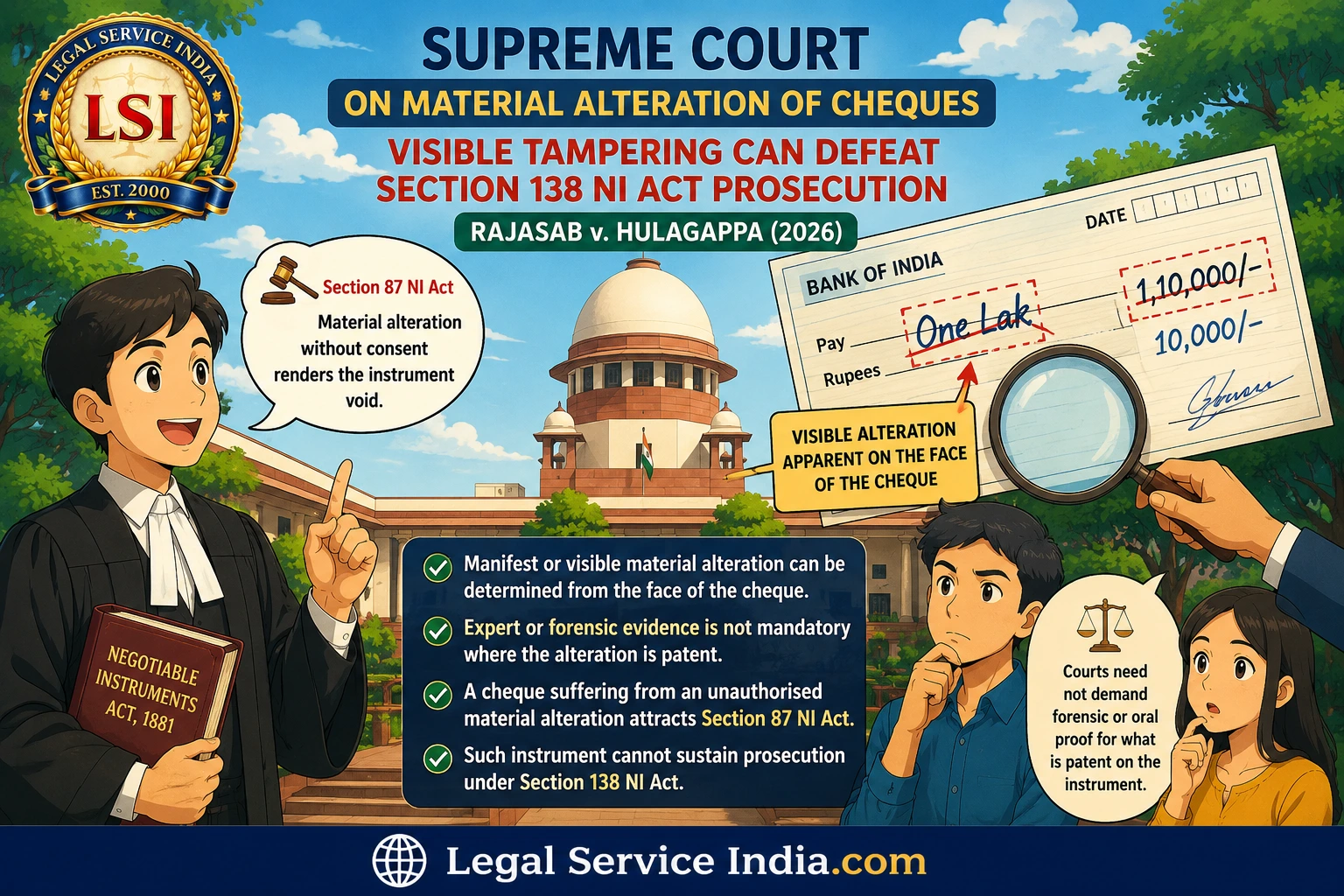
The Supreme Court’s decision in Rajasab v. Hulagappa, Criminal Appeal arising out of SLP No. 17025 of 2025 decided very recently on 17/07/2026 sets aside a conviction under Section 138 of the Negotiable Instruments Act, 1881 (“NI Act”) on the ground that the cheque bore a manifest, visible alteration of its amount, and that courts need not demand forensic or oral proof to confirm what is patent on the face of the instrument.
The ruling anchors itself in Section 87 of the NI Act and sits alongside a coherent line of authority on material alteration, consent, and the statutory presumptions under Sections 118 and 139. This article sharpens the doctrinal boundary between an unauthorized alteration (which voids the instrument) and an authorized filling-in of particulars (which does not).
Facts and Procedural History
The complaint under Section 138 alleged dishonour of a cheque said to be for Rs. 1,10,000, though the appellant maintained that the cheque was originally issued for Rs. 10,000 and later altered by the insertion of the words “One Lak” and the figure “1”.
A bench of Sanjay Kumar and Sanjeev Sachdeva, JJ. allowed the appeal, holding that the Trial Court and the High Court had erred in requiring the accused to independently prove the tampering through expert or other evidence when the alteration was apparent from a bare reading of the cheque itself.
Procedural Timeline
| Stage | Proceedings |
|---|---|
| 2014 | The trial court convicted the accused. |
| 2019 | Sessions Court, Koppal, dismissed the appeal. |
| High Court | Declined to accept the tampering plea and modified the payable amount from Rs. 115,000 to Rs. 110,000. |
| 17/07/2026 | The Supreme Court set aside the conviction and directed a refund of the amounts already paid pursuant to the High Court’s order. |
Legal Significance: Section 87 and the Patent-Alteration Standard
Section 87 of the NI Act renders any material alteration of a negotiable instrument void as against a party who did not consent to it, unless the change carried out the common intention of the original parties, and the provision operates subject to Sections 20, 49, 86 and 125.
Rajasab applies this command directly: where the alteration is visible on the face of the cheque, the criminal process under Section 138 cannot proceed on an instrument whose authenticity is doubtful without more, and the accused should not be penalised for failing to commission a handwriting expert to prove what the document itself discloses.
Key Principles Laid Down by the Supreme Court
- A manifest or visible material alteration can be determined from the face of the check.
- Expert or forensic evidence is not mandatory where the alteration is patent.
- An accused cannot be compelled to prove an obvious alteration through independent expert evidence.
- A check suffering from an unauthorized material alteration attracts Section 87 of the NI Act.
- Such an instrument cannot validly sustain criminal prosecution under Section 138 of the NI Act.
The Apex Court categorically held that the alteration was “manifest,” and expert evidence was not necessary to establish what was patent on the face of the check.
Citation Table: Material Alteration of Cheques Under the Negotiable Instruments Act
The following citation table compiles the leading judicial authorities on Section 87, Section 20, and the statutory presumptions under Sections 118 and 139 of the Negotiable Instruments Act. The original text has been preserved while improving readability and SEO structure.
| Case | Key Legal Principle |
|---|---|
| Rajasab v. Hulagappa (SC) (Cri. Appeal, decided 17.07.2026) | Material alteration visible on the face of the check renders the instrument void at the threshold under Section 87. |
| Pinak Bharat and Company v. Anil Ramrao Naik & Anr. 2023 ALLMR (Cri) 257; Bombay HC, decided 02.12.2022 | Filling date or payee particulars without satisfying Section 87 renders the check void and defeats prosecution under Section 138. |
| Veera Exports v. T. Kalavathy AIR 2002 SC 38; 2001 INSC 553 | Consent and common intention determine whether an alteration is valid under Section 87. |
| Bir Singh v. Mukesh Kumar (2019) 4 SCC 197 | Authorised completion of a blank cheque under Section 20 is not a material alteration under Section 87. |
| Rangappa v. Sri Mohan (2010) 11 SCC 441 | The accused rebuts the Section 139 presumption on a preponderance of probability. |
Supreme Court and High Court Citations
1. Rajasab v. Hulagappa (SC)
(Cri. Appeal, decided 17.07.2026)
2. Pinak Bharat and Company v. Anil Ramrao Naik & Anr.
2023 ALLMR (Cri) 257; Bombay HC, decided 02.12.2022
(S. M. Modak, J.) held that filling in the date/payee particulars without satisfying either limb of Section 87 (consent or common intention) renders the check void, barring Section 138 prosecution.
3. Veera Exports v. T. Kalavathy
AIR 2002 SC 38; neutral citation 2001 INSC 553; [2001] SUPP. 5 S.C.R.
The Apex Court held that a drawer may voluntarily revalidate a check by altering its date, since nothing in the NI Act bars such revalidation, and that whether an alteration was made with consent is a question of fact not to be resolved on demurrer. The High Court’s finding of automatic voidness was treated as premature. Veera Exports therefore holds consent (or its absence) is the fact in issue under Section 87 — a proposition entirely consistent with, and supportive of, the patent-alteration reasoning in Rajasab, since Rajasab concerns an alteration so visible that the factual inquiry into consent becomes unnecessary.
4. Pinak Bharat and Company v. Anil Ramrao Naik & Anr. (Bombay HC, 2022)
The Bombay High Court held that Section 87 permits alteration only in two contingencies — consent of the party affected, or an alteration made to carry out the parties’ common intention — and that filling in a date or payee’s name outside those contingencies renders the cheque void, defeating a Section 138 prosecution. The Court further clarified that this analysis is independent of, and does not overlap with, the Section 118/139 presumption addressed in Bir Singh v. Mukesh Kumar, because Section 87 goes to the threshold validity of the instrument rather than to the burden of proving consideration.
5. Bir Singh v. Mukesh Kumar, (2019) 4 SCC 197—Marking the Boundary
Bir Singh holds that a signed blank cheque voluntarily handed over may have its amount and other particulars filled in by the payee under Section 20, and that this alone does not invalidate the cheque or displace the Section 139 presumption; the onus then shifts to the accused. This authority is added to draw a clean doctrinal line: authorized completion of an inchoate instrument under Section 20 is not a “material alteration” within Section 87, whereas an unauthorized change to an already-completed instrument—as in Rajasab—is. Conflating the two lines of authority is a common drafting error this note is designed to avoid.
6. Rangappa v. Sri Mohan, (2010) 11 SCC 441—The Standard of Rebuttal
Rangappa confirms that the accused’s burden in rebutting the Section 139 presumption is discharged on a preponderance of probability, not proof beyond reasonable doubt. This is the standard against which a tampering defence such as the one in Rajasab must ordinarily be tested — except that, per Rajasab, where the alteration is visible on the face of the instrument, the defence succeeds at the threshold and the accused is not put to even that lower standard of proof.
Genuine Doctrinal Tension
There is a real, unresolved tension between the patent-alteration standard in Rajasab and the reverse-onus architecture of Sections 118 and 139 as explained in Bir Singh and Rangappa. Rajasab effectively creates a threshold carve-out—visible alteration defeats the prosecution without the accused having to discharge any rebuttal burden at all—whereas the ordinary presumption scheme expects the accused to lead evidence, even if only to the civil standard.
This article does not attempt to reconcile the two artificially: the better view is that Rajasab operates as a first-stage check on the document’s validity under Section 87, logically prior to the second-stage presumption inquiry under Sections 118 and 139.
Key Legal Principles at a Glance
- Visible material alteration may invalidate a check at the threshold under Section 87.
- Consent or common intention remains the decisive factual inquiry where alteration is disputed.
- Section 20 authorizes the completion of a validly delivered blank or inchoate check and is distinct from Section 87.
- Sections 118 and 139 create rebuttable presumptions that ordinarily require rebuttal on a preponderance of probability.
- Rajasab introduces a threshold validity analysis before the statutory presumptions become relevant.
Practitioner’s Checklist for Check- alteration Defense
The following checklist provides practical guidance for practitioners dealing with cases involving alleged material alteration of checks under the Negotiable Instruments Act. The original text has been preserved.
- Examine the original check (not a photocopy) for visible interlineations, differing ink, differing handwriting, or crowding of digits/words before framing a defense.
- Where alteration is patent, plead Section 87 at the threshold and resist any suggestion that expert evidence is a precondition to raising the defense.
- Where alteration is not obviously visible, be prepared to discharge the ordinary Rangappa standard—preponderance of probability—rather than relying on Rajasab alone.
- Distinguish, on the pleadings, between an unauthorized alteration of a completed check (Section 87) and the authorized completion of a validly delivered blank/inchoate check under Section 20 (Bir Singh).
- Check whether the alteration was consented to or made to carry out the parties’ common intention—both are complete answers under Section 87, per Veera Exports.
Quick Reference Table
| Issue | Practical Action | Relevant Authority |
|---|---|---|
| Original Check Examination | Inspect the original check for visible alterations before preparing the defense. | Rajasab |
| Patent Alteration | Raise Section 87 at the threshold without treating expert evidence as mandatory. | Rajasab |
| Non-Visible Alteration | Discharge the standard of preponderance of probability. | Rangappa |
| Blank/Incomplete Check | Differentiate Section 87 cases from authorized completion under Section 20. | Bir Singh |
| Consent or Common Intention | Establish consent or common intention where applicable. | Veera Exports |
Case Law Citations
- Rajasab v. Hulagappa, Supreme Court, decided on 17/07/2026.
- Veera Exports v. T. Kalavathy, Supreme Court of India, AIR 2002 SC 38; neutral citation 2001 INSC 553; [2001] SUPP. 5 S.C.R.
- Pinak Bharat and Company v. Anil Ramrao Naik & Anr., 2023 ALLMR (Cri) 257 (Bom.).
- Bir Singh v. Mukesh Kumar, (2019) 4 SCC 197.
- Rangappa v. Sri Mohan, (2010) 11 SCC 441.

