





Kerala High Court Reaffirms the Evidentiary Effect of Sections 118 and 139 of the NI Act
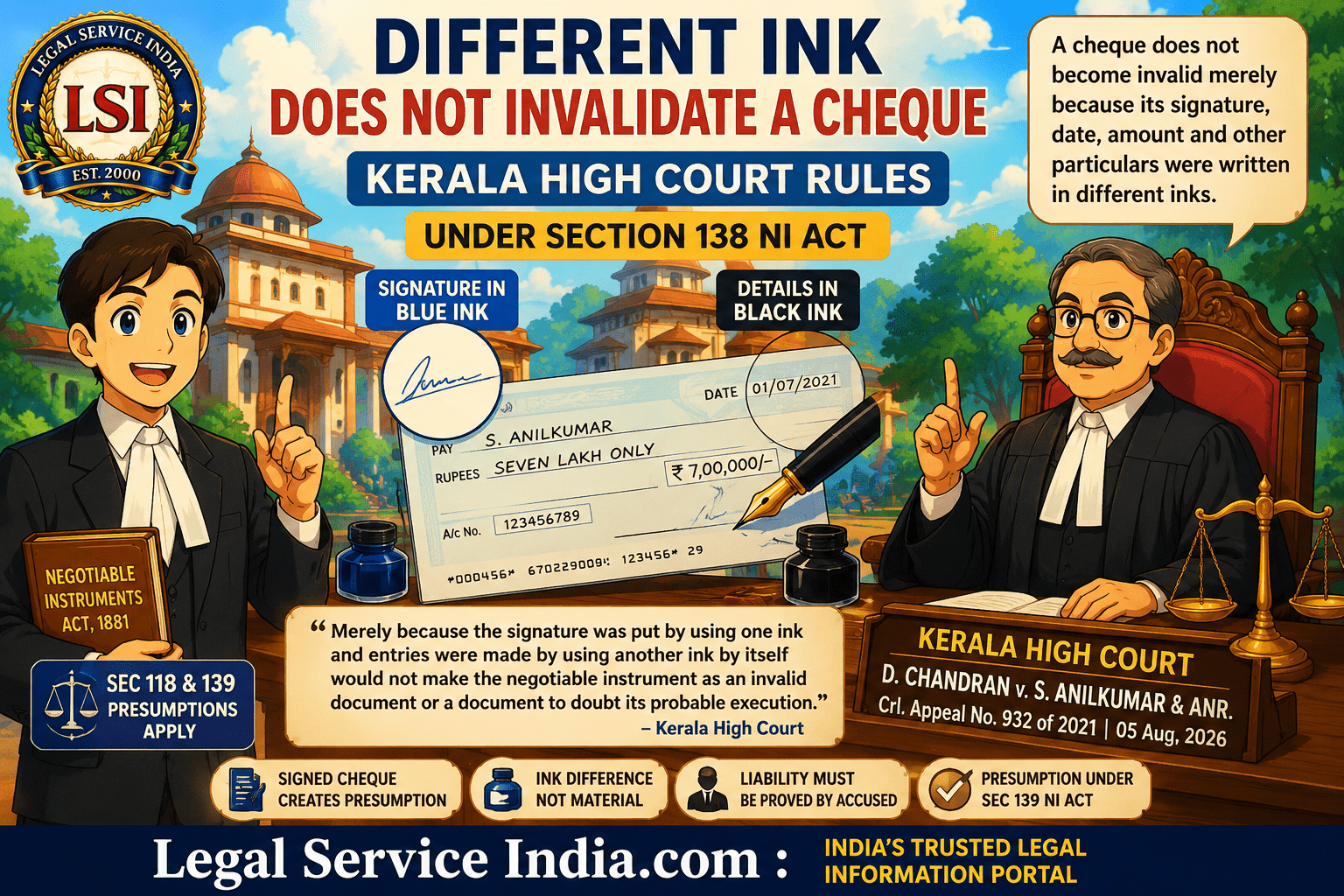
A Cheque Does Not Become Invalid Merely Because Its Signature, Date, Amount and Other Particulars Were Written in Different Inks
It is often seen that cheques are written by the accountant/clerk, or by another partner/director but signed by the authorized signatory, who is different from the person who wrote a cheque. Naturally, the pens & inks would be different. The accused often utilize this discrepancy to assail the case of the complainant pleading preponderance of probabilities against the accused.
Kerala High Court Decision Under Section 138 of the NI Act
The Kerala High Court in the case of D. Chandran v. S. Anilkumar & Anr., Criminal Appeal No. 932 of 2021, citation 2026 LLBiz HC (KER) 159 CNR : KLHC010726012021 recently decided on 5th August, 2026 has held that a cheque does not become invalid merely because its signature, date, amount and other particulars were written in different inks. The decision reinforces the settled principle that variation in ink, or the fact that the cheque particulars were filled in by someone other than the drawer, is not by itself sufficient to defeat prosecution under Section 138 of the Negotiable Instruments Act, 1881 (“NI Act”).
Decision in D. Chandran
In D. Chandran v. S. Anilkumar & Anr., Criminal Appeal No. 932 of 2021, Justice A. Badharudeen allowed the complainant’s appeal against acquittal and convicted the accused under Section 138 of the NI Act.
The cheque involved was for ₹7 lakh and had been dishonoured with the endorsement “payment stopped by drawer.” The accused admitted borrowing ₹2.35 lakh from the complainant and also admitted that the cheque bore his signature. His defence was that two signed blank cheques had been issued as security and that the liability had subsequently been discharged.
The Court found that, except for evidence of repayment of ₹35,000, the accused produced no convincing material to establish payment of the remaining ₹2 lakh. It therefore held that the plea of discharge had not been proved by cogent and convincing evidence.
The Court’s Exact Holding
The Kerala High Court rejected the argument that different inks cast doubt on the execution or validity of the cheque. It held thus:
“Merely because the signature was put by using one ink and entries were made by using another ink by itself would not make the negotiable instrument as an invalid document or a document to doubt its probable execution.”
The decision recognises an important practical reality: a drawer may sign a cheque at one point of time, while the date, amount or payee’s name may be inserted later. The NI Act does not prescribe that all particulars must necessarily be written simultaneously or with the same instrument.
Accordingly, a difference in ink may be a circumstance requiring examination in an appropriate case, but it cannot, without supporting evidence, establish forgery, material alteration, want of consideration or non-execution.
Statutory Scheme
Section 118(a) of the NI Act creates a presumption that a negotiable instrument was made or drawn for consideration. Section 139 further provides:
“It shall be presumed, unless the contrary is proved, that the holder of a cheque received the cheque… for the discharge, in whole or in part, of any debt or other liability.”
These presumptions are rebuttable, but they operate once the foundational facts—particularly the signature or execution of the cheque—are established or admitted.
The burden is therefore not initially on the complainant to prove every aspect of the underlying transaction as though no statutory presumption existed. The accused must first place before the court a probable and legally acceptable defence capable of rebutting the presumption.
Supreme Court Position
The Kerala High Court’s approach is consistent with the authoritative pronouncement of the Supreme Court in Bir Singh v. Mukesh Kumar, (2019) 4 SCC 197. The Supreme Court in the said case held thus:
“A meaningful reading of the provisions of the Negotiable Instruments Act including, in particular, Sections 20, 87 and 139, makes it amply clear that a person who signs a cheque and makes it over to the payee remains liable unless he adduces evidence to rebut the presumption that the cheque had been issued for payment of a debt or in discharge of a liability.”
The Court further clarified:
“It is immaterial that the cheque may have been filled in by any person other than the drawer, if the cheque is duly signed by the drawer.”
It also held thus:
“If a signed blank cheque is voluntarily presented to a payee, towards some payment, the payee may fill up the amount and other particulars. This in itself would not invalidate the cheque.”
The principle was reiterated by the Supreme Court in Oriental Bank of Commerce v. Prabodh Kumar Tewari, Criminal Appeal No. 1260 of 2022; (2022) 7 SCR 72; 2022 INSC 830. The Court held that the presumption under Section 139 arises when the drawer signs and hands over the cheque, and that the question whether the remaining particulars were filled in by the drawer is generally immaterial to determining whether the cheque was issued towards a debt or liability.
The Supreme Court specifically observed:
“The presumption which arises on the signing of the cheque cannot be rebutted merely by the report of a hand-writing expert.”
It added thus:
“Even if the details in the cheque have not been filled up by drawer but by another person, this is not relevant to the defense whether cheque was issued towards payment of a debt or in discharge of a liability.”
Standard for Rebuttal
The presumption under Section 139 is not conclusive. The accused may rebut it by relying on the complainant’s evidence, surrounding circumstances, documents, cross-examination or independent defence evidence.
However, the applicable standard is preponderance of probabilities, not proof beyond reasonable doubt. In Rangappa v. Sri Mohan, (2010) 11 SCC 441, the Supreme Court recognised that Section 139 creates a rebuttable presumption and that the accused may rebut it by raising a probable defence.
The Supreme Court later explained in Oriental Bank of Commerce that the accused need not necessarily enter the witness box, but the defence must nevertheless be sufficiently probable to create a genuine doubt regarding the existence of the legally enforceable debt or liability.
A merely possible explanation is not enough. In the words of the Kerala High Court:
“It is well settled law that when a party asserts discharge of a liability, he must prove the same with the aid of cogent and convincing evidence.”
Thus, an assertion that the cheque was issued as security, or that the debt was repaid, must be supported by credible circumstances such as receipts, bank entries, correspondence, accounts, settlement documents or reliable oral evidence.
Ink Difference and Material Alteration
Section 87 of the NI Act deals with material alteration. A material alteration is one that changes the legal effect of the instrument or affects the rights and liabilities of the parties without the consent of the relevant party.
A mere difference in ink does not, in itself, demonstrate that the contents were unlawfully altered. It does not show what was written originally, when it was written, whether the drawer authorised its completion, or whether the particulars changed the substance of the transaction.
The distinction is important:
| Issue | Legal Significance |
|---|---|
| Different ink | May be a circumstance requiring examination, but does not by itself establish invalidity or fabrication. |
| Signed blank cheque | May still attract the statutory presumption under Section 139. |
| Material alteration | Requires examination of whether the legal effect or rights and liabilities were changed without authority. |
| Repayment defence | Must be supported by cogent and convincing evidence. |
The court must therefore examine the entire evidentiary record rather than decide the case on the visual appearance of the cheque alone.
Application to the Present Case
In D. Chandran, the accused did not merely face an allegation based on ink variation. His signature on the cheque and the borrowing from the complainant were material admissions. His principal defence was repayment of the liability.
The Court found that the repayment plea was inadequately substantiated. Evidence of repayment of ₹35,000 could not establish discharge of the balance amount. The accused’s admission of the loan and issuance of the signed cheque strengthened the complainant’s entitlement to rely on the presumptions under Sections 118 and 139.
The Court also rejected the contention that the complainant’s statement that the money had been kept at his residence was inherently improbable. It observed:
“Keeping money in the house by itself is not an improbability, unless the improbability [is] established by evidence.”
The judgment consequently sets aside the acquittal and records conviction under Section 138. The accused was sentenced to simple imprisonment till the rising of the court and directed to pay a fine of ₹8.15 lakh, with six months’ simple imprisonment in default.
Evidentiary Lessons
The ruling carries the following practical implications for cheque-dishonour litigation:
- Different inks should not be treated as conclusive proof of fabrication or invalidity.
- Admission of the signature materially strengthens the complainant’s case.
- A signed blank cheque may still attract the presumption under Section 139.
- The accused must rebut the presumption through a probable and evidence-based defence.
- A claim of repayment should ordinarily be supported by documentary or reliable independent evidence.
- A handwriting or ink expert’s opinion cannot, by itself, determine whether the cheque was issued in discharge of a debt.
- Courts should distinguish between a visual irregularity and a legally proved material alteration.
- The complainant must still establish the statutory requirements of Section 138, including presentation, dishonour, legally compliant notice and failure to make payment within the prescribed period.
Doctrinal Significance
The judgment does not mean that every cheque containing entries in different inks must automatically result in conviction. The accused remains entitled to prove that the signature was forged, the cheque was stolen, the instrument was materially altered without authority, the debt did not exist, or the liability had already been discharged.
Its narrower and significant holding is that different ink is only a circumstance; it is not a legal invalidating factor by itself. The decisive inquiry remains whether the cheque was voluntarily signed and delivered, whether a legally enforceable debt or liability existed, and whether the accused has rebutted the statutory presumptions through credible evidence.
The Kerala High Court’s decision in D. Chandran v. S. Anilkumar therefore strengthens the evidentiary discipline required in Section 138 proceedings: courts must decide cheque cases on admissions, presumptions, probabilities and corroborative evidence—not on the color of ink alone.

