





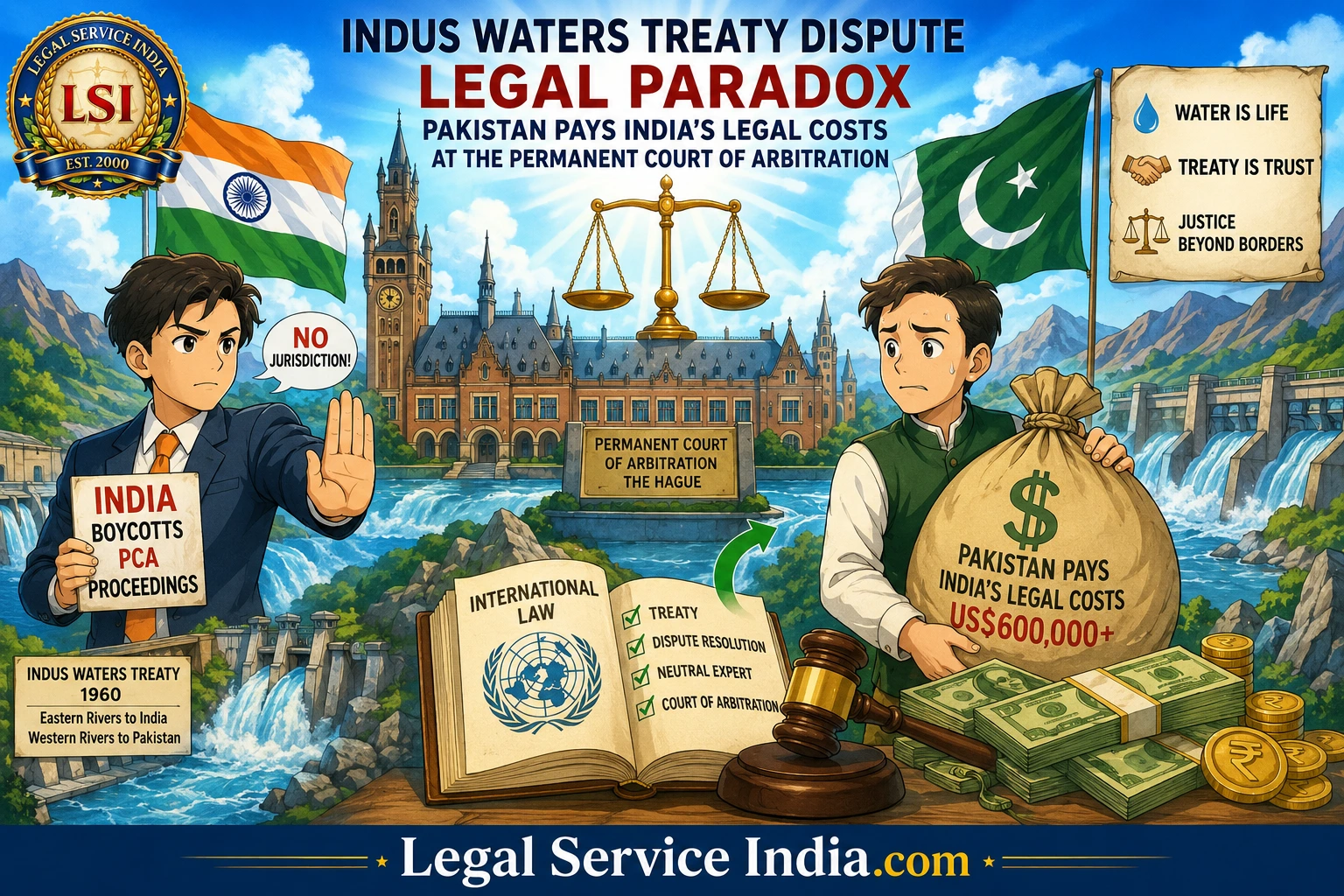
Pakistan Paying India’s Legal Costs Under the Indus Waters Treaty: A Legal Paradox With Global Consequences
The adage in international diplomacy is “The one who calls the tune pays the piper.” In the ongoing, growing acrimony over the Indus Waters Treaty (IWT), however, the geopolitical situation has got a strange twist. Islamabad has, in recent reports up to July 2026, and in the most unusual of circumstances, ended up paying not just its own legal costs, but also those of its bitter rival, India, at the Permanent Court of Arbitration (PCA) in The Hague.
For the average person, it appears to be a typographical mistake. For the legal scholar, it is a “dilemma” that is “utterly bizarre” and “a legal conundrum” that could “endanger” one of the most effective transboundary water accords in modern history. For the legal scholar it is a “legal dilemma” that could “endanger” one of the most effective transboundary water accords in modern history and is “utterly bizarre.” The question now is not only about the flow of water; it’s really about the survival of international law in South Asia, as Pakistan has already spent over $600,000 to cover arbitration costs, which India will cover.
The Genesis: A Treaty Under Pressure
The Indus Waters Treaty, which was signed in 1960 with the help of the World Bank, has always been called a miracle of diplomacy. India and Pakistan have followed these cardinal principles for more than 60 years, even in the face of three major wars and numerous skirmishes along the border.
River Allocation Under the Treaty
| Eastern Rivers (India) | Western Rivers (Pakistan) |
|---|---|
| Sutlej | Indus |
| Beas | Jhelum |
| Ravi | Chenab |
But the treaty includes a provision for India to use the western rivers for power generation “in a limited manner,” subject to certain technical specifications.
The ongoing firestorm focuses on two such projects in Jammu and Kashmir:
- 330 MW Kishanganga Hydroelectric Project on the Tributary of Jhelum.
- 850 MW Ratle Project on the Chenab.
Pakistan claims the design and implementation of the “pondage” (water storage for power generation) and positioning of the intake tunnels enable India to “telegraph” or manipulate water releases, which could lead to floods or droughts in the Pakistani agricultural belt or heartland. India’s designs are certainly “run of the river” and completely in line with the technical annexures of the treaty, India maintains.
The Procedural Quagmire: “Double-Tracking” the Dispute
The legal conundrum started in 2016.
The IWT has a tiered dispute resolution process that includes the following steps:
- Permanent Indus Commission: Standard level of bilateral technical talks.
- Neutral Expert: Appointed because of “differences” that are “technical” in nature.
- Court of Arbitration (CoA): For “disputes” over the meaning or application of the treaty.
In 2016, Pakistan requested the World Bank to set up a court of arbitration. India, feeling a sense of strategic and legal trespassing, countered by asking for the appointment of a neutral expert. The World Bank’s requests were temporarily suspended for several years so as to allow time for bilateral negotiation. If this failed, in late 2022, the bank made a controversial decision, permitting both processes to proceed at the same time.
This made for a “procedural nightmare.” India contended that it would be impossible to have two separate bodies—one the Neutral Expert and the other a Court of Arbitration—deciding on the same technical matters since there was a risk of contradictory decisions being passed.
India’s Position on the PCA Proceedings
India’s reaction was rapid and one-sided. The Hague is being called “unfair,” and New Delhi said it will boycott the proceedings under the PCA as it did not have jurisdiction. From India’s point of view, the establishment of the PCA was “illegal,” as it skips India’s “Neutral Expert” stage.
In 2023, India had also issued a formal notice asking Pakistan to change the treaty as per Article XII(3). In this way, India has put the dispute resolution mechanism of the treaty “on hold.” This way, India effectively parked the treaty’s dispute resolution process “on hold.”
That’s where the money irony starts. Article IX of the IWT states that both countries are to cover the costs of any arbitration equally. If one party does not agree to the existence of the court, however, the court won’t pay its own light bill.
The Financial Paradox: Pakistan’s $600,000 Gamble
The PCA must have financial resources to pay judges, administrative staff and to rent the Peace Palace in The Hague. If the bills are not paid, the proceedings are suspended.
The proceedings are not happening, and Pakistan is in dire need of an international law decision that would prevent India from building dams. Hence, Islamabad has had to “bear” India’s financial burden. The decision by Pakistan to foot its own arbitration fees is the country essentially paying for a sham legal process as India’s opponent.
The interesting thing is the way this setup is creating a bizarre situation in which a country in dire economic straits is paying legal fees to a much larger country that’s in much better economic condition for the purpose of keeping the seat of an Indian opposition member. This is a strange situation that’s created because a country that’s in terrible economic shape is paying the legal fees for another country that is far bigger and far richer and that’s not planning to even fill the seat with an Indian member of the opposition.
When You Have a Legal Dilemma: Jurisdiction v. Enforcement
The heart of the legal quagmire is the notion of “non-appearance.” As in the Philippines v. China South China Sea arbitration, the absence of a party doesn’t mean that a court cannot act or issue a judgment in international law. But it’s a significant difference between winning the law and enforcing it on the ground.
The Sovereignty Trap
If the PCA decides India’s dam plans are in violation of the treaty, then India has already indicated that it will consider the ruling “null and void.” There is no “consent,” the cornerstone of international arbitration, without India’s participation.
The World Bank’s Dilemma
The World Bank is in a dilemma as the guarantor of the treaty. It gave both sides the opportunity to allege the other is being dishonest.
The ‘Vitiation’ of the Treaty
India’s attempt to amend the treaty indicates that New Delhi does not think that a 1960 document can address the problems of 2026. Climate change is changing the patterns of glacial melt, and rising population is creating more water demand. India believes the ‘Neutral Expert’ is the only logical way to do the technical adjustments, and the PCA is a ‘political’ instrument being played by Pakistan.
Geopolitical ramifications extend beyond the bank accounts.
Geopolitical Ramifications Beyond the Legal Fees
It is not only a financial curiosity that Pakistan is paying India’s bill but also an indication of desperation as well. Water is not a mere problem for Pakistan; it is an existential issue. 90% of its agriculture is done using the Indus system water. If there is any threat to that flow, it is viewed as a national security problem.
The attitude of India is that of “principled non-cooperation.” India thus tries to discredit the legitimacy of the role of the PCA in the Indus Treaty. India is pushing for a bilateral agreement in which it has a greater say than an international one with third parties (in this case, the PCA judges) having the final say.
What About the Future: A Treaty on Life Support?
What is the impact of the PCA’s eventual ruling? India will defy it if it rules in favor of Pakistan. Pakistan will have paid for their own loss if it is found in favor of India, which will cost them millions of dollars.
The true horror of the “arbitration bill” is that it’s a sign of the loss of trust. The IWT was supposed to be an instrument that would help make water a tool for peace, but it has become one that will help make water a tool for “lawfare.”
Key Questions Before International Law
Looking ahead to the rest of 2026, the issue before the courts is
- Is it possible for a treaty to live if one party desires to rewrite it and the other party is paying to litigate a 60-year-old version of it?
- Can these international courts remain relevant if the powerful ones of a region choose not to step in?
While Pakistan may be footing India’s legal costs this time, the repercussions of this, if the Indus Waters Treaty goes under the burden of these procedural battles, will be much greater for the two countries than $600,000. It will be judged by how dry the fields are, how quiet the turbines are, and whether there will be a war that no court, whether paid or not, will be able to settle.
Key Takeaways
- The Indus Waters Treaty remains one of the world’s most significant transboundary water agreements.
- The simultaneous operation of the Neutral Expert and PCA mechanisms has created an unprecedented procedural conflict.
- Pakistan has reportedly borne arbitration expenses that also cover India’s unpaid share.
- India continues to challenge the PCA’s jurisdiction and supports resolution through the Neutral Expert mechanism.
- The dispute has implications extending beyond water management to international arbitration, treaty interpretation, and regional stability.
End-Notes:
- https://treaties.un.org/doc/Publication/UNTs/Volume%20419/volume-419-I-6032-English.pdf
- https://pca-cpa.org/en/cases/284/
- https://www.stimson.org/2024/a-shared-interest-why-india-and-pakistan-should-strengthen-the-indus-waters-treaty/
- https://www.mea.gov.in/press-releases.htm?dtl/36149/India_participates_in_the_hearing_of_the_Neutral_Expert_proceedings_related_to_the_Kishanganga_and_Ratle_Projects
- https://www.hindustantimes.com/india-news/india-serves-formal-notice-on-pakistan-to-review-and-modify-indus-waters-treaty-101726656572555.html
- https://mea.gov.in/bilateral-documents.htm?dtl/6439/Indus+Waters+Treaty+1960
- https://www.peacepalace.org/
- https://pca-cpa.org/en/cases/7/
- https://www.worldbank.org/en/home
- https://timesofindia.indiatimes.com/world/pakistan/indus-waters-treaty-fallout-nearly-a-third-of-pakistan-reels-as-sindh-balochistan-face-water-crisis/articleshow/131698486.cms
- https://www.mea.gov.in/bilateral-documents.htm?dtl/6439/Indus_Waters_Treaty_1960
- https://www.lawfaremedia.org/about
Written by: Shreya Amlani and Sankalp Mirani
Important Links
Important Links:
- Lawyers in India
- Copyright Registration in India
- Caveat Filing in Supreme Court of India
- Mutual Consent Divorce in Delhi NCR: WhatsApp 9650499965

