





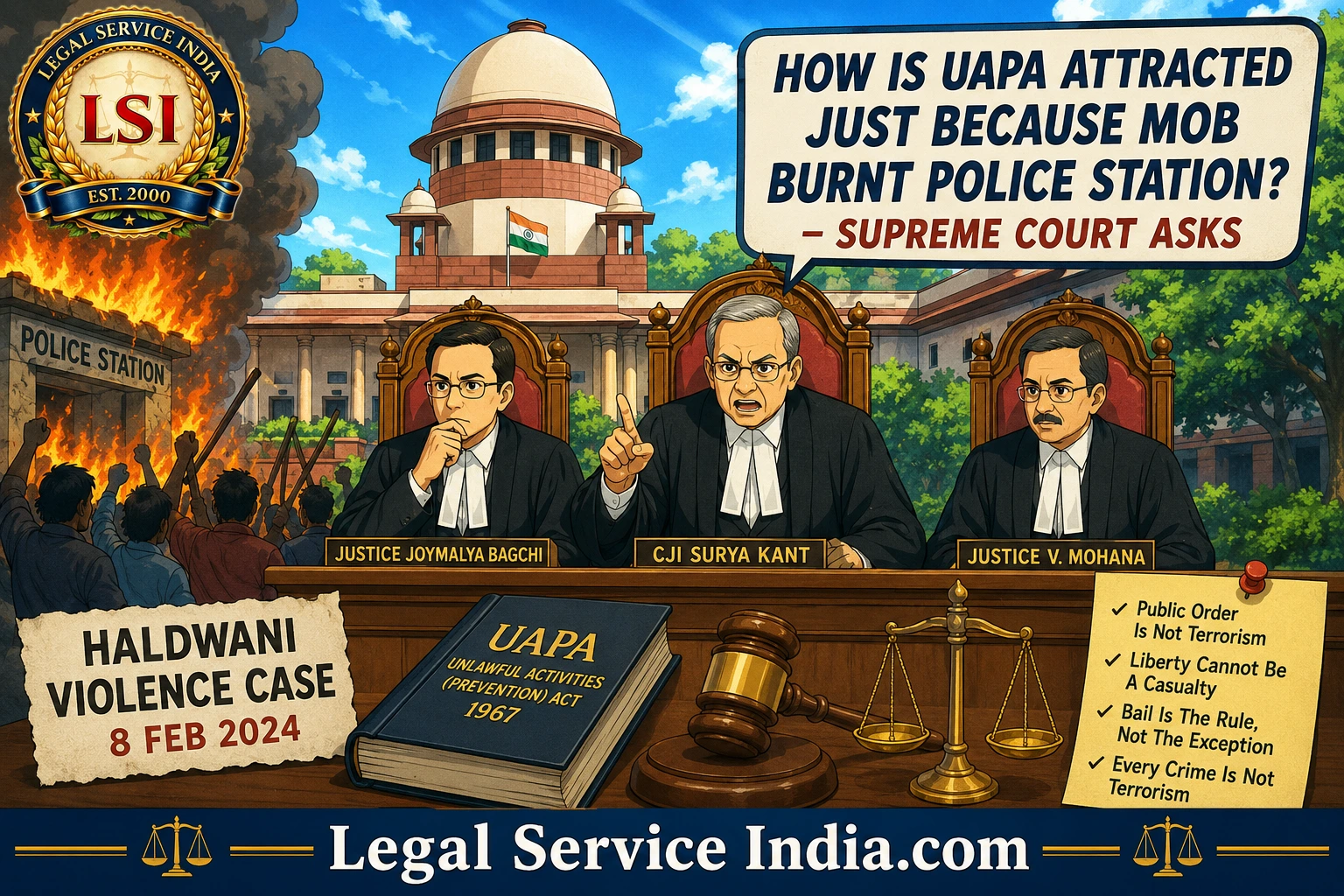
How Is UAPA Attracted Just Because Mob Burnt Police Station? Supreme Court’s Significant Observations in the Haldwani Violence Case
The Supreme Court’s latest observations in the Haldwani violence case have once again brought into sharp focus the limits of the Unlawful Activities (Prevention) Act, 1967 (UAPA) and the constitutional balance between national security and personal liberty.
In a significant order delivered on 31 July 2026, a three-Judge Bench comprising Chief Justice Surya Kant, Justice Joymalya Bagchi, and Justice V. Mohana dismissed the Uttarakhand Government’s challenge to the bail granted to Abdul Malik by the Uttarakhand High Court. More importantly, the Bench openly questioned the very applicability of the anti-terror law to the allegations arising out of the 2024 Haldwani violence.
The Court’s pointed query—
“How is UAPA attracted just because the mob burnt the police station?”
—is likely to become one of the most discussed judicial observations on the scope of India’s anti-terror legislation.
Citation
| Case | State of Uttarakhand v. Abdul Malik |
|---|---|
| Case Number | SLP (Criminal) No. 12779 of 2026 |
| Court | Supreme Court of India |
| Date of Decision | 31 July 2026 |
Background of the Haldwani Violence
The controversy stems from the Banbhoolpura violence in Haldwani on 8 February 2024, which erupted following an anti-encroachment drive involving demolition of an allegedly unauthorized madrasa and mosque.
According to the prosecution:
- A large mob allegedly attacked police personnel;
- Police vehicles were burnt
- Petrol bombs were allegedly used
- The Banbhoolpura Police Station was set on fire
- Several police officers sustained injuries.
Abdul Malik was alleged to be one of the principal conspirators behind the violence. He was subsequently booked under multiple provisions of the IPC, the Arms Act, and the UAPA.
Why Did the High Court Grant Bail?
The Uttarakhand High Court granted bail on 16 April 2026 after noting, among other things:
- The investigation itself suggested that Abdul Malik was not physically present at the place of occurrence;
- Similarly placed co-accused had already obtained bail;
- The prosecution material did not conclusively establish conspiracy at the stage of bail.
The State challenged the order before the Supreme Court, arguing that:
- Malik was the principal conspirator;
- Physical presence was unnecessary where conspiracy was alleged;
- The High Court had ignored the restrictive bail provisions contained in Section 43D(5) of UAPA.
Supreme Court’s Central Question: Does Every Violent Riot Become Terrorism?
The most remarkable aspect of the hearing was not the dismissal of the State’s appeal but the Court’s questioning of the legal foundation for invoking UAPA itself.
During arguments, the State contended that the police station had been attacked using petrol bombs and that such acts justified invocation of UAPA.
Justice Joymalya Bagchi, however, posed a fundamental constitutional question:
“If a mob goes and burns down a police station, will that per se attract UAPA?”
When the State attempted to justify the invocation by referring to disturbance of public order, the Court distinguished public order from national security, observing that the two cannot automatically be equated.
The Bench even remarked that it had “serious doubt” regarding the addition of UAPA charges.
Public Order Is Not the Same as Terrorism
The observations reaffirm an important constitutional principle that has consistently emerged from Indian jurisprudence.
- Every violent offense is undoubtedly serious.
- Every riot deserves prosecution.
- Every attack on police personnel deserves strict punishment.
- Yet, every criminal act is not terrorism.
The distinction has always been critical because UAPA is not an ordinary criminal statute. It is India’s principal anti-terror legislation, carrying exceptionally stringent provisions regarding investigation, custody, and bail.
Merely because public property has been damaged or a police station has been attacked does not automatically transform the incident into an act threatening the sovereignty, integrity, or security of the nation.
The Court’s oral observations reinforce this doctrinal distinction.
Importance of Section 43D(5) of UAPA
One of the most controversial provisions under UAPA is Section 43D(5).
Unlike ordinary criminal law, where bail is generally the rule, Section 43D(5) places a substantial restriction upon the grant of bail if the court finds reasonable grounds for believing that the accusation is prima facie true.
Consequently, the very decision to invoke UAPA has enormous consequences.
It affects:
- liberty;
- duration of incarceration;
- evidentiary burden;
- investigation;
- trial strategy;
- possibility of prolonged custody before conviction.
Therefore, courts have repeatedly emphasized that UAPA cannot be invoked casually or mechanically.
Liberty Cannot Depend Merely Upon the Quality of Judicial Reasoning
Another noteworthy aspect of the judgment concerns appellate interference with bail.
The State argued that the High Court’s order lacked elaborate reasoning and therefore deserved to be set aside.
Justice Bagchi responded with an important observation:
the inaccuracy”Liberty does not depend on inaccuracy of a court. It depends on the prosecution case.”
Chief Justice Surya Kant similarly observed that even if the High Court’s reasoning was not perfect, appellate courts need not interfere where application of mind is evident and personal liberty is involved.
These observations strengthen the long-standing judicial approach that cancellation of bail should not become routine merely because another court might have written a more detailed order.
Supreme Court’s Concern Regarding Delay in Trial
The Bench also expressed dissatisfaction regarding the pace of prosecution.
Justice Bagchi questioned the State on why, if the allegations were indeed so grave, the trial had not progressed meaningfully over nearly two years.
The Court observed that if delay was genuinely affecting the prosecution, the State could have sought an expeditious trial before higher courts rather than merely opposing bail.
The observations underline another recurring constitutional principle:
Prolonged incarceration before conviction cannot become a substitute for punishment.
Oral Observations Versus Final Order
An important legal clarification must be remembered.
The Bench’s observations regarding UAPA were made during the oral hearing.
The written order ultimately dismissed the State’s Special Leave Petition challenging the grant of bail.
Consequently, although the oral observations carry persuasive value and reveal the Court’s concerns, the operative order itself primarily upholds the High Court’s grant of bail without laying down a binding ratio on the interpretation of UAPA.
Broader Constitutional Significance
From a constitutional perspective, this case reiterates several important principles.
1. Extraordinary Laws Require Extraordinary Justification
Anti-terror legislation cannot become a substitute for ordinary criminal prosecution merely because offenses are grave.
2. Public Disorder and Terrorism Remain Distinct Legal Concepts
Serious rioting may amount to multiple offenses under ordinary criminal law, but invocation of UAPA requires satisfaction of statutory ingredients beyond mere violence.
3. Personal Liberty Remains Central
The Court once again demonstrated that prolonged incarceration, especially where trial is delayed, cannot be justified solely by invoking stringent statutory provisions.
4. Bail Jurisprudence Continues to Evolve
The Bench’s observations may influence future debates regarding:
- misuse of UAPA;
- cancellation of bail;
- appellate scrutiny of bail orders;
- Necessity of detailed judicial reasoning.
Legal Analysis
Having argued criminal matters before constitutional courts for over two decades, I believe the Supreme Court’s observations are institutionally significant because they reaffirm a principle that has repeatedly guided constitutional adjudication:
The severity of an allegation cannot replace the statutory ingredients of an offense.
India undoubtedly requires stringent anti-terror legislation to combat genuine threats against national security.
However, constitutional courts remain duty-bound to ensure that exceptional statutes are invoked only where Parliament intended them to apply.
If every violent riot were automatically treated as terrorism, the carefully maintained distinction between ordinary criminal law and anti-terror legislation would gradually disappear, potentially undermining both the rule of law and constitutional guarantees under Article 21.
The Court’s observations therefore represent not leniency towards crime but judicial insistence that criminal statutes be applied according to their precise legal requirements rather than the emotional gravity of the incident.
Conclusion
The Supreme Court’s observations in State of Uttarakhand v. Abdul Malik may well become an important reference point in future litigation concerning the invocation of UAPA.
While the Court did not finally determine the legality of the UAPA charges, its probing questions send a clear message: serious violence alone does not automatically amount to terrorism. The prosecution must demonstrate that the statutory requirements of UAPA are independently satisfied.
Equally significant is the Court’s reaffirmation that personal liberty cannot be sacrificed merely because the allegations are grave or because a lower court’s reasoning is less elaborate. As Indian anti-terror jurisprudence continues to evolve, this decision is likely to influence future debates on the proper boundaries of UAPA, the protection of individual liberty, and the constitutional distinction between public order offenses and acts that genuinely threaten national security.
Need Expert Legal Assistance from the Supreme Court of India?
Whether you are planning to file a Special Leave Petition (SLP), Writ Petition, Civil Appeal, Criminal Appeal, Transfer Petition, Review Petition, Curative Petition, or require expert legal advice on any matter before the Supreme Court of India, experienced legal guidance can make all the difference.
Adv. Tarun Choudhury
Supreme Court Advocate | 25+ Years of Legal Experience
📞 Call: 9891244487
💬 WhatsApp: 9891244487
Get trusted legal advice, strategic case evaluation, expert drafting, and dedicated representation before the Supreme Court of India and other courts.
Contact today for a confidential consultation and protect your legal rights with experienced Supreme Court representation.
