





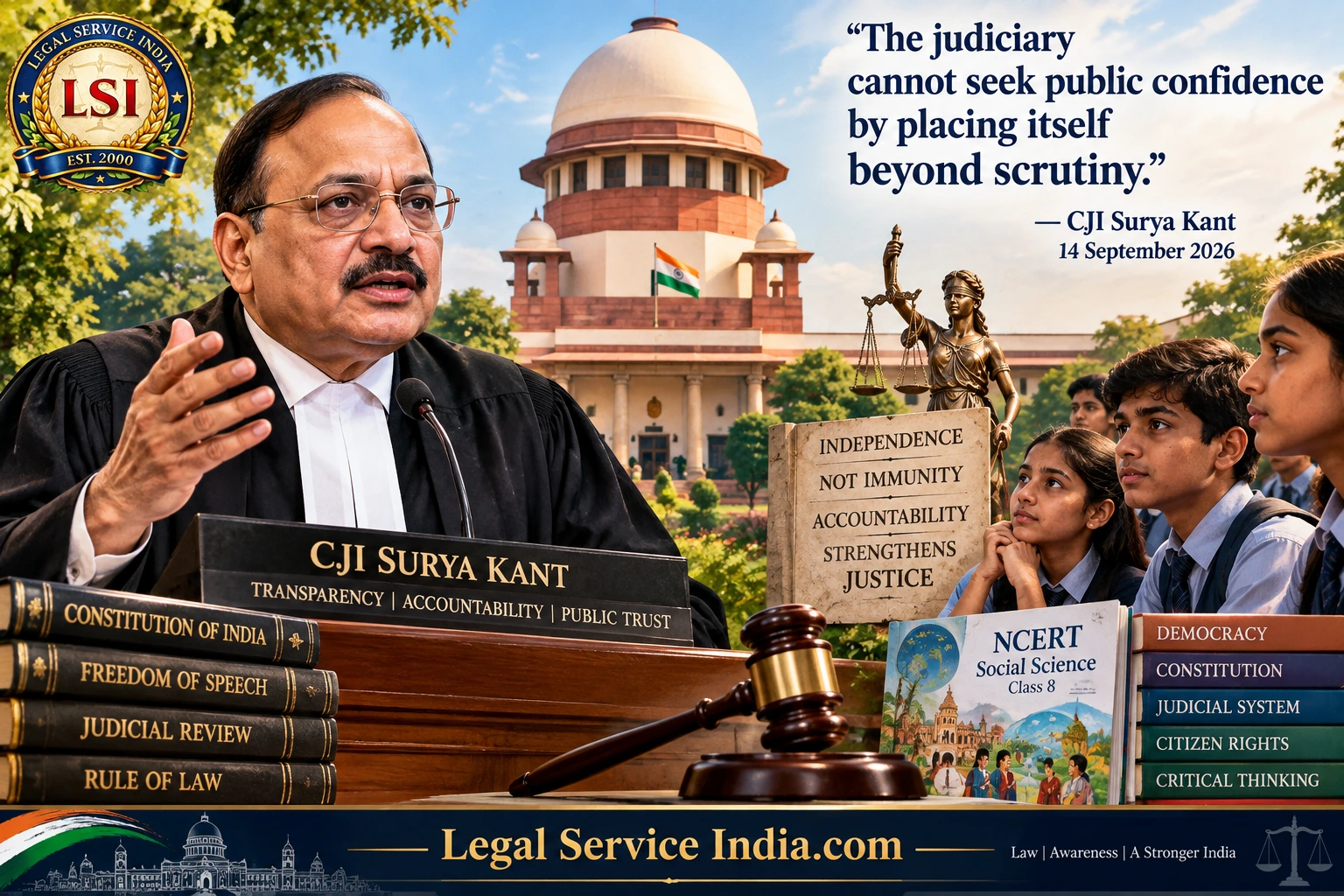
Introduction: A Remark That Goes to the Heart of Judicial Legitimacy
When the Chief Justice of India speaks about the judiciary’s relationship with criticism, transparency and public confidence, the observation deserves to be examined as a constitutional statement, not merely as a headline.
On 14 September 2026, Chief Justice of India Justice Surya Kant, speaking at the 6th Ram Jethmalani Memorial Lecture in New Delhi, made a powerful observation: the judiciary cannot seek public confidence by placing itself beyond scrutiny. Courts, he said, must remain willing to be examined, questioned and, where necessary, criticised.
This was not an isolated remark. It directly connected with an important observation already made by the Supreme Court in its suo motu proceedings concerning an NCERT Class 8 Social Science textbook containing a section titled “Corruption in the Judiciary”.
The larger constitutional message is therefore compelling:
- Judicial independence is indispensable, but judicial independence does not mean judicial immunity from legitimate scrutiny.
In my view, this distinction is fundamental to the future of public confidence in India’s justice system.
The Supreme Court’s NCERT Textbook Case: What Actually Happened?
The Supreme Court initiated Suo Motu Writ Petition (Civil) No. 1 of 2026 — In Re: Social Science Textbook for Grade-8 (Part-2) Published by NCERT and Ancillary Issues after concerns arose over Chapter 4 of an NCERT textbook titled Exploring Society: India and Beyond.
The original chapter contained a sub-topic dealing with “Corruption in the Judiciary”. On 26 February 2026, the Supreme Court took suo motu cognizance and expressed serious concern about the material and its pedagogical presentation. The official Supreme Court record confirms the proceedings and the Court’s initial concerns.
However, an important point must not be lost in subsequent reporting.
The Supreme Court itself subsequently clarified that its intervention was not intended to prevent or stifle healthy, objective and legitimate criticism of the functioning of the judiciary.
In its order dated 11 March 2026, the Court expressly recognised that if the judiciary has deficiencies and those deficiencies are highlighted by experts, such criticism can open avenues for correction and improvement.
That observation is exceptionally important because it transforms the case from a dispute about a school textbook into a wider constitutional conversation about how a democracy should discuss its own institutions.
What Did the Supreme Court Ultimately Decide?
The proceedings ultimately concluded after the disputed material was withdrawn and a revised chapter was prepared following expert review.
The final Bench comprised CJI Surya Kant, Justice Joymalya Bagchi and Justice V. Mohana. The revised chapter was found to provide an objective, factually accurate and balanced account of the judiciary, including its constitutional role and the safeguards of judicial independence and accountability. The proceedings were thereafter closed. The reported citation is 2026 LiveLaw (SC) 920.
The crucial point is that the Court did not ultimately say that the judiciary must be protected from criticism.
Quite the opposite.
The Court reiterated that the judiciary “is not, and cannot be, averse to criticism”, provided that criticism is fair, informed and constructive. Contemporary reporting of the final order records this formulation and its connection with institutional accountability and self-correction.
CJI Surya Kant — Judiciary Cannot Place Itself Beyond Scrutiny
CJI Surya Kant’s 14 September address takes that judicial principle one step further.
Speaking on the theme “Justice Seen To Be Done: Transparency and Public Trust as Pillars of the Legal System”, the CJI explained that transparency does not merely mean that courtrooms are open or hearings are conducted publicly.
It also means that the reasoning behind a judicial decision must be capable of examination.
This is a profound proposition.
A judgment is not legitimate merely because it has been pronounced by a constitutional court. Its institutional authority is strengthened when the reasoning can withstand legal examination by lawyers, academics, journalists, litigants and citizens.
The CJI also made another important distinction: public trust is not the same as public approval. A court cannot earn trust simply by producing outcomes that people like. Trust is earned when even a person who loses a case can believe that the process was fair.
Judicial Independence Is Not Judicial Immunity
This is, perhaps, the central constitutional lesson.
Judicial independence protects judges from improper political, governmental, commercial and popular pressure. Without such independence, constitutional adjudication becomes impossible.
But independence has a purpose.
It exists so that judges can decide according to the Constitution and law without fear or favour.
It does not exist to create an institution that cannot be questioned.
There is therefore a necessary distinction between:
| Constitutional Concept | Meaning |
|---|---|
| Judicial independence | Freedom from improper external influence; |
| Judicial accountability | Responsibility for institutional conduct and functioning; |
| Transparency | Making processes and reasoning capable of legitimate examination; |
| Judicial criticism | The right to disagree with judgments and institutional practices; and |
| Contempt jurisdiction | Protection of the administration of justice, not a general prohibition on disagreement with judges. |
When these concepts are confused, both sides of the constitutional balance are damaged.
Article 19 and the Right to Criticise a Judgment
In a constitutional democracy, a judgment does not become immune from public debate merely because it comes from the Supreme Court.
Article 19(1)(a) protects freedom of speech and expression, subject to constitutionally permissible restrictions.
Consequently, a lawyer may argue that a judgment is legally incorrect. A professor may publish an academic critique. A journalist may analyse judicial administration. A citizen may express disagreement with a judicial decision.
Such criticism does not automatically undermine judicial authority.
Indeed, legal development depends upon disagreement.
Many doctrines that are now accepted in constitutional law were developed through decades of argument, criticism, reconsideration and judicial refinement.
The important limitation is equally clear: legitimate criticism cannot be confused with deliberately false allegations, threats, personal vilification or conduct calculated to obstruct the administration of justice.
Criticism Can Help a Court Correct Itself
There is a valuable institutional insight in the Supreme Court’s March 2026 order.
The Court acknowledged that if deficiencies in the judiciary are identified by experts, such criticism can create an opportunity for corrective action and may even inspire future generations of judges and lawyers.
This is a mature constitutional position.
A strong institution should not be frightened by evidence-based criticism.
- It should ask whether the criticism is correct.
- If it is wrong, the institution can answer it.
- If it is partly correct, reform can follow.
- If it exposes a genuine systemic problem, ignoring it merely because it is uncomfortable ultimately damages institutional credibility.
In that sense, scrutiny can become a form of institutional self-correction.
What Does Judicial Transparency Really Mean?
The CJI’s lecture usefully expands the meaning of transparency.
Transparency should not be reduced to the physical openness of a courtroom.
For the justice system, meaningful transparency can include:
- reasoned and accessible judgments;
- transparent judicial and administrative procedures where constitutionally appropriate;
- clear mechanisms for addressing credible complaints against judges;
- appropriate disclosure of institutional information;
- effective review and correction of judicial errors; and
- an institutional culture that distinguishes good-faith criticism from malicious attacks.
The CJI nevertheless raised an equally important caution concerning complaints against judges. If every interlocutory order, adjournment or final decision automatically results in a public complaint, complaint mechanisms themselves can become instruments of harassment or pressure. He defended the existence of internal mechanisms while acknowledging that they remain capable of reform and qualitative improvement.
That is the difficult balance India must preserve: accountability without intimidation, and independence without insulation.
Public Trust Is More Important Than Public Approval
This distinction deserves particular emphasis.
A constitutional court will inevitably issue judgments that disappoint somebody.
- Governments lose cases.
- Political parties lose cases.
- Corporations lose cases.
- Individuals lose cases.
- Sometimes public opinion itself may strongly disagree with a judicial decision.
If public approval were the measure of judicial legitimacy, judicial independence would quickly collapse.
But public trust is different.
A losing litigant may say:
“I disagree with the judgment, but I believe that I was heard fairly, that the Court considered the law and evidence, and that the decision was reached honestly.”
That is genuine institutional legitimacy.
As CJI Surya Kant put it, the judiciary earns trust not by being liked but when those who lose still believe that the process was fair.
The Bar’s Responsibility
The responsibility does not rest with the Bench alone.
The Bar is an essential component of the justice system.
A lawyer must have the professional courage to tell a court that its reasoning is wrong.
But professional courage must be accompanied by professional discipline.
There is a world of difference between saying, “With respect, this judgment is legally unsustainable,” and making an unsupported personal allegation against a judge.
- The first is advocacy.
- The second may require evidence and an appropriate institutional forum.
This distinction is particularly important in the age of social media, where an allegation can travel millions of times faster than the evidence necessary to substantiate it.
The Deeper Constitutional Question
The real question raised by CJI Surya Kant’s statement is therefore not whether judges should be criticised.
That question is too simplistic.
The deeper question is:
How can India preserve a fiercely independent judiciary while ensuring that the institution remains accountable, transparent and open to legitimate democratic scrutiny?
The answer cannot be absolute immunity.
Nor can it be unrestricted public attack.
The constitutional answer lies in a disciplined middle path: independence, reasoned adjudication, institutional accountability, responsible criticism and fair procedures.
Why This Development Matters to Every Indian Litigant
For an ordinary litigant, judicial accountability is not an academic concept.
A judicial decision can determine liberty, property, livelihood, reputation, family rights and commercial survival.
What citizens ultimately seek is not necessarily a favourable judgment. They seek confidence that the system heard them fairly.
That is why transparency and public trust are inseparable from access to justice.
A court that is trusted even when it decides against a citizen is stronger than a court that is trusted only when citizens win.
Conclusion: A Strong Judiciary Should Not Fear Legitimate Scrutiny
The significance of CJI Surya Kant’s message lies in its constitutional confidence.
The judiciary does not become weaker because its judgments are analysed. It does not lose dignity because academics disagree with its reasoning. It does not lose authority because citizens demand greater transparency.
What weakens an institution is the perception that it cannot tolerate questions.
The Supreme Court’s NCERT proceedings provide an important foundation for this principle. The Court itself clarified that legitimate criticism of the judiciary must not be stifled and recognised that informed criticism can contribute to institutional accountability and self-correction.
CJI Surya Kant’s subsequent address gives that principle its broader constitutional meaning.
CJI Surya Kant — Judiciary Cannot Place Itself Beyond Scrutiny
That should not be understood as a challenge to judicial authority. It is, in fact, an affirmation of it.
A judiciary confident in the Constitution should be confident enough to face questions.
A judiciary confident in its reasoning should be willing to have that reasoning examined.
And a judiciary that seeks lasting public trust must understand that trust is not created by demanding silence. It is earned through fairness, transparency, accountability and the willingness to correct course when correction is justified.
Judicial independence protects the judge from improper pressure. Judicial accountability protects the institution from loss of public confidence. A constitutional democracy needs both.
That is the real significance of CJI Surya Kant’s powerful message.
Case Reference
| Particular | Details |
|---|---|
| Case | In Re: Social Science Textbook for Grade-8 (Part-2) Published by NCERT and Ancillary Issues |
| Case Number | Suo Motu Writ Petition (Civil) No. 1 of 2026 |
| Final Order | 1 September 2026 |
| Bench | CJI Surya Kant, Justice Joymalya Bagchi and Justice V. Mohana |
| Related Constitutional Theme | Judicial independence, judicial accountability, transparency, freedom of speech, criticism of judgments, contempt of court and public confidence in the judiciary. |
Need Experienced Supreme Court Legal Guidance?
When your legal rights, reputation or future are at stake, getting the right legal advice at the right time can make a critical difference.
If you are dealing with a constitutional law matter, judicial dispute, civil or criminal litigation, administrative issue, or a case requiring representation before the Supreme Court of India, do not rely on assumptions or incomplete legal information.
Adv. Tarun Choudhury, Supreme Court Advocate with 25+ Years of Legal Experience, provides professional legal consultation and strategic guidance on complex legal matters.
Book a Legal Consultation
Take the first step: contact Adv. Tarun Choudhury today and briefly explain your legal matter. You can then discuss the appropriate legal course of action, possible remedies and the next practical steps for your case.
- 📞 Call now: 9650499965
- 💬 WhatsApp for consultation: 8851978611
Adv. Tarun Choudhury
Supreme Court Advocate | 25+ Years of Legal Experience
Your next step: Call or WhatsApp today to request a consultation and discuss your legal issue directly with an experienced Supreme Court Advocate.
Professional legal guidance. Strategic advice. Confidential consultation.
Frequently Asked Questions About CJI Surya Kant and Judicial Accountability
1. What Did CJI Surya Kant Say About Criticism of the Judiciary?
CJI Surya Kant emphasised that the judiciary cannot place itself beyond legitimate public scrutiny. He stressed that courts must remain open to examination, questioning and responsible criticism.
His remarks highlight the constitutional importance of judicial transparency, accountability and public trust, while distinguishing fair and informed criticism from false allegations, personal attacks or conduct that interferes with the administration of justice.
2. Can Citizens Legally Criticise Supreme Court Judgments and Judges in India?
Yes. Citizens, lawyers, academics and journalists can engage in fair and informed criticism of Supreme Court judgments and judicial functioning, subject to the Constitution and applicable laws, including the law of contempt.
Disagreement with a judicial decision is not automatically contempt. The important distinction is between legitimate criticism of judicial reasoning and conduct that deliberately undermines or obstructs the administration of justice.
3. Does Judicial Independence Mean That Judges Are Above Public Scrutiny?
No. Judicial independence does not mean judicial immunity from legitimate scrutiny.
Judicial independence protects judges from improper political, governmental and external pressure so that they can decide cases according to law.
At the same time, judicial accountability and transparency require judicial institutions to remain open to appropriate examination.
A strong judiciary can protect its independence while allowing responsible scrutiny of its judgments and functioning.
4. Why Is Judicial Transparency Important for Public Trust in India?
Judicial transparency is essential for maintaining public confidence in India’s justice system.
Transparent procedures, reasoned judgments, accessible information and credible mechanisms for institutional accountability allow citizens to understand how judicial decisions are reached.
As highlighted by CJI Surya Kant, public trust is different from public approval; citizens may disagree with a judgment while still trusting the fairness and integrity of the judicial process.
5. What Is the Significance of the Supreme Court’s NCERT Textbook Judgment on Judicial Criticism?
The Supreme Court’s decision in In Re: Social Science Textbook for Grade-8 (Part-2) Published by NCERT and Ancillary Issues, Suo Motu Writ Petition (Civil) No. 1 of 2026, is significant because the Court recognised that the judiciary cannot be averse to fair, informed and constructive criticism.
The case demonstrates the constitutional balance between protecting judicial independence and permitting legitimate discussion about judicial accountability, transparency and institutional reform.
Key Takeaways: CJI Surya Kant on Judicial Accountability and Transparency
- CJI Surya Kant has emphasised that the judiciary cannot place itself beyond legitimate scrutiny, making judicial accountability and transparency central to maintaining public confidence.
- Judicial independence does not mean judicial immunity. Judges must remain protected from improper external influence while the judiciary remains open to legitimate examination and criticism.
- Fair and informed criticism of judicial decisions is compatible with democracy. Disagreeing with a Supreme Court judgment, analysing judicial reasoning or demanding institutional reform does not automatically amount to contempt of court.
- The Supreme Court’s NCERT textbook case is significant for judicial accountability. In In Re: Social Science Textbook for Grade-8 (Part-2) Published by NCERT and Ancillary Issues, the Court recognised the legitimate role of constructive criticism of the judiciary.
- The Court itself recognised that criticism can promote institutional self-correction. Evidence-based criticism can identify deficiencies and create opportunities for improvement within the justice system.
- Public trust is different from public approval. CJI Surya Kant’s message highlights that citizens do not necessarily have to agree with a judgment to trust the judiciary; confidence can arise from believing that the judicial process was fair and impartial.
- Judicial transparency goes beyond open court hearings. It includes accessible reasoning, transparent institutional processes, appropriate accountability mechanisms and the ability to understand how judicial decisions are reached.
- Article 19(1)(a) protects democratic discussion and criticism, subject to constitutionally valid restrictions. Judicial judgments can legitimately be analysed and criticised within the boundaries of law.
- There is an important distinction between criticism and contempt. Responsible disagreement with judicial reasoning is different from deliberate false allegations, personal vilification, threats or conduct intended to obstruct the administration of justice.
- The Bar has a constitutional responsibility. Lawyers must have the courage to challenge legally unsustainable reasoning while maintaining professional discipline and respect for the judicial process.
- The NCERT controversy raises a larger constitutional question: how should India protect judicial independence while ensuring meaningful judicial accountability and transparency?
- A strong judiciary should have confidence in reasoned scrutiny. Institutional authority is strengthened when judicial reasoning can withstand examination by lawyers, academics, journalists and citizens.
- The constitutional balance is clear: India needs judicial independence without institutional insulation, accountability without intimidation, and transparency without compromising the administration of justice.
Summary
CJI Surya Kant’s message on judicial accountability reinforces an important constitutional principle: the judiciary must remain independent but cannot place itself beyond legitimate scrutiny.
The Supreme Court’s NCERT textbook proceedings similarly recognised the value of fair, informed and constructive criticism of judicial functioning.
The larger significance lies in balancing judicial independence, judicial transparency, freedom of speech, accountability and public trust.
