





Introduction
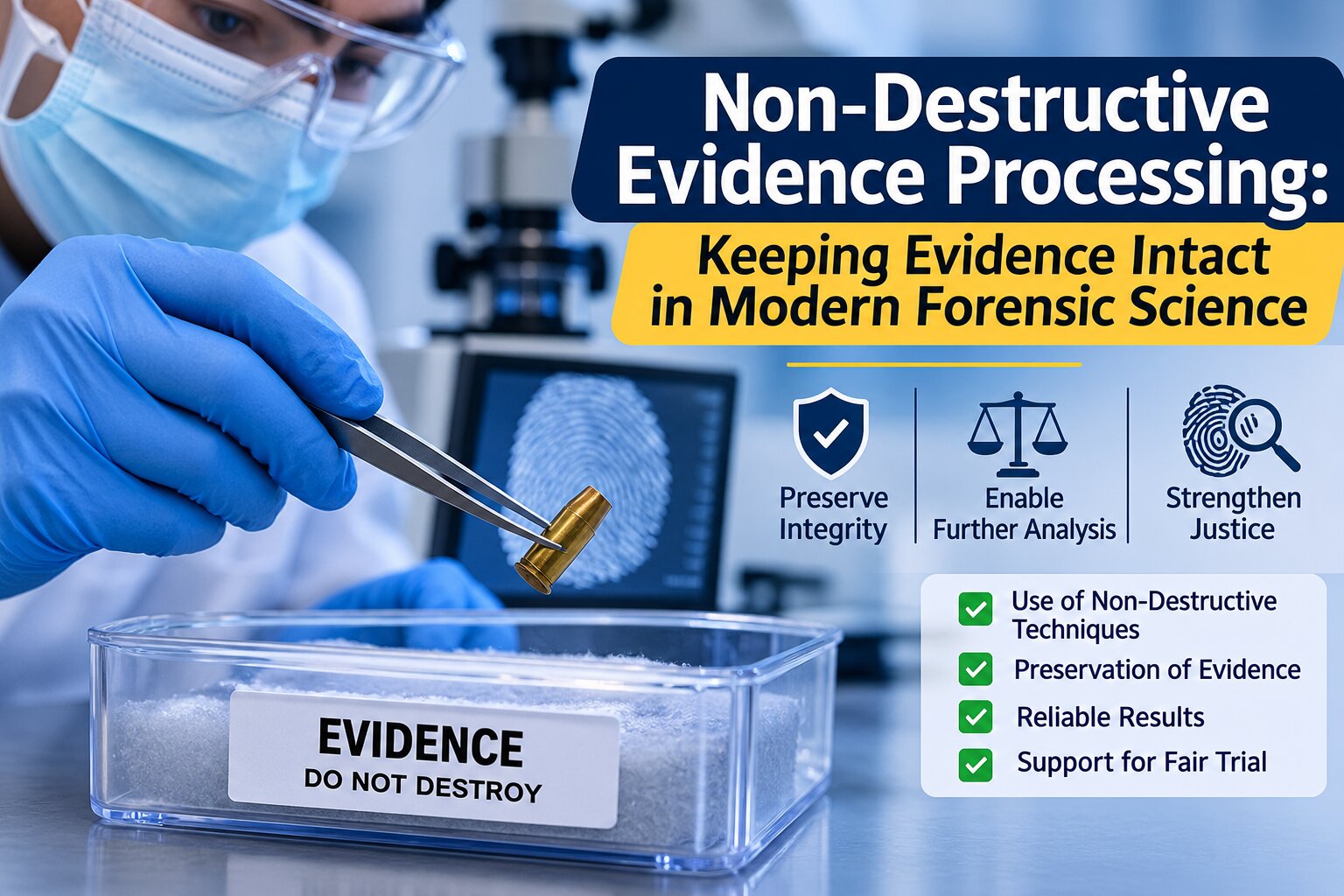
The ultimate goal of a criminal investigation is to uncover the truth using evidence—such as fingerprints, bloodstains, digital files, or bullets—that serves as a silent witness to solve crimes, identify suspects, or clear the innocent. Modern forensic science relies heavily on Non-Destructive Evidence Processing (NDEP), a modern approach that uses advanced tools like digital imaging, special lighting, CT scans, 3D laser scanning, spectroscopy, and artificial intelligence to record and analyze evidence without damaging, altering, or consuming it.
Unlike past destructive tests that permanently destroyed samples by cutting, scraping, or dissolving them, NDEP keeps the original evidence completely intact for re-examination, independent court review, and future advanced technologies, making criminal investigations far more reliable, fair, and transparent.
What Is Non-Destructive Evidence Processing?
Non-Destructive Evidence Processing (NDEP) is a fundamental forensic approach focused on analyzing, recording, and evaluating physical or digital evidence while preserving its complete physical state and intrinsic value. Unlike traditional destructive testing—which consumes, alters, or dissolves a sample during analysis—non-destructive methods ensure the original item remains fully intact for future legal proceedings or secondary expert evaluations.
Forensic examiners routinely employ these non-invasive techniques across various disciplines, such as capturing high-resolution macro photographs of latent fingerprints, performing non-contact computed tomography (CT) scans on firearms to inspect internal mechanisms without disassembly, creating precise digital 3D scans of shoeprint impressions, and utilizing infrared light to reveal hidden or erased writing on questioned documents without disturbing the underlying paper or ink.
Examples of Destructive Methods
Destructive testing methods, by contrast, inherently alter or consume a portion of the evidentiary matrix during analysis, making them an analytical option of last resort. Common examples include:
- Extracting nuclear DNA from blood or saliva stains, which consumes the biological sample.
- Dissolving suspected controlled substances in chemical reagents or solvents to perform mass spectrometry or chromatography.
- Sectioning organ tissue for histological examination under a microscope.
To balance these necessary chemical interventions with evidentiary integrity, modern forensic protocol follows a strict operational rule: examiners must always exhaust all feasible non-destructive screening and documentation methods before proceeding to any invasive technique.
Scientific Foundation of Non-Destructive Evidence Processing
The scientific foundation of Non-Destructive Evidence Processing relies on three core tenets that align with international quality standards, such as ISO/IEC 17025, and strict judicial expectations.
First, preservation ensures the evidence remains physically and chemically unchanged throughout examination, safeguarding its primary context. Second, repeatability allows an expert to run the exact same non-destructive test multiple times on the intact item and yield identical data.
Finally, reproducibility ensures that independent forensic scientists applying equivalent methods can verify the original conclusions. Together, these principles guarantee that forensic evidence remains legally admissible, scientifically valid, and capable of withstanding rigorous court scrutiny.
Why It Matters in Criminal Investigations
Keeping the Original Evidence
Original items carry the strongest value in court. Judges and lawyers often prefer to see the real exhibit rather than a copy. Once something is changed, questions about authenticity can arise.
Allowing Multiple Experts to Examine the Same Item
A single piece of evidence may need to be checked by ballistics experts, DNA analysts, fingerprint specialists, and trace-evidence scientists. Non-destructive methods keep the item in good condition for everyone.
Supporting Future Technology
Science moves quickly. Evidence saved today may reveal new facts years later with better tools. Many cold cases have been solved decades later because the original evidence was still available for advanced DNA testing.
Supporting Fairness in Court
Courts want forensic results that can be checked independently. If the evidence is destroyed during testing, the defence cannot examine it. Non-destructive methods help keep the process open and fair.
Main Non-Destructive Techniques
Modern forensic laboratories use various non-destructive techniques to document, examine, and analyze evidence while minimizing the risk of damage. The following methods demonstrate how forensic experts can preserve evidence while obtaining valuable investigative information.
High-Resolution Photography
Every item is photographed before, during, and after collection, and again in the lab. Modern methods include close-up photography, focus stacking, scale markers, and photogrammetry. Digital photos create a permanent record of the evidence’s condition.
Alternate Light Source (ALS)
Special wavelengths of light make hidden evidence visible—latent fingerprints, biological stains, fibres, bruises, bite marks, or gunshot residue patterns—without applying any chemicals.
Ultraviolet and Infrared Imaging
Different materials react differently to these lights. Infrared can show erased writing, altered documents, or burnt records. Ultraviolet helps detect biological fluids, counterfeit money, or forged documents.
Digital Microscopy
High-magnification viewing without taking samples. Useful for hair, fibres, tool marks, paint, and glass fractures. The evidence stays whole.
X-Ray Imaging
Shows internal structures of guns, ammunition, explosives, bones, hidden objects, or drug packets without opening or taking them apart.
Computed Tomography (CT)
Creates detailed 3D images. Used for virtual autopsies, bullet paths, bone fractures, hidden evidence, and skeletal reconstruction. Many labs now do CT scans before traditional dissection.
Three-Dimensional Laser Scanning
Produces accurate digital models of crime scenes, remains, shoe prints, tyre marks, or weapons. These models can be measured again and again without returning to the original scene.
Raman Spectroscopy
Identifies materials by how their molecules vibrate. Works on drugs, explosives, pigments, fibres, paint, and inks—without changing the sample.
Fourier Transform Infrared (FTIR) Spectroscopy
Reveals chemical composition of polymers, plastics, adhesives, fibres, and paint without using up the material.
Digital Forensic Imaging
Creates an exact bit-by-bit copy of a hard drive or storage device. Investigators work only on the copy. The original remains untouched, protected by write-blockers and verified with hash values.
Comparison of Non-Destructive Forensic Techniques
| Forensic Technique | Primary Purpose | Evidence Preservation Benefit |
|---|---|---|
| High-Resolution Photography | Documents the condition and visible details of evidence. | Creates a permanent visual record without physically altering the item. |
| Alternate Light Source (ALS) | Helps reveal hidden forensic evidence using special wavelengths of light. | Can reveal evidence without applying chemicals. |
| Ultraviolet and Infrared Imaging | Helps identify hidden writing, altered documents, and other evidence. | Allows examination without necessarily disturbing the underlying material. |
| Digital Microscopy | Examines small details such as fibres, hair, paint, and tool marks. | Enables high-magnification examination without taking samples. |
| X-Ray Imaging | Reveals internal structures and concealed objects. | Reduces the need to open or disassemble an item. |
| Computed Tomography (CT) | Produces detailed three-dimensional images of internal structures. | Supports virtual examination before potentially destructive procedures. |
| Three-Dimensional Laser Scanning | Creates measurable digital models of scenes and physical evidence. | Allows repeated digital measurements without repeatedly handling the original. |
| Raman Spectroscopy | Helps identify materials through molecular vibrational information. | Can analyze certain materials without changing the sample. |
| Fourier Transform Infrared (FTIR) Spectroscopy | Examines the chemical composition of materials. | Can analyze suitable samples without consuming the material. |
| Digital Forensic Imaging | Creates a bit-by-bit copy of a digital storage device. | Allows investigators to examine a verified copy while preserving the original device. |
How These Methods Are Used Across Disciplines
Non-destructive evidence processing is systematically applied across various forensic disciplines to prioritize preservation before any invasive examination takes place. At crime scenes, investigators utilize photography, drone mapping, laser scanning, and alternate light sources (ALS) to document context prior to evidence collection. Biological evidence and latent fingerprints are thoroughly recorded using optics, photography, ALS, and microscopy before proceeding to targeted chemical treatments or DNA extraction.
In ballistics and anthropology, high-resolution X-rays, CT scans, digital microscopy, and 3D surface mapping allow scientists to inspect internal firearm mechanisms and skeletal remains prior to test-firing or physical handling. Similarly, questioned documents are analyzed non-invasively using infrared, ultraviolet, multispectral imaging, and electrostatic detection, while digital forensics relies on bit-stream disk imaging, hash checks, and metadata verification to protect original media from alteration.
Advantages
Non-destructive evidence processing offers key advantages by keeping original evidence intact, allowing independent experts to re-examine the exact same items while fulfilling a scientist’s ethical duty to prevent unnecessary damage. By generating secure digital records, these methods minimize physical handling and transport risks while making evidence far more readily acceptable in court. Furthermore, preserving physical samples in their native state ensures that long-unsolved cold cases can be reopened and re-evaluated years later as more advanced technologies emerge.
Challenges
Despite its clear evidentiary benefits, non-destructive evidence processing faces significant financial, operational, and technical challenges. Advanced instruments like CT scanners, hyperspectral cameras, and Raman spectrometers require high initial capital outlays, creating a resource gap between well-funded central facilities and smaller regional or developing-world laboratories. Beyond equipment costs, operating these tools requires specialized analyst training to prevent data misinterpretation, while generating massive 3D scans and high-resolution images strains IT infrastructure and demands secure, encrypted storage.
Finally, NDEP cannot completely replace destructive testing—since definitive DNA extraction, toxicology, and chemical profiling still require sample consumption—forcing forensic teams to maintain strict administrative planning and documentation whenever invasive analysis becomes unavoidable.
Legal Importance
Modern judicial systems demand rigorous standards of scientific validity and procedural integrity before physical or digital evidence can be admitted in court. Non-destructive evidence processing directly underpins the legal requirements of repeatability, transparency, and independent verification established under evidentiary standards such as the Daubert and Frye tests.
By keeping the original sample intact, examiners preserve its primary physical context, allowing defense counsel and court-appointed independent experts the opportunity to re-evaluate or conduct secondary examinations. This open access removes allegations of procedural bias or concealment, strengthening the overall credibility of the prosecution’s forensic findings while protecting the defendant’s constitutional right to a fair trial.
In modern criminal proceedings, preserving evidence in its original state is often a strict statutory and ethical obligation rather than a mere preference. Failure to protect evidence from unnecessary alteration or consumption can trigger the spoliation of evidence doctrine, leading to severe judicial sanctions.
Courts may exclude compromised test results entirely, issue adverse inference instructions directing the jury to assume the destroyed evidence favored the opposing party, or even dismiss serious charges outright. Non-destructive methods provide an essential safeguard against claims of spoliation by ensuring that any necessary testing proceeds progressively from the least invasive optical and spectroscopic methods to invasive ones only when unavoidable.
Ultimately, the technical quality of evidence preservation directly dictates its legal persuasiveness before a judge or jury. Unbroken chains of custody coupled with complete, non-destructive digital and physical records—such as 3D laser scans, high-resolution photogrammetry, and non-contact spectral measurements—establish an unassailable record of authenticity.
Conversely, poor preservation, unexplained sample consumption, or premature destructive testing creates vulnerabilities that defense teams can exploit to establish reasonable doubt. By prioritizing non-destructive processing from the moment of collection through court presentation, forensic practitioners ensure that the evidence presented is legally resilient, scientifically objective, and capable of withstanding intense courtroom scrutiny.
Looking Ahead
Future advancements will further revolutionize non-destructive forensic processing through powerful technologies like AI-driven evidence recognition, hyperspectral imaging, quantum sensing, and automated 3D scene reconstruction. By combining portable Raman and FTIR spectrometers with robotic documentation, digital twins, and secure cloud platforms, investigators will soon perform immediate, highly detailed analysis directly at the crime scene. Ultimately, these emerging tools will make criminal investigations significantly faster, more precise, and highly collaborative, all while preserving the original evidence untouched for courtroom presentation.
Best Practices
To ensure non-destructive processing remains scientifically sound and court-admissible, forensic practitioners must follow core operational best practices throughout an investigation. Examiners should fully document evidence and preserve original packaging before handling, always progressing from the least invasive methods to destructive testing only when scientifically necessary and meticulously justified. Maintaining an unbroken chain of custody, storing encrypted digital copies of all scans, regularly calibrating instruments, and adhering strictly to recognized quality standards ensure that all physical and digital evidence retains its integrity and withstands legal scrutiny.
Comparative Matrix: Non-Destructive vs. Destructive Testing
| Dimension | Non-Destructive Processing (NDEP) | Destructive Forensic Analysis |
|---|---|---|
| Sample Integrity | Completely preserved in native state | Consumed, dissolved, charred, or permanently altered |
| Re-examination Potential | Infinite within physical shelf-life limits | Unrepeatable or severely limited by sample quantity |
| Legal Admissibility Risk | Minimal exposure to spoliation challenges | Subject to pre-testing defense notice and joint protocols |
| Primary Utility | Initial screening, spatial mapping, class identification | Definitive individualization (e.g., nuclear DNA, mass spec) |
| Core Instrumentation | ALS, CT Scans, Raman, FTIR, mew-XRF, HSI | GC-MS, LC-MS/MS, Acid Digestion, STR Profiling |
Conclusion
Non-Destructive Evidence Processing has transformed forensic science by allowing investigators to gather crucial details while keeping every piece of physical or digital evidence completely intact. By grounding examinations in preservation, repeatability, and transparency, these non-invasive tools—ranging from photography and alternate light sources to CT scans and spectroscopy—ensure that evidence remains available for independent verification, defense review, and future scientific advances. Safeguarding evidence in its original state is no longer just a technical preference, but a vital legal, ethical, and societal necessity that ensures forensic findings withstand courtroom scrutiny and uphold the principles of fairness and justice.
Written By:
- Md. Imran Wahab, IPS – Inspector General of Police, West Bengal
- Reilly Hall – Chief Deputy Coroner at Douglas County Coroner’s Office (WA) | Adjunct Lecturer, Greater Wenatchee Area, USA

