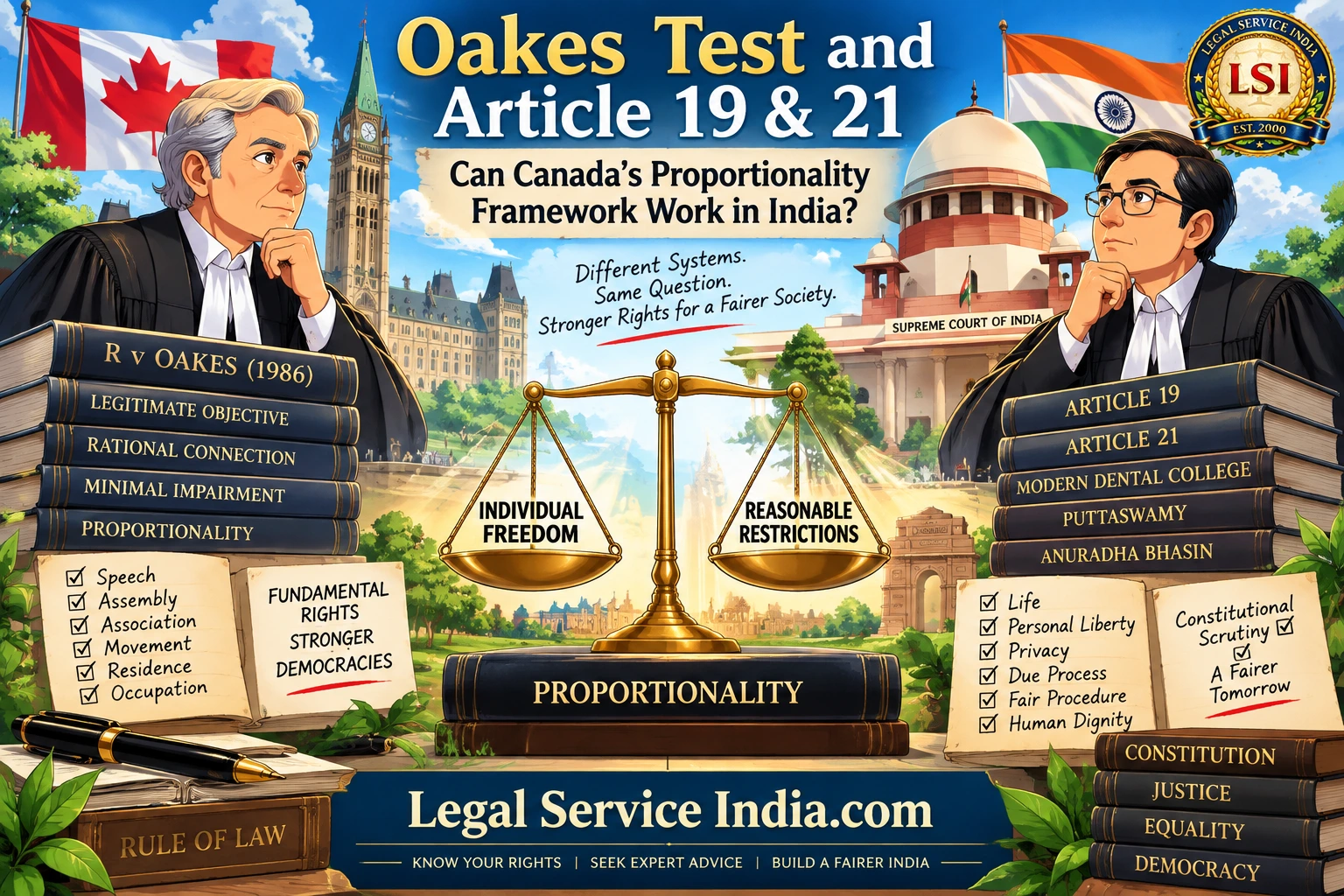
Borrowing the Oakes Test: Could Canada’s Proportionality Framework Fix India’s Article 19 and 21 Muddle?
A Look at R v Oakes (1986) and Why India’s Proportionality Doctrine Still Hasn’t Settled Down
I. Introduction
Every legal system that limits fundamental rights eventually has to answer an awkward question: how much justification does the state actually owe the citizen before it can take a right away? Canada answered that question with unusual clarity in 1986. In R v Oakes, the Supreme Court of Canada built a test — now simply called the Oakes test — that turned a vague constitutional promise into something close to a checklist. It has held up remarkably well for almost forty years.
India has been reaching for something similar, but it hasn’t quite gotten there. The Supreme Court now talks about “proportionality” constantly, in privacy cases, internet-shutdown cases, occupational-freedom cases, and it clearly wants the discipline that word implies. But dig into the actual judgments and you find three, sometimes four, different versions of the test floating around, applied with very different levels of rigour depending on the bench and the mood of the moment. This piece walks through what Oakes actually said, how Indian courts picked up (and half-adapted) its logic in cases like Modern Dental College, Puttaswamy and Anuradha Bhasin, and then asks the harder question: if India formally adopted an Oakes-style test wholesale, would that actually fix anything, or is the real problem somewhere else entirely?
II. R v Oakes: What the Case Was Actually About
A. The Facts
The facts are almost mundane, which is part of what makes the case interesting — a landmark constitutional ruling built on eight vials of hash. David Oakes was stopped by police carrying eight one-gram vials of cannabis resin and just over six hundred dollars in cash. He admitted to possession but said the drugs were for his own use and that the money was from a workers’ compensation cheque, not from selling narcotics.
The trouble for Oakes was section 8 of the Narcotic Control Act, which contained a reverse-onus clause: if you were found in possession of a narcotic, the law presumed you possessed it for the purpose of trafficking, unless you could prove otherwise.
Oakes argued that shifting that burden onto the accused violated the presumption of innocence guaranteed by section 11(d) of the Charter of Rights and Freedoms. The Ontario Court of Appeal agreed with him, and the Crown took the case to the Supreme Court, which heard it in March 1985 and delivered judgment in February 1986. Chief Justice Brian Dickson wrote the main opinion, joined by four other justices, with Estey and McIntyre JJ. concurring separately.
B. The Test Itself
The Court agreed section 8 violated the Charter — that part wasn’t really contested. The interesting question was whether the violation could still be upheld under section 1, which allows “reasonable limits” on Charter rights that are “demonstrably justified in a free and democratic society.” It’s here that Dickson C.J. set out what everyone now calls the Oakes test, and it’s worth walking through slowly because its structure is the whole point.
First, the government has to show the law is pursuing a pressing and substantial objective — not just any goal, but one serious enough to justify overriding a constitutional right in the first place.
If a court gets past that, it moves into what’s usually described as the proportionality stage, which itself breaks into three separate questions:
- Is there a rational connection between the measure and the objective — does the law actually, logically, get you toward the goal it claims to serve?
- Does the measure impair the right as little as possible, or could the same goal have been achieved with a lighter touch?
- And finally, do the law’s benefits actually outweigh the harm it does to the right — because even a law that clears every earlier hurdle can still fail if the damage to the right is simply too severe for what’s gained.
What happened in Oakes itself is a good illustration of how the test is meant to work in practice. The Court accepted without much difficulty that fighting drug trafficking was a pressing and substantial objective. But the reverse-onus provision fell apart at the very next step, rational connection.
Possessing a small amount of a narcotic simply doesn’t logically support an inference that you intended to sell it — someone with a few grams for personal use looks nothing like a trafficker on the facts alone.
Because the law failed at that early stage, the Court never even had to reach minimal impairment or the final balancing exercise. The presumption was struck down, and the appeal was dismissed.
C. Why It Mattered
Oakes wasn’t working from nothing — the Court had gestured toward similar ideas the year before in R v Big M Drug Mart. But Oakes is the case that gave the idea real shape, tying it directly to the words of section 1 and giving lower courts something they could actually apply consistently.
Later cases refined the edges. R v Edwards Books and Art Ltd pushed on how much accommodation a law needs to offer before it counts as minimally impairing. R v Tse dealt with what kind of procedural safeguards a law needs against abuse. And in the administrative law context, Doré v Barreau du Québec applied a somewhat softer, more deferential version of proportionality to individual discretionary decisions rather than the full Oakes machinery.
But the core structure — legitimate goal, rational connection, minimal impairment, balancing — has stayed intact, and Canadian lawyers still reach for it as the default way of testing any law that limits a Charter right.
III. Where the Idea Came From, and Where It Travelled
It’s worth remembering that Oakes didn’t invent proportionality analysis out of thin air. The structured four-stage version of the test has its deepest roots in German constitutional law, and scholars like David Beatty and, separately, Alec Stone Sweet and Jud Mathews, have traced how it spread from there across much of Europe, into South Africa’s post-apartheid jurisprudence (think S v Makwanyane and Coetzee v Government of the Republic of South Africa), and eventually into large parts of the common-law world.
Vicki Jackson has gone so far as to call the present moment in comparative constitutional law an “age of proportionality,” where the structured test functions almost as a shared vocabulary across otherwise very different legal systems.
Oakes matters within that story because it’s the version that made the leap from civil-law doctrinal thinking into a common-law, judge-made test tied to a specific piece of constitutional text — section 1 of the Charter.
That made it unusually exportable. Courts in other common-law jurisdictions with similarly worded limitation clauses, South Africa among them, could pick it up relatively easily.
India, with its own scattering of “reasonable restriction” clauses under Article 19 and its “procedure established by law” standard under Article 21, has been drawn into that same current, even if it has arrived somewhat later and with less consistency.
How Proportionality Became a Shared Constitutional Language
| Legal System | Role in the Development of Proportionality |
|---|---|
| Germany | The structured four-stage proportionality test has its deepest roots in German constitutional law. |
| Canada | Oakes developed proportionality into a common-law, judge-made test linked to section 1 of the Charter. |
| South Africa | Proportionality became an important part of post-apartheid constitutional jurisprudence. |
| India | Proportionality developed through Article 19’s reasonable restrictions and Article 21’s protection of life and personal liberty. |
IV. How India Picked Up Proportionality — In Fits and Starts
A. Before 2016: Reasonableness Without a Real Structure
India’s Constitution already contains the raw ingredients for something like proportionality review.
Article 19(1) protects a bundle of freedoms — speech, assembly, association, movement, residence, occupation — each subject to “reasonable restrictions” spelled out in clauses (2) through (6).
Article 21 guarantees that no one can be deprived of life or personal liberty except by “procedure established by law,” a phrase the Court read, in Maneka Gandhi v Union of India back in 1978, as requiring the procedure itself to be fair, just and reasonable — not merely whatever procedure Parliament happened to enact.
Also Read: Can a U.S. President Be Prosecuted While in Office? Presidential Immunity Explained
The Older Indian Approach to Reasonableness
For decades, though, Indian courts tested restrictions mostly through a looser reasonableness enquiry, borrowing heavily from the administrative-law Wednesbury standard of irrationality — essentially asking whether a restriction seemed arbitrary or excessive, without walking through any fixed sequence of questions.
You can find traces of proportionality-style thinking scattered through older cases like Chintaman Rao v State of Madhya Pradesh and Ibrahim Wazir v State of Bombay, but these were instinctive, case-by-case judgments rather than anything resembling a repeatable test.
- Article 19 protected several fundamental freedoms.
- Those freedoms were subject to constitutionally recognised “reasonable restrictions.”
- Article 21 protected life and personal liberty.
- Maneka Gandhi v Union of India expanded the understanding of fair, just and reasonable procedure.
- Older cases contained proportionality-style reasoning, but without a uniform structured test.
B. Modern Dental College (2016): The Formal Shift
The real turning point came in 2016, in Modern Dental College & Research Centre v State of Madhya Pradesh.
A Constitution Bench, in a judgment written by A.K. Sikri J., was asked to decide whether state regulation of admissions and fees at private, unaided professional colleges went too far under Article 19(1)(g)’s freedom of occupation.
The Court’s answer was that reasonableness under Article 19 should now be tested through proportionality, and it laid the test out in four stages:
- The measure needs a legitimate goal.
- It needs to be a suitable way of achieving that goal, with a rational connection between means and ends.
- It needs to be necessary, meaning no less restrictive but equally effective alternative was realistically available.
- It can’t have a disproportionate impact on the person whose right is being limited, which requires an overall weighing of costs and benefits.
Anyone familiar with Oakes will recognise the shape immediately, though the Court arrived at it through its own comparative reading of German, Canadian and South African material rather than by lifting Oakes directly.
| Stage | Core Question |
|---|---|
| Legitimate Goal | Does the measure pursue a legitimate objective? |
| Suitability | Is there a rational connection between the measure and its objective? |
| Necessity | Was there a less restrictive but equally effective alternative? |
| Balancing | Is the impact on the right-holder disproportionate when the costs and benefits are weighed? |
C. Puttaswamy (2017–2019): More Detail, More Disagreement
The Aadhaar litigation is where India’s proportionality doctrine got its most serious workout — and also where its cracks became hardest to ignore.
In the first Puttaswamy judgment, in 2017, a nine-judge bench unanimously recognised privacy as a fundamental right under Article 21.
Crucially, the Court also agreed that any state interference with that right had to satisfy a proportionality standard.
What it couldn’t agree on was what, exactly, that standard required.
Also Read: Can America Reform the Supreme Court? Latest 5–4 Ruling Reignites Term Limits Debate
Different Formulations of Proportionality
| Opinion | Formulation |
|---|---|
| Justice Chandrachud’s Opinion | Legality, legitimate aim and proportionality. |
| Justice Kaul’s Separate Opinion | State action must be authorised by law, pursue a legitimate aim, be proportionate to the need for interference, and come with procedural safeguards against misuse. |
Justice Chandrachud’s opinion, which several other judges joined, described a three-part requirement of legality, legitimate aim and proportionality.
Justice Kaul, writing separately, set out a four-part version instead: state action must be authorised by law, pursue a legitimate aim, be proportionate to the need for interference, and come with procedural safeguards against misuse.
Two years later, when the Aadhaar scheme itself was tested on the merits, the split became even more consequential.
The majority, again led by Sikri J., applied the four-part Modern Dental College test but sharpened the necessity and balancing stages, requiring the government to show it had actually considered less intrusive alternatives and found them comparably less effective — something closer to the “least restrictive means” scrutiny associated with strict review in other jurisdictions.
Chandrachud J., dissenting, applied his own version of the test and reached the opposite conclusion, finding Aadhaar disproportionate because it effectively treated every citizen as a potential criminal without any individualised suspicion at all.
So you had, in the same case, two judges both claiming to apply “proportionality,” using meaningfully different formulations of it, and landing on opposite outcomes.
That is more or less exactly the inconsistency that critics of Indian proportionality doctrine keep pointing to.
D. Anuradha Bhasin (2020): Proportionality Meets Internet Shutdowns
The next major test came with the internet shutdowns in Jammu and Kashmir following the August 2019 reorganisation.
In Anuradha Bhasin v Union of India, the petitioners argued that a blanket, indefinite internet suspension, imposed under old colonial-era public-order powers, disproportionately burdened both freedom of speech under Article 19(1)(a) and the freedom to carry on trade or business under Article 19(1)(g) — and the Court agreed that both extend to the internet as a medium.
It didn’t strike the restrictions down outright, but it held that any suspension order:
- Has to be proportionate.
- Has to show a rational connection to the objective pursued.
- Has to adopt the least restrictive available alternative.
- Has to be published so it can actually be challenged in court.
The government was directed to go back and review every existing suspension order against that standard.
Also Read: Can a U.S. President Be Prosecuted While in Office? Presidential Immunity Explained
Practical Limitations of the Judgment
In practice, though, the judgment reads more like a set of aspirations than a demanding legal test.
The Court articulated the right principles — necessity, proportionality, temporariness, publication — but left the executive a great deal of room in applying them, and it didn’t really work through a rigorous, stage-by-stage rational-connection or minimal-impairment analysis of the specific shutdown orders in front of it.
It also left open exactly how the doctrine is supposed to operate when the government invokes national security, which is precisely the context where rigorous scrutiny matters most.
Unsurprisingly, internet shutdowns in India have continued at a very high rate since the judgment, which suggests the proportionality language didn’t translate into much practical change in how the executive actually behaves.
| Case | Year | Key Contribution |
|---|---|---|
| Maneka Gandhi v Union of India | 1978 | Read Article 21 as requiring procedure to be fair, just and reasonable. |
| Modern Dental College & Research Centre v State of Madhya Pradesh | 2016 | Formally articulated proportionality as the framework for testing reasonableness under Article 19. |
| Puttaswamy | 2017–2019 | Applied proportionality in the context of privacy and Aadhaar while revealing differences over the precise formulation of the test. |
| Anuradha Bhasin v Union of India | 2020 | Applied proportionality principles to internet restrictions and shutdowns. |
V. So Would Formally Adopting Oakes Actually Help?
A. The Argument For Borrowing It Wholesale
There’s a reasonably strong case for it. The most obvious benefit is sequencing discipline. Oakes forces a court to work through rational connection, minimal impairment and balancing in a fixed order, and to stop the moment a measure fails a stage, exactly as happened in Oakes itself once the reverse-onus provision failed rational connection.
That produces a chain of reasoning that other courts, litigants and academics can actually pick apart and test stage by stage, rather than a single vague verdict on “reasonableness” that can be stretched to justify almost anything.
There’s also the question of who carries the burden of proof. Oakes puts that burden squarely on the state — it has to justify the infringement, on a balance of probabilities — and that clarity is something Indian jurisprudence has never really nailed down; commentators have pointed out that Indian judgments are often genuinely unclear about whether the government has to justify a restriction or the citizen has to disprove it.
And then there’s the sheer weight of precedent: Oakes has been tested and refined across roughly four decades of Charter litigation, so adopting an equivalent structure would let Indian courts draw on a much deeper well of comparative case law — Canadian, German, South African — to fill in vague phrases like “pressing objective” or “least restrictive means” with actual content.
Also Read: Abdel-Hady v Commonwealth of Australia [2026]: Unlawful Detention, Rule of Law & Lessons for India
B. The Argument Against — And The Real Problem Underneath
The stronger objection, and the one developed most carefully by Aparna Chandra in her essay “Proportionality in India: A Bridge to Nowhere?”, is that India’s trouble was never really the absence of a formal test. It’s a judicial culture that tends to apply whatever test it happens to adopt with fairly low evidentiary rigour and a strong instinct toward deference.
Chandra’s own review of the case law found that Indian courts rarely conduct a genuine necessity enquiry — rarely actually ask whether a less restrictive alternative existed and would have worked just as well — and that the balancing stage is usually asserted rather than actually demonstrated with evidence.
On this reading, both Modern Dental College and the Aadhaar majority formally invoked the four-part test but didn’t seriously interrogate the government’s claims about necessity; broad assertions of public interest were largely taken at face value.
A related worry, raised by scholars like Abhinav Chandrachud, is that proportionality hasn’t really replaced India’s older reasonableness and Wednesbury-style review so much as it’s been layered on top of it.
Courts cite the four-part test in their opening paragraphs and then, in substance, keep reasoning in the older, more forgiving idiom.
Grégoire Webber’s broader point about balancing tests generally — that they can let judges dress up contestable value judgments in the language of logical rigour — applies with real force here.
A court can march through all four Oakes-style stages and still land on a predetermined, deferential outcome if it simply declines to demand hard evidence at the necessity and balancing stages, which is arguably what happened in the Aadhaar majority’s treatment of alternatives to biometric authentication.
Put together, this points to a real limit on what formally adopting Oakes could achieve. The test didn’t create predictability in Canada just by existing on paper.
It did so because Canadian courts, over decades, built up a genuine practice of demanding evidence from the government at every stage — social science data, legislative records, comparative regulatory material — particularly at the minimal-impairment stage.
Section 1 jurisprudence in Canada is predictable not because the test has four neat boxes to tick, but because courts actually insist on a real evidentiary burden and have built up a dense body of precedent giving concrete meaning to “minimal impairment” in specific contexts.
Transplant the structure without transplanting that evidentiary culture, and you risk reproducing exactly what happened in Puttaswamy II and Anuradha Bhasin: the right doctrinal labels attached to reasoning that’s still fundamentally deferential underneath.
C. A Complication The Text Itself Creates
There’s also a textual mismatch worth flagging.
Section 1 of the Canadian Charter is a single, general limitation clause that applies uniformly to every Charter right, which is exactly what let Oakes produce one universal test in the first place.
India’s Constitution is built differently — it has several distinct limitation clauses rather than one.
Article 19(2) through (6) each set out different permissible grounds of restriction for different sub-clauses of Article 19(1), and Article 21’s “procedure established by law” standard, as read in Maneka Gandhi, operates on its own separate logic again.
Bolting a single, unified Oakes-style test onto that more fragmented text would take real adaptation, and some of the Supreme Court’s own inconsistency — a three-part test in Chandrachud J.’s Puttaswamy I opinion, a four-part version in Kaul J.’s opinion and in Modern Dental College, and a fifth prong added afterward in Gujarat Mazdoor Sabha v State of Gujarat requiring procedural safeguards — may reflect a genuine, still-unresolved argument about how many distinct questions India’s own plural rights-limitation clauses actually demand, rather than simple carelessness on the Court’s part.
VI. Where Things Stand Right Now
As things stand, structured proportionality is formally part of Indian constitutional doctrine for both Article 19 and, since Puttaswamy, Article 21 claims — but it exists in at least three overlapping versions, three-part, four-part and five-part, with no single authoritative ruling on which one applies when, and no settled position on who carries the burden of proof.
The Foreign Contribution (Regulation) Amendment Act litigation in Noel Harper v Union of India has been criticised for applying only part of the four-prong test, which suggests that even a decade after Modern Dental College, application of the doctrine is still selective rather than routine.
Anuradha Bhasin confirmed that proportionality governs Article 19(1)(a) and 19(1)(g) claims involving internet access, but its actual effect on how the executive behaves has been limited at best.
No Indian judgment has yet done the kind of tight, single-issue, stage-by-stage proportionality analysis that you find in the leading Canadian cases — Oakes itself, or Edwards Books.
VII. Conclusion
R v Oakes earned its place in comparative constitutional law because it turned a vague constitutional promise — “reasonable limits” — into an operational test with a clear sequence and a clear burden of proof, and because Canadian courts have gone on to apply that test with genuine rigour ever since.
India’s Supreme Court has, since Modern Dental College, formally adopted a structurally similar four-part test and pushed it into privacy, internet-access and other Article 19 and 21 disputes.
But the predictability that proponents of Oakes-style borrowing hope for hasn’t really arrived, and it’s worth being honest about why.
The deeper source of unpredictability isn’t the absence of a structured test — it’s that the Court itself keeps articulating a different number of stages depending on the bench, and, more importantly, that Indian courts remain reluctant to demand real evidentiary justification, especially at the necessity and balancing stages.
Formally adopting a single, fixed version of the Oakes framework could genuinely help with the first problem — pinning down the number and order of the stages.
It wouldn’t, on its own, fix the second, which is a matter of judicial habit and institutional culture rather than doctrinal design.
The lesson from Canada’s own experience is that predictability in proportionality review has to be earned through decades of careful, evidence-demanding application.
It isn’t something a well-drafted test hands you automatically.
Need Legal Advice on Article 19, Article 21 or Fundamental Rights?
When a government action, restriction, administrative decision or law affects your Fundamental Rights under Article 19 or Article 21, the question is not merely whether the restriction exists — it is whether that restriction can withstand constitutional scrutiny and the test of proportionality.
If your matter involves Fundamental Rights, Constitutional Law, Article 19, Article 21, freedom of speech, personal liberty, privacy, internet restrictions, government action, unreasonable restrictions or proportionality, professional legal advice at the right stage can make a significant difference.
Speak Directly With an Experienced Supreme Court Advocate
Adv. Tarun Choudhury
Supreme Court Advocate | 25+ Years of Legal Experience
Get professional legal guidance on your constitutional or legal issue and understand the available legal remedies, constitutional grounds and appropriate legal strategy for your matter.
- 📞 Call: 9650499965
- 💬 WhatsApp: 8851978611
Don’t wait until a constitutional violation becomes more difficult to challenge. Discuss your legal issue with an experienced Supreme Court Advocate and understand your options.
References
- R v Oakes, [1986] 1 SCR 103 (SCC)
- R v Big M Drug Mart Ltd, [1985] 1 SCR 295 (SCC)
- R v Edwards Books and Art Ltd, [1986] 2 SCR 713 (SCC)
- R v Tse, 2012 SCC 16
- Doré v Barreau du Québec, 2012 SCC 12
- Maneka Gandhi v Union of India, (1978) 1 SCC 248
- Modern Dental College & Research Centre v State of Madhya Pradesh, (2016) 7 SCC 353
- Justice K.S. Puttaswamy (Retd.) v Union of India, (2017) 10 SCC 1 (“Puttaswamy I”)
- Justice K.S. Puttaswamy (Retd.) v Union of India, (2019) 1 SCC 1 (“Puttaswamy II” / Aadhaar)
- Anuradha Bhasin v Union of India, (2020) 3 SCC 637
- Gujarat Mazdoor Sabha v State of Gujarat, (2020) 10 SCC 459
- Noel Harper v Union of India, 2022 SCC OnLine SC 434
- Aparna Chandra, ‘Proportionality in India: A Bridge to Nowhere?’ (2020) 3(2) Oxford Human Rights Hub Journal 55
- Vicki C. Jackson, ‘Constitutional Law in an Age of Proportionality’ (2015) 124 Yale Law Journal 3094
- David M. Beatty, The Ultimate Rule of Law (Oxford University Press, 2004)
- Alec Stone Sweet and Jud Mathews, ‘Proportionality Balancing and Global Constitutionalism’ (2008) 47 Columbia Journal of Transnational Law 68
Frequently Asked Questions About Article 19, Article 21 and Fundamental Rights
1. What Is the Proportionality Test Under Article 19 of the Indian Constitution?
The proportionality test is used by Indian courts to examine whether a restriction on a Fundamental Right under Article 19 is justified. The test considers whether the restriction has a legitimate objective, whether there is a rational connection between the measure and that objective, whether a less restrictive but equally effective alternative was available, and whether the impact on the right-holder is disproportionate.
2. How Does Article 21 Protect Fundamental Rights in India?
Article 21 protects life and personal liberty and provides that no person shall be deprived of them except according to procedure established by law. The Supreme Court has interpreted Article 21 to require a procedure that is fair, just and reasonable. Proportionality has also become an important constitutional principle when state action interferes with rights protected under Article 21.
3. When Can Government Action Be Challenged for Violating Fundamental Rights?
Government action may be challenged when a law, administrative decision or restriction interferes with a constitutionally protected Fundamental Right without satisfying the applicable constitutional requirements. Depending on the nature of the right and restriction, courts may examine factors such as legality, legitimate objective, rational connection, necessity, proportionality and procedural safeguards.
4. What Legal Remedies Are Available for an Article 19 or Article 21 Violation?
A person whose Fundamental Rights under Article 19 or Article 21 are affected may seek appropriate constitutional or legal remedies. The available remedy depends on the facts, the nature of the government action, the right involved and the jurisdiction of the appropriate court. Professional legal advice can help identify the relevant constitutional grounds and available legal remedies.
5. Why Consult a Supreme Court Advocate for an Article 19 or Article 21 Matter?
Article 19 and Article 21 matters can involve complex questions of constitutional law, proportionality and judicial review. Consulting an experienced Supreme Court Advocate can help a person understand the constitutional issues involved, assess potential legal grounds and identify the appropriate legal strategy and remedies for the particular matter.
Key Takeaways: Oakes Test, Article 19, Article 21 and Proportionality in India
- The Oakes Test provides a structured framework for testing restrictions on fundamental rights. It examines a legitimate objective, rational connection, minimal impairment and proportionality between the benefits of a measure and its impact on rights.
- India has adopted a similar proportionality approach, but not a completely uniform version. The Supreme Court has developed proportionality principles through cases including Modern Dental College, Puttaswamy and Anuradha Bhasin.
- Article 19 protects important freedoms but permits constitutionally recognised reasonable restrictions. These include freedoms such as speech, assembly, association, movement, residence and occupation.
- Article 21 has evolved beyond a narrow procedural guarantee. Following Maneka Gandhi, the procedure affecting life and personal liberty must be fair, just and reasonable.
- Modern Dental College marked an important development in Indian proportionality jurisprudence. The Court articulated a four-stage framework involving legitimate goal, suitability, necessity and balancing.
- Puttaswamy demonstrated both the importance and complexity of proportionality review. Different opinions articulated different formulations, including three-part and four-part approaches, showing that the precise structure of proportionality remained contested.
- Anuradha Bhasin applied proportionality to internet restrictions. The judgment emphasised proportionality, rational connection, the least restrictive available alternative and publication of suspension orders.
- The central issue is not simply the absence of a proportionality test. The article argues that the deeper difficulty concerns how rigorously courts apply the test, particularly when assessing evidence, necessity and less restrictive alternatives.
- India’s constitutional structure differs from Canada’s. Canada’s Charter has a general limitation clause in Section 1, whereas India’s Constitution contains different limitation provisions under Article 19 and a distinct Article 21 framework.
- Simply adopting the Canadian Oakes Test would not automatically resolve India’s proportionality debate. A structured test may improve consistency, but effective proportionality review also depends on rigorous evidence-based judicial application.
Core Search Intent: Oakes Test and Proportionality in India
Understanding how the Oakes Test and proportionality doctrine compare with India’s constitutional framework under Articles 19 and 21, and whether adopting a more structured proportionality test could improve consistency in Indian constitutional adjudication.