Introduction
The recent development where Supreme Court lawyers recite the preamble amid student protests has emerged as one of the most constitutionally significant legal events of the year. While student protests have often shaped India’s democratic discourse, the participation of members of the Supreme Court Bar through the collective recitation of the Preamble to the Constitution of India has elevated the conversation beyond immediate political disagreements to the enduring values of constitutional governance.
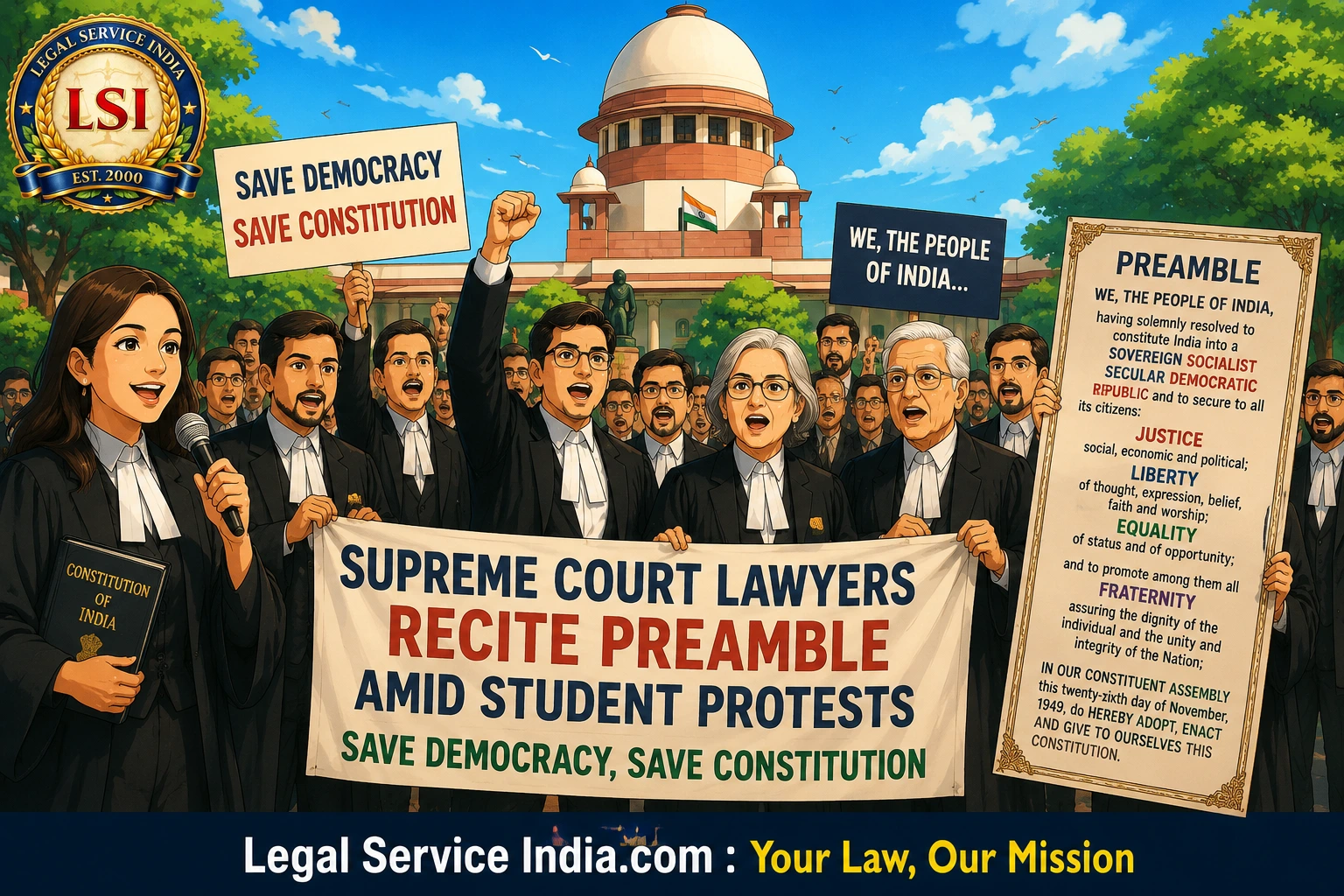
According to media reports, a large number of advocates assembled near the Supreme Court under the banner of “Save Democracy, Save Constitution”, publicly reading the Preamble as an affirmation of constitutional principles amid continuing student protests. Reports also indicate that distinguished members of the legal fraternity, including Senior Advocate Indira Jaising and Justice (Retd.) S. Muralidhar, who now practises as a senior advocate after serving as a judge of the Delhi High Court and the Punjab & Haryana High Court, participated in the programme.
It is important to underline, however, that this was not an official event organised by the Supreme Court of India. The participation was by individual members of the Bar exercising their constitutional freedoms. The Supreme Court, as an institution, maintained complete neutrality, consistent with its constitutional role as the country’s highest judicial authority.
The incident has generated widespread public debate because it sits at the intersection of several constitutional principles—freedom of speech, peaceful assembly, the independence of the Bar, constitutional morality, judicial neutrality, and democratic accountability. It also raises an important question: What role should lawyers play when constitutional values become the subject of public discourse?
Having practised before the Supreme Court of India for over twenty-five years, I believe that this event deserves careful legal analysis rather than partisan interpretation. The Constitution is not merely a legal document—it is the foundational charter of the Republic. Whenever members of the legal profession invoke its Preamble, the act carries constitutional symbolism that extends far beyond the immediate controversy.
This article examines the legal significance of the event through constitutional provisions, landmark Supreme Court judgements, professional ethics governing advocates, and India’s constitutional history.
The Event: What Happened?
The programme was reportedly organised under the theme “Save Democracy, Save Constitution” against the backdrop of ongoing student protests that have attracted national attention.
Instead of raising political slogans, participating lawyers collectively read the Preamble to the Constitution of India, reaffirming the ideals of:
- Justice
- Liberty
- Equality
- Fraternity
- Democracy
- Secularism
- Rule of Law
This choice was itself constitutionally significant. The Preamble represents the philosophical foundation of the Constitution and embodies the aspirations that guided the Constituent Assembly in framing India’s supreme law.
Unlike a political rally, the event projected itself as an affirmation of constitutional values rather than support for any specific political party or ideology.
Nevertheless, because the gathering involved advocates practising before the Supreme Court and occurred amid an ongoing national controversy, it attracted enormous public attention and sparked debate regarding the role of lawyers in public constitutional discourse.
Why the Preamble Occupies a Unique Constitutional Position
To understand why the event attracted such widespread attention, one must first appreciate the constitutional importance of the Preamble.
The Preamble begins with perhaps the most powerful words in the Constitution:
“We, the People of India…”
These words establish that sovereignty flows not from Parliament, the Executive, or even the Judiciary, but from the people themselves.
The Preamble declares India to be:
- Sovereign
- Socialist
- Secular
- Democratic
- Republic
It further promises to secure:
- Justice—social, economic, and political;
- Liberty of thought, expression, belief, faith and worship;
- Equality of status and opportunity; and
- Fraternity assuring the dignity of the individual and the unity and integrity of the nation.
Although the Preamble does not itself confer enforceable rights, it reflects the constitutional philosophy that informs every part of the Constitution.
Is the Preamble Legally Enforceable?
One of the most frequently misunderstood aspects of constitutional law concerns the legal status of the Preamble.
The answer has evolved through judicial interpretation.
Early Position
Initially, in In Re: Berubari Union and Exchange of Enclaves, AIR 1960 SC 845, the Supreme Court observed that the Preamble was not a source of substantive power and could not independently confer rights or powers.
However, this understanding underwent a significant transformation.
Kesavananda Bharati: A Constitutional Turning Point
The landmark judgement in Kesavananda Bharati v. State of Kerala (1973) 4 SCC 225 fundamentally altered Indian constitutional jurisprudence.
A thirteen-judge Constitution Bench held that:
- The Preamble forms part of the Constitution;
- it reflects the Constitution’s basic philosophy; and
- It serves as an interpretative guide while construing constitutional provisions.
More importantly, the judgement gave birth to the Basic Structure Doctrine, one of the most influential principles in comparative constitutional law.
The Court ruled that although Parliament possesses wide powers to amend the Constitution under Article 368, it cannot alter or destroy the Constitution’s basic structure.
The ideals expressed in the Preamble significantly influenced the identification of these basic features.
Thus, while citizens cannot directly file a writ petition solely on the basis of the Preamble, constitutional courts consistently rely upon it while interpreting the scope of constitutional rights.
The Preamble as the Moral Compass of the Constitution
Constitutional scholar Nani A. Palkhivala famously described the Constitution as a living document whose spirit is reflected in the Preamble.
Similarly, former Attorney General Soli J. Sorabjee often emphasised that constitutional democracy survives only when institutions remain faithful to the values embedded in the Constitution rather than merely its literal text.
From a legal perspective, the Preamble performs three important functions:
- It identifies the source of constitutional authority.
The Constitution derives legitimacy from “We, the People.” - It declares the objectives of the Constitution.
Every constitutional institution exists to secure justice, liberty, equality and fraternity. - It guides constitutional interpretation.
Whenever ambiguity exists, courts frequently refer to the Preamble to understand the broader constitutional purpose.
Consequently, public recitation of the Preamble carries symbolic significance because it invokes the constitutional vision rather than any ordinary statutory provision.
Constitutional Rights Relevant to the Event
| Constitutional Provision | Relevance |
|---|---|
| Article 19(1)(a) | Freedom of Speech and Expression |
| Article 19(1)(b) | Right to Peaceful Assembly |
| Article 19(1)(c) | Freedom to Form Associations |
| Article 21 | Protection of Life and Personal Liberty |
Article 19(1)(a): Freedom of Speech and Expression
Article 19(1)(a) guarantees every citizen the right to freedom of speech and expression.
Reading the Preamble publicly constitutes expressive conduct protected by Article 19.
However, this freedom is not absolute.
Article 19(2) permits reasonable restrictions in the interests of:
- sovereignty and integrity of India;
- security of the State;
- public order;
- decency;
- morality;
- contempt of court;
- defamation; and
- incitement to an offence.
Therefore, any assessment of such events must balance constitutional freedoms with permissible restrictions.
Article 19(1)(b): Right to Peaceful Assembly
The Constitution guarantees citizens the right to assemble peacefully and without arms.
The Supreme Court has consistently recognised peaceful assembly as an essential component of democratic governance.
However, reasonable regulations may be imposed to ensure:
- traffic management;
- public safety;
- security; and
- maintenance of public order.
Thus, peaceful constitutional gatherings ordinarily enjoy constitutional protection unless they cross legally permissible limits.
Article 19(1)(c): Freedom to Form Associations
Lawyers’ associations, bar bodies and professional organisations derive constitutional protection from Article 19(1)(c).
This freedom enables legal professionals to collectively express concerns regarding issues affecting constitutional governance, subject always to reasonable restrictions.
Article 21: Protection of Life and Personal Liberty
Modern constitutional jurisprudence has transformed Article 21 into one of the broadest guarantees of individual liberty anywhere in the world.
The Supreme Court has interpreted Article 21 to include:
- dignity;
- privacy;
- procedural fairness;
- access to justice;
- reputation; and
- meaningful personal liberty.
Many constitutional debates involving public protests ultimately revolve around safeguarding these values.
Constitutional Morality: The Larger Principle
The phrase “constitutional morality” has become increasingly important in recent Supreme Court jurisprudence.
Its origins lie in the debates of the Constituent Assembly, where Dr B.R. Ambedkar warned that constitutional democracy cannot survive merely through legal institutions; it requires a culture of respect for constitutional principles.
The Supreme Court elaborated on this doctrine in several landmark judgements, including:
- Government of NCT of Delhi v. Union of India, (2018) 8 SCC 501;
- Navtej Singh Johar v. Union of India, (2018) 10 SCC 1.
The Court explained that constitutional morality requires all constitutional actors—including governments, courts, public institutions and citizens—to remain faithful to constitutional values rather than transient political majorities.
In this context, the recitation of the Preamble may be viewed by participants as an affirmation of constitutional morality rather than a purely political act.
Why Lawyers Chose the Preamble Instead of Political Slogans
Perhaps the most legally significant aspect of the event is what was read.
The participants did not reportedly raise partisan slogans or endorse electoral candidates.
Instead, they chose to recite the Preamble—the very text that embodies the constitutional aspirations of the Republic.
From a constitutional perspective, this distinction is important.
The Preamble belongs to every citizen irrespective of political affiliation.
Its language represents shared constitutional commitments rather than partisan positions.
Accordingly, the symbolism of reading the Preamble carries a fundamentally different constitutional character from conventional political demonstrations.
The Constitutional Position of Advocates: Officers of the Court and Guardians of the Rule of Law
To understand the legal implications of the event where Supreme Court lawyers recite the preamble amid student protests, one must first appreciate the unique constitutional status of advocates in India.
Unlike ordinary professionals, advocates occupy a dual role.
Dual Constitutional Role of Advocates
- Officers of the Court entrusted with assisting in the administration of justice; and
- Citizens entitled to enjoy the fundamental rights guaranteed by the Constitution.
This dual character places lawyers in a distinctive constitutional position. While they enjoy freedoms under Articles 19 and 21, they are also expected to maintain the dignity of the judiciary, uphold professional ethics, and preserve public confidence in the justice delivery system.
The Supreme Court has repeatedly recognised that an independent bar is indispensable to an independent judiciary. Judicial independence is not sustained by judges alone; it also depends upon fearless and responsible advocates who are willing to defend constitutional values within the framework of law.
Therefore, participation by lawyers in public constitutional discourse cannot be examined solely from the standpoint of free speech. It must also be viewed in light of their professional responsibilities.
Constitutional Responsibilities of Advocates
| Constitutional Freedom | Professional Responsibility |
|---|---|
| Rights under Articles 19 and 21 | Maintain the dignity of the judiciary. |
| Freedom of expression | Uphold professional ethics. |
| Participation in constitutional discourse | Preserve public confidence in the justice delivery system. |
| Constitutional liberties | Support the rule of law and the administration of justice. |
The Advocates Act, 1961, and Professional Ethics
The legal profession in India is primarily governed by the Advocates Act, 1961, together with the Bar Council of India Rules framed under the Act.
These rules prescribe the standards of professional conduct expected from advocates.
Duties Owed by an Advocate
An advocate owes duties to:
- the Court;
- the client;
- the opponent;
- fellow advocates; and
- society at large.
Professional Standards Under Bar Council Rules
The Bar Council Rules require advocates to:
- maintain dignity and self-respect;
- conduct themselves in a manner befitting the legal profession;
- avoid conduct that interferes with the administration of justice; and
- uphold the rule of law.
At the same time, nothing in the Advocates Act prohibits advocates from participating in peaceful public discussions concerning constitutional values, provided such participation does not obstruct court proceedings, interfere with the administration of justice, or violate professional ethics.
Accordingly, whether participation in a public event is professionally improper depends upon the nature of the conduct, not merely the fact of participation.
Can Advocates Participate in Public Protests?
This question has generated considerable debate.
The answer requires balancing constitutional freedoms with professional obligations.
Constitutional Freedoms Available to Advocates
Like every citizen, advocates enjoy:
- freedom of speech under Article 19(1)(a);
- freedom of peaceful assembly under Article 19(1)(b); and
- freedom of association under Article 19(1)(c).
However, because advocates are officers of the court, they must exercise these freedoms responsibly.
Participation in a peaceful constitutional event does not, by itself, amount to professional misconduct.
Conduct That May Invite Legal or Disciplinary Consequences
On the other hand, actions that:
- disrupt court functioning;
- obstruct access to justice;
- intimidate litigants;
- scandalise the judiciary without legal basis; or
- interfere with pending judicial proceedings,
may invite legal or disciplinary consequences.
Peaceful Constitutional Expression vs. Professional Misconduct
| Generally Permissible Conduct | Conduct That May Invite Consequences |
|---|---|
| Peaceful constitutional expression | Disrupting court functioning |
| Participating in public constitutional discussions | Obstructing access to justice |
| Lawful exercise of constitutional freedoms | Intimidating litigants |
| Peaceful assembly consistent with professional ethics | Scandalising the judiciary without legal basis |
| Responsible public participation | Interfering with pending judicial proceedings |
The distinction is therefore between peaceful constitutional expression and conduct that impairs the administration of justice.
Landmark Supreme Court Judgements on Peaceful Protest
The constitutional issues arising from the event cannot be analysed without referring to the Supreme Court’s jurisprudence on peaceful demonstrations.
| Judgement | Year | Key Constitutional Principle |
|---|---|---|
| Himat Lal K. Shah v. Commissioner of Police, Ahmedabad | 1973 | Right to hold public meetings subject to reasonable regulation |
| Ramlila Maidan Incident v. Home Secretary, Union of India | 2012 | Peaceful protest is a democratic right. |
| Mazdoor Kisan Shakti Sangathan v. Union of India | 2018 | Balancing protest rights with competing public rights |
| Amit Sahni v. Commissioner of Police (Shaheen Bagh Case) | 2020 | Protected dissent cannot indefinitely block public ways. |
1. Himat Lal K. Shah v. Commissioner of Police, Ahmedabad (1973) 1 SCC 227
This landmark judgement recognised that citizens possess a constitutional right to hold public meetings on public streets, subject to reasonable regulation.
The Court held that the State cannot impose a blanket prohibition on public assemblies.
Instead, restrictions must satisfy constitutional standards of reasonableness.
The judgement laid the foundation for modern jurisprudence on peaceful assembly under Article 19(1)(b).
2. Ramlila Maidan Incident v. Home Secretary, Union of India (2012) 5 SCC 1
This case arose from the midnight police action at Delhi’s Ramlila Maidan.
The Supreme Court strongly reaffirmed that:
- Peaceful protest is an important democratic right;
- citizens have a constitutional entitlement to express dissent; and
- Executive action must remain proportionate.
The Court observed that democracy flourishes through dialogue rather than suppression.
The judgement continues to serve as an important precedent on balancing civil liberties with public order.
3. Mazdoor Kisan Shakti Sangathan v. Union of India (2018) 17 SCC 324
The Supreme Court recognised that protest is an essential feature of constitutional democracy.
However, it also held that competing rights must be balanced.
While citizens possess the right to demonstrate peacefully, authorities may regulate the time, place, and manner of assemblies to ensure that the rights of others are not disproportionately affected.
This principle reflects the constitutional doctrine of proportionality.
4. Amit Sahni v. Commissioner of Police (2020) 10 SCC 439 (Shaheen Bagh Case)
Perhaps the most widely discussed judgement on public protest in recent years, the Shaheen Bagh decision held that:
- Dissent is a constitutional right;
- peaceful protest remains protected;
- However, public ways cannot be occupied indefinitely.
The Court clarified that constitutional rights must coexist with the rights of other citizens.
Thus, while protest enjoys constitutional protection, its exercise cannot permanently obstruct public movement or essential civic functions.
What Does This Jurisprudence Mean for the Present Event?
Applying these principles, several observations emerge.
If advocates peacefully gathered to recite the Preamble without disrupting judicial proceedings, obstructing court functioning, or violating lawful restrictions, such conduct would ordinarily fall within the protective ambit of Article 19.
However, every situation ultimately depends upon its specific facts.
Questions such as:
- the location of the gathering;
- permissions obtained;
- impact upon court functioning;
- compliance with lawful regulations; and
- maintenance of public order,
would all be relevant in assessing legality.
Constitutional freedoms are broad, but they are not absolute.
Constitutional Morality and Public Constitutional Expression
The doctrine of constitutional morality has acquired increasing importance in Indian constitutional law.
The Supreme Court explained its significance in Government of NCT of Delhi v. Union of India, (2018) 8 SCC 501.
The Court observed that constitutional morality requires all constitutional institutions to act consistently with the values embodied in the Constitution rather than transient political preferences.
Similarly, in Navtej Singh Johar v. Union of India, (2018) 10 SCC 1, the Constitution Bench described constitutional morality as an indispensable safeguard against majoritarian excess.
For advocates, constitutional morality implies fidelity to:
- rule of law;
- constitutional supremacy;
- equality;
- liberty;
- dignity; and
- democratic accountability.
Viewed from this perspective, reciting the Preamble can be interpreted by participants as a reaffirmation of constitutional values rather than merely a political act.
The Basic Structure Doctrine: Why the Preamble Matters
The significance of the event becomes even clearer when viewed through the Basic Structure Doctrine.
In Kesavananda Bharati v. State of Kerala, (1973) 4 SCC 225, the Supreme Court held that Parliament cannot destroy the Constitution’s essential features.
Subsequent judgements have recognised among these features:
- rule of law;
- judicial review;
- democracy;
- secularism;
- federalism;
- separation of powers;
- constitutional supremacy;
- dignity of the individual.
Each of these principles finds expression, directly or indirectly, in the Preamble.
Consequently, the Preamble is not merely ceremonial language.
It represents the constitutional philosophy that binds every organ of the State.
Lawyers and India’s Constitutional History
The participation of lawyers in constitutional movements has deep historical roots.
India’s freedom struggle was led by some of the country’s most distinguished lawyers, including:
- Mahatma Gandhi;
- Dr B.R. Ambedkar;
- Jawaharlal Nehru;
- Motilal Nehru;
- Sardar Vallabhbhai Patel;
- K.M. Munshi; and
- Alladi Krishnaswami Ayyar.
Following Independence, eminent jurists such as
- M.C. Setalvad;
- H.M. Seervai;
- Nani A. Palkhivala;
- Fali S. Nariman and
- Soli J. Sorabjee,
continued to shape constitutional discourse through advocacy, scholarship, and public engagement.
This historical tradition demonstrates that members of the Bar have often contributed to constitutional debates beyond courtroom litigation, while remaining committed to the rule of law.
The Emergency (1975–1977): Lessons for Constitutional Democracy
Any discussion concerning constitutional values inevitably recalls the experience of the Emergency.
During that period:
- civil liberties were curtailed;
- Preventive detention expanded;
- press freedoms were restricted; and
- Constitutional institutions came under intense strain.
Many lawyers, judges, and civil society members played significant roles in defending constitutional principles during those years.
The Emergency reinforced an enduring lesson: constitutional democracy survives only when institutions and citizens remain vigilant in protecting constitutional values.
While the present circumstances are entirely different, the historical memory of constitutional resilience explains why symbolic acts—such as reading the Preamble—often resonate deeply within the legal community.
Is There Any Question of Contempt of Court?
Whenever activities occur in or around court premises, the issue of contempt is sometimes raised.
The Contempt of Courts Act, 1971, together with Articles 129 and 215 of the Constitution, empowers constitutional courts to punish acts that:
- scandalise the court;
- obstruct the administration of justice; or
- interfere with judicial proceedings.
However, peaceful recitation of the Constitution does not automatically amount to contempt.
The crucial legal test is whether the conduct substantially interferes with the administration of justice or undermines the authority of the court in a manner recognised by contempt jurisprudence.
Mere expression of constitutional values, without obstructing judicial work or scandalising the court, would ordinarily not satisfy the threshold for criminal contempt. Each case, however, depends on its own facts and circumstances.
Supreme Court vs. Supreme Court Lawyers: An Important Constitutional Distinction
One of the most important legal clarifications that must be made while discussing the event “Supreme Court Lawyers Recite Preamble Amid Student Protests” is the distinction between the Supreme Court of India as a constitutional institution and the advocates who practise before it.
This distinction is often blurred in public discourse, particularly through headlines or social media commentary. However, from a constitutional perspective, they occupy entirely different positions.
Constitutional Position of the Supreme Court
The Supreme Court of India derives its authority from Part V, Chapter IV of the Constitution and functions as the country’s highest constitutional court. Its legitimacy rests upon judicial independence, impartiality, and institutional neutrality. Judges speak only through their judgements and judicial orders.
Constitutional Position of Supreme Court Lawyers
By contrast, advocates practising before the Supreme Court remain independent legal professionals. Although they are officers of the court, they do not represent the institution unless specifically authorised. Their opinions, speeches, or participation in public events are personal or professional expressions and cannot be attributed to the Supreme Court itself.
| Supreme Court of India | Supreme Court Lawyers |
|---|---|
| Constitutional institution established under Part V, Chapter IV. | Independent legal professionals practising before the Court. |
| Exercises judicial power. | Represent litigants and assist the court. |
| Acts through judicial orders and judgements. | Express personal and professional opinions unless officially authorised. |
| Must remain institutionally neutral. | May participate in lawful constitutional discourse. |
Therefore, while reports state that Supreme Court lawyers recited the Preamble, this should not be understood as an institutional action or endorsement by the Supreme Court.
This distinction preserves the constitutional doctrine of judicial neutrality, a cornerstone of the rule of law.
Why the Legal Community Chose the Preamble
One of the most remarkable aspects of the event was the decision to read the Preamble rather than chant political slogans.
This choice carries profound constitutional significance.
The Preamble is not a party manifesto, a government policy, or an ideological declaration. It is the common constitutional foundation accepted by every citizen of India.
By reading the Preamble, participants invoked principles that transcend political differences:
- Justice
- Liberty
- Equality
- Fraternity
- Democracy
- Secularism
- National Unity
Whether one agrees with the objectives of the student protests or not, few would dispute that these constitutional ideals belong to every Indian.
From a constitutional perspective, the symbolism of reading the Preamble is therefore fundamentally different from ordinary political demonstrations.
Constitutional Patriotism and Democratic Dialogue
Modern constitutional democracies increasingly recognise the idea of constitutional patriotism—a commitment to constitutional values rather than allegiance to any particular political ideology.
India’s Constitution represents a shared social compact among its citizens.
The Supreme Court has repeatedly observed that constitutional democracy flourishes through:
- Dialogue;
- Tolerance;
- Peaceful disagreement;
- Institutional accountability; and
- Respect for the rule of law.
Public engagement with constitutional principles, when undertaken peacefully and responsibly, contributes to constitutional literacy and democratic awareness.
At the same time, constitutional patriotism also demands respect for judicial independence and lawful processes. Democratic dissent must remain within the framework of the Constitution itself.
Comparative Constitutional Perspective
India is not unique in witnessing lawyers publicly invoking constitutional principles during moments of national importance.
Across constitutional democracies, members of the legal profession have historically played a significant role in defending constitutional governance.
United States
American lawyers and bar associations have frequently participated in debates involving:
- Civil rights;
- Voting rights;
- Judicial independence;
- Constitutional freedoms; and
- Separation of powers.
While courts remain institutionally neutral, members of the Bar regularly contribute to constitutional discourse.
United Kingdom
Although the United Kingdom does not have a single written constitution, barristers and solicitors have historically defended the principles of:
- Parliamentary accountability;
- Rule of law; and
- Judicial independence.
South Africa
Following the end of apartheid, South African constitutional lawyers became instrumental in shaping one of the world’s most progressive constitutional frameworks, with a strong emphasis on human dignity, equality, and human rights.
These international experiences demonstrate that lawyers often act not only as courtroom advocates but also as custodians of constitutional values.
Frequently Asked Questions (FAQs)
Why Did Supreme Court Lawyers Recite the Preamble Amid Student Protests?
According to reports, the recitation was organised as part of the “Save Democracy, Save Constitution” campaign to reaffirm commitment to constitutional values during ongoing student protests. It was an initiative of members of the legal fraternity and not an official programme of the Supreme Court.
Is the Preamble Legally Enforceable?
The Preamble does not independently confer enforceable rights. However, following Kesavananda Bharati v. State of Kerala (1973) 4 SCC 225, it forms part of the Constitution and serves as an important interpretative guide in constitutional adjudication.
Can Advocates Participate in Public Protests?
Advocates enjoy the same fundamental rights as other citizens under Article 19 of the Constitution. However, because they are officers of the Court, they must exercise these rights consistently with the Advocates Act, 1961, the Bar Council of India Rules, and their professional duties.
Does Reading the Preamble Amount to Contempt of Court?
No. Merely reading the Preamble does not amount to contempt of court. Contempt arises only where conduct substantially interferes with the administration of justice, obstructs judicial proceedings, or scandalises the court within the meaning of the Contempt of Courts Act, 1971, and constitutional jurisprudence.
What Is Constitutional Morality?
Constitutional morality refers to adherence to the values and principles embodied in the Constitution—such as liberty, equality, dignity, secularism, and the rule of law—even when they may conflict with transient political preferences. The Supreme Court has elaborated on this doctrine in decisions including Government of NCT of Delhi v. Union of India (2018) and Navtej Singh Johar v. Union of India (2018).
What Constitutional Provisions Are Relevant to This Event?
The key constitutional provisions include:
| Constitutional Provision | Relevance |
|---|---|
| Preamble | Reflects the Constitution’s guiding philosophy and values. |
| Article 19(1)(a) | Freedom of speech and expression. |
| Article 19(1)(b) | Right to assemble peacefully. |
| Article 19(1)(c) | Freedom to form associations. |
| Article 21 | Protection of life, liberty, and dignity. |
| Article 32 | Constitutional remedies before the Supreme Court. |
| Article 129 | The Supreme Court’s power to punish for contempt. |
| Article 368 | Constitutional amendment power, subject to the Basic Structure Doctrine. |
Quick Summary of Key Constitutional Principles
| Topic | Key Constitutional Principle |
|---|---|
| Preamble | Guides constitutional interpretation and reflects India’s foundational values. |
| Freedom of Speech | Protected under Article 19(1)(a), subject to reasonable restrictions. |
| Peaceful Assembly | Guaranteed under Article 19(1)(b). |
| Associations | Protected under Article 19(1)(c). |
| Personal Liberty | Protected under Article 21. |
| Judicial Remedies | Available under Article 32 before the Supreme Court. |
| Contempt Jurisdiction | Governed by Article 129 and the Contempt of Courts Act, 1971. |
| Constitutional Amendments | Subject to Article 368 and the Basic Structure Doctrine. |
Key Judicial Precedents
The following landmark decisions provide the constitutional framework for analysing this development:
| Case | Legal Principle |
|---|---|
| Kesavananda Bharati v. State of Kerala (1973) 4 SCC 225 | Basic Structure Doctrine: The preamble forms part of the Constitution. |
| In Re: Berubari Union, AIR 1960 SC 845 | Early view on the legal status of the Preamble. |
| S.R. Bommai v. Union of India (1994) 3 SCC 1 | Secularism is part of the Basic Structure. |
| K.S. Puttaswamy v. Union of India (2017) 10 SCC 1 | Right to privacy as a fundamental right rooted in dignity and liberty. |
| Government of NCT of Delhi v. Union of India (2018) 8 SCC 501 | Constitutional morality and cooperative constitutionalism. |
| Navtej Singh Johar v. Union of India (2018) 10 SCC 1 | Constitutional morality, dignity, and equality. |
| Himat Lal K. Shah v. Commissioner of Police (1973) 1 SCC 227 | Right to peaceful assembly in public spaces. |
| Ramlila Maidan Incident v. Home Secretary (2012) 5 SCC 1 | Peaceful protest as an essential democratic right. |
| Mazdoor Kisan Shakti Sangathan v. Union of India (2018) 17 SCC 324 | Balancing the right to protest with public order. |
| Amit Sahni v. Commissioner of Police (2020) 10 SCC 439 | The right to protest cannot indefinitely obstruct public spaces. |
Expert Analysis: Why This Event Matters
From a constitutional lawyer’s perspective, the significance of this event lies not in the political controversy surrounding the student protests but in the constitutional symbolism of the legal profession publicly invoking the Preamble.
The event illustrates three enduring principles:
- The Constitution remains the ultimate source of democratic legitimacy. Public discourse—whether in support of or in opposition to government action—must remain anchored in constitutional values.
- The independence of the Bar is an essential component of the rule of law. Advocates are not merely representatives of clients; they are officers of the court with a broader responsibility to uphold constitutional governance and the administration of justice.
- Judicial neutrality must always be preserved. While lawyers may engage in public constitutional expression, the Supreme Court as an institution must remain detached from political contests and continue to adjudicate disputes impartially.
These principles are complementary rather than contradictory. A vibrant democracy requires both an independent judiciary and an independent legal profession.
Key Takeaways
- The event involving Supreme Court lawyers reciting the preamble amid student protests was a symbolic affirmation of constitutional values by members of the Bar and not an official function of the Supreme Court of India.
- The Preamble, though not independently enforceable, forms part of the Constitution and guides constitutional interpretation.
- Articles 19 and 21 protect freedom of speech, peaceful assembly, and personal liberty, subject to reasonable restrictions.
- Advocates enjoy constitutional freedoms but must exercise them in accordance with the Advocates Act, 1961, the Bar Council of India Rules, and their duties as officers of the Court.
- Supreme Court jurisprudence consistently recognises peaceful dissent as an essential feature of constitutional democracy while permitting reasonable regulation to protect public order and the rights of others.
- The distinction between the judiciary and the legal profession is fundamental to preserving public confidence in judicial impartiality.
Conclusion
The episode surrounding Supreme Court lawyers reciting the preamble amid student protests has become a powerful reminder that the Constitution is not merely a legal text but the living foundation of India’s democratic republic. Whether viewed as an act of constitutional affirmation, civic engagement, or symbolic dissent, the recitation of the Preamble underscores the enduring relevance of the values of justice, liberty, equality, fraternity, and the rule of law.
Equally important is the need to preserve the distinction between the Supreme Court as a constitutional institution and the advocates who practise before it. The judiciary must remain impartial and independent, while members of the Bar, as citizens and officers of the Court, retain the right to participate in public constitutional discourse, provided they do so within the bounds of law and professional ethics.
Ultimately, India’s constitutional democracy is strengthened not by unanimity of opinion but by the ability of its institutions and citizens to engage in reasoned, peaceful, and lawful dialogue. The Preamble continues to serve as the Republic’s moral compass, reminding every citizen—and every constitutional functionary—that democracy flourishes when differences are resolved through constitutional means rather than confrontation.
References and Legal Authorities
- Constitution of India – Preamble; Articles 19, 21, 32, 129, and 368.
- Advocates Act, 1961.
- Bar Council of India Rules (Standards of Professional Conduct and Etiquette).
- Contempt of Courts Act, 1971.
- Kesavananda Bharati v. State of Kerala, (1973) 4 SCC 225.
- In Re: Berubari Union and Exchange of Enclaves, AIR 1960 SC 845.
- S.R. Bommai v. Union of India, (1994) 3 SCC 1.
- K.S. Puttaswamy v. Union of India, (2017) 10 SCC 1.
- Government of NCT of Delhi v. Union of India, (2018) 8 SCC 501.
- Navtej Singh Johar v. Union of India, (2018) 10 SCC 1.
- Himat Lal K. Shah v. Commissioner of Police, (1973) 1 SCC 227.
- Ramlila Maidan Incident v. Home Secretary, Union of India, (2012) 5 SCC 1.
- Mazdoor Kisan Shakti Sangathan v. Union of India, (2018) 17 SCC 324.
- Amit Sahni v. Commissioner of Police, (2020) 10 SCC 439.
Important Links
Important Links:
- Lawyers in India
- Copyright Registration in India
- Caveat Filing in Supreme Court of India
- Mutual Consent Divorce in Delhi NCR: WhatsApp 9650499965