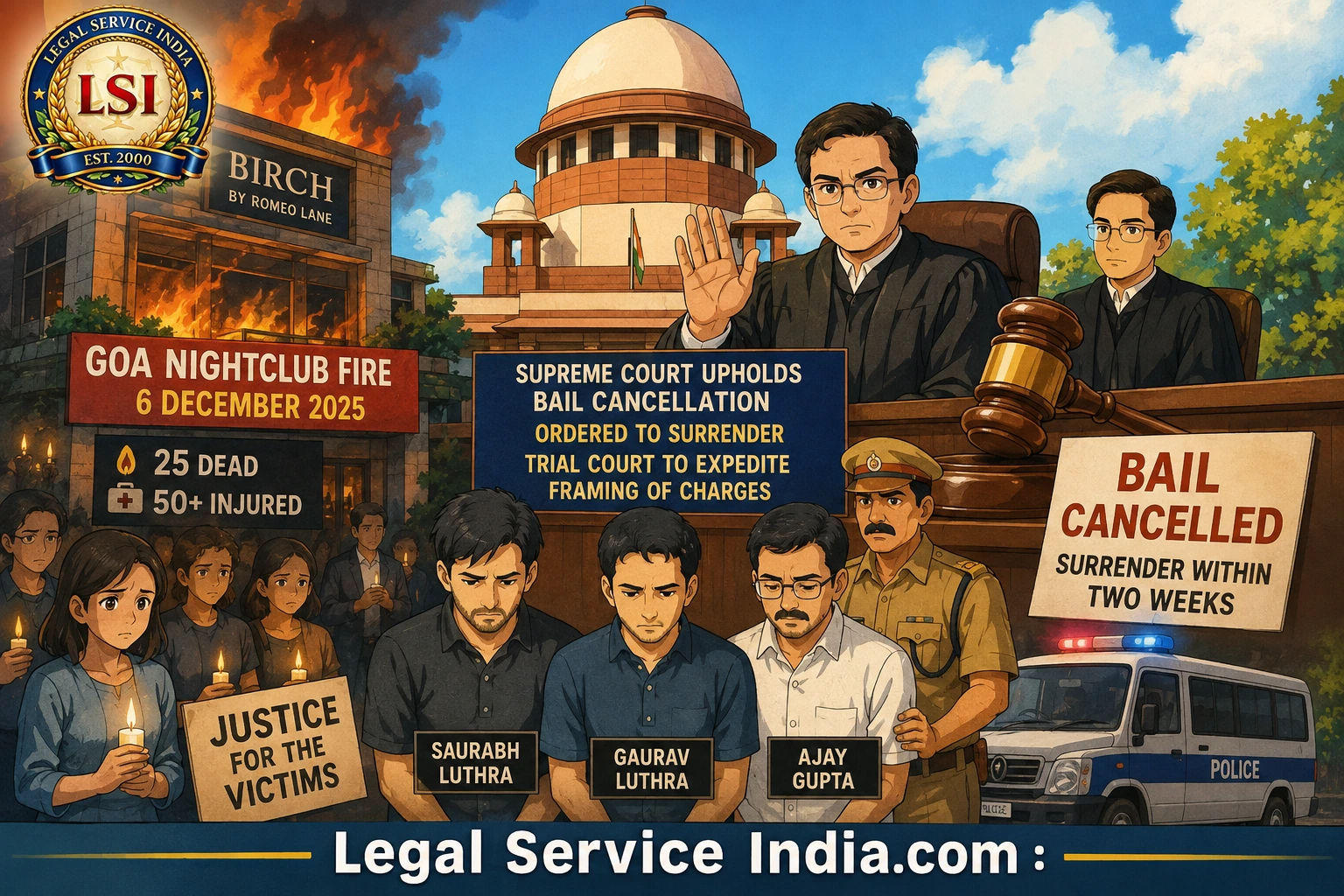
Goa Nightclub Fire: Supreme Court Upholds Cancellation of Bail of Three Owners
“The cancellation of bail is not a declaration of guilt; it is a reminder that when public safety and judicial responsibility are tested, liberty must be balanced with the need for a fair, effective and expeditious trial.”
— Adv. Tarun Choudhury, Supreme Court Advocate
Introduction
The Supreme Court has delivered an important order concerning the Goa Nightclub Fire, refusing to interfere with the Bombay High Court’s decision cancelling the bail granted to three co-owners of Birch by Romeo Lane, the nightclub at Arpora, North Goa, where a devastating fire claimed 25 lives on December 6, 2025.
A bench comprising Justice Dipankar Datta and Justice Sheel Nagu dismissed the pleas filed by Saurabh Luthra, Gaurav Luthra and Ajay Gupta and directed them to surrender within two weeks. The Supreme Court also indicated that the trial court should expedite the process of framing charges.
The order is significant not merely because three accused persons have been required to surrender again. Its larger importance lies in the Court’s approach towards bail in a case involving multiple deaths, alleged violations of safety norms, the manner in which the premises were allegedly operated, and the conduct attributed to the accused after the incident.
At the same time, it is important to understand what the Supreme Court’s order does—and does not—decide. The Court has not convicted the accused. The criminal trial will still determine whether the prosecution’s allegations are proved beyond reasonable doubt.
That distinction is fundamental to criminal jurisprudence.
Case Citation
Citation: Gaurav Luthra v. State of Goa, SLP (Crl.) No. 15665/2026 & connected matters; order dated 31 August 2026, Supreme Court of India.
The connected matters include Saurabh Luthra v. State of Goa, SLP (Crl.) No. 15656/2026, and Ajay Gupta v. State of Goa, SLP (Crl.) No. 15634/2026.
The Goa Nightclub Fire: What Happened?
The case arises from the fire that broke out at Birch by Romeo Lane in Arpora, North Goa, on the night of December 6, 2025.
The tragedy resulted in the death of 25 persons, with more than 50 others reported injured. The incident therefore became one of the most serious nightclub fire tragedies in recent years and immediately raised questions regarding fire safety, licensing, construction permissions, emergency exits and the alleged use of pyrotechnics inside the premises.
The investigation subsequently resulted in a substantial chargesheet against multiple accused persons.
The prosecution case, as recorded in the proceedings before the Bombay High Court, included allegations that the establishment was operating without requisite safety clearances, that the structure itself was unauthorised, and that adequate fire-fighting and emergency evacuation arrangements were allegedly absent.
There were also allegations concerning the use of cold pyro/fire displays inside the premises, despite the alleged presence of combustible material and inadequate safety arrangements.
These allegations will ultimately have to be established in accordance with law during the trial.
Who Are the Three Accused?
The Supreme Court proceedings concern three persons associated with the establishment:
- Gaurav Luthra
- Saurabh Luthra
- Ajay Gupta
They were associated with Being GS Hospitality Goa Arpora LLP, which operated the nightclub.
The prosecution alleges that the accused were involved in the operation of the establishment and that serious regulatory and safety deficiencies existed at the premises.
Ajay Gupta’s counsel, however, argued before the Supreme Court that he was essentially an investor or sleeping partner, holding approximately a 10% share, and that he had no role in the day-to-day management of the establishment.
That defence contention remains a matter for judicial determination in the criminal proceedings.
The Trial Court Had Earlier Granted Bail
The three accused had earlier secured bail from the trial court.
According to the subsequent proceedings, Ajay Gupta was granted bail in March 2026, while the Luthra brothers were granted bail in April 2026.
The State of Goa challenged those orders before the Bombay High Court.
The High Court ultimately concluded that the bail orders required interference.
Why Did the Bombay High Court Cancel Their Bail?
The Bombay High Court’s decision is central to understanding why the Supreme Court ultimately refused to interfere.
Justice Neela Gokhale of the Bombay High Court found that the Sessions Court had not properly exercised its discretion while granting bail.
One of the major concerns was that the lower court’s reasoning did not adequately reflect the gravity and enormity of the alleged offence, particularly considering that 25 people had lost their lives.
The High Court also examined the investigation material concerning alleged safety violations.
Alleged Safety and Regulatory Violations
Among the issues noted in the proceedings were allegations relating to:
- absence of adequate fire-safety installations;
- lack of effective emergency arrangements;
- alleged unauthorised construction;
- alleged absence of necessary permissions;
- alleged deficiencies relating to emergency exits;
- alleged use of fire or pyro effects inside the premises; and
- alleged irregularities or forged documents concerning licences and permissions.
The High Court also took into account the allegation that the Luthra brothers travelled to Phuket, Thailand, shortly after the tragedy. They were subsequently detained by Thai authorities and brought back to India.
The High Court nevertheless made an important clarification: cancellation of bail did not prevent the accused from seeking bail afresh after surrender.
That distinction remains legally important.
Supreme Court Examines the Bail Challenge
The matter then reached the Supreme Court.
The cases were heard by a bench of:
- Justice Dipankar Datta
- Justice Sheel Nagu
The accused challenged the Bombay High Court’s cancellation of bail.
Their lawyers raised several legal and factual objections.
For the Luthra brothers, it was argued that the High Court had gone beyond the permissible scope of proceedings concerning cancellation of bail and had effectively undertaken a deeper examination of the prosecution material.
The defence also argued that there was no direct act attributable to the Luthra brothers which caused the deaths.
Senior Advocate Siddharth Dave submitted that the prosecution’s case, at its highest, could amount to an allegation of negligence rather than culpable homicide not amounting to murder.
Defence Argument: Section 304 Part II Could Not Apply
One of the important arguments raised before the Supreme Court concerned the alleged applicability of Section 304 Part II of the Indian Penal Code.
The defence argued that the offence of culpable homicide not amounting to murder could not be mechanically applied without establishing an act attributable to the particular accused which caused the deaths.
The argument, broadly stated, was that the prosecution case might at most fall within the realm of death caused by negligence, depending upon the evidence ultimately produced at trial.
This is an important criminal-law distinction.
A person cannot be convicted merely because he is associated with an establishment where a tragedy occurs.
The prosecution must ultimately establish the individual criminal liability of each accused in accordance with the ingredients of the offence charged.
But at the bail stage, the court is not conducting a full criminal trial.
That distinction becomes crucial.
Ajay Gupta’s Separate Defence
Senior Advocate Shyam Divan, appearing for Ajay Gupta, submitted that Gupta had only a minority shareholding and had no involvement in the day-to-day running of the establishment.
It was also argued that Gupta had cooperated with the investigation and complied with the conditions imposed upon him when bail was granted.
The defence therefore questioned whether cancellation of bail was justified, particularly when other accused persons had also obtained bail.
Again, these arguments concern the propriety of continued detention pending trial, rather than the ultimate question of guilt.
Supreme Court Refuses to Interfere
After hearing the submissions, the Supreme Court declined to interfere with the Bombay High Court’s order.
The appeals were dismissed.
The court directed the three accused to surrender within two weeks.
The Bench also directed that the trial court should expedite the process concerning the framing of charges.
This is perhaps the most important practical consequence of today’s order.
The Supreme Court has effectively said that the accused cannot continue to enjoy the benefit of the bail orders which were set aside by the Bombay High Court.
What Does the Supreme Court’s Order Actually Mean?
It is necessary to avoid an important misconception.
Cancellation of Bail Is Not Conviction
The Supreme Court has not held that the three accused are guilty of causing the 25 deaths.
The criminal prosecution still has to prove its case.
The presumption of innocence continues to operate until conviction in accordance with law.
Today’s order concerns the question of bail and custody pending trial.
This distinction is fundamental.
A court deciding bail is not expected to conduct a mini-trial or conclusively determine whether the prosecution’s evidence will ultimately result in conviction.
Why the Gravity of the Offence Matters at the Bail Stage
Bail jurisprudence in India proceeds on the principle that personal liberty is fundamental.
At the same time, bail is not an automatic entitlement in every case.
Courts ordinarily examine factors including:
- Nature and seriousness of the allegations;
- Prima facie material;
- Severity of the possible punishment;
- Possibility of the accused fleeing from justice;
- Likelihood of influencing witnesses;
- Possibility of tampering with evidence;
- Antecedents;
- Conduct of the accused;
- Stage of investigation and trial;
- And other circumstances relevant to the administration of justice.
The Goa Nightclub Fire case presents a particularly serious factual background because the prosecution alleges that multiple safety failures existed in a commercial establishment where members of the public were permitted to gather.
When 25 persons lose their lives in such circumstances, the court is naturally required to examine the allegations with considerable seriousness.
But the seriousness of the allegation alone does not dispense with the need for evidence.
The Importance of Alleged Safety Violations
From a legal perspective, perhaps the most significant aspect of this case is the relationship between regulatory compliance and criminal liability.
Running a public entertainment establishment carries responsibilities.
Owners, partners, managers and operators may have obligations relating to:
- Fire safety;
- Building permissions;
- Emergency exits;
- Occupancy limits;
- Electrical safety;
- Fire-fighting equipment;
- Emergency evacuation;
- Licences and statutory permissions;
- And the safety of customers and employees.
Where a prosecution alleges that such safeguards were knowingly disregarded and that the disregard contributed to a fatal incident, the question can move beyond a mere regulatory violation.
It can potentially become a question of criminal negligence or culpable conduct, depending upon the evidence and the statutory provisions ultimately applied.
That is why this case deserves close attention.
The Phuket Episode and Its Relevance to Bail
Another factor that attracted attention was the alleged departure of the Luthra brothers to Phuket following the fire.
According to the prosecution case, they travelled to Thailand shortly after the incident and were subsequently detained there. An Interpol Blue Corner Notice was also reportedly issued in the matter.
From a defence perspective, the circumstances surrounding their departure would have to be assessed fairly and in context.
From the prosecution’s perspective, however, such conduct can be relevant to the question of whether an accused presents a flight risk.
This is precisely why bail decisions cannot be determined merely by looking at the alleged offence in isolation.
The court examines the entire factual matrix.
A Significant Message on Judicial Discretion in Bail Matters
The case also highlights an important principle concerning judicial discretion.
Bail is discretionary, but judicial discretion must be exercised judicially.
A bail order must demonstrate that the court has considered the relevant factors.
The Bombay High Court found that the Sessions Court had inadequately considered the seriousness of the allegations and the material collected during investigation.
The Supreme Court, by refusing to interfere with that conclusion at this stage, has allowed the High Court’s cancellation of bail to stand.
This should not be interpreted as a declaration that every serious offence automatically requires incarceration pending trial.
Rather, it demonstrates that where a bail order is alleged to have been passed without proper consideration of relevant circumstances, the superior court can examine whether the discretion was properly exercised.
Supreme Court’s Direction to Expedite Framing of Charges
The Supreme Court’s direction to expedite the framing of charges is particularly noteworthy.
There is an important constitutional balance here.
On one side is the seriousness of the allegations and the interests of victims and their families.
On the other side is the accused person’s right to personal liberty and the constitutional guarantee against indefinite pre-trial detention.
If an accused is required to remain in custody because bail has been cancelled, the trial cannot be permitted to drift indefinitely.
Therefore, the Supreme Court’s direction for expeditious progress in framing charges is consistent with the broader principle that criminal trials should proceed within a reasonable time.
The Broader Legal Issue: Safety of Public Establishments
The Goa nightclub fire should also be viewed beyond the immediate prosecution of three individuals.
India has repeatedly witnessed tragic fires in restaurants, clubs, hospitals, factories, coaching centres and other public establishments.
Often, the immediate cause of a fire is only one part of the story.
The scale of casualties may depend upon whether:
- Emergency exits are available;
- Doors are unlocked;
- Fire alarms function;
- Smoke spreads rapidly;
- Combustible material has been used;
- Occupancy limits are respected;
- Fire extinguishers are available;
- Evacuation routes are clearly marked;
- Staff know emergency procedures;
- And statutory authorities have granted the necessary approvals.
A business cannot treat safety compliance as merely a paperwork exercise.
Where members of the public enter commercial premises, there is a corresponding responsibility to ensure that the premises are reasonably safe and legally compliant.
What the Case Means for Business Owners and Directors
There is also a broader lesson for business owners.
A person who invests in or holds an interest in a business is not automatically criminally liable for every incident occurring there.
Criminal liability generally requires a legally sustainable connection between the accused and the alleged offence.
However, merely describing oneself as an investor or partner will not necessarily answer the question if the prosecution produces material showing actual participation, knowledge, authorisation, consent, connivance or other legally relevant conduct.
The precise role of each accused therefore matters.
The trial will ultimately have to determine those questions on evidence.
What Happens Next?
Following today’s Supreme Court order:
1. The Three Accused Must Surrender
The Supreme Court has granted them two weeks from August 31, 2026, to surrender.
2. The Trial Proceedings Are Expected to Move Forward
The Supreme Court has urged the trial court to expedite the process of framing charges.
3. Fresh Bail Remains Legally Possible
Importantly, the Bombay High Court had indicated that the accused could seek bail afresh after surrender. Any such application would have to be considered on its own merits and in accordance with law.
Therefore, today’s order should not be misunderstood as permanently closing the door on every future bail application.
A subsequent bail application may be considered if legally relevant circumstances exist.
My Legal Analysis
As a lawyer who has spent more than two decades dealing with litigation, I believe the Goa Nightclub Fire case raises a question much larger than whether three individuals should remain on bail.
It concerns the relationship between commercial freedom, regulatory compliance and public safety.
When a business opens its doors to the public, the responsibility does not end with obtaining a licence or generating revenue. Safety obligations are substantive obligations.
At the same time, criminal law must remain individualised.
A tragedy of enormous magnitude understandably generates public anger. But criminal courts cannot convict on emotion. They must determine individual culpability on admissible evidence according to the ingredients of the offence.
That is why the present stage of the proceedings must be carefully understood.
The Supreme Court has not pronounced the accused guilty.
What it has done is uphold the High Court’s conclusion that the earlier grant of bail could not be allowed to stand in the circumstances presented before it.
The direction to surrender, coupled with the direction to expedite framing of charges, strikes an important procedural balance: the seriousness of the case must be respected, but the accused are also entitled to a prompt trial.
Key Takeaways from the Goa Nightclub Fire Judgement
| Issue | Supreme Court’s Position |
|---|---|
| Bail of three accused | Cancellation upheld |
| Accused | Saurabh Luthra, Gaurav Luthra and Ajay Gupta |
| Establishment | Birch by Romeo Lane, Arpora, North Goa |
| Fire | December 6, 2025 |
| Deaths | 25 |
| Supreme Court Bench | Justice Dipankar Datta and Justice Sheel Nagu |
| Result | Appeals dismissed |
| Surrender | Within two weeks |
| Trial | The court asked to expedite the framing of charges |
| Conviction? | No |
| Fresh bail | May be sought in accordance with law |
The factual background and today’s directions have been reported consistently by legal publications and national media following the Supreme Court hearing.
Conclusion: Goa Nightclub Fire Supreme Court Case
The Supreme Court’s decision in the Goa Nightclub Fire case is an important reminder that bail is a judicial discretion, not an irreversible entitlement, and that such discretion must be exercised after considering the seriousness of the allegations and the material available before the court.
The death of 25 people has understandably made this a case of exceptional public importance. Allegations concerning inadequate safety arrangements, licensing irregularities and the operation of a public establishment in allegedly unsafe conditions make the forthcoming trial particularly significant.
Yet the fundamental principle of criminal justice remains unchanged:
- An allegation, however serious, is not a conviction.
- The prosecution must still establish the criminal liability of each accused in accordance with law.
At the same time, where a court finds that bail was granted without proper consideration of the relevant circumstances, superior courts have the power to correct that exercise of discretion.
The Supreme Court’s order therefore represents not simply a decision about three accused persons. It reinforces two principles that must operate together in a constitutional democracy:
- Public safety cannot be treated casually.
- Personal liberty cannot be curtailed indefinitely without a fair and expeditious criminal process.
The next important chapter will now unfold before the trial court, where the allegations, evidence, individual roles and criminal liability of the accused will ultimately be tested.
Citation: Goa Nightclub Fire Supreme Court Order
Citation: Gaurav Luthra v. State of Goa, SLP (Crl.) No. 15665/2026 and connected matters, Supreme Court of India, order dated 31 August 2026. Connected matters include Saurabh Luthra v. State of Goa, SLP (Crl.) No. 15656/2026 and Ajay Gupta v. State of Goa, SLP (Crl.) No. 15634/2026.
Need Legal Advice? Consult an Experienced Supreme Court Advocate
If you are facing a serious legal issue or need professional guidance regarding a Supreme Court matter, criminal case, bail, appeal, or other complex legal dispute, seek advice from an experienced advocate at the earliest stage.
Adv. Tarun Choudhury
Supreme Court Advocate | 25+ Years of Legal Experience
- 📞 Call: 9650499965
- 💬 WhatsApp: 8851978611
Get professional legal guidance based on the facts and circumstances of your case.
Frequently Asked Questions (FAQs) — Goa Nightclub Fire Case
1. What Did the Supreme Court Decide in the Goa Nightclub Fire Case?
The Supreme Court upheld the cancellation of bail granted to Saurabh Luthra, Gaurav Luthra and Ajay Gupta, three accused associated with the Birch by Romeo Lane nightclub fire case in Goa. The Court directed them to surrender within two weeks and asked the trial court to expedite the framing of charges.
2. Why Was Bail Cancelled in the Goa Nightclub Fire Case?
The cancellation of bail followed the Bombay High Court’s finding that the trial court had not adequately considered the seriousness of the allegations, the deaths of 25 people, alleged safety violations and other relevant circumstances while granting bail. The Supreme Court declined to interfere with that decision.
3. Does Cancellation of Bail Mean That the Three Accused Have Been Convicted?
No. The Supreme Court’s decision to uphold cancellation of bail does not amount to a finding of guilt. The accused continue to have the presumption of innocence, and the prosecution must prove the charges against each accused during the criminal trial.
4. Can the Accused Apply for Bail Again After Surrender in the Goa Nightclub Fire Case?
Yes. Cancellation of the earlier bail does not necessarily prevent the accused from seeking fresh bail in accordance with law. Any subsequent bail application will have to be considered by the appropriate court on its own facts and circumstances.
5. What Is the Legal Significance of the Supreme Court Judgement in the Goa Nightclub Fire Case?
The Goa Nightclub Fire judgement highlights the importance of properly exercising judicial discretion in serious criminal cases. It also underscores the significance of public safety, fire-safety compliance and individual criminal responsibility while balancing these concerns against the accused’s fundamental right to personal liberty and a speedy trial.
Key Takeaways: Goa Nightclub Fire Supreme Court Judgement
- Supreme Court Upholds Bail Cancellation: The Supreme Court upheld the Bombay High Court’s decision cancelling the bail of Saurabh Luthra, Gaurav Luthra and Ajay Gupta in the Goa Nightclub Fire case.
- 25 People Lost Their Lives: The case relates to the tragic Birch by Romeo Lane nightclub fire in Arpora, Goa, on December 6, 2025, in which 25 people died.
- Three Accused Directed to Surrender: The Supreme Court directed the three accused to surrender within two weeks following dismissal of their pleas challenging the cancellation of bail.
- Trial Court Asked to Expedite Proceedings: The Supreme Court directed the trial court to move forward expeditiously, particularly with the framing of charges.
- Cancellation of Bail Is Not Conviction: The Supreme Court’s order does not mean that the accused have been found guilty. Their criminal liability will be determined during the trial.
- Alleged Fire-Safety Violations Are Significant: The case involves allegations concerning fire-safety deficiencies, emergency arrangements, unauthorised construction, permissions and alleged use of pyrotechnics at the nightclub.
- Individual Criminal Liability Remains Crucial: Merely being an owner, partner or investor does not automatically establish criminal liability. The prosecution must ultimately establish the specific role and culpable conduct of each accused.
- Flight Risk Can Be Relevant to Bail: The alleged departure of the Luthra brothers to Thailand after the nightclub fire was among the circumstances considered in the bail proceedings.
- Personal Liberty Must Be Balanced With Public Safety: The case demonstrates that courts must balance the accused’s right to personal liberty with the seriousness of allegations, public safety, investigation and the administration of justice.
- Fresh Bail May Still Be Possible: Cancellation of the earlier bail does not permanently bar the accused from seeking fresh bail in accordance with law after surrender.
- Important Legal Principle: The judgement reinforces that bail is a judicial discretion that must be exercised after considering relevant facts and circumstances, particularly in cases involving grave allegations and multiple fatalities.
Summary: Goa Nightclub Fire Supreme Court Judgement
The Supreme Court’s Goa Nightclub Fire judgement upholds the cancellation of bail granted to three accused linked to the Birch by Romeo Lane nightclub fire in Goa, where 25 people died.
The Court directed the accused to surrender within two weeks and asked the trial court to expedite the framing of charges.
However, cancellation of bail is not a finding of guilt. The accused remain entitled to a fair trial and the presumption of innocence, while the prosecution must establish their individual criminal liability in accordance with law.