





Introduction
The law governing fatal road accidents in India has evolved through a small but significant body of decisions that mark the boundary between mere negligence and culpable homicide. I am reminded of the landmark cases of State of Maharashtra v. Salman Salim Khan, (2004) 1 SCC 525 & Alister Anthony Pareira v. State of Maharashtra, (2012) 2 SCC 648, where the Court again treated drunken driving into people sleeping on a pavement as conduct exhibiting the requisite knowledge for Section 304 Part II, rather than a mere case of rash or negligent driving under Section 304A.
The strikingstriking similarity betweenbetween all these 2 cases is that hapless labourers and homeless people were killed/injured by cars while sleeping on the pavements. However, it was never pleaded on behalf of the accused that the deceased/injured had been negligent in sleeping on the footpath but in Digambar Kumar, the case in question, the Insurance Company had taken a specific plea that negligence ought to be taken into account for sleeping on the footpath, which is meant for pedestrians and not for sleeping. This was done as an attempt to minimiseminimise the burden of compensation to be borne by the insurance company.insurance company.
Why This Delhi High Court JudgementJudgement Matters
It is against this doctrinal backdrop that the Delhi High Court’s recent judgementjudgement assumes significance, for the Court has now reaffirmed, in the context of motor accident compensation, that the fact of a person sleeping on a pavement cannot by itself be treated as contributory negligence or used to reduce compensation.
The ruling recognizes a basic legal and social reality: pavements are public spaces intended for pedestrians, and when vulnerable persons, including the homeless and daily-wage workers, rest there out of necessity, the legal burden does not shift away from the driver who unlawfully mounts the pavement and causes the accident.
Digamber Kumar v. National Insurance Company: Case Overview
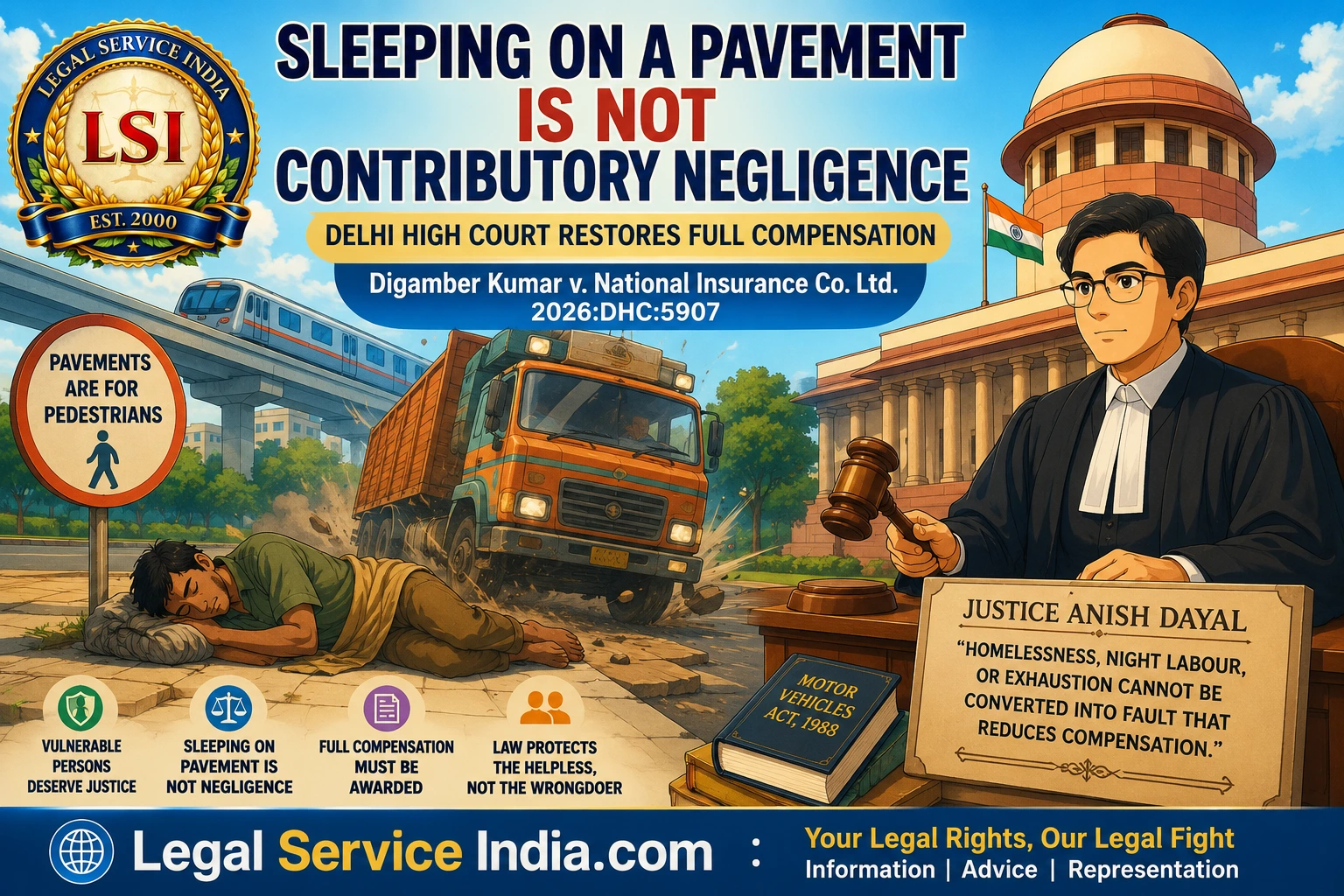
The Delhi High Court’s decision in Digamber Kumar v. National Ins. Co. Ltd. (Neutral Citation: 2026:DHC:5907) restores a simple but frequently forgotten proposition of tort law: contributory negligence is a finding about the claimant’s own causal fault, not a verdict on the claimant’s social circumstances.
Setting aside a 50% deduction imposed by the Motor Accident Claims Tribunal (MACT) against persons who were sleeping on a pavement when a truck was driven onto it, Justice Anish Dayal held that homelessness, night labour, or simple exhaustion driving a person to rest on a footpath cannot, without more, be converted into fault that reduces compensation.
Supreme Court Precedents on Contributory Negligence
This article restates the ruling, then places it within the wider architecture of Supreme Court authority on contributory negligence — both the older line represented by Municipal Corporation of Greater Bombay v. Laxman Iyer and Pramodkumar Rasikbhai Jhaveri v. Karmasey Kunvargi Tak, and two recent decisions, Prem Lal Anand v. Narendra Kumar (2024 INSC 585) and Sushma v. Nitin Ganapati Rangole (2024 INSC 706), which sharpen the same personal-fault requirement that animates Digamber Kumar.
The object is to show that the Delhi High Court’s humane conclusion is not an isolated equitable gesture but a straightforward application of settled doctrine to a fact pattern the doctrine was always capable of reaching.
Key Takeaways
- The article examines the distinction between rash and negligent driving and culpable homicide in fatal road accident jurisprudence.
- It discusses the significance of State of Maharashtra v. Salman Salim Khan and Alister Anthony Pareira v. State of Maharashtra.
- The Delhi High Court held that sleeping on a pavement does not automatically amount to contributory negligence.
- The judgementjudgement protects vulnerable persons such as homeless individuals and daily-wage labourers from unjust reductions in compensation.
- The decision aligns with established Supreme Court principles governing contributory negligence and motor accident compensation.
Landmark Cases Mentioned
| Case | Citation | Legal Significance |
|---|---|---|
| State of Maharashtra v. Salman Salim Khan | (2004) 1 SCC 525 | Distinguishes culpable homicide from mere rash and negligent driving. |
| Alister Anthony Pareira v. State of Maharashtra | (2012) 2 SCC 648 | Drunken driving into persons sleeping on pavements treated under Section 304 Part II IPC. |
| Digamber Kumar v. National Ins. Co. Ltd. | 2026: DHC: 59072026: DHC: 5907 | Sleeping on a pavement is not contributory negligence by itself. |
| Municipal Corporation of Greater Bombay v. Laxman Iyer | — | Leading authority on contributory negligence. |
| Pramodkumar Rasikbhai Jhaveri v. Karmasey Kunvargi Tak | — | Explains principles governing contributory negligence. |
| Prem Lal Anand v. Narendra Kumar | 2024 INSC 585 | Reaffirms the requirement of personal causal fault. |
| Sushma v. Nitin Ganapati Rangole | 2024 INSC 706 | Further clarifies the doctrine of contributory negligence. |
Facts of the Case
In 2015, Digambar Kumar, Lekh Raj, and two others — Anil Bedi and Ramesh Chand, who did not survive — were sleeping on the pavement beneath the Madipur Metro Station in Delhi. A truck, driven at high speed from the direction of Punjabi Bagh, struck all four before colliding with a metro pillar; the driver abandoned the vehicle and fled. A PCR van carried the injured to hospital, where two of the victims succumbed to their injuries. The injured claimants and the legal representatives of the deceased filed claim petitions, which the MACT disposed of by a common award.
Tribunal Findings
The Tribunal granted compensation under the several heads applicable to each claimant butclaimant but reduced every award by attributing 50% contributory negligence to the victims for having been asleep on the pavement. It is this finding of contributory negligence — not the underlying quantum methodology — that the appeal to the Delhi High Court principally challenged.
Key Facts at a Glance
| Particular | Details |
|---|---|
| Year of Incident | 2015 |
| Location | Pavement beneath Madipur Metro Station, Delhi |
| Victims | Digambar Kumar, Lekh Raj, Anil Bedi, and Ramesh Chand |
| Accident | A speeding truck struck the victims before colliding with a metro pillar. |
| Driver’s Conduct | The driver abandoned the truck and fled the scene. |
| Medical Response | A PCR van shifted the injured to hospital. |
| Outcome | Two victims succumbed to their injuries. |
| MACT Award | Compensation was awardedwas awarded but reduced by 50% on the ground of contributory negligence. |
| Appeal | The finding of contributory negligence was challenged before the Delhi High Court. |
Issue Before the Court
The central question was whether the mere fact of sleeping on a pavement could, without evidence of any causally contributing act, support a finding of contributory negligence sufficient to reduce compensation by half. A subsidiary question was the evidentiary route by which negligence on the part of an absconding driver may be established in the absence of a direct explanation from him.
Legal Issues for Determination
- Whether merely sleeping on a pavement amounts to contributory negligence.
- Whether compensation can be reduced by 50% without proof that the victims’ conduct contributed to the accident.
- How negligence of an absconding driver can be established when there is no direct explanation from the driver.
The High Court’s Reasoning
The Bench first anchored the analysis in the Delhi Police Act, 1978, holding that a footway or pavement falls within the definition of a ‘street’ under Section 2(r) and is a space reserved for pedestrians and licensed users, not for the passage of motor vehicles. From that premise, the Court reasoned that a driver who takes a vehicle onto such a space bears the primary — and, absent contrary evidence, the entire — responsibility for what follows, since the intrusion is itself impermissible regardless of how the pavement happens to be used at that moment.
Pavements Are for Pedestrians, Not Vehicles
“It is a reality in this country that many persons are homeless, work through the night, or are part of labour deployed at various construction sites and do not have a place to sleep. For such persons, these pavements also become a relatively safer place to rest, considering that they do not expect vehicles to be driven onto the pavements and mow them down. Even if they had taken a calculated risk sleeping on the pavement, it certainly cannot be translated into contributory negligence.” negligence.” — Justice Anish Dayal, Digamber Kumar v. National Ins. Co. Ltd., 2026:DHC:5907
Res Ipsa Loquitur and Negligence
On the evidentiary question, the Court reaffirmed that negligence is not to be presumed merely because an accident has occurred; the circumstances themselves must point to fault. Where, however, the person in control of the vehicle offers no credible explanation for how the accident occurred — as the absconding driver here did not — the doctrine of res ipsa loquitur permits the court to draw an inference of negligence from the occurrence itself.
“Contributory negligence arises only where the victim’s own negligent act contributes to the accident and the resulting harm. The proximate cause of the accident should be the act of the deceased/injured. In the present case, there is no material to show that the injured/deceased’s act had contributed towards the accident.” accident.” — Justice Anish Dayal, Digamber Kumar v. National Ins. Co. Ltd., 2026:DHC:5907
Compensation Enhanced After Setting Aside Contributory Negligence
On this footing, the finding of 50% contributory negligence was set aside in each of the appeals,appeals, and the compensation wascompensation was enhanced accordingly.
The Doctrinal Core: Contributory Negligence Requires Personal, Causal Fault
Indian courts have long distinguished contributory negligence from composite negligence and from the mere fact of presence at the scene of an accident. In Pramodkumar Rasikbhai Jhaveri v. Karmasey Kunvargi Tak, the Supreme Court explained that contributory negligence arises only where the claimant’s own act or omission has materially contributed to the damage suffered, and is of a nature properly described as negligence in the specialised sense — a failure to take reasonable care for one’s own safety, not a breach of any duty owed to another.
Supreme Court on Personal Liability in Contributory Negligence
This principle received a further and directly relevant elaboration in Sushma v. Nitin Ganapati Rangole (2024 INSC 706), where the Karnataka High Court had applied the ‘doctrine of last opportunity’ to hold that a car driver, who could have avoided colliding with an unlit truck abandoned on the highway, was jointly at fault, and had accordingly reduced the compensation payable to the car’s injured passenger and to the legal heirs of the deceased occupants by 50%.
The Supreme Court reversed this, holding that even where a driver may bear some responsibility, that responsibility cannot be visited vicariously upon passengers who did nothing themselves to contribute to the accident. The ruling is a forceful restatement that contributory negligence is a personal finding: it must attach to the particular claimant’s own conduct, not be imputed from the conduct of someone else who happened to be nearby.
How Jhaveri and Sushma Shaped the Delhi High Court Ruling
Read together, Jhaveri and Sushma supply the doctrinal spine of Digamber Kumar. The victims sleeping on the pavement did nothing that materially contributed to the truck’s presence there; at most they made a choice about where to rest, in circumstances of practical necessity, that carried a background risk they had no reason to anticipate would materialise as a vehicle being driven onto a pedestrian space. That is not a causally contributing act in the sense the doctrine requires, and the Delhi High Court was right to say so.
Key Legal Principles from the JudgementJudgement
- A pavement is part of a “street” under Section 2(r) of the Delhi Police Act, 1978,1978, and is reserved for pedestrians and authorised users.
- A motorist who drives onto a pavement bears primary responsibility for the consequences of that unlawful act.
- The doctrine of res ipsa loquitur permits an inference of negligence when the driver offers no credible explanation for the accident.
- Contributory negligence requires a claimant’s own negligent act to be the proximate cause of the accident or injury.
- Sleeping on a pavement, even out of necessity, does not amount to contributory negligence.
- Liability for contributory negligence is personal and cannot be imposed vicariously on innocent victims.
Case Law Summary
| Case | Legal Principle | Relevance |
|---|---|---|
| Digamber Kumar v. National Ins. Co. Ltd., 2026:DHC:5907 | Sleeping on a pavement does not amount to contributory negligence. | Set aside aaside a 50% deduction in compensation. |
| Pramodkumar Rasikbhai Jhaveri v. Karmasey Kunvargi Tak | Contributory negligence requires the claimant’s own negligent conduct. | Defines the doctrine of contributory negligence. |
| Sushma v. Nitin Ganapati Rangole (2024 INSC 706) | Contributory negligence cannot be attributed vicariously to innocent passengers. | Reinforces that negligence is a personal finding. |
Apportionment Where Fault Is Genuinely Shared
None of this displaces the ordinary rule, stated in Municipal Corporation of Greater Bombay v. Laxman Iyer, that where a claimant’s own conduct has in fact contributed to an accident, courts have the power — and indeed the duty — to apportion liability as is just and equitable, having regard to the degree of the claimant’s own want of care. Laxman Iyer itself involved a cyclist who rode against the flow of traffic and in contravention of traffic rules; the Supreme Court upheld a finding of contributory negligence on those facts while fixing the deduction at a measured 25% rather than the disproportionate figure originally applied.
Laxman Iyer Principle on Contributory Negligence
- Apportionment is justified where the claimant’s conduct contributed to the accident.
- Courts must assess liability based on the degree of the claimant’s lack of care.
- A proportionate deduction should be applied instead of an arbitrary reduction.
| Case | Legal Principle | Outcome |
|---|---|---|
| Municipal Corporation of Greater Bombay v. Laxman Iyer | Contributory negligence where the claimantthe claimant violated traffic rules | 25% deduction upheld |
Prem Lal Anand v. Narendra Kumar (2024 INSC 585)
Prem Lal Anand v. Narendra Kumar (2024 INSC 585) illustrates the same discipline from the opposite direction: overtaking a slow-moving vehicle is, the Supreme Court held, ‘an everyday occurrence on the road’, and the mere fact of overtaking — without more — does not amount to rashness or negligence capable of grounding a contributory-negligence finding, particularly where the offending vehicle was independently shown to have been driven rashly. The Court there also corrected the multiplier applied by the Tribunal, underscoring that quantum errors and negligence errors are analytically distinct and both open to correction on appeal.
Key Principles from Prem Lal Anand
- Mere overtaking is not proof of rash or negligent driving.
- Contributory negligence requires independent evidence of fault.
- Errors in compensation calculation and negligence findings are separate legal issues.
- Both categories of errors may be corrected in appellate proceedings.
| Issue | Supreme Court Observation |
|---|---|
| Overtaking | An everyday occurrence and not negligence by itself |
| Contributory Negligence | Requires proof of a causally contributing act |
| Compensation | Multiplier errors can be independently corrected.corrected. |
Relationship Between Laxman Iyer, Prem Lal Anand and Digamber Kumar
The lesson for practice is that Laxman Iyer and Prem Lal Anand are not in tension with Digamber Kumar; they occupy different points on the same causal spectrum. Apportionment is available andavailable and appropriate onlyappropriate only once a claimant’s own conduct is shown to have been a proximate contributing cause. Where, as in the pavement case, no such causal contribution exists, apportionment has no factual foundation to operate upon, and the correct order is not a reduced percentage but no deduction at all.
Practice Takeaways on Apportionment
- Apportionment applies only where the claimant’s conduct is a proximate cause of the accident.
- Absence of causal contribution means there can be no deduction in compensation.
- Courts must distinguish between genuine contributory negligence and mere assumptions.
Res Ipsa Loquitur and the Absconding Driver
The evidentiary posture in Digamber Kumar — a driver who fled the scene and offered no account of the accident — is squarely addressed by the Supreme Court’s long-standing guidance in N.K.V. Bros (P) Ltd. v. M. Karumai Ammal, where the Court cautioned Tribunals against permitting transport operators to escape liability through ‘niceties, technicalities and mystic maybes’, and affirmed that culpability may properly be inferred from the circumstances of an accident where those circumstances fairly warrant it. The doctrine does not dispense with proof; it recognises that a party who alone possesses the explanation for an occurrence andoccurrence and withholds it cannotit cannot complain if an adverse inference is drawn.
Application of Res Ipsa Loquitur in Digamber Kumar
In Digamber Kumar, the fact that a truck driven at high speed left the carriageway, struck four sleeping persons on a pedestrian pavement, and then collided with a metro pillar, coupled with the driver’s flight from the scene, comfortably satisfies this threshold. There being no rival explanation on record, the inference of the driver’s negligence — and correspondingly the absence of any causally contributing act by the victims — was available to the Court without further evidentiary excavation.
Key Legal Principles on Res Ipsa Loquitur
- The doctrine permits negligence to be inferred from surrounding circumstances.
- It does not eliminate the requirement of proof.
- An adverse inference may be drawn where the person possessing the explanation withholds it.
- An absconding driver strengthens the inference of negligence when no contrary evidence exists.
| Doctrine | Application in Digamber Kumar |
|---|---|
| Res Ipsa Loquitur | Negligence inferred from the circumstances of the accident |
| Driver Absconding | Permitted an adverse inference due to the absence of any explanation |
| Victims’ Conduct | No evidence of any causally contributing act |
Why the Ruling Matters
The wider significance of Digamber Kumar lies in its refusal to let contributory negligence operate as a proxy for penalising poverty. Homeless persons, night-shift labourers, and construction workers frequently have no private space in which to rest; a pavement, precisely because it is not meant for vehicular traffic, is a rational and often the only available refuge. To treat the choice to sleep there as a faulta fault would be to convert a structural social deprivation into a legal liability — a result at odds with the remedial and compensatory purpose of the Motor Vehicles Act.
The decision also reinforces the protection owed to pedestrians and other informal users of road-adjacent space more generally. If liability could be shifted onto victims merely because a vehicle intruded into a space reserved for them, the deterrent function of negligence law directed at drivers who enter such spaces would be substantially eroded. Digamber Kumar restores the allocation of responsibility to the party who introduced the danger — the driver who took a heavy vehicle into a pedestrian zone — consistent with the personal-fault principle traced through Jhaveri, Laxman Iyer, Prem Lal Anand, and Sushma.
Key Takeaways from the Ruling
- Refuses to equate poverty with contributory negligence.
- Strengthens legal protection for pedestrians and vulnerable road users.
- Places liability on the party who created the danger.
- Reaffirms the personal-fault principle in negligence law.
- Supports the remedial and compensatory objectives of the Motor Vehicles Act.
Quantification of Compensation: The Settled Framework
Once liability is correctly apportioned — here, wholly against the driver and owner — quantification proceeds on the standardised principles laid down by the Constitution Bench in National Insurance Co. Ltd. v. Pranay Sethi, which fixed the addition for future prospects, the heads and quantum of conventional damages, and the applicable rate of interest, building upon the multiplier methodology settled in Sarla Verma v. Delhi Transport Corporation. Neither authority bears on the negligence question addressed in Digamber Kumar, but both remain indispensable once the negligence question is correctly resolved, since an error in either the multiplier or the conventional heads can silently undo the benefit of a favourable negligence finding.
Compensation Framework at a Glance
| Aspect | Governing Authority | Role in Compensation |
|---|---|---|
| Future Prospects | National Insurance Co. Ltd. v. Pranay Sethi | Determines addition towards future income. |
| Conventional Heads | National Insurance Co. Ltd. v. Pranay Sethi | Fixes standard amounts for conventional damages. |
| Multiplier Method | Sarla Verma v. Delhi Transport Corporation | Determines the appropriate multiplier for compensation. |
| Negligence Determination | Digamber Kumar | Establishes liability before compensation is calculated. |
A Genuine Doctrinal Tension Worth Flagging
One tension deserves candid acknowledgementacknowledgement rather than artificial reconciliation. The ‘doctrine of last opportunity’ — the idea that a party who had the last clear chance to avoid an accident bears responsibility for failing to take it — continues to surface in High Court reasoning, as it did in the Karnataka High Court’s judgementjudgement that the Supreme Court reversed in Sushma. The doctrine sits uneasily against the personal-fault principle of Jhaveri and Digamber Kumar, because it can be, and has been, used to impute a form of constructive fault to a claimant based on what a reasonable person in the claimant’s position might theoretically have done, rather than on what that particular claimant actually did.
Practitioners should expect this tension to resurface at the Tribunal and High Court level even after Sushma, and should be prepared to distinguish ‘last opportunity’ reasoning applied to a claimant’s own driving conduct (which may still be legitimate) from its extension to non-driving claimants such as passengers, or, as in Digamber Kumar, resting pedestrians (which Sushma and Digamber Kumar both foreclose).
Practical Guidance for Practitioners
- Differentiate between a claimant’s own driving conduct and the conduct of non-driving claimants.
- Challenge attempts to invoke the doctrine of last opportunity against passengers or pedestrians.
- Rely on Sushma and Digamber Kumar to resist constructive fault arguments.
- Ensure negligence is correctly determined before addressing compensation calculations.
- Verify the application of Pranay Sethi and Sarla Verma while computing compensation.
Practitioner’s Checklist
Use the following checklist while handling motor accident compensation claims involving contributory negligence. It provides a quick reference to the governing principles laid down by the Supreme Court and the Delhi High Court.
- ☐ Before conceding or contesting contributory negligence, identify the specific act or omission of the claimant said to constitute fault — mere presence at, or proximity to, the accident site is not enough (Jhaveri; Digamber Kumar).
- ☐ Where the claimant is a passenger or bystander rather than the driver whose conduct is in question, resist any attempt to impute the driver’s negligence to them vicariously (Sushma v. Rangole).
- ☐ Where genuine shared fault exists, press for an apportionment tied to the degree of causal contribution, not an arbitrary round figure such as 50% (Laxman Iyer).
- ☐ Treat ordinary, lawful road conduct — overtaking, resting on a pavement, walking on a footpath — as insufficient by itself to found contributory negligence, absent evidence of an additional unreasonable act (Prem Lal Anand; Digamber Kumar).
- ☐ Where the driver has fled or offers no explanation, plead res ipsa loquitur affirmatively and marshal the circumstantial sequence of events to support the inference (N.K.V. Bros).
- ☐ Keep the negligence finding and the quantum calculation analytically separate; audit the multiplier, future-prospects addition, and conventional heads independently under Sarla Verma and Pranay Sethi even after a favourable negligence finding.
- ☐ Where a tribunaltribunal or lower court invokes ‘last opportunity’ reasoning against a non-driving claimant, cite Sushma v. Rangole directly to resist its extension.
Citation Table
| Authority | Citation(s) |
|---|---|
| Digamber Kumar v. National Ins. Co. Ltd. | Neutral Citation 2026: DHC:59072026: DHC:5907 (Del HC, Anish Dayal, J., 25.07.2026) |
| Municipal Corporation of Greater Bombay v. Laxman Iyer | (2003) 8 SCC 731; 2003 INSC 568; AIR 2003 SC 4182 |
| Pramodkumar Rasikbhai Jhaveri v. Karmasey Kunvargi Tak | (2002) 6 SCC 455; AIR 2002 SC 2864 |
| Archit Saini v. Oriental Insurance Co. Ltd. | (2018) 3 SCC 365 (decided 09.02.2018, Khanwilkar, J.) |
| Prem Lal Anand v. Narendra Kumar | 2024 INSC 585; MANU/SC/0845/2024 (Ravikumar & Karol, JJ.) |
| Sushma v. Nitin Ganapati Rangole & Ors. | 2024 INSC 706; MANU/SC/1032/2024 (P.S. Narasimha & Sandeep Mehta, JJ., 19.09.2024) |
| N.K.V. Bros (P) Ltd. v. M. Karumai Ammal | (1980) 3 SCC 457; AIR 1980 SC 1354; 1980 SCR (3) 101 |
| Sarla Verma v. Delhi Transport Corporation | (2009) 6 SCC 121 |
| National Insurance Co. Ltd. v. Pranay Sethi | (2017) 16 SCC 680 (Constitution Bench, decided 31.10.2017) |
Conclusion
Digamber Kumar v. National Ins. Co. Ltd. does not create new law so much as apply settled law faithfully to a fact pattern that earlier decisions had not squarely confronted. Jhaveri supplied the definition of contributory negligence as personal, causal fault; Laxman Iyer supplied the apportionment mechanism for cases where such fault genuinely exists; Prem Lal Anand confirmed that ordinary, lawful conduct does not become negligent merely because harm follows it; Sushma confirmed that fault cannot be imputed vicariously to a claimant who did nothing; and N.K.V. Bros supplied the evidentiary tool for cases where the person best placed to explain an accident declines to do so.
Digamber Kumar assembles these threads and applies them to homeless and labouring persons resting on a pavement, concluding — correctly — that necessity is not negligence, and that the burden of an unlawful vehicular intrusion into a pedestrian space belongs to the driver who caused it, not to the persons he struck.
Important Links
Important Links:
- Lawyers in India
- Copyright Registration in India
- Caveat Filing in Supreme Court of India
- Mutual Consent Divorce in Delhi/NCR: WhatsApp 9650499965

