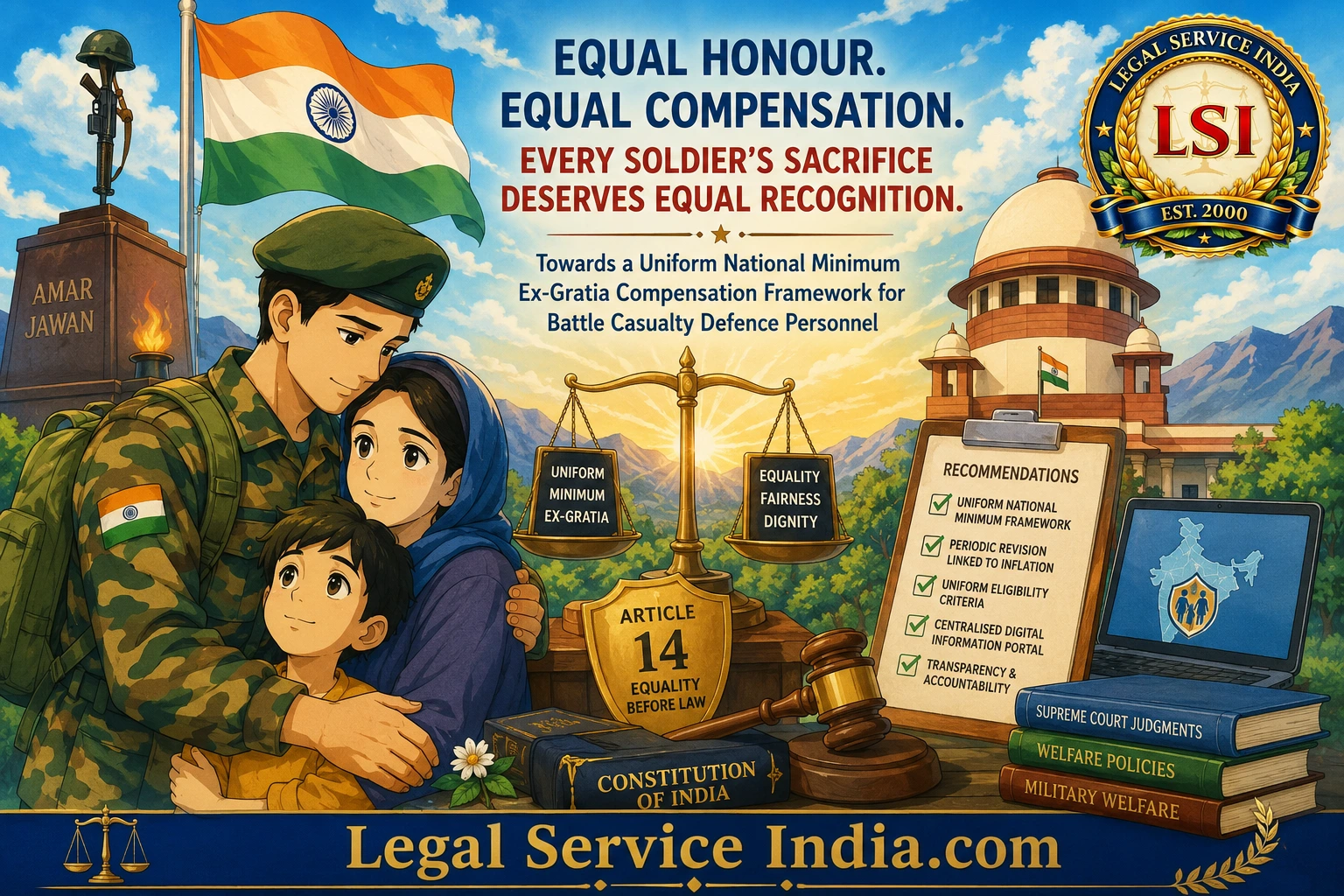
Uniform National Minimum Ex-Gratia Compensation for Battle Casualty Defence Personnel Under Article 14: Constitutional Analysis
A comprehensive constitutional analysis of State-wise ex-gratia compensation disparities for battle casualty defence personnel, Article 14 equality, Supreme Court jurisprudence, inflation, and the need for a uniform national minimum framework.
Uniform National Minimum Ex-Gratia Compensation Framework for Battle Casualty Defence Personnel
Abstract
The death of a soldier in battle is a sacrifice made for the nation and not for any particular state. Although the union government provides a uniform framework of financial assistance to the families of battle casualty defense personnel, many state governments have introduced their own ex gratia policies. As a result, tdefencent of financial assistance received by the next of kin differs significantly from one state to another, even where the circumstances of sacrifice are identical. This raises important constitutional questions regarding equality, fairness, and non-arbitrariness under Article 14 of the Constitution of India.
This research examines the constitutional validity of the existing state-wise ex gratia compensation framework by analysing constitutional provisions, judicial decisions of the Supreme Court, official government notifications, and RTI responses obtained from different states. The study also compares the ex gratia policies adopted by various state governments to identify differences in compensation, eligibility conditions, and implementation practices. It further examines the effect of inflation on the real value of ex-gratia compensation and the absence of a mechanism for periodic revision.
The paper argues that while the federal structure permits states to frame independent welfare policies, there is a constitutional need for a uniform national minimum standard of ex gratia compensation for the families of battle casualty defence personnel. Such a framework would reduce disparities between states, promote fairness and transparency, and ensure that every soldier’s sacrifice receives equal recognition irrespective of the state of domicile, while preserving the freedom of states to provide additional welfare benefits according to their financial capacity and policy priorities.
Introduction
The Indian Armed Forces constitute one of the most respected institutions of our nation, responsibly performing their duty of safeguarding India’s sovereignty, territorial integrity, and constitutional order. [1] Every soldier who attains battle casualty status makes the utmost sacrifice in respect to the service of the nation, irrespective of his state of domicile. [2] While the union government provides ex-gratia compensation under the welfare framework, several state governments have independently introduced additional ex-gratia schemes through their respective policies and notifications. [3] However, the smallest possible way of such assistance varies crucially from one state to another, which results in unequal financial support to the families of the deceased soldiers who have made the immense same sacrifice for their nation.
This imbalance raises an important constitutional concern relating to equality before the law and equal protection of the law cited in Article 14 of the Indian constitution. [4] The principle of fairness integration is also a matter of concern under the constitution of India. [5] The article critically examines whether the considerable imbalance in ex gratia compensation among states for families of battle casualty defense personnel is constitutionally justifiable within India’s united framework. The study further evaluates the legal framework governing ex gratiaensation, judicial principles concerning equality and non-arbitrariness, and the constitutional balance between union and statdefenceymaking. [6] This article also seeks to determine whether India should adopt a uniform national minimum ex gratia framework while preserving the independence of states to provide additional welfare benefits.
The issue assumes considerable importance in the contemporary constitutional and policy landscape because the financial assistance extended to the family of a deceased soldier is not merely an economic benefit but also a symbolic recognition of the nation’s gratitude towards those who have laid down their lives in its defence. Although ex-gratia compensation is generally regarded as an act of welfare and compassion rather than a legally enforceable right, its distribution by public authorities must nevertheless conform to constitutional principles governing fairness, equality, and reasonableness. Public welfare policies cannot operate in a manner that results in arbitrary distinctions among individuals who are similarly situated.
Article 14 guarantees equality before the law and equal protection of the law to every person. [7] While the constitution permits reasonable classification, it prohibits arbitrary state action and mandates that any categorization must satisfy the twin tests of intelligible differentia and rational nexus. [8] categorisationilies of defense personnel have suffered the same loss arising from the death of a soldier while serving the nation in the same battle circumstances.
Welfare State and Directive Principles
The issue assumes even greater significance when viewed in light of the constitutional vision of India as a welfare state. The Ddefencee Principles of State Policy, though non-justiciable, impose a moral and constitutional obligation upon the state to promote social justice, reduce inequalities, and ensure the welfare of its citizens. Ex-gratia compensation, while not a statutory entitlement or a substitute for legal damages, represents an important instrument of social welfare and recognition of the extraordinary sacrifice made by members of the Armed Forces. It serves not merely as financial assistance but also as a tangible expression of the nation’s gratitude and commitment towards the families of those who laid down their lives in defense of the country.
Judicial Expansion of Article 14
Furthermore, the Supreme Court of India has consistently interpreted Article 14 as prohibiting arbitrariness in all forms of state action. Through a series of landmark judgments, the Court has expanded the scope of equality beyond formal classification to include a broader doctrine of fairness, reasonablenjudgements,on-arbitrariness. These judicial principles provide an important constitutional foundation for examining whether differential ex gratia policies adopted by various states stand up to constitudefenceresearch.
Constitutional Need for a Uniform Minimum Standard
Accordingly, the evolution of the existing ex-gratia compensation framework should be guided by the constitutional jurisprudence developed by the Supreme Court under Article 14. While preserving the federal structure and the legislative independence of the states, there remains a convincing constitutional need to establish a fair, transparent, and uniform minimum standard of compensation for the families of defense personnel who sacrifice their lives in the service of the nation. Such an approach would not only promote constitutional equality but would also reinforce the state’s obldefence to honor the sacrifices of its soldiers with dignity, fairness, and uniformity across the country.
E.P. Royappa v. State of Tamil Nadu: Constitutionalising the Relevance
Transformation of Article 14
The constitutional doctrine of equality undergoes an important transformation with the Supreme Court’s decision in E.P. Royappa v. State of Tamil Nadu [9]. Previous to this judgment, Article 14 was mainly interpreted through the traditional doctrine of reasonable classification. Howevehonourstice P. N. Bhagwati elaborately expanjudgement,cope of Article 14, including that equality is not limited to classification but extends to protect individuals against arbitrary state actions. The court observed that “equality is a dynamic concept with many aspects and dimensions, and it cannot be put away within the doctrine limits.” [10] The importance of this judgment lies in its fact that arbitrariness itself is a violation of Article 14. Therefore, every action of the state must satisfy the constitutional requirement of justice, fairness, and non-arbitrariness. As the Supreme Court subsequently observed in Maneka Gandhi v. Union of India, Article 14 strikes at arbitrariness in every form of state action and requires that governmental decisions must be just, fair, and reasonable. [11]
Relevance to State Ex-Gratia Policies
The principle laid down in the E.P. Royappa case is somewhat relevant in the context of state ex gratia compensation for the battle casualty defence personnejudgementthough intheidual states have the authority to make independent welfare policies, the resulting imbalance in ex gratia compensation raises an important constitutional question: can families of battle casualty defense personnel receive different compensation solely because the deceased soldier belongs to a particular state? If two soldiers lose their lives while perfodefencedentical duties under similar operational circumstances, the sacrifice made by each is equal in the eyes of the nation. Yet, under the present framework, their families may receive vastly different amounts of financial assistance depending exclusively upon the state of domicile. Such differentiation does not arise from the nature of the sacrifice, the degree of risk undertaken, or the circumstances of death, but from geographical considerations that bear little relation to the purpose of honoring military sacrifice.
Constitutional Foundation for Reviewing Differential Compensation
This case, therefore, provides the constitutional basics for examining whether unequal state ex-gratia policies are consistent with the principles of equality and non-arbitrariness guaranteed by the constitution of India. The doctrine established in E.P. Royappa therefore requires that any differential treatment adopted by the state must be supported by a reasonable and constitutionally defensible justification rather than by mere administrative judgment.
Continuing Impact of the Royappa Doctrine
The importance of E.P. Royappa extends beyond its immediate facts and continues to influence the development of constitutional jurisprudence relating to equality. It lajudgement.undation for subsequent decisions in which honouringeme Court consistently states that arbitrariness and equality are mutually incompatible. In this sense, the judgment transformed Article 14 from a narrow guarantee against discriminatory classification into a broader constitutional safeguard against unfair and irrational state action.
Comparative Analysis of State Ex-Gratia Policies
A relative analysis of state ex-gratia policies is essential to understand the extent ofjudgementstency in financial assistance provided to the families of battle casualty defence personnel across India. While the union government has established a structured ex-gratia concept applicable to eligible defense personnel, independent states have independently planned additional welfare measures through policies and government orders. Therefore, compensation, eligibility criteria, procedural requirementsdefenceecessary benefits vary from one state to another.
Families of battle casualty defence personnel, who are similarly situated by the morality of the uniform sacrifice made in the service of the nation, often receive clearly different levels of financial assistance solely because of the state to which the deceased soldier belonged. [12] The purpose of this comparative analysis is not to question the authority of state government for planning independent welfare policies within India’s federal structure. Rather, the intention is to evaluate whether the existing imbalances are comparable, logical, and consistent with constitutional principles.
To the end, the study compares the official government notifications and orders and RTI responses obtained from various states to identify differences in the smallest possible way of ex gratia compensation, eligibility conditions, and fulfilling practices. [13]
The comparative data presented below shows that although the main purpose of all state policies remains the welfare of the families of battle casualty defence personnel, the absence of a nationally advised minimum standard has resulted in considerable instability.
Comparison of State Ex-Gratia Compensation Policies
Government Resolution (GR) enhancing ex-gratia to ₹1 crore (Revenue & Forest Department / Sainik Welfare Department).
Constitutional Implications of the Comparative Analysis
The imbalance identified above raises important constitutional questions under Article 14 of the Constitution of India. The principle laid down by the Supreme Court in cases like E.P. Royappa v. State of Tamil Nadu and Maneka Gandhi v. Union of India provided the constitutional fundamentals for evaluating whether such imbalances constitute arbitrary state actions. A uniform national minimum standard would not weaken India’s federal structure; rather, it would establish a constitutional baseline below which no state would fall, while capacity and welfare priorities would remain state-level.
Inflation and the Need for a Uniform National Minimum Standard
Impact of Inflation on Ex-Gratia Compensation
One of the most significant yet often overlooked challenges in the existing framework of state ex gratia compensation is the impact of inflation and the rising cost of living. Ex gratia compensation’s main intention is to provide immediate financial assistance to the families of battle casualty defense personnel following the loss of their primary earning members. However, the real value of such compensation reduces overtime due to inflation unless it is periodically defence. [14]
Although a fixed amount may havprimary-earninged sufficient at the time when it was introduced, often within a few years that amount can be insufficient in meeting the economic needs of the families of defence personnel. The comparative analysis of state policies shows that the revisions in ex-gratiover time have been inconsistent across India. While states such as Punjab, Haryana, and Maharashtra have enhanced their compensation in recent years, other states continue to provide significantly lower amounts.
Inflation as a Nationwide Concern
Although the cost of living varies among states, inflation is a nationwide economic phenomenon affecting all citizens. Essentials such as housing, education, healthcare, food, and transportation have witnessed a rapid increase across the country over the past decade. Families of battle casualty defense personnel are therefore exposed to similar economic pressure irrespective of their state of domicile.
The absence of a minimum ex gratia compensation nationwide will lead to some families receiving compensation that is insufficient to meet even basic financiadefence in this general economic environment. [15]
Central Government Ex-Gratia Framework
At the central level, the Ministry of Defence follows a uniform framework for the grant of ex gratia benefits to the families of defence personnel. Under the existing policy, a reward amount of ₹10 lakh is payable in cases involving death during enemy action in international wars or notified war-like engagements, in addition to other admissible central benefits. However, state governments continue to determine their own ex-gratia policies independently.
As a result, while central benefits remain uniform, the total financial assistance received by the family of a battle casualty varies considerably depending upon the soldier’s state of domicile. This creates disparities among families of personnel who have made the same sacrifice under similar operational conditions. [16]
Constitutional Validity of State-Wise Disparities
The constitutional validity of such disparities may be examined in light of Article 14 of the Constitution of India, which guarantees equality before the law and equal protection of the laws. Service conditions and benefits available to members of the armed forces are generally determined by objective considerations such as rank, length of service, and the nature of duty performed, rather than the place of domicile.
Judicial decisions have consistently held that arbitrary distinctions between similarly situated personnel are inconsistent with the principle of equality. At the same time, courts have also recognized that where a state grants ex gratia assistance under a specific policy, the entitlement of beneficiaries is ordinarily confined to the limits prerecognised that policy. This position highlights the absence of a uniform national minimum standard rather than resolving the resulting disparities.
Judicial Recognition of Inflation-Adjusted Compensation
Although no statutory provision presently requires automatic revision of ex-gratia compensation based on inflation, the Supreme Court has repeatedly acknowledged the necessity of accounting for the declining purchasing power of money while determining compensation.
In Nagappa v. Gurudayal Singh, the Court recognised that compensation must reflect prevailing economic conditions, including inflation and the reduced value of the rupee. [17]
Similarly, in Lata Wadhwa v. State of Bihar, the Court adopted the Consumer Price Index as a relevant factor for updating compensation to contemporary economic conditions. [18]
The importance of inflation-adjusted compensation was further recognised in Court on Its Own Motion v. Government of NCT of Delhi, where the Court endorsed the use of the Consumer Price Index for revising standard compensation amounts. [19]
Need for Periodic Revision and a National Minimum Standard
These judicial principles, although developed primarily in the context of compensation law, provide persuasive guidance for ex-gratia policies relating to battle casualties. Since the primary purpose of ex-gratia compensation is to provide immediate and meaningful financial assistance to bereaved families, its effectiveness depends upon maintaining its real economic value over time.
A national minimum standard coupled with a mechanism for periodic revision, either through regular review or linkage with the Consumer Price Index, would ensure that the compensation remains adequate despite inflation. Such a framework would promote greater uniformity, reduce domicile-based disparities, and better fulfill the constitutional principles of equality and fairness while preserving the autonomy of states to grant higher amounts where they consider appropriate. [20]
Pattern Emerging from the Comparative Analysis
Overafulfilrvations
The comparative analysis of the state ex-gratia policies reveals that the existing framework is characterised by considerable diversity rather than uniformity. The analysis indicates that states with a long-standing tradition of military services or a larger population of service and retired defense personnel often appear to have compensation and welfare measures, including enhanced ex-gratia compensation and additional benefits.
Another important defencetion is the absence of regular revision in several state policies. While some states have revised ex-gratia compensation in response to changing socio-economic conditions and inflation, other states continue to operate under notifications issued several years ago.
Geographical Patterns
The comparative study also suggests that geographical location alone does not necessarily determine the liberty of ex gratia policies. Although some border states have adopted higher compensation frameworks, others continue to provide comparatively modest financial assistance. Similarly, some non-border states have introduced generous ex gratia schemes, showing that government policy and financial priorities play a more important role than geography.
Key Findings
There is no uniform national approach to state ex gratia compensation for battle casualties.
Compensation amounts vary substantially across different states.
Policy revisions are inconsistent from one state to another.
Additional welfare benefits differ significantly among states.
Government policy choices and financial priorities influence compensation more than geographical location.
Overall, the comparative analysis demonstrates that there is no uniform national approach to state ex gratia compensation for battle casualties. The large variations in compensation amounts, policy revisions, and welfare benefits raise important questions regarding equality, fairness, and the need for a more consistent framework across all states. Such disparities may undermine the principle that every member of the Armed Forces serves the nation with equal commitment, regardless of their state of domicile.
Recommendation: Towards a Uniform National Minimum Ex-Gratia Framework
A comparative analysis undertaken in this study demonstrates that although both the union and state governments have adopted welfare measures for the families of battle casualty defence personnel, the absence of a uniform national standard has resulted in significant imbalance in the smallest possible way of ex gratia compensation eligibility conditions and implementation practices. While the federal structure of the constitution permits states to make independent welfare policies, such freedom should operate within a structure that ensures a minimum level of fair treatment for all similarly situated beneficiaries.
In light of the prior analysis, the following recommendations are proposed.
Key Recommendations
Formulation of a Uniform National Minimum Ex-Gratia Framework The union government, in consultation with state governments, should make a uniform national minimum ex gratia framework prescribing a baseline amount of compensation payable to the next of kin of battle casualty defense personnel. Such a framework would establish a common mindefenceandard throughout the country while preserving the authority of individual states to provide higher compensation according to their financial capacity and welfare priorities.
Periodic Revision Based on Inflation The minimum ex gratia amount should not remain static; it should be revised periodically through an objective method linked to inflation and changes in cost of living. Regular revision would preserve the real value of compensation and ensure that financial assistance remains meaningful over time.
kin”, Uniform Eligibility Criteria A nationally accepted set of eligibility criteria should be developed to minimise inconsistencies among state policies. A uniform definition of “battle casualty”, “next of kin”, and the categories of eligible beneficiaries would enhance transparency, reduce administrative disputes, and ensure the treatment of jurisdictions.
Centralised Digital Information Portal A national digital portal should be established to publish all central and state government notifications relating to battle casualty welfare measures. The portal should provide updated information regarding ex gratia policies, eligibility conditions, application procedures, and implementation states; such transparency would improve accessibility and facilitate public accountability.
Expected Impact
The implementation of these recommendations would not diminish the federal freedom of the states. Rather, it would strengthen the constitutional commitment to equality by ensuring that every family of a battle-casualty defence personnel receives a minimum level of financial recognition, irrespective of battle-casualty defence, while allowing states to extend additional benefits according to their respective welfare policies.
Conclusion
Summary of the Study
The present study has examined the issue of state-wise ex gratia compensation payable to the families of battle casualty defence personnel from a constitutional perspective. The analysis demonstrates that, although the union government provides a structured framework of ex gratia assistance, additional compensation granted by various state governments differs substantially in amount, eligibility conditions, procedural requirements, and implementation practices. Consequently, families of soldiers who have made an identical sacrifice in the service of the nation may receive markedly different financial assistance solely on the basis of the state of domicile of the deceased personnel.
Findings from the Comparative Analysis
The comparative analysis undertaken in this study reveals that the existing framework is characterised by significant diversity rather than uniformity. Some states have adopted generous compensation schemes and have periodically revised the amount of ex gratia assistance, while other states continue to follow older notifications with comparatively lower compensation. The study further indicates that geographical location alone does not provide a satisfactory explanation for these disparities. Rather, the level of compensation appears to depend largely upon individual state policy choices and financial priorities.
Constitutional Perspective
From a constitutional standpoint, such disparities raise important questions under Article 14 of the Constitution of India. The principles of equality, fairness, reasonableness, and non-arbitrariness, as developed through the decisions of the Supreme Court in E.P. Royappa v. State of Tamil Nadu and Maneka Gandhi v. Union of India, require that state action must not create arbitrary distinctions among persons who are similarly situated. Although ex-gratia compensation is generally regarded as a welfare measure and not as a statutory right, its distribution by public authorities must nevertheless conform to constitutional standards. Where soldiers have laid down their lives under comparable operational circumstances, the resulting disparities in state compensation call for careful constitutional scrutiny.
Importance of Inflation Adjustment
The study has also highlighted the practical importance of inflation and the declining purchasing power of money. A fixed amount of ex-gratia compensation may gradually lose its real value unless it is periodically revised. In this context, judicial principles relating to compensation and inflation provide persuasive guidance for ensuring that ex-gratia assistance remains meaningful and effective for bereaved families over time.
The Way Forward
In light of the foregoing analysis, this paper concludes that there is a compelling constitutional and policy-based need for the establishment of a uniform national minimum ex gratia framework for battle casualty defence personnel. Such a framework would not undermine India’s federal structure or the autonomy of state governments. Rather, it would create a common minimum standard of financial recognition applicable across the country while preserving the authority of individual states to grant higher compensation and additional welfare benefits according to their own policy priorities and financial capacity.
Final Observations
A uniform national minimum standard, accompanied by periodic revision linked to inflation, uniform eligibility criteria, and greater transparency in implementation, would promote equality, reduce domicile-based disparities, and strengthen public confidence in the fairness of the welfare system. Most importantly, it would ensure that every family of a battle-casualty defence personnel receives a minimum level of financial recognition that reflects the equal value of the sacrifice made in the service of the nation. Such an approach would be consistent with the constitutional commitment to equality, dignity, fairness, and non-arbitrariness while acknowledging the collective gratitude towards those who have laid down their lives in its defence.
Key Takeaways
The following key takeaways summarise the constitutional, legal, and policy issues relating to state-wise ex gratia compensation for battle casualty defence personnel in India.
The sacrifice of a soldier is made for the nation, not for an individual state. Therefore, families of battle casualty defence personnel should receive equal recognition irrespective of the soldier’s defence domicile.
State-wise ex-gratia compensation in India varies significantly, resulting in substantial differences in financial assistance for families of soldiers who made identical sacrifices under similar operational circumstances.
The article examines whether these disparities are constitutionally valid under Article 14 of the Constitution of India, which guarantees equality before law and equal protection of the laws.
The Supreme Court’s landmark decisions in E.P. Royappa v. State of Tamil Nadu and Maneka Gandhi v. Union of India establish that arbitrariness violates Article 14, making fairness and reasonableness essential components of all state action.
Although states have the constitutional autonomy to frame independent welfare policies, the study argues that such discretion should not result in arbitrary inequalities affecting similarly situated families of battle casualty defence personnel.
A comparative analysis of state government policies reveals wide disparities in ex-gratia amounts, eligibility criteria, implementation practices, and additional welfare benefits across India.
The research highlights that compensation differences arise primarily from state policy choices rather than the nature of the soldier’s sacrifice, raising important constitutional and policy concerns.
Inflation has significantly reduced the real value of ex gratia compensation, yet several state policies have not been revised for years, diminishing the effectiveness of financial assistance.
Judicial principles laid down in cases such as Nagappa v. Gurudayal Singh and Lata Wadhwa v. State of Bihar support the need for compensation to reflect prevailing economic conditions and inflation.
The paper proposes the creation of a Uniform National Minimum Ex-Gratia Compensation Framework, allowing every family of a battle-casualty defence personnel to receive a guaranteed minimum level of financial recognition while preserving the states’ power to provide higher benefits.
The study recommends periodic inflation-linked revision of ex-gratia compensation, ensuring that financial assistance retains its real value over time.
Uniform national eligibility criteria for battle casualty status and next of kin are recommended to reduce inconsistencies, administrative disputes, and unequal treatment across states.
A centralised national digital portal is proposed to improve transparency by publishing all central and state government notifications, eligibility conditions, application procedures, and welfare schemes related to battle casualty compensation.
The article concludes that a uniform national minimum standard would strengthen constitutional equality without undermining India’s federal structure, balancing national fairness with state autonomy.
Ultimately, the research argues that every soldier’s sacrifice deserves equal constitutional recognition, and a uniform minimum ex gratia framework would reinforce the nation’s commitment to dignity, fairness, transparency, and gratitude towards the families of those who laid down their lives in defence of India.