





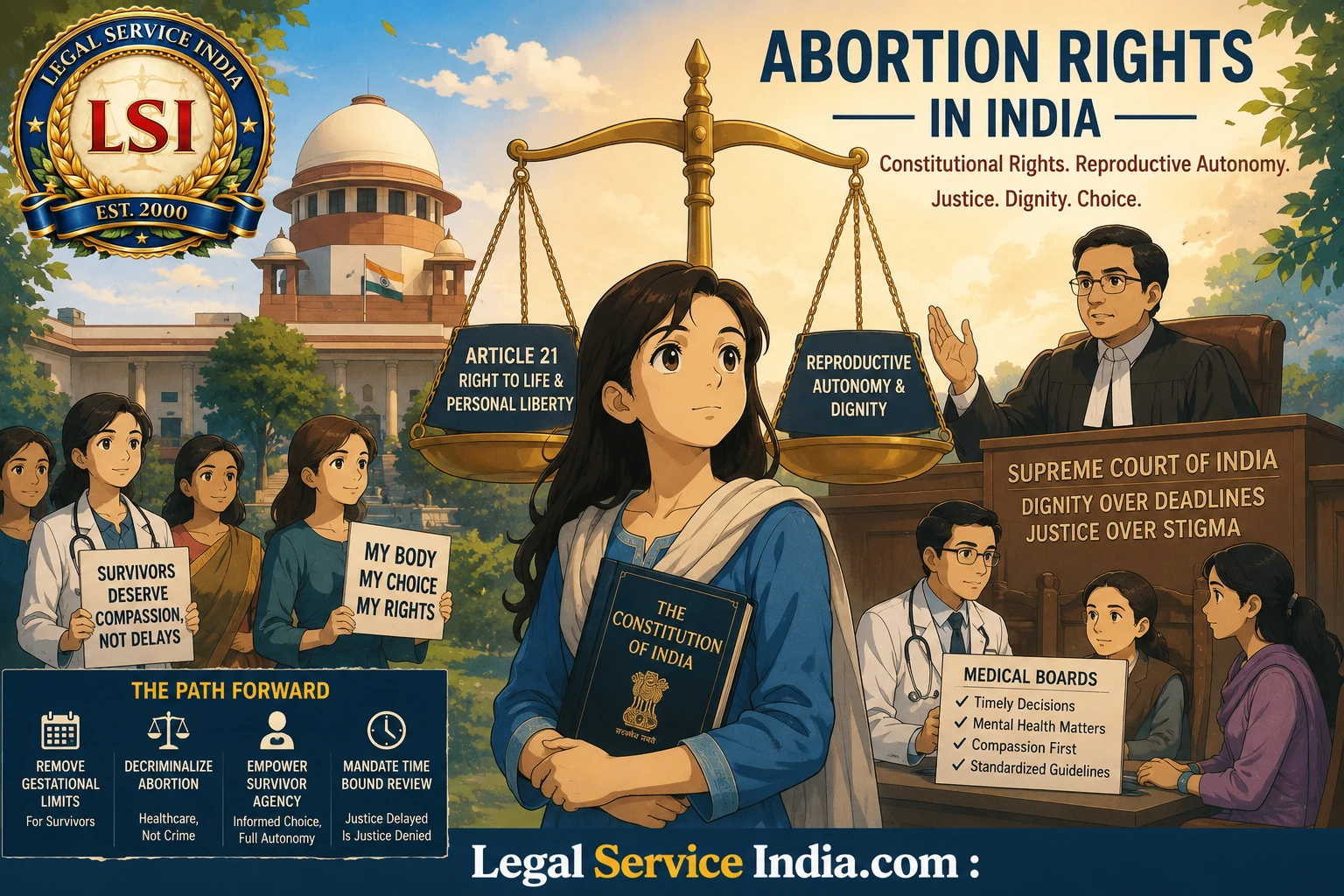
Introduction
The overlap between legislative statutes and constitutional protections frequently generates tension in Indian jurisprudence, especially concerning reproductive rights. Although the Medical Termination of Pregnancy (MTP) Act of 1971 originally marked a forward-thinking shift from the total criminalisation of abortion, recent court rulings indicate that the statute’s strict gestational limits are now inadequate. With the Supreme Court of India placing greater focus on a human-rights perspective, momentum is building to restructure the legal framework. This shift aims to harmonise the law with constitutional promises of personal dignity, individual privacy, and autonomy over one’s own body.
The Statutory Landscape
The MTP Act and Its Constraints
The legal framework governing abortion in India is primarily found in the MTP Act, as amended in 2021. The amendment expanded the access to abortion under certain conditions:
| Gestational Period | Legal Position Under the MTP Act |
|---|---|
| Up to 20 Weeks | Termination is permissible based on the opinion of one registered medical practitioner. |
| 20 to 24 Weeks | Access is extended to specific categories of women—including survivors of sexual assault, minors, and those with physical disabilities—subject to the opinion of two medical practitioners. |
| Beyond 24 Weeks | Termination is generally restricted to cases involving “substantial foetal abnormalities”, as determined by a state-level medical board. |
Despite these advancements, the Act remains tethered to a “doctor-centric” model rather than a “woman-centric” one. The law operates as an exception to the Bhartiya Nyaya Sanhita (BNS), which still contains provisions criminalising abortion outside the MTP Act’s strict parameters. This creates a defensive medical environment where practitioners may be hesitant to act without clear judicial or board-sanctioned mandates, often leading to critical delays.
Key Constraints Under the Current Framework
- Continued dependence on medical practitioners’ approval.
- Strict gestational limits for termination of pregnancy.
- Restricted access beyond 24 weeks except in narrowly defined circumstances.
- Potential criminal liability outside the MTP Act framework under the Bhartiya Nyaya Sanhita (BNS).
- Delays caused by medical board reviews and judicial intervention.
The Conflict of Gestational Limits for Rape Survivors
For survivors of sexual assault, the 24-week legal threshold frequently stands as an impossible hurdle to clear. Legal research and sociological evidence show that victims often experience significant delays in discovering or reporting a pregnancy. These delays stem from profound psychological trauma, intense social stigma, and a lack of reproductive health awareness. Furthermore, many survivors are minors who face overwhelming barriers when trying to navigate the healthcare and legal systems without adult assistance.
Reasons for Delay in Reporting Pregnancy
- Profound psychological trauma following sexual assault.
- Fear of social stigma and societal judgement.
- Lack of awareness regarding reproductive health.
- Limited access to medical facilities and counselling.
- Additional barriers faced by minors in accessing legal and healthcare systems.
If a survivor identifies a pregnancy past the 24-week threshold, the MTP Act offers no legislative recourse unless severe foetal anomalies are detected. Consequently, individuals must petition the High Courts or the Supreme Court under Article 226 or Article 32 of the Constitution to request exceptional judicial intervention. This legal gridlock often delays the process by several weeks, pushing the pregnancy into an even later stage. As a result, the subsequent medical procedure becomes highly complex, while the petitioner endures prolonged and severe emotional distress.
Legal Challenges After 24 Weeks
- No statutory remedy is generally available beyond 24 weeks in the absence of substantial foetal abnormalities.
- Survivors must seek constitutional remedies before the high courts or the Supreme Court.
- Judicial proceedings can result in further delays.
- Advancing gestation increases medical complexity and associated risks.
- Petitioners often suffer prolonged emotional and psychological distress during litigation.
Constitutional Sovereignty: Article 21 and Bodily Integrity
The Supreme Court of India has consistently filled the gaps left by the legislature by invoking Article 21 of the Constitution—the right to life and personal liberty. The landmark judgement in Suchita Srivastava v. Chandigarh Administration established that reproductive choice is a fundamental aspect of personal liberty. The court held that a woman’s right to make reproductive choices is a matter of “decisional autonomy”.
In recent rulings, the judiciary has adopted a broader definition of personal dignity, particularly regarding underage rape survivors. The Supreme Court has noted that compelling a survivor to carry an unwanted pregnancy to term constitutes a form of institutional cruelty that directly infringes upon Article 21 protections. By placing the victim’s psychological well-being and dignity above the rigid boundaries of the MTP Act, the courts have demonstrated that legislative deadlines must give way to constitutional rights whenever the law inflicts inhumane suffering.
Key Constitutional Principles
- Article 21 protects the right to life and personal liberty.
- Reproductive choice is recognised as a component of personal liberty.
- Decisional autonomy is central to reproductive rights.
- Psychological well-being and dignity are integral constitutional protections.
- Constitutional rights prevail where statutory restrictions cause inhumane suffering.
| Constitutional Principle | Judicial Interpretation |
|---|---|
| Article 21 | Protects life, liberty, dignity, and bodily integrity. |
| Reproductive Choice | Recognised as a fundamental aspect of personal liberty. |
| Decisional Autonomy | Ensures an individual’s right to make reproductive decisions. |
| Survivor Dignity | Courts prioritise mental health and dignity over rigid statutory deadlines. |
The Role of Medical Boards: Facilitators or Gatekeepers?
One of the most significant procedural hurdles in late-term abortions is the role of the medical board. While these boards are intended to provide expert clinical guidance, they often function as gatekeepers. Reports suggest that boards sometimes focus narrowly on physical health risks while neglecting the “grave injury to mental health” that the MTP Act itself recognises as a valid ground for termination.
The Supreme Court has recently clarified that a medical board’s function must remain supportive and advisory, rather than deterministic. Ultimate choice and decision-making power must belong to the pregnant individual, so long as the intervention does not directly endanger their life. Consequently, standardised national guidelines are urgently required to ensure these panels operate with maximum speed and compassion, keeping in mind that when dealing with abortion, any delay in justice effectively destroys it.
Challenges Associated with Medical Boards
- Delays in evaluation and decision-making.
- Overemphasis on physical health considerations.
- Insufficient attention to mental health impacts.
- Lack of uniform national standards.
- Procedural barriers affecting timely access to healthcare.
| Issue | Impact on Patients |
|---|---|
| Administrative Delays | May push patients beyond safe clinical windows. |
| Narrow Clinical Assessment | Mental health concerns may receive inadequate consideration. |
| Absence of Standardized Guidelines | Leads to inconsistent decision-making across jurisdictions. |
| Gatekeeping Approach | Can undermine individual autonomy and access to care. |
The Path Forward: Legislative Reform
The constant demand for court intervention highlights that the MTP Act fails to match the actual experiences of individuals. Moving toward a framework based truly on rights requires several vital statutory changes:
Eliminating Thresholds for Victims
The legislature should abolish or greatly extend the maximum gestational deadline for rape and incest survivors, utilising medical safety instead of a fixed calendar date as the deciding factor.
Complete Decriminalization
Shifting abortion out of criminal statutes and placing it entirely under healthcare and human rights laws would diminish the ambient fear and social stigma.
Focusing on Survivor Agency
Enhancing individual autonomy by confirming that a practitioner’s judgement cannot dismiss or replace the survivor’s educated consent.
Strict Time Constraints
Enforcing fixed legal deadlines for medical board evaluations to prevent administrative delays from pushing patients past safe clinical windows.
Summary of Recommended Reforms
| Reform Area | Proposed Change | Expected Outcome |
|---|---|---|
| Gestational Limits | Abolish or extend deadlines for rape and incest survivors. | Greater access to reproductive healthcare. |
| Decriminalization | Move abortion regulation from criminal law to healthcare law. | Reduced stigma and fear. |
| Survivor Agency | Prioritise informed consent and personal autonomy. | Enhanced reproductive rights protection. |
| Medical Board Timelines | Introduce mandatory decision-making deadlines. | Faster access to time-sensitive care. |
Key Takeaways
- The MTP Act has gestational limits that hinder access to abortion, especially for rape survivors.
- Delays in reporting pregnancies arise from psychological trauma and societal stigma, complicating legal recourse after 24 weeks.
- Article 21 of the Constitution emphasises personal liberty, allowing courts to prioritise mental health over rigid statutory limits.
- Medical boards often act as gatekeepers, resulting in delays and insufficient attention to mental health in abortion cases.
- Legislative reforms are necessary to eliminate thresholds for victims, decriminalise abortion, and ensure survivor agency in reproductive decisions.

