





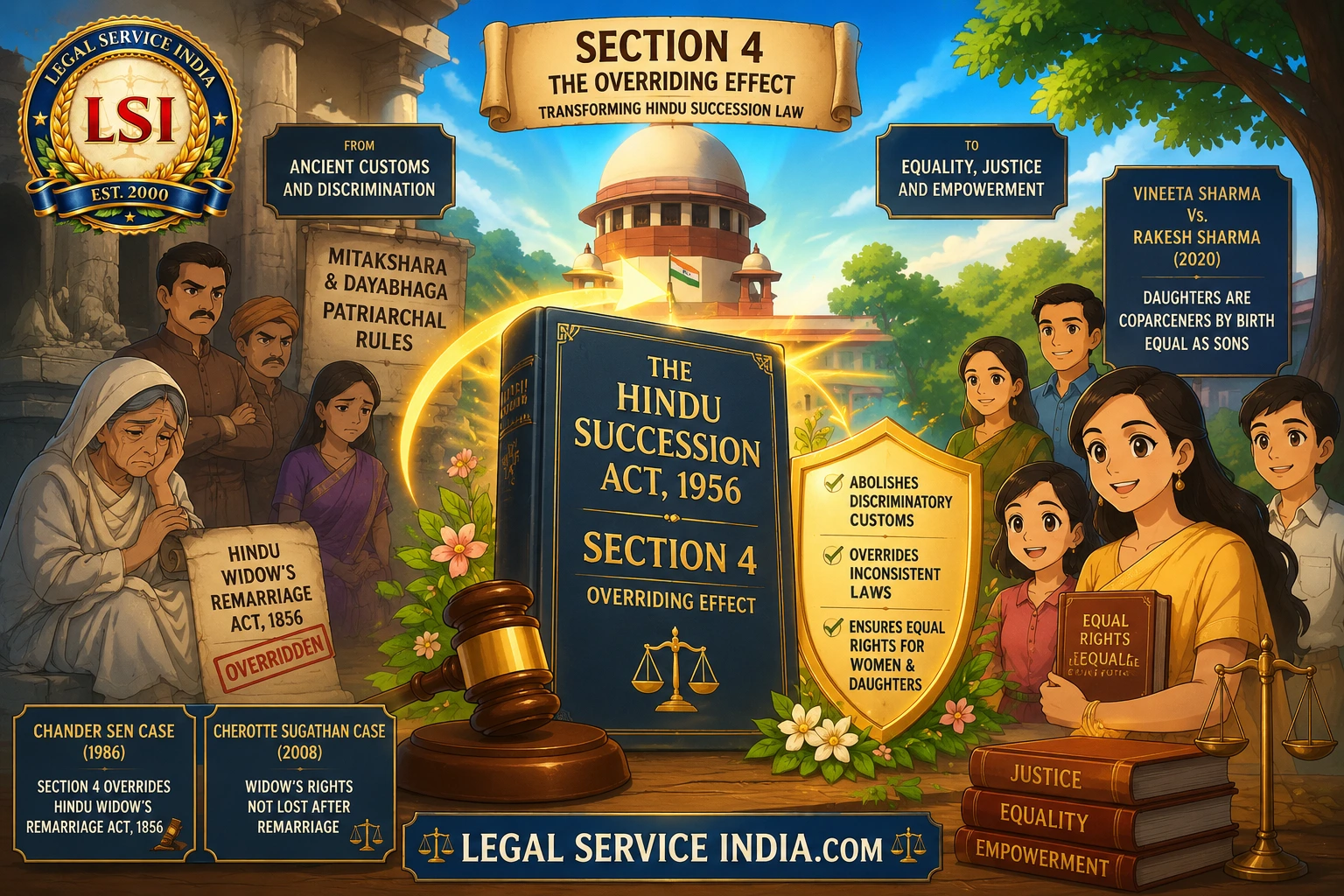
Section 4’s Overriding Effect and Its Jurisprudential Implications
I. Introduction
The codification of Hindu personal law in post-independence India witnessed a remarkable legislative sequence: the Hindu Marriage Act, 1955, was enacted primarily to regulate and codify matrimonial relations among Hindus, yet it inadvertently preserved the ancient succession lines that had governed Hindu inheritance for centuries. The Hindu Succession Act, 1956 (hereinafter ‘HSA’ or ‘the Act’), enacted a year later on June 17, 1956, effected a fundamental and revolutionary transformation of intestate succession among Hindus. The instrument of this transformation was Section 4, which expressly overrode the pre-existing legal framework — both the uncodified traditional law and earlier statutes.
This article examines that legislative anomaly, analyses Section 4’s overriding mechanism, and furnishes a fortified account of the landmark judicial interpretations – from the Supreme Court’s early engagement in Commissioner of Wealth Tax v. Chander Sen (1986) to the constitutional watershed of Vineeta Sharma v. Rakesh Sharma (2020) – that have collectively shaped the modern architecture of Hindu succession law.
II. Historical Context: The Pre-1956 Succession Framework
A. Traditional Hindu Law of Inheritance
Before the enactment of the HSA, succession among Hindus was governed by uncodified Hindu law derived from the Vedas, Smritis, and regional commentaries. Two principal schools emerged:
| School | Region | Key Characteristics |
|---|---|---|
| Mitakshara | Northern, Western, and Southern India | A patriarchal system where only male coparceners (sons, grandsons, and great-grandsons) had rights in coparcenary property by birth (janmasvatva). Female members were entitled only to maintenance. |
| Dayabhaga | Bengal and Assam | Inheritance arose on the death of the holder rather than by birth, but daughters were excluded from the category of coparceners. |
- The Mitakshara school — prevalent across northern, western, and southern India — was notably patriarchal. Only male coparceners (sons, grandsons, great-grandsons) had rights in coparcenary property by birth (janmasvatva). Female members were entitled only to maintenance.
- The Dayabhaga school — prevalent in Bengal and Assam — differed in that inheritance arose on the death of the holder rather than by birth, but it equally excluded daughters from the category of coparceners.
B. The Hindu Widow’s Remarriage Act, 1856
A critical pre-1956 statute was the Hindu Widow’s Remarriage Act, 1856. Section 2 of that Act imposed a severe disqualification: any rights and interests of a widow in her deceased husband’s property — whether by way of maintenance, inheritance, or otherwise — would cease and determine upon her remarriage, as if she had died at that moment. This provision created a grave and structural inequity in the succession line and became the focal point of the legislative anomaly analysed below.
III. The Legislative Sequence: Hindu Marriage Act, 1955
The Hindu Marriage Act, 1955, enacted to regulate and codify Hindu marriage, did not comprehensively address succession. It left the traditional framework of inheritance intact, producing an anomalous situation: marriage was codified, but inheritance continued under both uncodified shastric Hindu law and earlier statutes, including the Hindu Widow’s Remarriage Act, 1856.
This gap between matrimonial codification and the persistence of ancient succession norms set the stage for the comprehensive overhaul that followed in 1956.
Key Legislative Position After 1955
| Area of Law | Status After Hindu Marriage Act, 1955 |
|---|---|
| Marriage | Codified and regulated by statute |
| Succession and Inheritance | Continued under traditional Hindu law and earlier statutes |
| Widow’s Property Rights | Still affected by the Hindu Widow’s Remarriage Act, 1856 |
| Coparcenary Rights | Predominantly restricted to male members |
IV. The Hindu Succession Act, 1956: A Revolutionary Codification
The HSA was enacted with the long title ‘An Act to amend and codify the law relating to intestate succession among Hindus.’ Its principal objects included the following:
- Establishing a uniform and comprehensive system of inheritance and succession.
- Abolishing the concept of the Hindu woman’s ‘limited estate’ (streedhan).
- Conferring absolute property rights on Hindu females (Section 14).
- Placing daughters on equal footing with sons, especially after the 2005 Amendment.
- Creating a statutory hierarchy that prevailed over both customary law and earlier legislation.
V. Section 4: The Overriding Effect — Text and Analysis
A. Statutory Text
Section 4 of the Hindu Succession Act, 1956, provides:
“(1) Save as otherwise expressly provided in this Act,
(a) any text, rule or interpretation of Hindu law or any custom or usage as part of that law in force immediately before the commencement of this Act shall cease to have effect with respect to any matter for which provision is made in this Act;
(b) any other law in force immediately before the commencement of this Act shall cease to apply to Hindus in so far as it is inconsistent with any of the provisions contained in this Act.”
B. Dual Limbs of the Overriding Clause
Section 4 operates through two limbs:
| Provision | Effect |
|---|---|
| Section 4(1)(a) | Abrogates any text, rule, or interpretation of Hindu law, and any custom or usage forming part of that law, in force immediately before the commencement of the Act, to the extent provision is made by the Act on the same matter. This limb directly displaced Mitakshara and Dayabhaga rules on inheritance. |
| Section 4(1)(b) | Nullifies any other law — statutory or otherwise — in force before 1956, insofar as it is inconsistent with any provision of the HSA. This limb directly affected the supersession of the Hindu Widow’s Remarriage Act, 1856. |
C. Interaction with Section 14 and Section 8
Section 14(1) of the HSA declares that any property possessed by a Hindu female — whether acquired before or after the commencement of the Act — shall be held by her as full owner and not as a limited owner. Section 8 places the widow of a Hindu male in Class I of the Schedule, entitling her to inherit simultaneously with the deceased’s sons, daughters, and mother. The combined effect of Sections 4, 8, and 14 comprehensively displaced the earlier framework.
VI. The Anomaly Explored
The legislative anomaly arises from the following sequence:
| Year | Legislative Development |
|---|---|
| 1955 | The Hindu Marriage Act codified matrimonial law but left ancient succession untouched. |
| 1956 | Hindu Succession Act, via Section 4, expressly overrode that earlier framework. |
The result was a statutory supersession of threefold scope:
- (a) the traditional Mitakshara and Dayabhaga schools;
- (b) the Hindu Widow’s Remarriage Act, 1856; and
- (c) any customary law or usage that conflicted with the Act’s provisions.
The implicit preservation of ancient succession norms by the 1955 Act became immediately obsolete upon the commencement of the 1956 Act.
VII. Landmark Judicial Interpretations
The following judicial decisions constitute the most significant interpretations of Section 4 of the Hindu Succession Act, 1956 and its overriding effect on customs, usages, and pre-existing Hindu laws.
| Case | Court | Key Principle |
|---|---|---|
| Cherotte Sugathan v. Cherotte Bharathi (2008) | Supreme Court | HSA overrides Hindu Widow’s Remarriage Act, 1856 |
| V. Tulasamma v. V. Sesha Reddi (1977) | Supreme Court | Section 14 abolishes limited estates. |
| Commissioner of Wealth Tax v. Chander Sen (1986) | Supreme Court | Section 8 overrides Mitakshara survivorship |
| Vellikannu v. R. Singaperumal (2005) | Supreme Court | Statutory disqualification overrides survivorship |
| Prakash v. Phulavati (2016) | Supreme Court | Daughter’s coparcenary rights interpretation |
| Vineeta Sharma v. Rakesh Sharma (2020) | Supreme Court | Daughters become coparceners by birth |
| Shrimati Banso v. Charan Singh (1960) | Punjab & Haryana High Court | HSA overrides agricultural customs |
| A.N. Amruth Kumar v. A.N. Vanitha (2019) | Karnataka High Court | Remarriage does not divest inherited property |
| Smt. Atri v. Babita (2014) | Punjab & Haryana High Court | Widow retains vested inheritance rights |
| Khushboo Gupta v. LIC of India (2019) | Patna High Court | A widow’s vested rights survive remarriage |
1. Cherotte Sugathan (D) by L.Rs. v. Cherotte Bharathi & Ors., (2008) 2 SCC 610; AIR 2008 SC 1467
Supreme Court of India | 15 February 2008 | Civil Appeal 1323 of 2008 | Bench: S.B. Sinha & V.S. Sirpurkar JJ.
This is the most authoritative judicial interpretation of Section 4’s overriding effect on the Hindu Widow’s Remarriage Act, 1856.
Properties belonged to Sri Pervakutty, who died leaving sons and daughters. The central question was whether Section 2 of the Hindu Widow’s Remarriage Act, 1856, could deprive a widow of her share in her deceased husband’s property upon her remarriage.
The Supreme Court held definitively: a widow who has already inherited her husband’s property as an absolute owner under Section 14 of the HSA cannot be divested of that property by a subsequent remarriage.
Section 8 of the HSA permits the widow to inherit simultaneously with Class I heirs — son, daughter, mother, etc. Once succession opens on the husband’s death, the vested estate cannot be displaced by any subsequent act, including remarriage.
The Court affirmed that the HSA, 1956, brought about ‘a sea change in Shastric Hindu law’, placing Hindu widows on equal footing with male heirs in inheritance and succession.
Held: The Hindu Succession Act, 1956, prevails over the Hindu Widow’s Remarriage Act, 1856, by virtue of Section 4(1)(b).
Significance: This judgement is the leading authority on the interaction between Section 4(1)(b) of the HSA and the Hindu Widow’s Remarriage Act, 1856. It has been consistently followed by high courts across India.
2. V. Tulasamma & Ors v. V. Sesha Reddi (Dead) by L.Rs, (1977) 3 SCC 99; AIR 1977 SC 1944
Supreme Court of India | 17 March 1977 | Civil Appeal No. 1360 of 1968 | Bench: P.N. Bhagwati, A.C. Gupta & Syed Murtaza Fazal Ali JJ.
The foundational judgment on Section 14 of the HSA and the abolition of the ‘limited estate’ concept for Hindu women.
Tulasamma had received properties under a compromise in lieu of her right to maintenance. The compromise prescribed a limited interest with restrictions on alienation. The central question was whether Section 14(1) or Section 14(2) of the HSA applied.
The Supreme Court held, by a three-judge bench, that Section 14(1) governs where property is given to a Hindu female in recognition of a pre-existing right, such as maintenance. In such cases, limitations on the nature of the interest are wiped out, and she becomes the full owner.
Section 14(2), by contrast, applies only where the instrument creating the interest expressly creates a new restricted estate for the first time, not in recognition of any pre-existing right.
The Court held that sub-section (2) must be read as a proviso to sub-section (1) and cannot be invoked to defeat the latter’s operation where a pre-existing right of maintenance is being recognised.
Section 4 was directly engaged: the Court confirmed that the HSA’s provisions override prior customary limitations on the female limited estate.
Significance: Tulasamma remains the leading three-judge Bench authority on Section 14 and has been consistently followed, including in the recent Kerala High Court decision in P.K. Lakshmi v. Gopi (March 2026). It is the bedrock precedent abolishing the ‘stridhan’ concept of the limited estate.
3. Commissioner of Wealth Tax, Kanpur v. Chander Sen, (1986) 3 SCC 567; AIR 1986 SC 1753
Supreme Court of India | 16 July 1986 | Civil Appeals 1668–70/1974 | Bench: Sabyasachi Mukharji J.
This Supreme Court decision is the principal authority on Section 4(1)’s overriding effect on traditional Mitakshara survivorship rules in the context of property inherited under Section 8.
- Property inherited under Section 8 becomes individual property.
- Grandsons are excluded from succession under Section 8.
- Traditional survivorship principles yield to statutory succession.
- Section 4 gives overriding force to the Act.
The statutory provision of Section 8 must prevail, in view of the unequivocal intention in Section 4(1) that ‘to the extent to which provisions have been made in the Act, those provisions shall override the established provisions in the texts of Hindu law.’
Significance: This judgement is the earliest Supreme Court articulation of Section 4’s overriding effect on Mitakshara survivorship rules — making it foundational for the entire edifice of post-1956 Hindu succession jurisprudence.
4. Vellikannu v. R. Singaperumal & Ors (2005) 6 SCC 622
Supreme Court of India | 6 June 2005 | Civil Appeal No. 4838 of 1999 | Bench: Ashok Bhan & A. Mathur JJ.
A landmark decision on Sections 25 and 27 of the HSA read with Section 4’s overriding effect on the principle of survivorship.
- Murderer cannot inherit property of the victim.
- Disqualification under Section 25 is absolute.
- Section 27 treats the murderer as predeceased.
- Statutory disqualification overrides survivorship principles.
Significance: This decision authoritatively established the doctrine that the disqualification for murder under Section 25 — an express statutory provision — overrides any residual customary law of survivorship by virtue of Section 4(1)(a).
5. Prakash & Ors v. Phulavati & Ors., (2016) 2 SCC 36; AIR 2016 SC 769
Supreme Court of India | Decided 2016 | Division Bench
- Considered operation of the 2005 amendment.
- The held amendment was not retrospective.
- Required father and daughter to be alive on 9 September 2005.
- Recognised overriding effect of amended Section 6.
Note: The holding in Prakash v. Phulavati was subsequently overruled by the larger bench in Vineeta Sharma v. Rakesh Sharma, (2020) 9 SCC 1, as detailed below.
6. Vineeta Sharma v. Rakesh Sharma & Ors., (2020) 9 SCC 1
Supreme Court of India | 11 August 2020 | Three-Judge Bench: Arun Mishra, S. Abdul Nazeer & M.R. Shah JJ.
- Daughter is a coparcener by birth.
- Right is identical to that of a son.
- Father need not be alive on 9 September 2005.
- Prakash v. Phulavati expressly overruled.
- Customs contrary to amended Section 6 stand displaced.
The court powerfully affirmed Section 4’s overriding effect, holding that the substituted Section 6 entirely displaces the Mitakshara rule of coparcenary which excluded daughters, and this displacement operates with the force of Section 4(1)(a).
Significance: Vineeta Sharma is the constitutional high-water mark of Section 4’s overriding effect in the domain of coparcenary.
7–10. Important High Court Decisions
- Shrimati Banso v. Charan Singh (1960) – Punjab agricultural customs cannot override the HSA.
- A.N. Amruth Kumar v. A.N. Vanitha (2019) – Widow’s inheritance survives remarriage.
- Smt. Atri v. Babita (2014) – Remarriage does not divest vested inheritance rights.
- Khushboo Gupta v. LIC of India (2019) – Widow’s rights in estate and insurance benefits continue after remarriage.
VIII. The 2005 Amendment: Further Strengthening Section 4’s Effect
The Hindu Succession (Amendment) Act, 39 of 2005, made critical changes that reinforced and extended the overriding effect of the 1956 Act:
- Section 6 was substituted in its entirety: daughters of a coparcener became coparceners by birth in the same manner as sons, with the same rights and liabilities. Mitakshara survivorship was abolished and replaced by testamentary or intestate succession.
- Section 23 was deleted: removing restrictions on a female heir’s right to seek partition of a dwelling house.
- Section 24 was repealed, eliminating disqualification arising from the remarriage of certain widows and reinforcing inheritance equality.
- Section 30 was amended, clarifying testamentary powers of Hindu males and females over coparcenary property.
Citation: Hindu Succession (Amendment) Act, 39 of 2005, Sections 3–6.
IX. Jurisprudential Analysis: The Sea Change in Hindu Law
A. Statutory Supremacy over Custom
The Supreme Court’s observation in Cherotte Sugathan (2008) 2 SCC 610 that the HSA brought about ‘a sea change in Shastric Hindu law’ encapsulates the transformation wrought by Section 4. The mechanism is straightforward but profound: Parliament chose a comprehensive codification approach, with Section 4 serving as the constitutional clasp that locks the new statutory regime in place and excludes the operation of all inconsistent prior law.
B. Four Pillars of the Transformation
| Pillar | Key Principle | Leading Authority |
|---|---|---|
| Abolition of the Limited Estate | The concept of streedhan or ‘limited estate’ — under which a Hindu female’s ownership was perpetually fettered — was abolished by Section 14. | Tulasamma (1977) 3 SCC 99 |
| Gender Equality in Coparcenary | Daughters are coparceners by birth. This principle, now embedded in Section 6, operates with the force of Section 4(1)(a) to override all Mitakshara customary exclusions. | Vineeta Sharma (2020) 9 SCC 1 |
| Widow’s Absolute Inheritance | A widow’s absolute ownership of inherited property — secured under Sections 8 and 14 — cannot be defeated by any subsequent event, including remarriage, in the face of Section 4(1)(b). | Cherotte Sugathan (2008) 2 SCC 610 |
| Statutory Priority over Property Incidents | Section 8, overriding old Mitakshara survivorship, determines the character of inherited property as the individual separate property of the heir, not the HUF property. | Chander Sen (1986) 3 SCC 567 |
Abolition of the Limited Estate
The concept of stridhan, or ‘limited estate’ — under which a Hindu female’s ownership was perpetually fettered — was abolished by Section 14. Tulasamma (1977) 3 SCC 99 gave this provision its broadest constitutional sweep.
Gender Equality in Coparcenary
Vineeta Sharma (2020) 9 SCC 1 established that daughters are coparceners by birth. This principle, now embedded in Section 6, operates with the force of Section 4(1)(a) to override all Mitakshara customary exclusions.
Widow’s Absolute Inheritance
Cherotte Sugathan (2008) 2 SCC 610 established that a widow’s absolute ownership of inherited property—secured under Sections 8 and 14—cannot be defeated by any subsequent event, including remarriage, in the face of Section 4(1)(b).
Statutory Priority over Property Incidents
Chander Sen (1986) 3 SCC 567 established that Section 8, overriding old Mitakshara survivorship, determines the character of inherited property as the individual’s separate property of the heir, not the HUF property.
C. Constitutional Alignment
The transformations wrought by the HSA and reinforced by Section 4’s overriding mechanism align with Articles 14 (equality before law), 15 (non-discrimination on grounds of sex), and 21 (right to life with dignity) of the Constitution of India. In Vineeta Sharma (2020), the Court explicitly grounded the amended Section 6 in the constitutional guarantee of equality, making the displacement of discriminatory customary norms under Section 4(1)(a) constitutionally mandated.
- Article 14: Equality before law.
- Article 15: Non-discrimination on grounds of sex.
- Article 21: Right to life with dignity.
X. Conclusion
The legislative anomaly between the Hindu Marriage Act, 1955, and the Hindu Succession Act, 1956, represents a pivotal chapter in Indian legal history. While the 1955 Act inadvertently preserved ancient succession norms by its silence, Section 4 of the HSA, 1956, remedied this with precision and comprehensiveness. Its two limbs—Section 4(1)(a) abrogating customary law and Section 4(1)(b) displacing inconsistent prior statutes—together constitute the most powerful overriding clause in the body of Indian personal law.
The jurisprudence from Cherotte Sugathan (2008) to Vineeta Sharma (2020) has progressively deepened and widened the effect of this overriding clause. Widows inherit absolutely and are not divested by remarriage. Daughters are coparceners by birth. Property inherited under Section 8 devolves as individual property, not HUF property. Murderers cannot inherit. Customary exclusions of daughters from coparcenary have been wholly abolished.
Key Legal Outcomes
- Widows inherit absolutely and are not divested by remarriage.
- Daughters are coparceners by birth.
- Property inherited under Section 8 devolves as individual property, not HUF property.
- Murderers cannot inherit.
- Customary exclusions of daughters from coparcenary have been wholly abolished.
Impact of the 2005 Amendment
The 2005 Amendment’s repeal of Section 24 and substitution of Section 6 further reinforced this trajectory. What appeared initially as a legislative anomaly — the juxtaposition of the 1955 Act’s silence and the 1956 Act’s comprehensiveness — ultimately proved to be the engine of a revolutionary, constitutionally aligned transformation in Hindu succession law.
XI. Complete Citation List
This section contains the complete citation list of Supreme Court judgements, High Court decisions, and statutory provisions referred to in the article.
A. Supreme Court of India
| Case Name | Citation | Date | Remarks |
|---|---|---|---|
| Cherotte Sugathan (D) by L.Rs. v. Cherotte Bharathi & Ors. | (2008) 2 SCC 610; AIR 2008 SC 1467 | 15.02.2008 | — |
| V. Tulasamma & Ors. v. V. Sesha Reddi (Dead) by L.Rs. | (1977) 3 SCC 99; AIR 1977 SC 1944; 1977 SCR (3) 261 | 17.03.1977 | — |
| Commissioner of Wealth Tax, Kanpur v. Chander Sen | (1986) 3 SCC 567; AIR 1986 SC 1753; 1986 SCR (3) 254 | 16.07.1986 | — |
| Vellikannu v. R. Singaperumal & Ors. | (2005) 6 SCC 622 | 06.06.2005 | — |
| Prakash & Ors. v. Phulavati & Ors. | (2016) 2 SCC 36; AIR 2016 SC 769 | — | Overruled by Vineeta Sharma |
| Danamma @ Suman Surpur & Anr. v. Amar & Ors. | (2018) 3 SCC 343 | — | Partly overruled by Vineeta Sharma |
| Vineeta Sharma v. Rakesh Sharma & Ors. | (2020) 9 SCC 1 | 11.08.2020 | Landmark Judgment |
B. High Courts
| Case Name | Citation | Date |
|---|---|---|
| Shrimati Banso & Ors. v. Charan Singh & Ors. | Punjab & Haryana High Court | 23 August 1960 |
| Mst. Taro v. Darshan Singh | AIR 1960 Punj. 145 | — |
| L. Duni Chand v. Mt Anar Kali | AIR 1946 PC 173 | — |
| Amar Singh v. Sewa Ram | (1960) 62 PLR 537 | — |
| A.N. Amruth Kumar v. A.N. Vanitha | 2019 SCC OnLine Kar 683 | 13.06.2019 |
| Smt. Atri v. Babita | Punjab & Haryana High Court | 23 July 2014 |
| Khushboo Gupta v. Life Insurance Corporation of India | CWJC No. 12012 of 2018 (Patna High Court) | 25.09.2019 |
Important High Court Precedents
- Shrimati Banso & Ors. v. Charan Singh & Ors.
- Mst. Taro v. Darshan Singh
- L. Duni Chand v. Mt Anar Kali
- Amar Singh v. Sewa Ram
- A.N. Amruth Kumar v. A.N. Vanitha
- Smt. Atri v. Babita
- Khushboo Gupta v. Life Insurance Corporation of India
C. Legislation
| Statute | Relevant Provisions | Remarks |
|---|---|---|
| The Hindu Succession Act, 1956 (Act 30 of 1956) | Sections 4, 8, 14, 24, 25, 27 | Primary legislation governing succession |
| The Hindu Marriage Act, 1955 (Act 25 of 1955) | Relevant provisions as applicable | Marriage-related statutory framework |
| The Hindu Widow’s Remarriage Act, 1856 | Section 2 | Repealed by Act 24 of 1983 w.e.f. 31.08.1983 |
| Hindu Succession (Amendment) Act, 2005 (Act 39 of 2005) | Sections 3–6 | Introduced significant reforms in coparcenary rights |
| Constitution of India | Articles 14, 15 and 21 | Equality, non-discrimination and life & liberty protections |
Statutory Framework Referred
- The Hindu Succession Act, 1956 (Act 30 of 1956)
- The Hindu Marriage Act, 1955 (Act 25 of 1955)
- The Hindu Widow’s Remarriage Act, 1856
- Hindu Succession (Amendment) Act, 2005 (Act 39 of 2005)
- Constitution of India — Articles 14, 15 and 21

