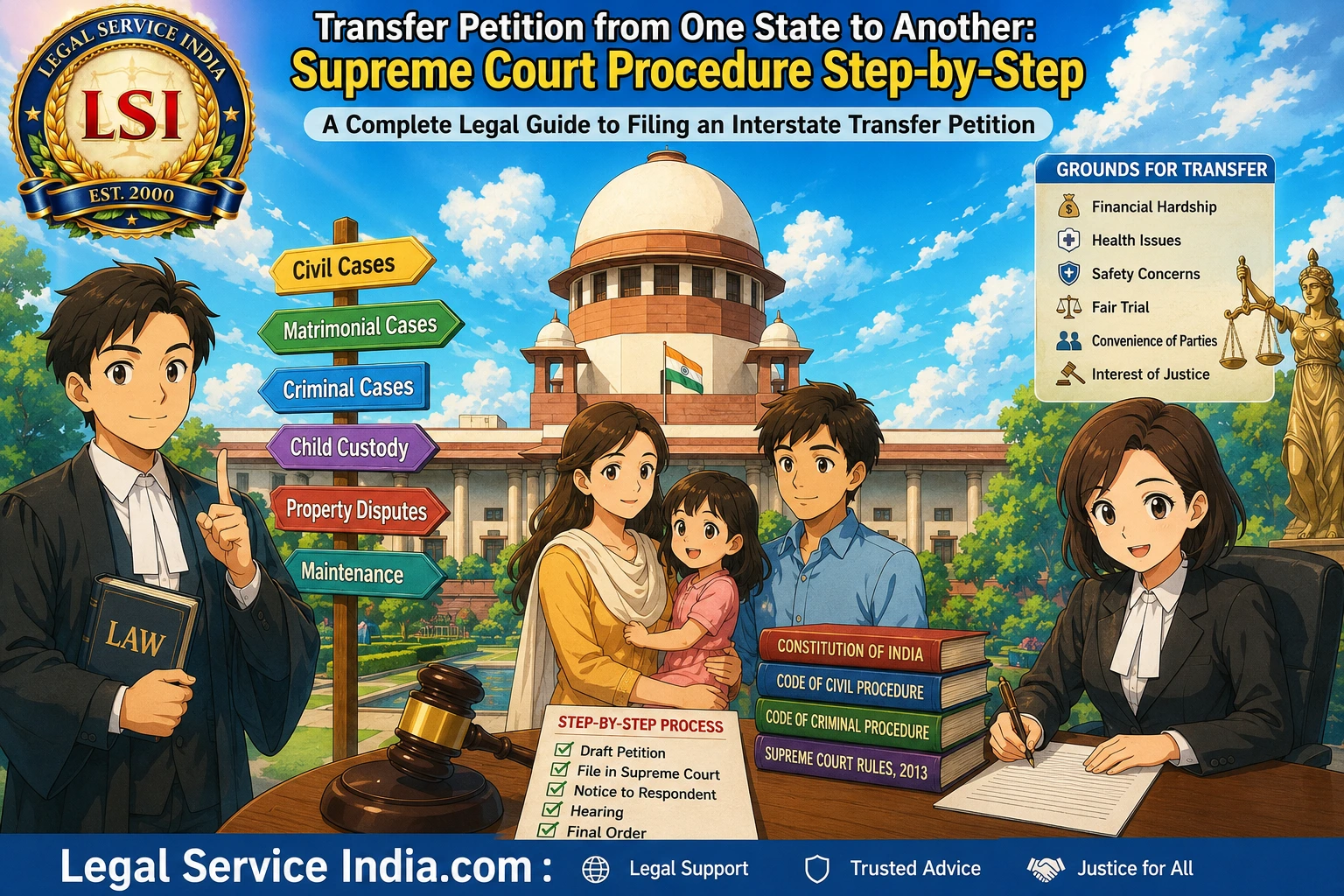
A Complete Legal Guide to Filing an Interstate Transfer Petition Before the Supreme Court
Written By: Adv. Tarun Choudhury
Supreme Court Advocate | 25+ Years of Practice Before the Honorable Supreme Court of India
Introduction
Transfer Petition from One State to Another: Supreme Court Procedure Step-by-Step is one of the most frequently searched legal topics by litigants who find themselves compelled to pursue or defend proceedings in a court situated far from their place of residence. Whether the case involves matrimonial disputes, child custody, maintenance, commercial litigation, property disputes, or criminal prosecution, interstate litigation often imposes significant financial, logistical, and emotional burdens on the parties involved.
For many litigants, particularly women with young children, senior citizens, persons with disabilities, individuals suffering from serious medical conditions, or those facing financial constraints, traveling repeatedly across state boundaries to attend court hearings can become practically impossible. In some cases, concerns regarding personal safety, intimidation, or the likelihood of an unfair trial further aggravate the hardship.
Recognizing these realities, Indian law vests the Supreme Court of India with the extraordinary power to transfer judicial proceedings from one state to another whenever such transfer is necessary to secure the ends of justice. This power, however, is exceptional rather than routine. The Supreme Court carefully scrutinizes every transfer petition and grants relief only when the applicant establishes genuine hardship or compelling circumstances warranting the exercise of its extraordinary jurisdiction.
As a practitioner before the Supreme Court for over twenty-five years, I have observed that many transfer petitions fail not because the applicant lacks a genuine grievance, but because the petition is poorly drafted, unsupported by evidence, or founded upon vague allegations instead of legally sustainable grounds. Conversely, petitions supported by credible documentation, relevant statutory provisions, and binding judicial precedents stand a significantly better chance of success.
This comprehensive guide explains Transfer Petition from One State to Another: Supreme Court Procedure Step-by-Step, covering the governing statutory provisions, constitutional framework, Supreme Court practice, landmark judgments, procedural requirements, practical considerations, common mistakes, and strategic guidance for litigants seeking an interstate transfer of proceedings.
Also Read: File Legal Notice in India: Complete Guide to Drafting, Procedure, Cost & Legal Rights
What Is a Transfer Petition?
A transfer petition is an application filed before the Supreme Court requesting that a pending judicial proceeding be transferred from a court in one state to a competent court in another state.
It is important to understand that a transfer petition does not affect the merits of the dispute. The Supreme Court does not decide who is right or wrong while considering such an application. Instead, it examines whether justice would be better served by changing the forum where the case is heard.
The Court considers whether continuing the proceedings before the existing court would cause undue hardship, prejudice, or inconvenience of such a nature that transferring the matter becomes necessary to ensure a fair and effective administration of justice.
Transfer Petitions Commonly Arise In
- Divorce and matrimonial disputes
- Child custody and guardianship matters
- Maintenance proceedings
- Domestic violence cases
- Civil suits involving property or commercial disputes
- Probate and succession proceedings
- Criminal trials and criminal appeals
- Other civil or criminal proceedings where the law permits transfer
Why Does the Law Permit Interstate Transfer of Cases?
Justice must not only be done but must also be seen to be done. Access to justice loses its meaning if a litigant is effectively denied an opportunity to prosecute or defend a case because attending court is financially or physically impossible.
Repeated travel between states may involve the following:
- Substantial travel expenses;
- Loss of income due to absence from work;
- Accommodation costs;
- Childcare responsibilities;
- Health-related difficulties;
- Physical disability;
- Concerns regarding safety or intimidation; or
- Practical impossibility of attending frequent hearings.
Recognizing these realities, Parliament has empowered the Supreme Court to intervene where transferring a case would better serve the interests of justice.
However, inconvenience alone is not sufficient. The Court examines whether the hardship is genuine, substantial, and supported by evidence.
Transfer Petition at a Glance
| Particular | Details |
|---|---|
| Purpose | Transfer a pending judicial proceeding from one state to another. |
| Forum | Supreme Court of India. |
| Applicable Matters | Matrimonial, child custody, maintenance, civil, commercial, probate, succession, criminal, and other legally transferable proceedings. |
| Primary Consideration | Whether a transfer is necessary to secure the ends of justice. |
| Key Requirement | Proof of genuine hardship, prejudice, or compelling circumstances supported by evidence. |
Key Highlights
- The Supreme Court exercises this power sparingly and only in appropriate cases.
- A transfer petition does not decide the merits of the dispute.
- Strong documentary evidence significantly improves the chances of success.
- Vague allegations without supporting material are generally insufficient.
- The guiding principle is the effective administration of justice and fairness to both parties.
Why Is the Supreme Court the Only Court Competent to Transfer Cases Between States?
One of the most common misconceptions among litigants is that any high court can transfer a case from one state to another. This is legally incorrect.
A High Court ordinarily exercises supervisory and transfer jurisdiction only over subordinate courts situated within its own territorial jurisdiction. Under Section 24 of the Code of Civil Procedure, 1908, a High Court may transfer civil proceedings between courts subordinate to it within the same state. Similar principles apply in criminal matters under the applicable procedural law.
However, where a case is pending before a court in one state and a party seeks its transfer to a court situated in another state, no high court has jurisdiction over courts located outside its territorial limits.
Accordingly, only the Supreme Court of India possesses the authority to order an interstate transfer under the following:
- Section 25 of the Code of Civil Procedure, 1908 (civil proceedings);
- Section 406 of the Code of Criminal Procedure, 1973 (and the corresponding framework under the Bharatiya Nagarik Suraksha Sanhita, 2023, where applicable); and
- Article 139A of the Constitution of India in specified constitutional matters.
This centralized jurisdiction ensures uniformity, impartiality, and consistency in deciding requests that involve courts situated in different states.
Quick Reference: Jurisdiction Framework
| Provision | Applicable To | Authority |
|---|---|---|
| Section 24, Code of Civil Procedure, 1908 | Transfer within the same State | High Court |
| Section 25, Code of Civil Procedure, 1908 | Interstate transfer of civil proceedings | Supreme Court of India |
| Section 406, Code of Criminal Procedure, 1973 / Corresponding BNSS framework | Interstate transfer of criminal proceedings | Supreme Court of India |
| Article 139A, Constitution of India | Specified constitutional matters pending before different High Courts | Supreme Court of India |
Statutory and Constitutional Framework
The Supreme Court’s power to transfer proceedings is founded upon statutory provisions enacted by Parliament as well as the Constitution of India.
1. Section 25 of the Code of Civil Procedure, 1908
Section 25 of the CPC provides:
“On the application of a party, and after notice to the parties, and after hearing such of them as desire to be heard, the Supreme Court may, if satisfied that an order under this section is expedient for the ends of justice, direct that any suit, appeal, or other proceeding be transferred from a High Court or other Civil Court in one State to a High Court or other Civil Court in any other State.”
This provision governs the transfer of civil proceedings between different states.
The expression “expedient for the ends of justice” gives the Supreme Court wide discretion. Nevertheless, this discretion is exercised judicially and not arbitrarily.
2. Section 406 of the Code of Criminal Procedure, 1973
Section 406 empowers the Supreme Court to transfer criminal cases and criminal appeals whenever such transfer is expedient for the ends of justice.
The provision is frequently invoked where
- allegations of local influence exist;
- there is a reasonable apprehension of bias.
- witness safety is involved;
- there are concerns regarding a fair trial; or
- Extraordinary circumstances require proceedings to be shifted to another state.
The Court has consistently held that mere allegations are insufficient. The apprehension of injustice must be reasonable, genuine, and supported by material on record.
3. Bharatiya Nagarik Suraksha Sanhita, 2023
Following the replacement of the Code of Criminal Procedure by the Bharatiya Nagarik Suraksha Sanhita, 2023 (BNSS), criminal procedural law has undergone significant restructuring.
While many pending transfer petitions continue to refer to Section 406 CrPC, proceedings instituted after the commencement of the BNSS must be understood in the context of the corresponding provisions under the new criminal procedural framework. Litigants should therefore ensure that their petitions cite the applicable law based on the date and nature of the proceedings.
4. Article 139A of the Constitution of India
Article 139A empowers the Supreme Court to transfer cases involving substantial questions relating to the interpretation of the Constitution that are pending before different high courts.
Unlike Section 25 CPC or Section 406 CrPC, Article 139A is generally invoked in constitutional litigation involving questions of national importance rather than ordinary civil or criminal disputes.
Supreme Court Rules, 2013: The Procedural Backbone
Apart from the statutory provisions, transfer petitions are governed procedurally by the Supreme Court Rules, 2013, which regulate the manner in which proceedings are instituted before the Supreme Court.
These rules prescribe, among other things:
- the format of the petition;
- preparation of the synopsis and list of dates;
- affidavits verifying facts;
- filing requirements;
- vakalatnama;
- court fees;
- annexures;
- curing of Registry defects;
- service upon respondents; and
- listing before the appropriate bench.
Failure to comply with the Supreme Court Rules frequently results in registry objections, delays, or the return of defective petitions for rectification.
When Can a Transfer Petition Be Filed?
A transfer petition may be filed whenever continuing the proceedings before the existing court would seriously prejudice the applicant or defeat the interests of justice.
Common circumstances include:
Financial Hardship
Where repeated interstate travel imposes an unreasonable financial burden upon the litigant.
Medical Grounds
Serious illness, advanced age, disability, pregnancy, or prolonged medical treatment may justify transfer.
Safety Concerns
Where credible material demonstrates threats, intimidation, harassment, or a genuine apprehension regarding personal safety.
Custody of Minor Children
Courts frequently consider whether the applicant is solely responsible for caring for young children whose welfare would be adversely affected by frequent travel.
Employment Constraints
Where professional obligations make repeated interstate appearances impracticable, particularly if supported by documentary evidence.
Connected Proceedings
Where several connected proceedings are already pending before courts in another state, consolidation may avoid conflicting judgments and unnecessary multiplicity of litigation.
Interest of Justice
Ultimately, every transfer petition turns upon whether transferring the matter would better serve the interests of justice.
| Ground | Typical Reason for Transfer |
|---|---|
| Financial Hardship | Interstate travel causes unreasonable financial burden. |
| Medical Grounds | Illness, disability, pregnancy, or ongoing treatment. |
| Safety Concerns | Threats, harassment, or genuine security risks. |
| Minor Children | Primary responsibility for childcare. |
| Employment Constraints | Professional commitments supported by evidence. |
| Connected Proceedings | Avoid conflicting decisions and multiplicity of litigation. |
| Interest of Justice | Transfer better serves justice. |
When Is a Transfer Petition Not Maintainable?
Not every inconvenience justifies invoking the Supreme Court’s transfer jurisdiction.
A transfer petition may not be maintainable, or may ultimately fail, where
- the proposed transfer is between courts situated within the same State, for which the High Court may possess jurisdiction;
- the petition is filed merely to delay the proceedings;
- allegations are unsupported by credible evidence;
- the applicant suppresses material facts;
- an alternative statutory remedy is available; or
- The petition is premature.
The Supreme Court discourages litigants from using transfer petitions as a tactical device to prolong litigation or harass the opposite party.
| Situation | Likely Outcome |
|---|---|
| Transfer sought within the same State | The High Court may have jurisdiction. |
| Petition filed only to delay proceedings | Transfer likely to be refused. |
| No supporting evidence | Petition may fail. |
| Suppression of material facts | Petitioner may lose equitable relief. |
| Alternative statutory remedy available | A transfer petition may not be maintainable. |
| Premature filing | Petition may be rejected. |
Burden of Proof: Who Must Prove the Need for Transfer?
A common misconception is that once hardship is alleged, the Supreme Court will automatically transfer the case. That is not the law.
The burden of proof squarely rests upon the applicant seeking the transfer. The petitioner must satisfy the Court that the transfer is genuinely required and that refusing the transfer would result in substantial prejudice or defeat the ends of justice.
The applicant should therefore place before the Court credible and objective material demonstrating:
- genuine hardship rather than mere inconvenience;
- comparative prejudice suffered by the parties;
- financial constraints, where relevant;
- medical or physical disability supported by records;
- childcare responsibilities, if relied upon;
- safety concerns supported by complaints or other evidence;
- the existence of connected proceedings pending elsewhere; and
- any other circumstances showing that justice would be better served by transferring the case.
The Supreme Court consistently discourages petitions founded solely upon emotional assertions or bald allegations. Documentary evidence invariably strengthens the case for transfer.
The Comparative Hardship Test
One of the most important principles governing transfer petitions is the doctrine of comparative hardship.
The Court does not simply ask:
“Will the petitioner face inconvenience?”
Instead, it examines a broader question:
“Which course would cause the least overall hardship while advancing the interests of justice?”
Accordingly, the Court balances the inconvenience likely to be suffered by both parties.
Relevant considerations include the following:
- financial capacity of each party;
- age and health;
- employment obligations;
- responsibility for minor children;
- distance between the courts;
- availability of public transport;
- possibility of virtual participation;
- pendency of connected proceedings;
- overall fairness.
This balancing exercise reflects the Court’s effort to ensure that justice is administered fairly rather than favoring one party merely because a transfer has been sought.
| Comparative Hardship Factors | Considered by the Court |
|---|---|
| Financial capacity | ✔ |
| Age and health | ✔ |
| Employment obligations | ✔ |
| Minor children | ✔ |
| Distance between courts | ✔ |
| Public transport availability | ✔ |
| Virtual hearing availability | ✔ |
| Connected proceedings | ✔ |
| Overall fairness | ✔ |
Transfer Petitions in Matrimonial Cases
A substantial percentage of transfer petitions before the Supreme Court arise out of matrimonial disputes.
These commonly include:
- divorce petitions;
- restitution of conjugal rights;
- judicial separation;
- maintenance proceedings;
- child custody disputes;
- guardianship petitions;
- domestic violence proceedings; and
- proceedings under personal laws.
Historically, the Supreme Court often observed that the convenience of the wife ordinarily deserved greater consideration because women frequently faced greater practical and financial difficulties in pursuing litigation away from their matrimonial home.
However, the Court’s modern approach is more balanced. While the circumstances of the wife remain an important consideration, the Court now evaluates the comparative hardship faced by both spouses and the overall interests of justice.
Landmark Supreme Court Judgments
The principles governing transfer petitions have evolved through a series of important Supreme Court decisions.
1. Sumita Singh v. Kumar Sanjay
Citation: (2001) 10 SCC 41
This remains one of the leading authorities in matrimonial transfer petitions.
The Supreme Court observed that, in matrimonial disputes, the convenience of the wife ordinarily deserves greater consideration, particularly where she lacks independent financial means or would suffer disproportionate hardship by traveling long distances.
Although frequently cited, the judgment does not create an absolute rule that every petition filed by a wife must automatically succeed.
2. Rajani Kishor Pardeshi v. Kishor Babulal Pardeshi
Citation: (2005) 12 SCC 237
The Court reiterated that while the wife’s convenience generally deserves weight, each transfer petition must ultimately be decided on its own facts.
The decision emphasizes that no rigid formula governs transfer applications.
3. Anindita Das v. Srijit Das
Citation: (2006) 9 SCC 197
This judgment marked an important development in the law.
The Supreme Court cautioned against routinely transferring every matrimonial case merely because the wife requested such a transfer.
The court observed that each case requires an objective evaluation of the following:
- comparative hardship;
- availability of evidence;
- convenience of both parties; and
- the overall interests of justice.
The decision reinforced that transfer jurisdiction must be exercised judicially rather than mechanically.
4. Maneka Sanjay Gandhi v. Rani Jethmalani
Citation: (1979) 4 SCC 167
Although delivered in the context of criminal proceedings, this landmark judgment continues to guide transfer jurisprudence.
The Supreme Court held that transfer cannot be ordered merely because one party expresses apprehension regarding the fairness of the proceedings.
The apprehension must be
- reasonable;
- genuine;
- supported by objective circumstances; and
- sufficient to demonstrate a real likelihood of injustice.
This decision remains one of the leading authorities governing criminal transfer petitions.
5. N.C.V. Aishwarya v. A.S. Saravana Karthik Sha
Citation: (2022) 12 SCC 286
This is one of the most significant modern judgments on matrimonial transfer petitions.
The Supreme Court observed that contemporary realities—including widespread availability of video conferencing, changing social circumstances, and increasing professional commitments of both spouses—require courts to adopt a more balanced approach.
The Court clarified that transfer should not automatically be granted merely because the applicant is the wife.
Instead, courts should evaluate:
- financial condition of both spouses;
- employment commitments;
- educational needs of children;
- availability of virtual hearings;
- comparative hardship; and
- overall interests of justice.
This judgment reflects the Supreme Court’s movement towards a gender-neutral assessment while remaining sensitive to genuine hardship.
| Supreme Court Judgment | Citation | Key Principle |
|---|---|---|
| Sumita Singh v. Kumar Sanjay | (2001) 10 SCC 41 | The convenience of the wife ordinarily deserves greater consideration. |
| Rajani Kishor Pardeshi v. Kishor Babulal Pardeshi | (2005) 12 SCC 237 | Every transfer petition depends upon its own facts. |
| Anindita Das v. Srijit Das | (2006) 9 SCC 197 | Transfer should not be granted mechanically. |
| Maneka Sanjay Gandhi v. Rani Jethmalani | (1979) 4 SCC 167 | Apprehension must be genuine, reasonable, and supported by evidence. |
| N.C.V. Aishwarya v. A.S. Saravana Karthik Sha | (2022) 12 SCC 286 | Balanced, gender-neutral approach with comparative hardship assessment. |
Transfer Petition from One State to Another: Supreme Court Procedure Step-by-Step
Understanding the procedural journey is essential for anyone approaching the Supreme Court.
Step 1: Consult an Experienced Supreme Court Advocate
The first step is obtaining proper legal advice.
An experienced Supreme Court advocate will evaluate the following:
- Whether the petition is maintainable;
- Whether adequate legal grounds exist;
- Whether supporting evidence is sufficient;
- The likelihood of obtaining interim relief; and
- Whether alternative remedies are available.
Professional advice at this stage often prevents avoidable procedural mistakes.
Step 2: Collect Relevant Documents
Before drafting begins, all relevant documents should be assembled.
These ordinarily include:
- Copy of the plaint or petition;
- Written statement or reply;
- Interim orders;
- Summons;
- Latest case status;
- Medical records;
- Residence proof;
- Income documents;
- Travel records, where relevant;
- FIR or criminal complaint (if applicable);
- Police complaints regarding threats, if any; and
- Any connected proceedings.
The Court places considerable reliance upon documentary evidence.
Documents Checklist
| Document | Purpose |
|---|---|
| Petition/Plaint | Establishes the nature of the pending proceedings |
| Written Statement/Reply | Presents the respondent’s defence |
| Interim Orders | Shows previous judicial directions |
| Medical Records | Supports hardship or health-related grounds |
| Residence & Income Proof | Demonstrates inconvenience or financial hardship |
| FIR/Police Complaint | Supports allegations relating to safety or threats |
Step 3: Draft the Transfer Petition
The petition should contain:
- Complete facts;
- Details of pending proceedings;
- Statutory provisions relied upon;
- Precise grounds for transfer;
- Judicial precedents;
- Details of the proposed transferee court; and
- Supporting annexures.
The drafting should avoid exaggerated allegations or unnecessary emotional language.
The emphasis should always remain upon facts capable of objective verification.
Step 4: Prepare the Supporting Affidavit
Every transfer petition is ordinarily accompanied by an affidavit affirming the truthfulness of the factual statements.
The affidavit serves as evidence supporting the petition and should accurately verify every material fact.
False statements may expose the deponent to serious legal consequences.
Step 5: Filing Before the Supreme Court Registry
The petition is then filed before the Registry of the Supreme Court.
The registry examines whether the filing complies with the Supreme Court rules.
Among the aspects scrutinized are the following:
- Court fee;
- Formatting;
- Pagination;
- Indexing;
- Annexures;
- Affidavit;
- Vakalatnama;
- Attestation;
- Jurisdiction; and
- Limitation, where relevant.
Step 6: Registry Scrutiny and Removal of Defects
Many transfer petitions are not immediately listed because procedural defects are noticed during scrutiny.
Common Registry objections include:
- Incomplete annexures;
- Missing affidavits;
- Improper indexing;
- Defective vakalatnama;
- Unreadable documents;
- Incorrect pagination, and
- Inadequate court fees.
The petitioner must remove the defects within the time granted by the Registry before the matter proceeds further.
Common Registry Defects at a Glance
| Registry Objection | Action Required |
|---|---|
| Incomplete annexures | File complete supporting documents |
| Missing affidavit | Submit duly affirmed affidavit |
| Improper indexing | Correct the paper book index |
| Defective vakalatnama | Rectify signatures or authorization. |
| Incorrect pagination | Repaginate the entire record |
| Insufficient court fee | Pay the prescribed court fee |
Step 7: Registration of the Transfer Petition
Once the registry is satisfied that all procedural requirements have been fulfilled, the matter receives a formal registration number.
Depending upon the nature of the proceedings, it may be registered as
- Transfer Petition (Civil); or
- Transfer Petition (Criminal).
Registration does not imply that the petition will necessarily succeed; it merely indicates that the matter is ready for judicial consideration.
Step 8: Issue of Notice to the Respondent
The Supreme Court ordinarily issues notice to the opposite party.
The respondent may then:
- File a counter-affidavit;
- Dispute the alleged hardship;
- Produce contrary evidence;
- Oppose the transfer; or
- Point out suppression of facts.
The Court hears both sides before arriving at its decision.
Step 9: Interim Stay of Proceedings
In appropriate cases, the Supreme Court may stay further proceedings before the original court until the transfer petition is finally decided.
Such interim relief is entirely discretionary.
The applicant must demonstrate that allowing the original proceedings to continue would seriously prejudice the purpose of the transfer petition.
Step 10: Final Hearing Before the Supreme Court
At the final hearing, the court evaluates the following:
- Comparative hardship;
- Statutory provisions;
- Judicial precedents;
- Documentary evidence;
- Objections raised by the respondent; and
- Overall interests of justice.
The Bench may also explore practical alternatives, including the use of technology, before deciding whether transfer is genuinely necessary.
Step 11: Final Order
After hearing both parties, the Supreme Court may
- Allow the transfer petition;
- Dismiss the petition;
- Transfer the matter to another competent court;
- Issue consequential directions regarding records; and
- Grant further procedural directions considered necessary for expeditious disposal.
Once transfer is ordered, the records are transmitted to the transferee court, and the proceedings continue there in accordance with law.
Interim Relief: Can the Original Court Continue the Case?
Yes.
The mere filing of a transfer petition does not automatically stay the proceedings before the original court.
Unless the Supreme Court specifically grants an interim stay, the trial or other proceedings may continue.
Applicants seeking urgent protection should therefore make a specific prayer for interim relief and demonstrate why such relief is necessary.
Key Points on Interim Relief
- Filing a transfer petition does not automatically stay proceedings.
- An interim stay must be specifically granted by the Supreme Court.
- The applicant should specifically pray for interim relief.
- The applicant must establish genuine urgency and likely prejudice.
Modern Approach: Impact of Video Conferencing
The judicial landscape has undergone significant transformation following the widespread adoption of virtual hearings.
The Supreme Court now frequently examines whether the availability of video conferencing adequately addresses the inconvenience complained of by the applicant.
Where:
- Evidence can be recorded virtually;
- Routine hearings do not require personal appearance, or
- Technology substantially reduces travel.
The court may conclude that transfer is unnecessary.
However, virtual hearings are not treated as a complete substitute in every case. Where personal presence is indispensable or genuine hardship continues despite technological alternatives, the Supreme Court may still exercise its transfer jurisdiction.
The availability of virtual hearings is therefore one relevant factor—not the sole determining consideration.
Video Conferencing and Transfer Petitions
| Situation | Possible Judicial View |
|---|---|
| Evidence can be recorded virtually | May reduce the need for transfer |
| Routine hearings conducted online | Travel hardship may be mitigated |
| Personal appearance is indispensable | A transfer may still be justified |
| Genuine hardship continues despite technology | The Supreme Court may exercise transfer jurisdiction |
Civil and Criminal Transfer Petitions: Understanding the Difference
Although both civil and criminal transfer petitions are decided by the Supreme Court, the governing legal provisions and the considerations applicable to each are distinct.
| Aspect | Civil Transfer Petition | Criminal Transfer Petition |
|---|---|---|
| Governing Law | Governed primarily by Section 25, Code of Civil Procedure, 1908 | Governed by Section 406, Code of Criminal Procedure, 1973 (and the corresponding framework under the BNSS, where applicable) |
| Common Cases | Common in matrimonial disputes, property disputes, commercial suits, guardianship, probate and civil appeals | Common in criminal trials, criminal appeals and proceedings where a fair trial is in question |
| Primary Consideration | Focuses on comparative convenience, hardship and the ends of justice | Places greater emphasis on ensuring a fair and impartial trial |
| Personal Inconvenience | Personal inconvenience often plays a significant role | Mere inconvenience is insufficient unless it affects the administration of criminal justice |
Although the legal tests differ, the guiding principle in both categories remains the same: whether transferring the proceedings is expedient for the ends of justice.
Transfer of a Judicial Case Is Different from Transfer of Investigation
Many litigants confuse a transfer petition with a request for transfer of investigation.
The two remedies are entirely different.
- A transfer petition concerns the transfer of an already pending judicial proceeding from one court to another.
- By contrast, a request seeking transfer of investigation—such as transferring an investigation from the State Police to the Central Bureau of Investigation (CBI) or another specialized agency—relates to the investigative stage of a criminal case and is governed by a different legal framework.
Accordingly, an application seeking transfer of investigation cannot ordinarily be pursued through a transfer petition filed under Section 25 CPC or Section 406 CrPC.
How Long Does a Transfer Petition Take in the Supreme Court?
One of the most frequently asked questions by litigants is how much time the Supreme Court generally takes to decide a transfer petition.
There is no fixed timeline. The duration depends upon several factors, including:
- Scrutiny by the Registry;
- Removal of defects;
- Service of notice upon the respondent;
- Filing of the counter-affidavit;
- Filing of the rejoinder, if any;
- The urgency of the matter; and
- The Court’s docket.
Procedural Journey of a Transfer Petition
- Drafting of Petition
- Filing Before Supreme Court Registry
- Registry Scrutiny
- Removal of Defects (if any)
- Registration of Transfer Petition
- Issue of Notice
- Counter-Affidavit by Respondent
- Rejoinder (if filed)
- Final Hearing
- Order of the Supreme Court
Urgent matters involving child custody, personal liberty, serious illness, or exceptional hardship may receive priority listing, subject to the court’s discretion.
Evidence That Strengthens a Transfer Petition
Since the burden lies on the applicant, every assertion should, wherever possible, be supported by documentary evidence.
Depending upon the facts, the following documents may strengthen the petition:
- Medical certificates and hospital records.
- Disability certificates.
- Proof of pregnancy or serious illness.
- Residence proof.
- Income documents demonstrating financial hardship.
- School records of minor children.
- Police complaints regarding threats or harassment.
- Employment records showing inability to travel frequently.
- Orders passed in connected proceedings.
- Distance and travel details.
- Any other material demonstrating genuine hardship.
The stronger the documentary foundation, the greater the likelihood that the court will be satisfied that the transfer is genuinely necessary.
Common Mistakes That Lead to Dismissal of Transfer Petitions
In practice, many transfer petitions fail because of avoidable errors.
Some of the most common mistakes include:
- Relying upon vague allegations without supporting evidence.
- Filing the petition merely to delay the original proceedings.
- Suppressing material facts or connected litigation.
- Incorrectly invoking the statutory provisions.
- Filing incomplete annexures.
- Defective affidavits.
- Failure to explain comparative hardship.
- Ignoring the availability of virtual hearings where relevant.
- Seeking transfer based solely upon personal preference.
The Supreme Court has repeatedly emphasized that transfer jurisdiction should not be abused as a litigation strategy.
In appropriate cases, frivolous or mala fide transfer petitions may even invite the imposition of costs.
Practical Checklist Before Filing a Transfer Petition
Before approaching the Supreme Court, ensure that the following documents and information are complete:
- ✔ Proper cause title.
- ✔ Synopsis and list of dates.
- ✔ Transfer petition.
- ✔ Supporting affidavit.
- ✔ Vakalatnama.
- ✔ Certified or legible copies of relevant pleadings.
- ✔ Interim orders passed by the lower court.
- ✔ Medical records (if relied upon).
- ✔ Residence proof.
- ✔ Documents supporting financial hardship.
- ✔ Details of connected proceedings.
- ✔ Relevant judicial precedents.
- ✔ Court fees and registry compliance.
A carefully prepared petition significantly reduces registry objections and procedural delays.
Frequently Asked Questions (FAQs)
| Question | Answer |
|---|---|
| Can every case be transferred from one state to another? | No. The Supreme Court exercises this power sparingly and only where the transfer is expedient for the ends of justice. |
| Can a high court transfer a case from one state to another? | No. A High Court may ordinarily transfer proceedings only within its own territorial jurisdiction. Interstate transfers fall within the exclusive jurisdiction of the Supreme Court. |
| Can a transfer petition be filed in matrimonial disputes? | Yes. Matrimonial disputes constitute one of the largest categories of transfer petitions filed before the Supreme Court. |
| Will the Supreme Court always favor the wife in matrimonial transfer cases? | No. While earlier decisions often accorded greater weight to the wife’s convenience, recent judgments require courts to balance the convenience of both parties, the welfare of children, the availability of virtual hearings, and the overall interests of justice. |
| Does filing a transfer petition automatically stay the proceedings? | No. Proceedings before the original court continue unless the Supreme Court specifically grants an interim stay. |
| Can a transfer petition be dismissed with costs? | Yes. If the Court concludes that the petition is frivolous, filed with an ulterior motive, or intended merely to delay proceedings, it may dismiss the petition and impose costs. |
| Can connected cases pending in different states be transferred to one court? | Yes. Where multiple connected proceedings are pending in different states and consolidation would avoid conflicting decisions or multiplicity of litigation, the Supreme Court may consider transferring them to one competent court if the interests of justice so require. |
Key Takeaways
- Only the Supreme Court can transfer a civil or criminal case from one state to another.
- Civil transfers are primarily governed by Section 25 of the Code of Civil Procedure, 1908.
- Criminal transfers are governed by Section 406 of the Code of Criminal Procedure, 1973, subject to the applicable provisions under the Bharatiya Nagarik Suraksha Sanhita, 2023, for newer proceedings.
- The Supreme Court exercises this power sparingly and judicially.
- The burden of proof lies upon the applicant.
- The Court applies the comparative hardship test, balancing the inconvenience of both parties.
- Documentary evidence significantly strengthens a transfer petition.
- Filing a transfer petition does not automatically stay the proceedings before the original court.
- Frivolous or mala fide petitions may be dismissed with costs.
- Proper drafting and compliance with the Supreme Court Rules, 2013, can substantially improve the prospects of success.
Author’s Practical Note
During my more than twenty-five years of practice before the Supreme Court of India, I have observed that the outcome of a transfer petition often depends less on the number of grounds pleaded and more on the quality of evidence supporting those grounds. A concise, factually accurate petition backed by medical records, financial documents, or other objective material is generally more persuasive than one containing broad allegations of inconvenience. Full disclosure of connected proceedings, reliance on binding precedents, and strict compliance with the Supreme Court Rules frequently make the difference between success and dismissal.
Conclusion
A transfer petition from one state to another is an extraordinary legal remedy designed to ensure that geographical distance, financial hardship, health concerns, safety issues, or other compelling circumstances do not impede access to justice. While the Supreme Court enjoys wide powers under Section 25 of the Code of Civil Procedure, 1908, Section 406 of the Code of Criminal Procedure, 1973 (and the corresponding provisions under the BNSS), and Article 139A of the Constitution of India, those powers are exercised with considerable restraint and only where the facts clearly demonstrate that a transfer is necessary to secure the ends of justice.
The jurisprudence developed through landmark decisions such as Sumita Singh v. Kumar Sanjay, Anindita Das v. Srijit Das, Maneka Sanjay Gandhi v. Rani Jethmalani, and N.C.V. Aishwarya v. A.S. Saravana Karthik Sha makes it clear that the court does not decide transfer petitions on sympathy or convenience alone. Instead, it evaluates the comparative hardship faced by the parties, the availability of technological alternatives such as video conferencing, the credibility of the evidence produced, and the larger interests of justice.
For litigants, the practical lesson is straightforward: a well-researched, meticulously drafted petition supported by cogent evidence and relevant precedents stands a far greater chance of success than one founded on general assertions. Obtaining experienced legal advice at the earliest stage can help avoid procedural defects, present the strongest possible case, and ensure that the petition complies with the statutory requirements and the Supreme Court Rules, 2013.
Whether the matter involves matrimonial litigation, a civil dispute, or criminal proceedings, understanding the Transfer Petition from One State to Another: Supreme Court Procedure Step-by-Step equips litigants to make informed decisions and to pursue the appropriate legal remedy before the Supreme Court of India.
Need Professional Assistance in Filing a Transfer Petition Before the Supreme Court?
If you are facing litigation in another state and believe that continuing the proceedings there would cause undue hardship or prejudice, obtaining experienced legal representation at the earliest stage can significantly improve your chances of success.
Adv. Tarun Choudhury
Supreme Court Advocate | 25+ Years of Legal Experience
- 📞 Call: 9891244487
- 💬 WhatsApp: 9891244487
With extensive experience in handling Transfer Petition (Civil) and Transfer Petition (Criminal) matters before the Supreme Court of India, Adv. Tarun Choudhury provides the following:
Legal Services Offered
- Strategic case evaluation.
- Expert drafting of transfer petitions.
- Advice on maintainability and legal strategy.
- Representation before the Supreme Court of India.
- Assistance in matrimonial, civil, commercial, property, custody, maintenance, and criminal transfer matters.
Contact today for a confidential consultation and obtain trusted legal advice to protect your rights with experienced Supreme Court representation.
Important Links
Important Links:
- Lawyers in India
- Copyright Registration in India
- Caveat Filing in Supreme Court of India
- Mutual Consent Divorce in Delhi/ NCR: WhatsApp 9650499965