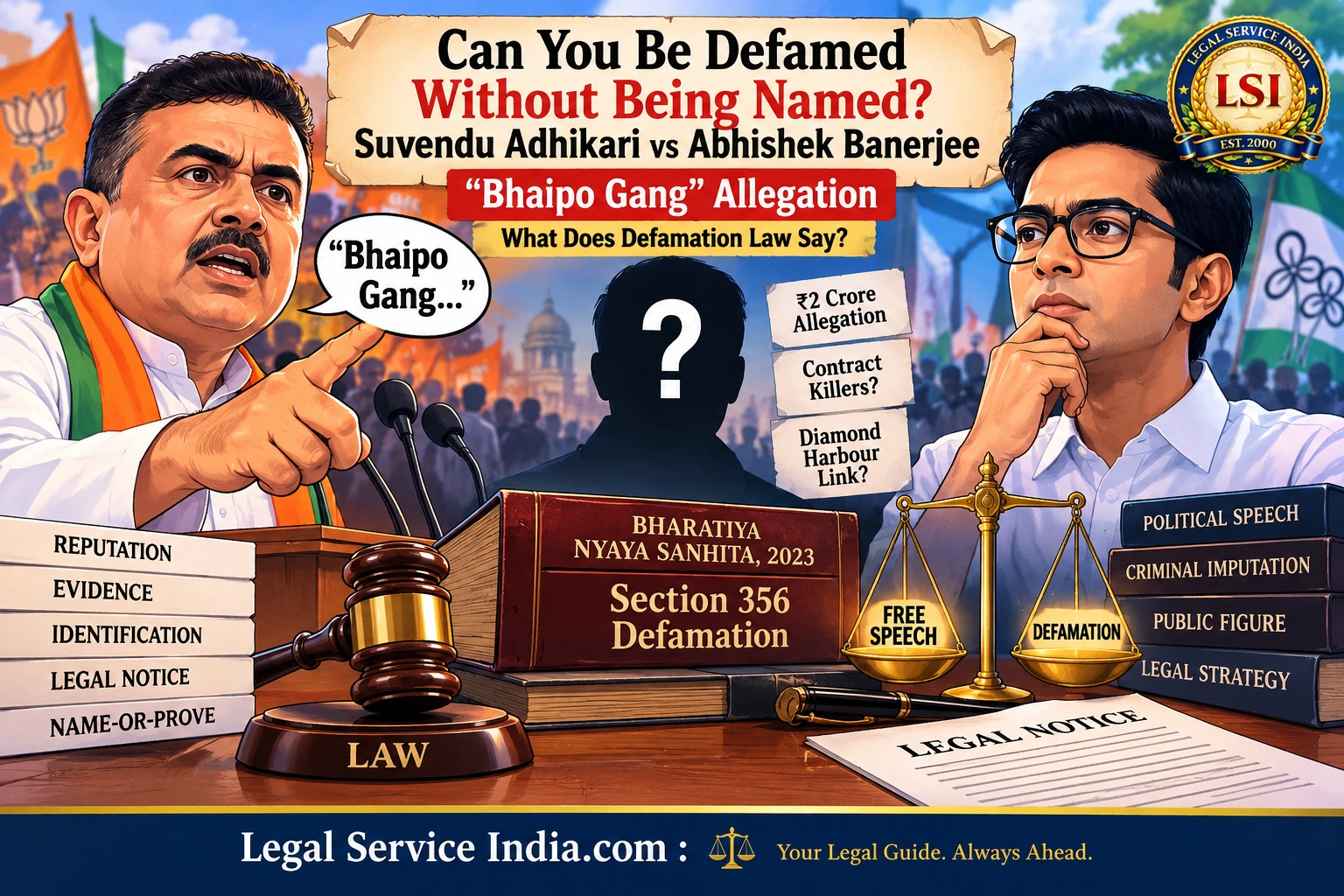
When a Political Allegation Becomes a Legal Problem: How Would a Senior Lawyer Draft a Defamation Notice for Abhishek Banerjee?
A Legal Case Study on Indirect Defamation, Political Speech, Evidence, Reputation, and the Art of Drafting a “Name-or-Prove” Legal Notice
By Adv. Tarun Choudhury
Supreme Court Advocate | 25+ Years of Legal Experience
Introduction: Sometimes the Most Important Words Are the Words That Are Not Spoken
Lawyers are often taught to look carefully at what a person has said.
Experienced lawyers also learn to look carefully at what a person has deliberately not said.
The controversy surrounding West Bengal Chief Minister Suvendu Adhikari’s recent remarks concerning the murder of his former aide Chandranath Rath provides an unusually interesting case study in this regard.
On September 15, 2026, Adhikari reportedly alleged that a “Bhaipo gang” was behind the murder and that approximately ₹2 crore had been spent, including money allegedly paid to shooters or contract killers. He also reportedly referred to persons from Diamond Harbour allegedly transferring money.
The political context is significant.
Abhishek Banerjee is the Lok Sabha MP from Diamond Harbour, and contemporary reporting notes that “Bhaipo”—meaning nephew—is commonly used in West Bengal political discourse as a reference to him. At the same time, Adhikari did not expressly utter Abhishek Banerjee’s name in the reported statement.
That apparent contradiction creates an excellent legal question:
Can a Person Be Defamed Without Being Expressly Named?
The answer is potentially, yes.
But that is only the beginning.
The real legal question is
Can the surrounding words, circumstances, and context make the identity of the person sufficiently ascertainable that an allegedly defamatory criminal imputation is understood by reasonable members of the public as referring to that person?
That is where the law becomes much more interesting.
This article examines the controversy as a legal case study and, hypothetically, asks:
If I were advising Abhishek Banerjee, how would I analyze the matter and draft a legal notice to the Chief Minister?
This is not an assertion that any court has found the statement defamatory. It is a study in legal strategy based upon publicly reported facts as presently available.
Also Read: File Legal Notice in India: Complete Guide to Drafting, Procedure, Cost & Legal Rights
1. First Principle: A Lawyer Must Separate the Facts From the Politics
This is the first discipline of good legal drafting.
A weak lawyer begins with:
“This is a political conspiracy against my client.”
A better lawyer begins with:
“What exactly was said?”
The reported allegation contains several distinct components:
- A murder occurred.
- Approximately ₹2 crore was allegedly spent.
- Contract killers were allegedly paid.
- A “Bhaipo gang” was allegedly involved.
- Persons from Diamond Harbour allegedly transferred money.
- The statement was made in the context of a political event involving the deceased’s mother, who had been nominated as a BJP candidate for the Nandigram by-election.
These are not all the same kind of statement.
Some concern the murder investigation.
Some concern alleged evidence.
Some concern political identity.
And some may potentially constitute an imputation against an identifiable person.
A legal notice must separate these strands rather than mixing them into political rhetoric.
2. The First Question I Would Ask: Who Is “Bhaipo Gang”?
This is where the case becomes fascinating.
The speaker did not reportedly say:
“Abhishek Banerjee financed the murder.”
Instead, the reported expression was
“Bhaipo gang.”
That creates two possibilities.
Possibility One
The expression was not intended to refer to Abhishek Banerjee.
If so, the matter becomes much less straightforward from Abhishek’s perspective.
Possibility Two
The expression was intended to refer to Abhishek Banerjee and persons associated with him.
If that is the case, the absence of his formal name may not necessarily end the legal inquiry.
Why?
Because defamation law is concerned with the imputation and identification, not merely with whether the speaker mechanically pronounced the person’s name.
Also Read: Manipur Relief Camps: Supreme Court Seeks Probe Into 25 Unnatural Deaths
3. The Law Recognizes Indirect Identification
Section 356 of the Bharatiya Nyaya Sanhita, 2023, deals with defamation.
It covers an imputation concerning a person made with the requisite intention, knowledge, or reason to believe that it would harm that person’s reputation.
Significantly, Explanation 4 recognizes reputational harm resulting from an imputation made directly or indirectly. The statutory illustrations themselves contemplate situations in which a person may be identified without the speaker simply naming that person.
This produces a useful legal proposition:
A lawyer should not ask only, “Was my client named?”
The better question is
“Would a reasonable person, knowing the surrounding circumstances, understand the statement as referring to my client?”
That distinction can completely change the drafting strategy.
4. The Diamond Harbour Connection Makes the Context Legally Interesting
Suppose a political speaker says:
“A particular gang financed a murder.”
That statement by itself may leave the identity of the alleged gang uncertain.
But now suppose the same speaker adds that people from Diamond Harbour allegedly delivered the money.
And suppose the principal political figure whom the term “Bhaipo” commonly denotes is also the sitting MP representing Diamond Harbour.
Now the lawyer has something more substantial to analyze.
This does not automatically prove identification.
But it provides contextual material from which identification might potentially be argued.
That is precisely why the legal notice should not make an absolute statement such as
“You named Abhishek Banerjee.”
That would be inaccurate.
The more careful formulation is
“Your statement, read in its full context, has been widely understood as referring to my client.”
That is a lawyer’s formulation—not a political slogan.
5. The Second Question: What Exactly Is the Allegation?
This is even more important than the nickname.
Calling someone “Bhaipo” is political rhetoric.
But saying that a group associated with that person financed a murder is something entirely different.
The reported allegation concerns:
- ₹2 crore;
- contract killers;
- transfer of money;
- alleged persons from Diamond Harbour;
- and an alleged connection with the murder of Chandranath Rath.
That is not merely a disagreement over political policy.
It is a purported factual allegation concerning criminal conduct.
Therefore, the legal notice should focus not on the political nickname but on the criminal imputation allegedly attached to that nickname.
This is a critical drafting distinction.
6. The Lawyer’s Most Important Rule: Never Overstate Your Case
Suppose I were drafting the notice.
I would not write:
“You have falsely accused my client of murder.”
Why?
Because the reported statement may not literally say that Abhishek Banerjee committed the murder.
The statement, as reported, refers to a “Bhaipo gang.”
Therefore, an experienced lawyer should not put words into the speaker’s mouth.
I would instead write:
“Your reference to the ‘Bhaipo gang,’ when read together with your references to the alleged financing of the murder and persons connected with Diamond Harbour, has been publicly understood as an imputation concerning my client and persons allegedly associated with him.”
That sentence is much more difficult to attack.
It is precise.
It is contextual.
And it leaves the court to determine the ultimate legal question.
Also Read: Can America Reform the Supreme Court? Latest 5–4 Ruling Reignites Term Limits Debate
7. The “Name-or-Prove” Strategy
This is the central strategy I would adopt.
The Name-or-Prove Principle
The notice should put the speaker in a simple choice.
| Question | Required Clarification |
|---|---|
| If “Bhaipo Gang” does not refer to Abhishek Banerjee | Say so clearly. |
| If it does refer to Abhishek Banerjee | Identify the evidence. |
This is strategically superior to merely demanding an apology.
Why?
Because an apology can sometimes be dismissed politically as weakness.
A demand for clarification and an evidentiary foundation is different.
It says:
“You made the allegation. Tell the public whom you meant and tell the investigating authority what evidence you possess.”
That is a much more forensic position.
8. The ₹2 Crore Allegation Requires Special Attention
The reported statement was not merely:
“I suspect political involvement.”
It reportedly went considerably further, alleging that approximately ₹2 crore was spent and that the “Bhaipo gang” handled or supplied the money to contract killers.
That is important.
If somebody publicly asserts the existence of:
- a specific sum;
- a payment mechanism;
- alleged contract killers;
- a money transfer;
- and alleged call records,
The natural legal question becomes:
What is the evidentiary foundation for those assertions?
This does not mean that the legal notice should demand that every investigative secret be disclosed publicly.
That could actually be counterproductive.
Instead, the notice should say:
If such evidence exists, preserve it and place it before the competent investigating agency.
That is much more responsible.
9. The Call-Record Issue
Adhikari reportedly stated that he had heard call records involving persons from Diamond Harbour who allegedly delivered money to the assailants.
That creates a second legal opportunity.
The notice could ask:
- Are you in possession of the original recordings?
- How were they obtained?
- Are they part of the CBI case material?
- Have they been supplied to the investigating agency?
- Who authenticated them?
The purpose is not to conduct the trial through a legal notice.
The purpose is to prevent a serious criminal allegation from remaining suspended between political speech and evidence.
10. Never Ask the Wrong Question
A weak legal notice might say:
“Prove that Abhishek Banerjee is guilty.”
That is the wrong question.
The burden of proving guilt in a criminal case lies where criminal law places it.
The better question is
“What was the evidentiary basis upon which you publicly associated my client with the alleged financing of a murder?”
That is a fundamentally different question.
It is also much more professionally drafted.
11. What About Truth and Public Good?
A good lawyer must anticipate the defense before sending the notice.
Section 356 contains statutory exceptions, including an exception concerning a true imputation where publication is for the public good. It also contains exceptions relating to good-faith opinions concerning public servants and public questions.
Therefore, the notice should not pretend that every harsh political statement automatically constitutes defamation.
That would weaken the lawyer’s credibility.
Instead, I would expressly acknowledge:
“My client does not object to good-faith political criticism or legitimate public scrutiny.”
Then draw the line:
“The objection concerns the attribution of specific criminal conduct.”
This is the kind of distinction that makes a legal notice look like the work of a lawyer rather than a press release.
12. Political Speech Is Not the Enemy
A sophisticated legal notice should respect political speech.
Abhishek Banerjee is a public political figure.
Therefore, criticism of his policies, political decisions, leadership, or public conduct may legitimately form part of political debate.
The notice should never attempt to silence political criticism.
Instead:
Political opinion is one thing.
A factual allegation of participation in financing a contract killing is another.
That distinction should run through the entire document.
13. The Investigating Agency Must Be Kept Out of the Political Battlefield
Another important drafting principle is institutional.
If the CBI is investigating the murder, a political leader who claims to possess relevant information should be encouraged to give that information to the investigating agency.
The legal notice should therefore state:
“If you possess material relating to the alleged conspiracy, my client calls upon you to preserve and lawfully furnish the same to the competent investigating agency.”
This accomplishes two things.
First, it demonstrates that the notice is not trying to obstruct the investigation.
Second, it subtly changes the terrain:
Political allegation → evidentiary material → investigating agency → judicial scrutiny.
That is where a criminal allegation belongs.
14. The Timing Also Deserves Examination
The allegation was reportedly made while Adhikari was accompanying the mother of the deceased, Hasirani Rath, during her nomination process for the Nandigram by-election. The BJP had fielded her as its candidate, and the by-election is scheduled for October 6.
A careful lawyer should record that context.
But there is an important difference between recording context and alleging political motive.
I would record:
“The statement was made in the course of a political event connected with the forthcoming by-election.”
I would not automatically allege:
“You made the allegation deliberately to influence voters.”
The latter is a conclusion requiring evidence.
A senior lawyer should resist the temptation to overreach.
15. The Four-Layer Test Before Sending the Notice
Before signing the notice, I would ask four questions.
Layer One: Words
What exactly did the speaker say?
Layer Two: Identification
Who would a reasonable listener understand the statement to refer to?
Layer Three: Imputation
What criminal or reputational allegation was actually made?
Layer Four: Evidence
What evidence does the speaker claim to possess?
Only after answering all four should the notice be drafted.
16. The Most Important Documents I Would Obtain First
If this were a real brief before me, I would not immediately dispatch a notice based solely upon newspaper reports.
I would first obtain:
1. The Complete Video Recording
Not a clipped social media video.
The full recording.
2. The Exact Transcript
Every word matters.
3. The CBI Case Record
Particularly:
- FIR;
- remand orders;
- chargesheet;
- relevant court orders;
- allegations against the accused;
- alleged money trail;
- electronic evidence;
- call-record references.
4. Newspaper Reports
Useful for establishing how the statement was understood and disseminated.
5. Social-Media Replication
Particularly posts expressly interpreting “Bhaipo Gang” as referring to Abhishek Banerjee.
This evidence may become relevant to the issue of identification.
17. Why the CBI Record Is So Important
This is where the lawyer must remain intellectually honest.
Some reports say the CBI has arrested and charged seven people, while other reports say an 11-accused chargesheet was filed.
That discrepancy itself demonstrates why a lawyer should never draft a pleading from headlines.
The actual CBI record must be checked.
A legal notice should never say:
“The CBI has found no TMC connection.”
unless the actual investigative record establishes precisely that proposition.
Likewise, it should not say:
“The CBI has established a connection.”
unless the record actually says so.
This is one of the most important lessons for young lawyers:
A newspaper report can tell you where to look. It cannot always tell you what to plead.
18. How I Would Structure the Legal Notice
My notice would have eight principal parts:
Part I—Identify the Statement
Precisely reproduce or accurately describe what was said.
Part II — Establish Context
Explain why “Bhaipo” may be understood as referring to the client.
Part III — Identify the Defamatory Imputation
Focus on the alleged financing of the murder.
Part IV — Separate Political Criticism from Criminal Accusation
Make clear that political criticism is not being challenged.
Part V — Demand Evidentiary Clarification
Ask what evidence supports the allegation.
Part VI — Demand Preservation
Call for preservation of call records, electronic evidence, and financial material.
Part VII — Provide an Opportunity to Clarify
If the speaker did not mean Abhishek, ask him to say so.
Part VIII — Reserve Remedies
Civil and criminal remedies can then be considered based on the final factual record.
19. The Legal Notice Should Contain a Strategic “Escape Door”
This is a subtle but powerful drafting technique.
The notice should give the respondent a lawful opportunity to retreat.
For example:
“If by the expression ‘Bhaipo Gang’ you did not intend to refer to Shri Abhishek Banerjee or persons associated with him, you are called upon to clarify the same unequivocally.”
Why is that useful?
Because if the respondent clarifies:
“I was not referring to Abhishek Banerjee,”
Then the reputational controversy may immediately narrow.
If he says:
“Yes, I was referring to Abhishek.”
Then the evidentiary question becomes unavoidable.
The lawyer has therefore created a binary legal framework.
That is much more sophisticated than simply demanding an apology.
20. The Most Powerful Sentence in the Notice
If I had to identify one sentence that captures the entire strategy, it would be
“If ‘Bhaipo Gang’ does not refer to my client, say so; if it does, identify the evidentiary basis upon which you have publicly associated my client with the financing of a contract killing.”
That sentence is short.
But it changes the entire character of the dispute.
It moves the discussion:
| From | To |
|---|---|
| Politics | Identification |
| Identification | Evidence |
| Evidence | Law |
21. What I Would Never Put in the Notice
A serious lawyer should avoid the following:
- “You are lying.”
Too conclusive. - “You are politically motivated.”
Requires proof of motive. - “You have committed defamation.”
Better to say the conduct may attract the ingredients of defamation, subject to evidence and statutory exceptions. - “You must prove Abhishek innocent.”
Wrong legal framework. - “The CBI has exonerated everyone.”
Only if the record actually says so. - “Bhaipo definitely means Abhishek.”
Too absolute when the speaker himself did not use the name.
The language of a good legal notice should be firm without becoming reckless.
22. The Real Art of Legal Drafting
Young lawyers sometimes believe that an aggressive notice is a strong notice.
That is not necessarily true.
A strong notice does something different.
- It anticipates the respondent’s best defense.
- It closes unnecessary escape routes.
- It preserves evidence.
- It identifies the precise legal injury.
- It avoids allegations that cannot presently be proved.
- It creates a record that can later be placed before a court.
That is the difference between a threatening letter and a litigation document.
23. The Hypothetical Notice
If I were instructed to draft the notice in this hypothetical case, its central architecture would be
“You have publicly alleged that a ‘Bhaipo Gang’ financed a murder and that approximately ₹2 crore was transferred to contract killers. In the context in which the statement was made, the expression has been understood as referring to my client and persons associated with him. If that was not your intention, clarify it. If that was your intention, identify the evidentiary basis. Preserve the alleged call records and financial material and place genuine evidence before the investigating agency.”
That is the essence.
Not anger.
Not political rhetoric.
Not a television debate.
Evidence.
24. Why This Approach Is More Powerful Than an Ordinary Defamation Notice
An ordinary notice says:
“You defamed my client. Apologize.”
The Name-or-Prove notice says:
“Who did you mean?”
Then:
“If you meant my client, what evidence did you rely upon?”
Then:
“If the evidence exists, preserve it.”
Then:
“If it concerns an ongoing investigation, place it before the investigating agency.”
And finally:
“If you did not mean my client, clarify that publicly.”
This creates a legally disciplined chain.
25. The Larger Lesson for Indian Lawyers
This case study illustrates a broader principle of Indian public-law litigation.
Political speech operates in a highly charged environment.
Public figures will criticize one another.
Nicknames will be used.
Allegations will be made.
Media will amplify them.
Social media will reinterpret them.
But the lawyer’s job is not to reproduce that noise.
The lawyer’s job is to extract the legally relevant proposition from the noise.
Here, the proposition is not
“Suvendu Adhikari attacked Abhishek Banerjee.”
The legally useful proposition is narrower:
“A public statement allegedly connected an identifiable political figure or his associates with the financing of a specific murder. What was the factual basis of that imputation?”
That is a question a court can understand.
26. The Lesson in One Formula
I would teach young lawyers to remember the following formula:
| Step | Legal Focus |
|---|---|
| 1 | Words |
| 2 | Identification |
| 3 | Imputation |
| 4 | Evidence |
| 5 | Defense |
| 6 | Remedy |
WORDS → IDENTIFICATION → IMPUTATION → EVIDENCE → DEFENSE → REMEDY
Never jump directly from:
WORDS → DEFAMATION.
There are several legal steps in between.
27. Final Thoughts: The Lawyer Should Not Win the Argument—He Should Improve the Record
The finest legal notices do not necessarily contain the strongest adjectives.
They contain the strongest questions.
In the present case study, the most useful questions are
- Who is the “Bhaipo Gang”?
- Was Abhishek Banerjee intended to be identified?
- If yes, what evidence supports that identification?
- What is the source of the alleged ₹2 crore figure?
- What call records are being referred to?
- Are those records available to the investigating agency?
- Is the allegation an investigative finding, information received from a source, or merely a political assertion?
- If the statement was not directed at Abhishek Banerjee, why not clarify that?
These questions do something an angry press statement cannot do.
They create a legal record.
And that is ultimately what a lawyer should strive to create.
Conclusion: The Senior Lawyer’s Advantage Is Precision
The lesson from this hypothetical exercise is not that every political allegation should become a defamation case.
Nor is it that political speech should be suppressed.
The lesson is more fundamental.
A serious allegation requires serious evidentiary discipline.
A political leader has the right to criticize another political leader.
A citizen has the right to demand an investigation into a murder.
A journalist has the right to report allegations.
But when an identifiable person is publicly connected—directly or indirectly—with financing a contract killing, the law asks important questions about:
- Identification
- Imputation
- Evidence
- Intention
- Truth
- Public good
- Reputation
That is where the lawyer enters.
And the lawyer’s most effective weapon is often not accusation.
It is a carefully framed question:
“If you did not mean my client, say so. If you did mean my client, show us the evidentiary foundation.”
That is not political theatre.
That is legal craftsmanship.
Facing a Defamation, Reputation, or Public Allegation?
When a public statement can affect your reputation, professional standing, or public image, reacting emotionally may make the situation worse.
The right legal response begins with understanding:
- What was said
- How you were identified
- What evidence exists
- Which legal remedy is appropriate
Whether you are dealing with defamation, reputational harm, political allegations, false criminal imputations, damaging public statements, or a sensitive legal dispute, experienced legal advice can help you respond with precision, strategy, and confidence.
Speak to an Experienced Supreme Court Advocate
Adv. Tarun Choudhury
Supreme Court Advocate | 25+ Years of Legal Experience
Get professional legal guidance on defamation notices, criminal and civil remedies, reputation protection, legal strategy, and high-stakes disputes.
| Contact | Details |
|---|---|
| Call | 9650499965 |
| 9891244487 |
Don’t Let a Serious Allegation Go Unanswered
Your reputation matters. Your response matters even more.
Before you issue a legal notice, make a public statement or begin litigation, discuss the facts with an experienced advocate, and understand your available legal options.
- Confidential legal consultation
- Strategic legal advice
- Supreme Court experience
Take the first step towards protecting your reputation and legal rights.
Important Legal Note
This article is a legal case study based on publicly reported statements as of September 16, 2026.
It does not determine whether any person is guilty of the murder, whether the reported allegation is true or false, or whether the reported statement legally constitutes defamation.
Those questions would depend upon the complete statement, evidence, investigation record, applicable law, and judicial determination.
The statutory framework discussed includes Section 356 of the Bharatiya Nyaya Sanhita, 2023. The provision defines defamation and contains several exceptions, including provisions concerning truth and public good and good-faith opinions on public questions.
Frequently Asked Questions
1. Can a Person Be Defamed Without Being Directly Named in India?
Yes. A defamatory imputation may potentially be made directly or indirectly.
Under Section 356 of the Bharatiya Nyaya Sanhita, 2023 (BNS), the key issue can be whether the statement identifies an individual sufficiently for the imputation to concern that person and whether the other legal ingredients of defamation are satisfied.
2. Can Calling Someone “Bhaipo” Amount to Defamation if the Person’s Name Is Not Mentioned?
The word itself would not automatically constitute defamation.
The legal issue is whether, considering the context, surrounding statements, and circumstances, reasonable persons would understand the reference as identifying a particular individual and whether the accompanying allegation contains a defamatory imputation.
In a case involving an alleged murder-financing accusation, the surrounding words would therefore be particularly important.
3. Can Abhishek Banerjee Issue a Legal Notice for Alleged Defamation by Suvendu Adhikari?
A person who believes that a public statement has unlawfully harmed his reputation may consider appropriate civil or criminal defamation remedies, subject to the facts, evidence, and statutory requirements.
In this case study, a carefully drafted legal notice could seek clarification of the identity intended by the expression “Bhaipo Gang” and the evidentiary basis for the alleged criminal imputation.
4. What Should a Legal Notice for Defamation Contain in India?
A well-drafted defamation legal notice should:
- Identify the precise statement.
- Explain how the claimant was identified.
- Specify the allegedly defamatory imputation.
- Establish the manner in which reputation was allegedly harmed.
- Address relevant legal exceptions and defenses.
- Demand appropriate corrective action.
- Preserve the claimant’s right to pursue available civil and criminal remedies.
5. What Is the “Name-Or-Prove” Strategy in a Defamation Case?
The “Name-or-Prove” legal strategy is a drafting approach in which the person making an ambiguous but potentially identifiable criminal allegation is asked to clarify whom the allegation referred to.
If the statement was not intended to refer to the claimant, the speaker can clarify that position.
If it was intended to refer to the claimant, the notice can ask for the evidentiary foundation of the allegation and preservation of relevant evidence.
This approach can be particularly useful where a political statement uses an indirect reference rather than expressly naming an individual.
Key Takeaways: Legal Notice for Defamation in Political Allegations
- A person does not necessarily have to be named directly to be identifiable in a defamation case. Under Section 356 of the Bharatiya Nyaya Sanhita, 2023 (BNS), an imputation may be made directly or indirectly.
- Context matters in indirect defamation. Courts may need to examine the words used, surrounding circumstances, audience understanding, and other contextual factors to determine whether an allegedly defamatory statement refers to a particular person.
- Political criticism and criminal allegations are legally different. Strong criticism of a politician’s policies or public conduct should be distinguished from a factual allegation connecting an identifiable person with serious criminal conduct.
- The “Bhaipo Gang” controversy illustrates the importance of identification. Where a political nickname or indirect expression is allegedly understood as referring to a particular public figure, the legal question becomes whether the overall statement sufficiently identifies that individual.
- A defamation notice should focus on the precise imputation. Rather than merely objecting to a nickname, a lawyer should identify the specific allegation that allegedly damages the person’s reputation.
- The evidentiary foundation should be carefully questioned. Where a public speaker refers to alleged ₹2 crore payments, contract killers, money transfers, or call records, a legal notice can seek clarification regarding the factual and evidentiary basis of those assertions.
- The “Name-or-Prove” strategy can create legal clarity. If the speaker did not intend to refer to the person concerned, the speaker can be asked to clarify that position; if the person was intended to be identified, the evidentiary foundation can be sought.
- A lawyer should not demand that the accused prove the claimant’s innocence. The more precise approach is to ask what evidence formed the basis for the speaker’s own public allegation.
- Evidence preservation is crucial. Original videos, transcripts, call recordings, electronic communications, financial records, and relevant investigative documents should be preserved before litigation is initiated.
- An ongoing criminal investigation should not be confused with a political allegation. Evidence concerning an alleged murder conspiracy should be placed before the competent investigating agency rather than being left solely in the arena of political speeches.
- Truth and public-good exceptions must be anticipated. Section 356 BNS contains statutory exceptions, so a carefully drafted defamation notice should address potential legal defenses rather than assuming that every adverse political statement is defamatory.
- A strong legal notice should be firm but factually restrained. Avoid unsupported assertions such as “you are lying” or claims about political motive unless evidence exists. Precision strengthens credibility.
- The best defamation notices ask the right questions. The essential sequence is: What was said? → Who was identified? → What was imputed? → What evidence supports it? → What legal defense exists? → What remedy is appropriate?
The Core Legal Lesson
| Stage | Key Legal Question |
|---|---|
| Words | What was said? |
| Identification | Who was identified? |
| Imputation | What was imputed? |
| Evidence | What evidence supports it? |
| Defense | What legal defense exists? |
| Remedy | What remedy is appropriate? |
Words → Identification → Imputation → Evidence → Defense → Remedy
This is the central framework for analysing political defamation, indirect defamatory statements, reputation damage, and legal notices in India.