





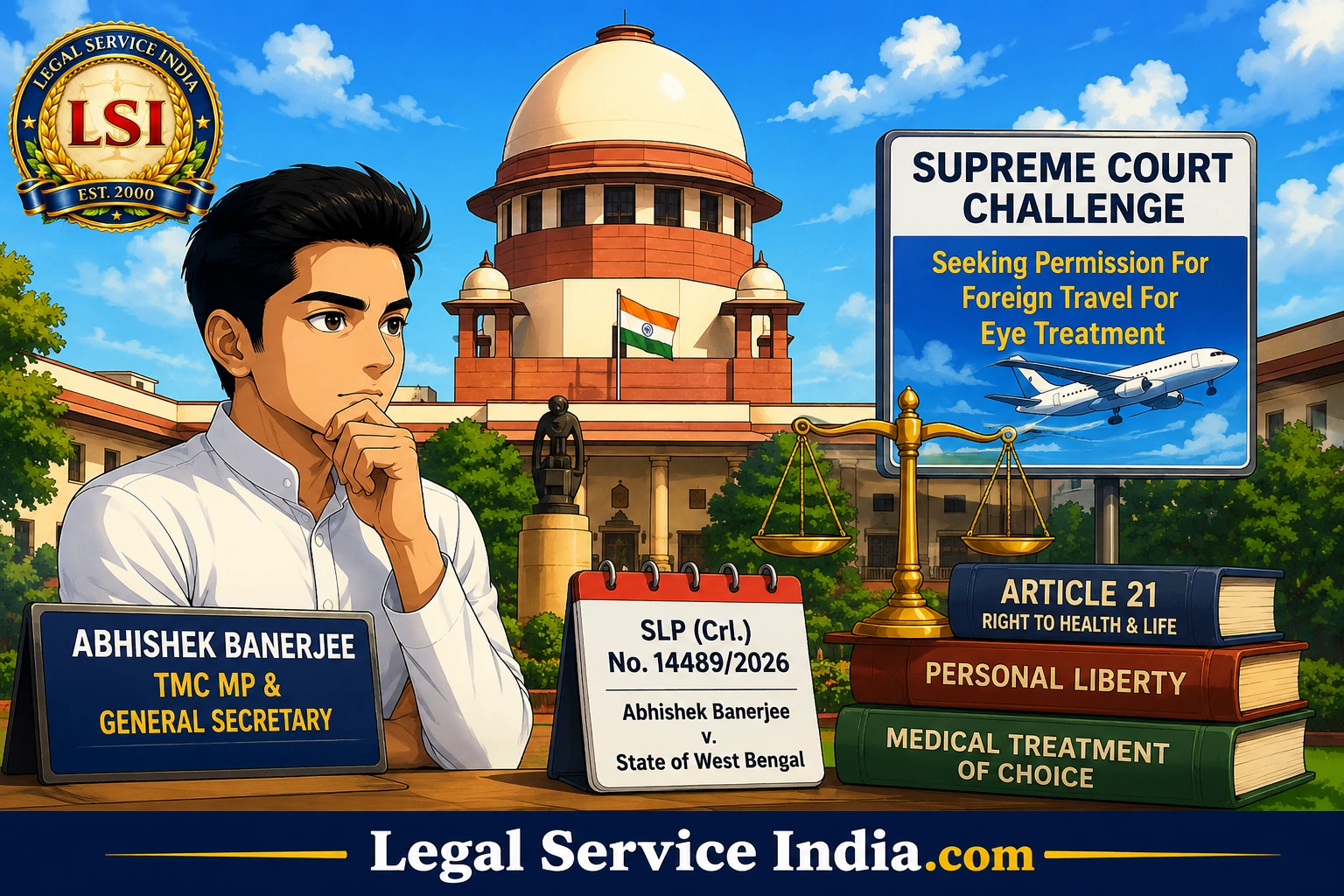
TMC MP Abhishek Banerjee Approaches Supreme Court Second Time Seeking Foreign Travel Permission for Eye Treatment
Supreme Court Challenge After Calcutta High Court Again Refuses Permission To Travel Abroad
Trinamool Congress MP and party General Secretary Abhishek Banerjee has once again approached the Supreme Court seeking permission to travel abroad for specialised eye treatment.
The latest proceedings arise from the Calcutta High Court’s order dated August 5, 2026, by which the High Court rejected Banerjee’s application for permission to travel overseas for medical treatment.
The High Court’s decision came after Banerjee declined to appear before a medical board constituted at the state-run SSKM Hospital in Kolkata to assess whether his condition required treatment abroad.
The matter is legally significant because it brings into focus an important question concerning the relationship between personal liberty, the right to obtain medical treatment of one’s choice, conditions imposed while granting protection from arrest, and the legitimate interests of an ongoing criminal investigation.
The present Supreme Court proceedings are in Abhishek Banerjee v. State of West Bengal, SLP (Crl.) No. 14489/2026.
Importantly, this is not yet a final Supreme Court judgement determining whether Banerjee should be permitted to travel abroad. It is a fresh challenge to the latest order of the Calcutta High Court.
Background Of The Dispute
The controversy arises out of criminal proceedings concerning alleged provocative or intimidatory statements attributed to Abhishek Banerjee during the campaign for the 2026 West Bengal Assembly elections.
While granting him protection from coercive action, the Calcutta High Court had imposed conditions concerning his cooperation with the investigation and had directed that he should not leave the country without obtaining prior permission of the Court.
That condition subsequently became important when Banerjee sought permission to travel abroad for treatment relating to an eye condition.
His case is that he requires specialised treatment and wishes to continue treatment with a United States-based specialist who had previously operated on him.
The State, on the other hand, has opposed overseas travel, arguing that there was no medical emergency warranting treatment abroad and that permitting foreign travel could have implications for ongoing investigations.
Thus, what may superficially appear to be a medical-travel application actually involves a broader judicial balancing exercise.
First Round Before the Supreme Court
This is not the first time that Banerjee has approached the Supreme Court concerning the foreign-travel restriction.
Earlier, Banerjee challenged the Calcutta High Court’s July 20, 2026, order refusing permission to travel abroad for eye treatment.
The High Court had instead directed him towards medical evaluation and treatment through specialists at SSKM Hospital and the Institute of Postgraduate Medical Education & Research (IPGME&R), Kolkata.
The matter then reached the Supreme Court.
On August 3, 2026, the Supreme Court disposed of that plea while requesting the High Court to consider the matter expeditiously. The Supreme Court therefore did not, at that stage, finally adjudicate the merits of Banerjee’s request for foreign medical treatment.
The matter consequently returned to the Calcutta High Court.
What Happened Before the Calcutta High Court?
The High Court subsequently considered Banerjee’s application.
A crucial issue before the Court was the proposed medical examination by a board at SSKM Hospital.
The High Court noted that Banerjee had declined to appear before the medical board constituted to assess whether his medical condition actually required treatment outside India.
The Court took the view that such an examination could have supplied an independent medical opinion on the necessity of overseas treatment.
This became the central reason for the rejection of the application on August 5.
The High Court effectively reasoned that before deciding where a person should receive treatment, there must first be credible medical material establishing whether the treatment sought requires travel abroad at all.
That distinction is important.
The Central Question: Can A Court Decide Where A Person Should Be Treated?
The dispute raises an interesting question of constitutional and criminal procedural law.
Ordinarily, a competent adult enjoys considerable autonomy in deciding matters concerning his or her medical treatment.
The law recognises personal autonomy as an important component of individual liberty.
However, the position becomes more complicated when a person is subject to judicial conditions in connection with a criminal proceeding.
A person who has been granted protection from arrest or coercive action subject to specific conditions cannot necessarily treat those conditions as meaningless.
If the Court has expressly imposed a restriction on foreign travel, departure from India becomes subject to judicial permission.
Two Competing Considerations
Therefore, two competing considerations arise:
- The individual’s autonomy and personal liberty;
- The Court’s authority to impose and enforce conditions necessary for the administration of criminal justice.
The question before the Supreme Court will therefore not simply be whether Banerjee has an eye condition.
The larger question is whether the High Court’s insistence upon independent medical evaluation and its refusal to permit overseas travel, in the circumstances of the case, represents a proportionate exercise of judicial discretion.
Right To Medical Treatment And Personal Liberty
Article 21 of the Constitution protects life and personal liberty.
The Supreme Court has repeatedly interpreted Article 21 broadly, treating the right to life as more than mere physical existence.
It encompasses dignity, bodily autonomy and several aspects of individual choice.
Medical treatment is therefore not merely a matter of convenience.
Where a person genuinely requires specialised medical treatment, access to appropriate healthcare may have a direct relationship with the constitutional guarantee of life and personal liberty.
But Article 21 does not operate in isolation.
Personal liberty is subject to procedure established by law, and judicial proceedings may legitimately impose reasonable restrictions where necessary to secure the administration of justice.
The present case consequently illustrates an important constitutional tension:
How far can the State or a Court restrict an individual’s choice concerning medical treatment when that individual is facing criminal proceedings and is subject to judicial conditions restricting foreign travel?
That is a question which extends beyond the individual litigant.
Does a person have an absolute right to choose his doctor?
One of the significant observations emerging from the Calcutta High Court proceedings concerns the proposition that an accused person has an absolute right to select the doctor or medical institution of his choice.
The High Court rejected such an absolute proposition in the circumstances before it.
The Court took into account the fact that several criminal proceedings and investigations were pending against Banerjee and that his foreign travel was already subject to judicial restrictions.
From a legal standpoint, this distinction is important.
There is a difference between:
| Legal Consideration | Meaning |
|---|---|
| Right to receive necessary medical treatment | The right to obtain necessary healthcare may have a strong constitutional foundation. |
| Right to insist upon treatment at a particular institution abroad | This may be subject to judicial scrutiny where the individual is facing criminal proceedings and has undertaken obligations before the court. |
The first may have a strong constitutional foundation.
The second may be subject to judicial scrutiny where the individual is facing criminal proceedings and has undertaken obligations before the court.
A court may therefore legitimately ask:
- Is overseas treatment medically necessary?
- Is equivalent treatment reasonably available in India?
- Is there an urgency requiring immediate travel?
- Would travel interfere with the investigation or future court proceedings?
- Can appropriate safeguards address the concerns of the investigating agency?
These questions permit a court to balance competing interests without treating either side as automatically decisive.
Why Did The Medical Board Become So Important?
The medical board became significant because the High Court was not itself in a position to determine complex medical questions.
Courts decide legal questions. They are not ordinarily medical experts.
The High Court therefore considered that an expert medical assessment could assist it in determining whether treatment abroad was medically required.
The Court specifically noted that if Banerjee had appeared before the medical board, its opinion could have assisted the Court in deciding whether overseas treatment was necessary.
In my view, this is an important aspect of judicial decision-making.
A court should ordinarily avoid substituting its own medical opinion for that of qualified medical professionals.
At the same time, an accused cannot necessarily be compelled to accept every medical recommendation merely because a criminal proceeding is pending.
The legal issue is therefore not simply whether the medical board was constituted.
The more fundamental question is what legal consequences should follow from the applicant’s refusal to submit to that medical evaluation.
The Argument Of The Applicant
Banerjee’s case, as reported from the proceedings, is that he wishes to continue treatment with a specialist in the United States who had previously treated him.
Senior Advocate Rebecca John reportedly submitted before the High Court that Banerjee was unwilling to undergo treatment at SSKM Hospital and wished to continue treatment with the specialist who had earlier operated on him.
From the standpoint of personal liberty, the argument has considerable force.
A patient who has already undergone treatment with a particular specialist may reasonably contend that continuity of medical care is important.
A medical decision is not always reducible to a question of whether another hospital has a department capable of treating the same broad medical condition.
Factors such as:
- previous surgical history;
- access to previous medical records;
- continuity of care;
- specialised expertise;
- familiarity of the treating physician with the patient’s condition; and
- the particular treatment protocol recommended
may all be relevant.
However, these matters should ideally be supported by objective medical evidence rather than merely asserted.
The State’s Opposition
The State has taken the position that there was no medical emergency requiring treatment abroad.
It has also expressed concern that overseas travel could affect ongoing investigations.
This is not an argument that can simply be brushed aside.
Where a court has already imposed a restriction on foreign travel because of pending criminal proceedings, the applicant bears a significant responsibility to demonstrate why an exception should now be made.
At the same time, the existence of a criminal investigation cannot become a blanket justification for preventing a person from obtaining necessary medical treatment.
The State must demonstrate a genuine and legally relevant connection between the proposed travel and the investigation.
The Principle Of Proportionality
The doctrine of proportionality provides a useful constitutional framework for analysing the dispute.
A restriction upon liberty should ordinarily bear a rational relationship to the legitimate governmental objective sought to be achieved.
In practical terms, the Court may have to consider:
1. What Is The Legitimate Objective?
The legitimate objective is to ensure that the criminal investigation and judicial proceedings are not frustrated by the accused leaving the country.
2. Is the restriction connected with that objective?
A restriction on foreign travel can plainly assist in ensuring the availability of an accused person during investigation and proceedings.
3. Is the restriction necessary?
This is where the medical issue becomes important.
If medical treatment genuinely requires travel abroad, an absolute refusal may be questioned.
4. Can Safeguards Achieve the Same Objective?
This is perhaps the most important practical consideration.
The Court could potentially consider conditions relating to:
- the duration of travel;
- destination;
- treating hospital;
- dates of treatment;
- furnishing travel details;
- surrender of passport, if appropriate;
- communication with the investigating agency;
- undertaking to return to India;
- providing contact details;
- appearance before the investigating officer after return; and
- Other conditions considered necessary.
Such conditions may sometimes reconcile medical liberty with the requirements of criminal investigation.
Criminal Proceedings Cannot Automatically Override Medical Rights
There is a danger at both extremes.
On one hand, an accused cannot use a medical-treatment request as an unrestricted passport to leave the country whenever he wishes.
On the other hand, the existence of criminal proceedings cannot automatically mean that the accused loses the ability to obtain appropriate medical treatment.
The Court’s task is therefore one of constitutional balancing.
The status of the applicant—whether politician, businessman, public figure or ordinary citizen—should not determine the legal standard.
The same principles should apply to every accused person.
That is the essence of equality before law.
What Is The Significance Of The August 5 Order?
The August 5 order is significant because the High Court did not merely reject the request on the ground that Banerjee was facing criminal proceedings.
The Court placed substantial emphasis upon the medical verification process.
According to the reported proceedings, the Court considered that an independent medical assessment could have helped determine whether treatment abroad was necessary.
The Court also observed that the immediate question was whether Banerjee required treatment, rather than where that treatment should be administered.
This distinction provides the legal foundation of the order.
The High Court was essentially unwilling to assume, without the proposed medical-board assessment, that treatment abroad was indispensable.
The Second Approach To The Supreme Court
Following the August 5 rejection, Banerjee has again approached the Supreme Court.
This is therefore the second round of proceedings before the Supreme Court concerning permission for foreign medical treatment.
The latest case is reported as:
Abhishek Banerjee v. State of West Bengal
SLP (Crl.) No. 14489/2026.
The latest petition challenges the Calcutta High Court’s August 5 decision.
As of August 8, 2026, available reports indicate that the Supreme Court has not yet finally decided this second challenge.
What Could The Supreme Court Consider?
The Supreme Court may have to examine several interconnected issues.
Whether the High Court Properly Balanced Article 21 Rights
The Supreme Court may examine whether the refusal to permit overseas treatment disproportionately affects Banerjee’s right to personal liberty and medical care.
Whether the Medical Board Requirement Was Reasonable
The Court may examine whether requiring an independent medical evaluation was a reasonable procedural safeguard or whether it unnecessarily interfered with the applicant’s autonomy.
Whether Refusal To Appear Before The Medical Board Justified Rejection
This could become a decisive issue.
If the medical board was constituted specifically to determine the necessity of foreign treatment and the applicant refused to appear, the Court may ask whether the applicant can simultaneously complain that the Court lacked adequate medical material to decide his request.
Whether Conditions Could Adequately Protect The Investigation
The Supreme Court could also examine whether the concerns of the investigating agency can be addressed through stringent conditions rather than an outright refusal of foreign travel.
A Larger Principle: Liberty and Criminal Procedure Must Coexist
The significance of this litigation extends beyond Abhishek Banerjee.
Indian criminal jurisprudence has progressively moved away from the philosophy that an accused person loses all meaningful liberty merely because criminal proceedings are pending.
An accused remains a person with constitutional rights.
At the same time, liberty during criminal proceedings is not identical to unrestricted liberty.
Courts routinely impose conditions to ensure that the process of justice is not defeated.
Foreign travel restrictions are one such mechanism.
The important question is whether the restriction remains justified in the particular circumstances.
That is why the present dispute is legally interesting.
Medical Treatment Abroad: What Should Courts Generally Examine?
In cases involving requests by persons facing criminal proceedings to travel abroad for treatment, a structured approach may be preferable.
A court may consider the following factors:
| Factor | Question For The Court |
|---|---|
| Medical Necessity | Is treatment genuinely required? |
| Urgency | Can treatment reasonably wait? |
| Specialist Expertise | Is the proposed foreign specialist uniquely qualified for the case? |
| Availability in India | Is comparable treatment reasonably available domestically? |
| Previous Treatment | Has the foreign doctor previously treated the patient? |
| Duration | How long is the proposed foreign stay? |
| Investigation | Could travel prejudice the investigation? |
| Flight Risk | Is there a genuine risk of non-return? |
| Safeguards | Can appropriate conditions neutralise the risks? |
| Compliance History | Has the applicant previously complied with court directions? |
Such a framework helps prevent the decision from becoming either excessively permissive or unnecessarily restrictive.
The Importance Of Equal Treatment
Because the present matter concerns a prominent political figure, there is inevitably a public and political dimension.
But the legal principle should remain neutral.
The Court should neither grant special treatment because the applicant is a Member of Parliament nor impose a harsher standard because he is politically controversial.
The correct question is simply:
What does the law require in the circumstances of this particular case?
That is the standard by which every citizen must ultimately be judged.
The Role Of Judicial Discretion
Applications for modification of bail or interim-protection conditions frequently involve judicial discretion.
But judicial discretion is not arbitrary discretion.
It must be exercised:
- on relevant considerations;
- on the basis of material before the Court;
- consistently with constitutional rights;
- proportionately;
- for legitimate judicial purposes; and
- without irrelevant considerations influencing the outcome.
In the present matter, the medical evidence and the applicant’s willingness or unwillingness to undergo examination may therefore assume considerable importance.
Why This Case Could Become Important
The immediate dispute concerns one person’s eye treatment.
The broader legal issue is much wider.
India increasingly sees cases where accused persons seek permission to travel overseas for:
- specialised surgery;
- cancer treatment;
- neurological treatment;
- organ-related treatment;
- advanced ophthalmic procedures; and
- Follow-up treatment with foreign specialists.
Courts therefore need principles that reconcile medical autonomy with the requirements of criminal justice.
A rigid rule would be inappropriate.
The better approach is likely to be a case-specific, evidence-based and proportionate assessment.
Conclusion
The latest move by TMC MP Abhishek Banerjee before the Supreme Court is significant not because political considerations should determine the result, but because it raises a genuine legal question at the intersection of Article 21, medical autonomy, foreign travel restrictions and criminal investigation.
Immediate Procedural History
The immediate procedural history is clear.
The Calcutta High Court had earlier restricted foreign travel as part of the conditions governing protection from coercive action. Banerjee sought permission to travel abroad for eye treatment. The High Court directed medical evaluation at SSKM Hospital. He approached the Supreme Court, which on August 3 requested the High Court to consider the matter expeditiously. The High Court thereafter rejected the application on August 5, principally noting his refusal to appear before the medical board. Banerjee has now returned to the Supreme Court for a second time.
The Ultimate Legal Question Is One Of Balance
The ultimate legal question is one of balance.
The State has a legitimate interest in ensuring that an accused remains available to face investigation and trial. But that interest cannot, by itself, extinguish the individual’s constitutional interest in receiving necessary medical care.
Equally, the right to medical treatment cannot automatically translate into an unrestricted right to travel abroad while criminal proceedings are pending.
The proper constitutional approach is therefore neither absolute liberty nor absolute restriction.
It is proportionality, medical evidence, judicial safeguards and equal application of the law.
As the second round of litigation reaches the Supreme Court, the Court’s eventual response may provide useful guidance on how Indian courts should approach requests for overseas medical treatment by accused persons who are subject to foreign-travel restrictions.
Case Citation and Latest Development
| Case Detail | Information |
|---|---|
| Case Name | Abhishek Banerjee v. State of West Bengal |
| Case Number | SLP (Crl.) No. 14489/2026 |
| Latest Development | The Supreme Court challenge is against the Calcutta High Court’s order dated August 5, 2026, refusing permission for overseas eye treatment. |
| Current Status | Pending Supreme Court challenge. |
Frequently Asked Questions
1. Why Did Abhishek Banerjee Approach The Supreme Court For Foreign Travel Permission?
Abhishek Banerjee approached the Supreme Court seeking permission to travel abroad for specialised eye treatment. His overseas travel is subject to judicial restrictions arising from pending criminal proceedings.
2. What Is The Latest Abhishek Banerjee Supreme Court Case?
The latest case is Abhishek Banerjee v. State of West Bengal, SLP (Crl.) No. 14489/2026. Banerjee has challenged the Calcutta High Court’s August 5, 2026, order refusing permission to travel abroad for eye treatment.
3. Why Did The Calcutta High Court Refuse Abhishek Banerjee’s Foreign Travel Request?
The Calcutta High Court refused the request after noting that Banerjee had declined to appear before a medical board at SSKM Hospital constituted to assess whether his eye condition required treatment abroad.
4. Does An Accused Have A Right To Travel Abroad For Medical Treatment?
An accused person may have constitutional rights relating to personal liberty and medical treatment under Article 21, but foreign travel can be restricted when criminal proceedings are pending. Courts can impose conditions and require medical evidence to determine whether overseas treatment is necessary.
5. Is The Supreme Court’s Decision In Abhishek Banerjee’s Foreign Travel Case Final?
No. The latest proceedings represent a second approach to the Supreme Court concerning permission for foreign eye treatment. As of August 8, 2026, the latest Supreme Court challenge is pending and should not be described as a final Supreme Court judgement.
Key Takeaways: Abhishek Banerjee’s Supreme Court Plea For Foreign Eye Treatment
- TMC MP Abhishek Banerjee has approached the Supreme Court for the second time, seeking permission to travel abroad for specialised eye treatment.
- The latest Supreme Court challenge concerns the Calcutta High Court’s August 5, 2026, order, which refused permission for overseas medical treatment.
- The case is Abhishek Banerjee v. State of West Bengal, SLP (Crl.) No. 14489/2026.
- The Calcutta High Court relied significantly on Banerjee’s refusal to appear before a medical board at SSKM Hospital, which was constituted to assess whether treatment abroad was medically necessary.
- The dispute involves a balance between Article 21, personal liberty and the right to medical treatment on one side, and the state’s interest in ensuring an accused remains available for criminal investigation and proceedings on the other.
- An accused does not necessarily have an unrestricted right to travel abroad for medical treatment when a court has imposed foreign-travel restrictions as a condition of protection from coercive action.
- At the same time, pending criminal proceedings cannot automatically extinguish an individual’s right to obtain necessary medical treatment.
- A key legal issue is whether specialised treatment abroad is medically necessary or whether comparable treatment is reasonably available in India.
- The Supreme Court may consider whether appropriate safeguards and travel conditions could protect the investigation while allowing Banerjee to obtain specialised medical treatment overseas.
- The case highlights the importance of the proportionality principle when courts balance personal liberty, medical autonomy and the administration of criminal justice.
- The latest Supreme Court proceedings should not be described as a final judgement. As of August 8, 2026, the second Supreme Court challenge remains pending.
