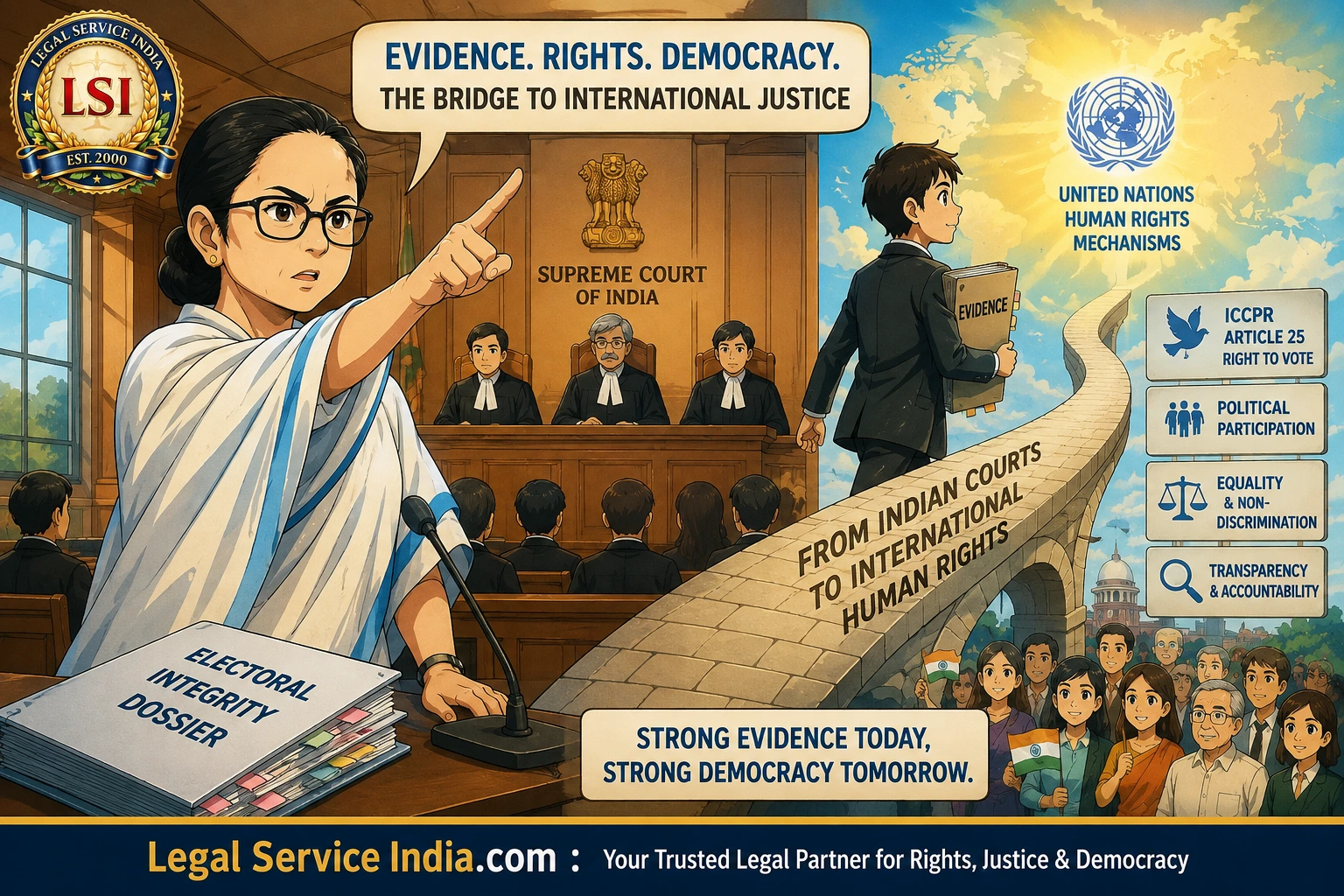
“When the domestic door closes, the answer is not to invent an international appeal; it is to build a bridge of credible evidence to the rights the world recognises. In matters of democracy, evidence speaks louder than politics.”
— Adv. Tarun Choudhury
Supreme Court Advocate | 25+ Years of Legal Experience
The International Door Exists, But It Is Not the ICJ Appeal Door
If the Supreme Court of India ultimately gives an adverse decision in a challenge concerning alleged electoral irregularities in West Bengal, the natural question is, ‘Can Mamata Banerjee take the matter to an international court?’
My legal advice would be to proceed with considerable caution.
The first thing I would tell Mamata Banerjee is this:
Do not try to create an international appeal that does not exist. Build an evidential bridge from Indian election law to international democratic-rights standards.
The International Court of Justice, or ICJ, is not an international Supreme Court of India. Article 34 of the Statute of the ICJ expressly provides that only states may be parties in cases before the Court. Its contentious jurisdiction depends upon the consent of states. Therefore, an individual political leader cannot file an appeal before the ICJ simply because she believes that the Supreme Court of India has wrongly decided an election dispute.
The International Criminal Court is also not the appropriate appellate forum for an ordinary election dispute. Allegations concerning voter deletion, counting irregularities, EVMs, electoral rolls or election administration do not automatically constitute crimes within the ICC’s jurisdiction.
The practical international strategy is therefore different.
If there is credible evidence that electoral processes have interfered with internationally protected rights relating to political participation, voting, democratic participation or equality, the objective should be to document those facts to an international evidentiary standard and place them before appropriate United Nations human rights mechanisms.
This is not an appeal against the Supreme Court.
It is a separate international-rights strategy.
1. My Advice To Mamata Banerjee: Change The Question
If I were advising Mamata Banerjee directly, I would suggest that she should not ask:
“Where can I appeal against the Supreme Court of India internationally?”
That question starts from the wrong legal premise.
The better question is:
“Do the facts established through the Indian legal process disclose a possible violation of internationally protected political and electoral rights, and is there an international mechanism competent to examine those allegations?”
That change in approach is critical.
International institutions will be far more interested in verifiable facts and internationally recognised rights than in a political assertion that an Indian court reached the wrong conclusion.
The case therefore has to move through three stages:
Indian evidence → international legal standards → international human rights mechanism.
That is the evidential bridge.
2. The First Principle: Exhaust and Preserve The Indian Legal Record
An international strategy should never be allowed to destroy or weaken the domestic case.
The first priority should remain the appropriate remedies available under Indian election law and constitutional law.
The Representation of the People Act, 1951, provides the statutory framework for election petitions and challenges to elections. An actual election challenge therefore has to be developed through the appropriate domestic proceedings, including compliance with statutory limitation and pleading requirements.
This is particularly important because the current West Bengal controversy is not merely theoretical.
A 2026 election petition concerning Bhabanipur has raised allegations including voter deletion, alleged irregularities in counting and other electoral issues. The Calcutta High Court has, at the interim stage, directed preservation of CCTV footage, EVMs, control units, ballot units and VVPAT machines pending adjudication.
That is precisely the kind of development that demonstrates why evidence preservation must come before international advocacy.
The international case should be built from the underlying evidence—not from political speeches or newspaper headlines.
3. The Most Important Immediate Step: Create an Electoral Evidence Dossier
I would recommend the creation of a professionally controlled:
“West Bengal Electoral Integrity Dossier”
This should not be a political pamphlet.
It should resemble a major litigation evidence room.
For every disputed constituency, the dossier should record:
- electoral-roll data;
- alleged deletions;
- alleged additions;
- objections filed;
- appeals concerning voter inclusion or exclusion;
- polling-station information;
- turnout data;
- counting records;
- Form 17A/17C material wherever lawfully obtainable;
- EVM and VVPAT information;
- CCTV footage;
- counting-centre records;
- affidavits;
- statements of witnesses;
- complaints to election authorities;
- orders of courts and tribunals;
- expert reports;
- statistical analysis;
- responses from the Election Commission;
- contrary evidence.
Every allegation should have a corresponding evidence reference.
The objective should be simple:
An independent lawyer who does not support TMC should be able to examine the dossier and reproduce the factual conclusion.
If that cannot be done, the international case is not yet ready.
4. Do Not Begin With The Entire State
I would strongly advise against beginning with a claim covering every constituency in West Bengal.
That creates an enormous evidentiary burden and makes the case vulnerable to accusations of political generalisation.
Instead, select a carefully designed sample of disputed constituencies.
Phase I
Select 5–10 constituencies representing different categories of alleged irregularity:
- alleged voter deletion;
- alleged wrongful inclusion;
- alleged counting irregularity;
- alleged denial of access to counting agents;
- alleged EVM/VVPAT irregularity;
- unusually narrow electoral margin;
- significant statistical anomaly.
The selection should be based on evidence—not merely on constituencies where TMC lost.
This distinction will be extremely important internationally.
5. Create A Chain Of Custody For Every Important Piece Of Evidence
International credibility will depend heavily upon evidence integrity.
Suppose there is CCTV footage showing an alleged counting irregularity.
It should not simply be presented as:
“Here is a video proving manipulation.”
Instead, the dossier should establish:
Original source → acquisition date → original file → metadata → cryptographic hash → custodian → forensic examination → independent verification → witness evidence → relevant official record → legal significance.
The same principle should apply to:
- videos;
- photographs;
- electronic documents;
- spreadsheets;
- electoral-roll databases;
- correspondence;
- digital communications.
This is one of the most important practical improvements I would make to the conventional political approach.
6. Separate Evidence From Allegation
Every allegation should be classified.
I recommend a three-level system:
RED — Unverified
The allegation exists, but reliable evidence is insufficient.
AMBER — Credible But Incomplete
There is substantial evidence requiring further investigation.
GREEN — Independently Corroborated
The allegation is supported by multiple independent evidence sources.
Only the strongest Green findings—and carefully qualified Amber findings where appropriate—should form the core of an international submission.
This would protect the credibility of the entire exercise.
7. Use the International Covenant on Civil and Political Rights.
The most relevant international legal framework is the International Covenant on Civil and Political Rights, or ICCPR.
Article 25 protects participation in public affairs, voting and being elected.
The UN Human Rights Committee has explained that genuine elections must be conducted fairly and freely and that political participation must be meaningful.
This provides a potentially important international legal framework for an electoral-integrity case.
But there is an important limitation.
India is a party to the ICCPR, but India has not accepted the First Optional Protocol, which provides the individual-communications mechanism through which individuals can bring complaints before the UN Human Rights Committee. Therefore, I would not advise filing an individual Article 25 complaint against India before that Committee as though it were an international appeal.
This is precisely why careful jurisdictional analysis is essential.
8. The More Practical International Route: UN Special Procedures
There is, however, another international mechanism that deserves serious consideration.
The United Nations Human Rights Council has established Special Procedures, consisting of independent experts with thematic or country-specific mandates.
Individuals, groups and civil-society organisations can submit information to Special Procedures.
OHCHR explains that Special Procedures may communicate directly with governments concerning alleged human rights violations within their mandates. The submissions need to contain credible and detailed information and should not be manifestly unfounded or politically motivated.
This is potentially much more realistic than attempting an ICJ case.
But there is another important warning:
A UN Special Procedure Is Not An International Supreme Court
It cannot simply declare:
“The Supreme Court of India is wrong; therefore, the election is cancelled.”
That is not its function.
The objective would instead be to bring credible evidence of possible internationally relevant human rights concerns to the attention of the relevant UN mandate-holder and seek appropriate communication, clarification and follow-up with the Government of India.
9. What Should The International Submission Say?
This is where I would make a major strategic change.
Do not write:
“The Indian Supreme Court has wrongly decided the case. Please overturn the judgement.”
Instead, the submission should say, in substance:
“Following the completion or progression of domestic proceedings, substantial documentary, statistical and forensic evidence remains concerning specific alleged interference with electoral participation and political rights. We request examination of these allegations under applicable international human rights standards.”
That formulation respects the limits of international jurisdiction.
It also avoids presenting the UN as a fourth level of appeal.
10. Build an Article 25 Evidence Matrix
I would prepare a separate document called:
“ICCPR Article 25 Electoral Rights Matrix”
It should contain five columns:
| Alleged Conduct | Evidence | Indian Law | International Standard | Requested Action |
|---|---|---|---|---|
| Voter deletion | Electoral records | RPA/electoral law | ICCPR Art. 25 | Clarification/investigation |
| Counting irregularity | CCTV + records | Election law | Electoral integrity | Examination |
| Denial of counting access | Witness + official records | Election rules | Fair electoral process | Clarification |
| Discriminatory exclusion | Voter data | Constitutional/statutory law | Equality/political rights | Investigation |
| Other verified irregularity | Primary evidence | Applicable law | Applicable UN standard | Appropriate action |
This converts a political dispute into a legal matrix.
11. The Role of Statistics
A sophisticated international case should also employ independent statistical analysis.
The purpose should not be to say:
“An unusual statistical pattern proves fraud.”
That would be scientifically and legally dangerous.
Statistics should instead identify places requiring further examination.
Experts could analyse:
- turnout anomalies;
- unusual changes in voter registration;
- geographical concentration of deletions;
- additions and deletions;
- polling-station patterns;
- rejected votes;
- candidate vote distributions;
- unusually concentrated changes;
- relationship between turnout and vote share;
- constituency-level anomalies.
The correct principle is:
Statistics identify the question; primary evidence answers it.
12. Adopt a Three-Evidence Rule
I would recommend that no major allegation be presented internationally unless it has at least three independent supporting components wherever reasonably possible.
For example:
- Documentary evidence
- Witness evidence
- Digital/forensic evidence
or:
- Official electoral record
- Statistical anomaly
- Independent expert verification.
This would be an important safeguard against the international submission becoming merely a partisan political document.
13. Include Evidence That Hurts Your Own Case
This may sound counterintuitive, but it could become one of the strongest features of the strategy.
The dossier should contain:
- the Election Commission’s position;
- explanations supporting the electoral process;
- evidence favourable to opposing candidates;
- judicial findings adverse to TMC;
- weaknesses in TMC’s own allegations;
- disputed evidence;
- unresolved questions.
Then the legal team should explain why, despite those matters, certain allegations remain independently supported.
That is how credibility is built.
An international expert is much more likely to trust a dossier that acknowledges its weaknesses than one that claims every fact supports one side.
14. Do Not Make “Election Fraud” the Only Legal Theory
This is another strategic improvement.
The international submission should not simply use the broad phrase:
“Election fraud.”
It should identify the precise conduct.
For example:
- unlawful exclusion from the electoral roll;
- denial of meaningful political participation;
- unequal treatment;
- interference with voting rights;
- obstruction of legitimate participation;
- failure of procedural safeguards;
- alleged interference with counting transparency.
Each factual allegation must then be connected to the appropriate international legal standard.
This is much more sophisticated than making one sweeping allegation.
15. The International Strategy Should Run in Parallel With Domestic Litigation
The two processes should not compete.
I would establish two legal teams working from one evidence database.
Domestic Team
Focus on:
- election petitions;
- Supreme Court proceedings;
- statutory remedies;
- ECI proceedings;
- preservation applications;
- evidentiary admissibility.
International Team
Focus on:
- ICCPR standards;
- UN mechanisms;
- international election standards;
- comparative jurisprudence;
- human rights documentation;
- international communications.
Both teams should use the same verified evidence repository.
16. Proposed Roadmap
First 30 Days
- Obtain the complete Supreme Court record.
- Obtain every relevant election petition and order.
- Map all disputed constituencies.
- Immediately preserve electronic evidence.
- Create the secure evidence repository.
- Identify all statutory limitation periods.
- Engage independent election-law experts.
- Engage statistical experts.
- Engage digital-forensics specialists.
- Begin the ICCPR Article 25 legal analysis.
17. Days 31–90
Prepare the first:
West Bengal Electoral Integrity Report
The report should contain:
- methodology;
- evidence sources;
- constituency analysis;
- statistical analysis;
- legal analysis;
- opposing explanations;
- expert opinions;
- unresolved questions.
At this stage, the report should still avoid making claims that the evidence cannot establish.
18. Three to Six Months
The legal team should prepare:
Document A
Domestic Election Litigation Brief.
Document B
International Human Rights Brief.
Document C
Constituency Evidence Database.
Document D
Independent Statistical Report.
Document E
Digital-Forensic Report.
Document F
UN Special Procedures Submission.
This modular approach allows the same evidence to be used for different legal purposes without confusing their respective jurisdictions.
19. Six to Twelve Months
Depending on the evidence and the progress of domestic proceedings, the international strategy could include:
- submission to appropriate UN Special Procedures;
- communications with relevant international human rights mechanisms;
- engagement with independent international election experts;
- publication of an independently reviewed electoral-integrity report;
- academic/legal analysis;
- international democratic-rights advocacy.
But every step should remain evidence-led.
20. What I Would Ask Mamata Banerjee to Avoid
I would strongly advise against five things.
First: Do Not File an ICJ Case Simply for Publicity.
The ICJ’s jurisdictional structure makes this legally unsustainable for an individual political leader. (icj-web.leman.un-icc.cloud)
Second: Do Not Call Every Anomaly “Fraud”.
An anomaly is an invitation to investigate—not proof of wrongdoing.
Third: Do Not Rely Principally on Media Reports.
The UN Special Procedures themselves emphasise the need for credible, detailed information and caution against submissions based exclusively on mass-media reports. (seoul.ohchr.org)
Fourth: Do Not Ignore Adverse Evidence.
Credibility is more valuable than rhetoric.
Fifth: Do Not Allow International Litigation Preparation to Cause Domestic Limitation Periods to Expire.
That would be a serious strategic mistake.
21. The 90-Day Pilot I Would Recommend
Rather than immediately attempting to internationalise the entire West Bengal election, I would conduct a:
“10-Constituency Independent Electoral Integrity Audit”
Duration
90 days.
Team
- election-law lawyers;
- constitutional lawyer;
- statistician;
- digital forensics specialists;
- document examiner;
- research associates;
- independent external reviewer.
Objective
Not:
“Prove that the election was stolen.”
But:
“Determine whether independently verifiable evidence exists of systematic or material electoral irregularities warranting further domestic and international examination.”
That is a much stronger research question.
22. Success Should Be Measured Scientifically
The project should be considered successful if:
- Primary evidence can be independently verified;
- electronic evidence has a demonstrable chain of custody;
- allegations can be linked to specific events;
- Statistical findings can be independently reproduced;
- Contrary evidence has been addressed;
- Domestic legal violations can be precisely identified;
- International legal standards can be precisely identified;
- Independent experts agree that at least some allegations warrant further examination.
| Success Criterion | What Should Be Demonstrated? |
|---|---|
| Primary Evidence | Evidence should be independently verifiable. |
| Electronic Evidence | A demonstrable chain of custody should exist. |
| Allegations | Allegations should be linked to specific events. |
| Statistical Findings | Findings should be independently reproducible. |
| Contrary Evidence | Contrary evidence should be addressed. |
| Domestic Law | Domestic legal violations should be precisely identified. |
| International Law | International legal standards should be precisely identified. |
| Independent Review | Experts should determine whether allegations warrant further examination. |
The objective should not be to manufacture an international victory.
The objective should be to create an internationally credible evidentiary record.
23. The Most Powerful Innovation: One Evidence Base, Multiple Legal Forums
This is where I believe the strategy becomes genuinely innovative.
Instead of preparing separate political, domestic and international narratives, create one controlled:
Electoral Integrity Evidence Architecture
From that single evidence base, generate:
- Domestic election petition
- Supreme Court litigation
- Election Commission proceedings
- Forensic report
- Statistical report
- Human rights submission
- International democratic rights report
Evidence Flow:
Domestic Election Petition ↓
Supreme Court Litigation ↓
Election Commission Proceedings ↓
Forensic Report ↓
Statistical Report ↓
Human Rights Submission ↓
International Democratic Rights Report
This avoids duplication, reduces contradictions and makes every subsequent legal proceeding stronger.
24. What Happens If the Supreme Court Rejects the Case?
An adverse Supreme Court judgement should not automatically result in the abandonment of the international strategy.
But the judgement must be incorporated into the international dossier.
The international legal team should identify:
- What factual findings did the Supreme Court make?
- What evidence did it accept?
- What evidence did it reject?
- What questions did it leave unresolved?
- Was the dismissal procedural or substantive?
- Were international-rights arguments actually considered?
- Does the alleged international violation concern something different from the domestic question decided?
| Question | Purpose |
|---|---|
| What factual findings did the Supreme Court make? | Understand the factual basis of the judgement. |
| What evidence did it accept? | Identify evidence recognised by the Court. |
| What evidence did it reject? | Understand evidentiary limitations. |
| What questions did it leave unresolved? | Identify issues that may require further examination. |
| Was the dismissal procedural or substantive? | Determine the nature and scope of the decision. |
| Were international-rights arguments actually considered? | Assess the relevance of an international submission. |
| Does the alleged international violation concern something different from the domestic question decided? | Determine whether an independent international issue may exist. |
Only after answering those questions should an international submission be considered.
The international document must engage with the Supreme Court’s reasoning rather than simply attack it.
25. The Most Important Legal Distinction
There are two entirely different propositions:
Proposition One
“The Supreme Court of India made an incorrect decision.”
That is primarily a domestic appellate/review question.
Proposition Two
“The underlying electoral process involved conduct incompatible with internationally protected political or democratic rights.”
That is potentially an international human rights question.
Confusing these two propositions could destroy the international strategy.
Keeping them separate could make the strategy viable.
| Proposition | Primary Legal Character |
|---|---|
| The Supreme Court of India made an incorrect decision. | Domestic appellate/review question |
| The electoral process involved conduct incompatible with internationally protected political or democratic rights. | Potential international human rights question |
26. My Recommended International Route
If I were advising Mamata Banerjee, my recommended sequence would be:
Recommended International Strategy: 10 Stages
- Stage 1: Preserve every piece of evidence.
- Stage 2: Pursue every available domestic remedy within limitation.
- Stage 3: Conduct an independent constituency-level forensic audit.
- Stage 4: Map verified facts against Indian constitutional/election law.
- Stage 5: Map the same verified facts against international democratic-rights standards, particularly ICCPR Article 25 where applicable.
- Stage 6: Prepare a neutral, independently reviewed International Electoral Integrity Dossier.
- Stage 7: Identify the UN Special Procedure mandates genuinely relevant to the verified allegations.
- Stage 8: Submit the evidence through the appropriate OHCHR mechanism.
- Stage 9: Request international examination, clarification and safeguards—not an impossible appeal against the Supreme Court.
- Stage 10: Continue the domestic and international processes simultaneously.
| Stage | Recommended Action |
|---|---|
| 1 | Preserve every piece of evidence. |
| 2 | Pursue every available domestic remedy within limitation. |
| 3 | Conduct an independent constituency-level forensic audit. |
| 4 | Map verified facts against Indian constitutional/election law. |
| 5 | Maps verified facts against international democratic-rights standards. |
| 6 | Prepare a neutral, independently reviewed International Electoral Integrity Dossier. |
| 7 | Identify relevant UN Special Procedure mandates. |
| 8 | Submit evidence through the appropriate OHCHR mechanism. |
| 9 | Request international examination, clarification and safeguards. |
| 10 | Continue domestic and international processes simultaneously. |
27. A Possible Formulation of the International Prayer
The international submission should not ask:
“Set aside the judgement of the Supreme Court of India.”
A much more appropriate request would be framed along the following lines:
“In light of the documented evidence presented, the submitting party respectfully requests that the relevant United Nations mandate-holder examine the allegations concerning interference with political participation and electoral rights, seek appropriate clarification from the Government of India and consider such follow-up measures as fall within the mandate.”
The precise wording should ultimately be settled by counsel after identifying the relevant UN mandate and the verified facts.
28. Final Advice to Mamata Banerjee
If I were appearing for Mamata Banerjee in an advisory capacity, my advice would be straightforward:
- Do not spend your resources trying to take an Indian election appeal to the International Court of Justice. That door is legally the wrong door.
- Instead, build the strongest evidence-based case possible inside India and then determine whether the verified facts establish an independent international human rights issue.
The International Strategy Should Begin With Evidence
The international strategy should begin with evidence, not politics.
It should proceed from:
Electoral Record → Forensic Verification → Independent Statistical Analysis → Indian Legal Violation → International Democratic-Rights Standard → Appropriate UN Mechanism
International Electoral Integrity Dossier
The most important document should therefore not be a political memorandum.
It should be an International Electoral Integrity Dossier capable of surviving hostile scrutiny.
If the allegations are correct, the evidence should demonstrate that.
If some allegations are incorrect, the dossier should say so.
If the evidence is inconclusive, the lawyers should say that too.
That intellectual honesty would actually strengthen the portions of the case that can be proved.
Conclusion: Build the Bridge, Do Not Pretend There Is an Appeal
There is no shortcut from an adverse judgement of the Supreme Court of India to the International Court of Justice for an individual political leader.
But that does not mean that the international dimension is necessarily closed.
The correct strategy is to distinguish international appeal from international accountability.
An international accountability strategy can potentially examine whether verified conduct implicates internationally recognised political and human-rights standards.
Therefore, my central recommendation is:
Do not try to create an international appeal that does not exist. Build an evidential bridge from Indian election law to international democratic-rights standards.
That bridge should be built from primary documents, preserved electronic evidence, constituency-level data, independent statistical analysis, forensic verification, witness testimony and a transparent chain of custody.
Only then should the international door be approached.
And when that door is approached, the request should not be:
“Overturn the Indian Supreme Court.”
It should be:
“Examine whether the verified facts disclose violations of internationally protected democratic and political rights, and take whatever action falls within your lawful mandate.”
That is, in my view, the most practical, legally defensible and internationally credible strategy available to Mamata Banerjee if the domestic litigation ultimately proves unsuccessful.
Need Expert Legal Advice on Internationalising an Indian Electoral Dispute?
Adv. Tarun Choudhury
Supreme Court Advocate | 25+ Years of Legal Experience
If you need strategic legal guidance on election disputes, constitutional remedies, international human-rights mechanisms, electoral integrity, or Supreme Court matters, professional legal advice can help identify the correct legal route and avoid pursuing remedies that lack jurisdiction.
- 📞 Call: 9891244487
- 💬 WhatsApp: 9891244487
Get in touch for professional legal consultation and strategic guidance.
Frequently Asked Questions
1. Can Mamata Banerjee appeal a Supreme Court of India election judgement to the International Court of Justice (ICJ)?
No. Mamata Banerjee cannot personally appeal an adverse Supreme Court of India election judgement to the ICJ. The ICJ is not an international appellate court for national courts, and contentious cases before it are between states. An international strategy would therefore need to rely on an appropriate human rights or UN mechanism rather than an ICJ appeal.
2. Can Mamata Banerjee Approach the United Nations Over Alleged West Bengal Election Irregularities?
Potentially, yes. Depending on the facts and evidence, information concerning alleged violations of internationally protected political and human rights may be submitted to relevant UN Human Rights Council Special Procedures. However, these mechanisms are not courts and generally cannot cancel an Indian election or overturn a Supreme Court judgement.
3. Can Mamata Banerjee File a Complaint Before the UN Human Rights Committee for Violation of Voting Rights?
India is a party to the International Covenant on Civil and Political Rights (ICCPR), including Article 25 concerning political participation and voting rights. However, India has not accepted the First Optional Protocol to the ICCPR, which provides the individual-complaint mechanism to the UN Human Rights Committee. Therefore, an individual complaint against India through that mechanism is presently unavailable.
4. What Evidence Is Required to Take a West Bengal Election Dispute to an International Human-Rights Mechanism?
A credible international submission should be based on primary and independently verifiable evidence, including electoral-roll records, election documents, affidavits, court orders, polling and counting records, CCTV footage where lawfully obtained, EVM/VVPAT-related evidence, statistical analysis and expert forensic reports. Every allegation should have a documented chain of custody and should be clearly connected to a specific international human-rights standard.
5. What Is the Most Practical International Legal Strategy if the Supreme Court Rejects Mamata Banerjee’s Election Challenge?
The most practical strategy is not to attempt an ICJ appeal. Instead, Mamata Banerjee could preserve and strengthen the domestic legal record, conduct an independent electoral-integrity and forensic investigation, map verified facts against international democratic-rights standards such as ICCPR Article 25, and, where legally appropriate, submit the evidence to relevant UN Special Procedures. The objective would be international examination and accountability—not an international appeal against the Supreme Court.
Key Takeaways
- Mamata Banerjee cannot appeal a Supreme Court of India election judgement directly to the International Court of Justice (ICJ) because the ICJ is not an international appellate court for national courts.
- The ICJ cannot be used to overturn or review an Indian Supreme Court judgement in an individual election dispute.
- If alleged West Bengal election irregularities involve credible violations of internationally protected political or electoral rights, a separate international human-rights strategy may be considered.
- ICCPR Article 25 is particularly relevant because it protects the right to participate in public affairs, vote and be elected through genuine and fair elections.
- India is a party to the International Covenant on Civil and Political Rights (ICCPR), but it has not accepted the First Optional Protocol, limiting the possibility of an individual complaint before the UN Human Rights Committee.
- UN Human Rights Council Special Procedures may provide a more practical international avenue for presenting credible allegations concerning political participation and human rights, although they are not international courts and cannot ordinarily overturn an Indian election or Supreme Court judgement.
- The strongest international strategy is to build an International Electoral Integrity Dossier containing primary documents, electoral records, affidavits, witness evidence, digital evidence, statistical analysis and independent forensic verification.
- Election fraud allegations should not be based solely on political statements, media reports or statistical anomalies. Statistics can identify suspicious patterns, but primary evidence is required to establish what actually occurred.
- A robust international submission should follow a chain of custody for electronic and documentary evidence, making every important allegation independently verifiable.
- The proposed strategy should use a three-evidence rule, wherever possible, combining independent documentary, witness, statistical or forensic evidence before treating an allegation as strongly corroborated.
- Domestic and international legal strategies should operate in parallel. Indian election petitions, Supreme Court remedies and Election Commission proceedings should not be neglected while preparing an international human-rights submission.
- The international submission should not ask the United Nations to “overturn the Supreme Court of India”. Instead, it should request examination of whether verified facts disclose violations of internationally protected democratic and political rights.
International Legal Pathway
| Stage | Strategic Focus |
|---|---|
| Indian Election Evidence | Collect and preserve primary electoral and documentary evidence. |
| Forensic Verification | Verify electronic, documentary and other relevant evidence. |
| Independent Statistical Analysis | Identify and assess potentially significant electoral patterns. |
| Indian Legal Assessment | Assess the evidence under applicable Indian election and constitutional law. |
| International Human Rights Analysis | Maps verified facts against internationally recognised democratic and political rights. |
| Appropriate UN Mechanism | Submit the matter, where legally appropriate, to the relevant international mechanism. |
The most practical international pathway is therefore:
Indian Election Evidence → Forensic Verification → Independent Statistical Analysis → Indian Legal Assessment → International Human-Rights Analysis → Appropriate UN Mechanism.
The central strategic lesson is: do not try to create an international appeal that does not exist. Build an evidential bridge from Indian election law to international democratic-rights standards.
Ultimately, the credibility of any international action will depend less on political allegations and more on whether independent lawyers, experts and investigators can examine the evidence and reproduce the conclusions.