Introduction
A journalist covering a public protest does not cease to be a journalist merely because the situation becomes tense or the police begin controlling the crowd. That distinction lies at the heart of the latest development before the Supreme Court of India, where allegations concerning the treatment of women journalists covering protests in Delhi have prompted the Court to seek an explanation from a senior police officer.
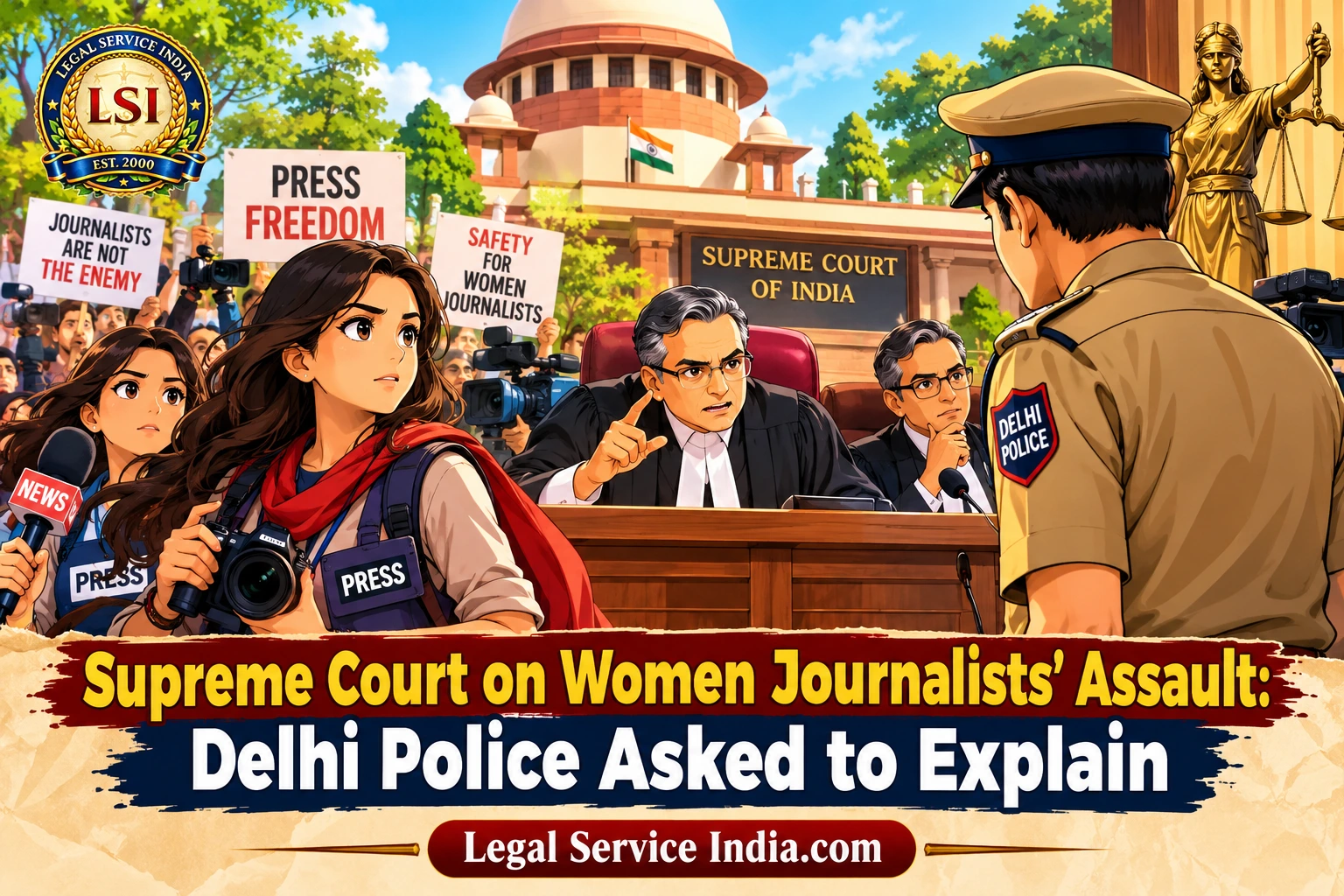
On 13 October 2026, Chief Justice of India Surya Kant indicated that a senior Delhi Police officer should remain present before the Court to explain allegations of assault and harassment involving women journalists reporting from protest sites. The development followed the mentioning of a petition filed by the Network of Women in Media, India (NWMI), seeking safeguards for journalists, particularly women, while performing their professional duties.
According to contemporaneous legal reporting, Senior Advocate Indira Jaising brought the petition to the Court’s attention. The Chief Justice observed, “We’d like some senior officer to remain present here and explain.” The petition was to be taken up alongside connected proceedings concerning the police response to the protests.
The intervention is significant, but its legal meaning must be understood precisely. The Court has sought an explanation; that does not mean it has already found the allegations proved. Nor does the development, as reported on 13 October, constitute a final judgment determining the liability of any police officer.
The larger constitutional question, however, is unmistakable: how can the State maintain public order without unlawfully interfering with the freedom of journalists to document events and inform the public?
That question deserves serious consideration because the freedom of the press is not an abstract constitutional ideal. It has practical value only when journalists can gather and communicate information without being subjected to arbitrary restraint or intimidation.
1. Background: Why Did the Matter Reach the Supreme Court?
The proceedings arise from protests in Delhi concerning the Election Commission’s Special Intensive Revision (SIR) of electoral rolls and demands relating to Chief Election Commissioner Gyanesh Kumar.
During the protests, allegations emerged that journalists covering the demonstrations had been detained, manhandled or prevented from carrying out their professional responsibilities. Women journalists reportedly faced particular difficulties while documenting events and identifying themselves as members of the press.
The Network of Women in Media, India, subsequently approached the Supreme Court seeking safeguards for journalists covering protests, public assemblies and similar events.
The organisation’s concerns extend beyond the circumstances of an isolated confrontation. Its petition seeks protection against alleged physical handling, intimidation, arbitrary detention and forcible removal of women journalists engaged in legitimate newsgathering. It also raises the need for clearer safeguards governing police-media interactions during demonstrations.
The issue is connected with earlier proceedings concerning the police response to the demonstrations.
In related proceedings, the Supreme Court had reportedly directed that lawyers, journalists and other professionals should not be hindered in the discharge of their professional duties. A separate petition filed by the Free Speech Collective alleges that subsequent police action against journalists was inconsistent with the Court’s directions.
These developments bring two questions before the Court.
- First, what safeguards should govern the treatment of journalists covering public demonstrations?
- Second, did the conduct complained of violate the Constitution, applicable law or an existing judicial direction?
The questions overlap, but they are not identical. The first concerns the protection of journalists’ rights and the need for workable safeguards. The second requires examination of the actual incidents, the police response and the precise terms of any earlier court order.
The Supreme Court’s decision to seek an explanation from a senior officer provides an opportunity to examine these issues against the constitutional framework.
The procedural position must be kept clear
As of 13 October 2026, the development under discussion is a reported judicial observation and a listing decision.
The Supreme Court’s official cause-list portal provides the Court’s listing information. However, I could not independently locate a publicly accessible signed order recording the specific oral observation in this matter. The observation and the circumstances of the mentioning are therefore supported here by contemporaneous legal reporting rather than an independently verified signed order.
The article should accordingly be understood as legal analysis of an ongoing proceeding, not a report of a final judgment.
2. Freedom of the Press Is Part of Article 19(1)(a)
The constitutional starting point is Article 19(1)(a), which guarantees citizens the right to freedom of speech and expression.
Although the Constitution does not separately enumerate a fundamental right bearing the title “freedom of the press”, the Supreme Court has consistently recognised press freedom as an essential component of the freedom of speech and expression.
The protection extends beyond the publication of news. The ability to gather information, observe public events and communicate matters of public importance is central to meaningful journalism.
This becomes particularly important when the subject of reporting is the exercise of State power.
A journalist covering a protest may record the conduct of demonstrators, the instructions issued by police personnel, the dispersal of a gathering or the detention of an individual. Such reporting enables the public to assess events that might otherwise be known only through the accounts of the authorities or those directly involved.
If journalists are arbitrarily prevented from documenting these events, the immediate injury may be suffered by the journalist, but the consequences can extend much further.
- Information may never reach the public.
- Evidence of possible misconduct may be lost.
- Competing accounts of an incident may become more difficult to verify.
- Other journalists may hesitate to cover similar events for fear of suffering the same treatment.
That is why interference with newsgathering can have implications for freedom of expression even before a report is published.
Article 19(1)(a), however, does not confer an unlimited right to enter restricted locations or disregard lawful police instructions. Article 19(2) permits reasonable restrictions on specified grounds, including the interests of public order.
The legal question is whether a particular restriction is justified under the Constitution and the applicable law.
A genuine safety concern may justify directing journalists away from a dangerous area. An arbitrary decision to prevent a journalist from recording police conduct merely because the recording is inconvenient would raise a different constitutional concern.
The distinction must be determined from the facts, not from general assertions about public order.
3. What the Supreme Court’s Press-Freedom Precedents Tell Us
The present controversy must be examined against the Court’s established jurisprudence. Several decisions remain relevant to understanding the constitutional protection afforded to the press.
A. Romesh Thappar v. State of Madras
Citation: AIR 1950 SC 124; 1950 SCR 594.
In Romesh Thappar v. State of Madras, the Supreme Court examined restrictions affecting the circulation of a journal.
The judgment is one of the foundational decisions on freedom of speech and expression in India. It recognised the constitutional importance of the free circulation of ideas and information.
Its relevance to the present controversy lies in the principle that freedom of expression cannot be meaningful if the communication of information is subjected to unjustified State interference.
Although the case concerned the circulation of a publication rather than the physical treatment of journalists at a protest, the constitutional principle remains important. The freedom to communicate information presupposes a legal environment in which legitimate journalistic activity can take place.
The judgment does not, however, create an absolute immunity for journalists from laws governing public order or criminal conduct.
B. Brij Bhushan v. State of Delhi
Citation: AIR 1950 SC 129; 1950 SCR 605.
In Brij Bhushan v. State of Delhi, the Court considered pre-censorship imposed on a newspaper.
The decision forms part of the early jurisprudence protecting the freedom of the press against constitutionally impermissible restrictions.
The broader lesson is that State measures interfering with the ability of the press to communicate information must be examined against the guarantees of freedom of expression.
The present dispute involves alleged interference at the stage of gathering information rather than a restriction imposed directly on publication. The legal circumstances are different, but the underlying constitutional concern is related.
C. Bennett Coleman & Co. v. Union of India
Citation: (1972) 2 SCC 788.
In Bennett Coleman & Co. v. Union of India, the Supreme Court examined the implications of the newsprint policy for newspaper publication.
The decision recognised that measures affecting the practical functioning of the press may have consequences for freedom of speech and expression.
The significance of the judgment is not confined to the particular regulatory policy involved. It reflects the need to consider how State action affects the actual exercise of constitutional freedoms.
In the present case, the question is whether the alleged treatment of journalists interfered unlawfully with their ability to gather and communicate information.
That question must be decided on its own facts, but the constitutional importance of an independent press provides the necessary context.
D. Indian Express Newspapers (Bombay) Pvt. Ltd. v. Union of India
Citation: (1985) 1 SCC 641.
In Indian Express Newspapers (Bombay) Pvt. Ltd. v. Union of India, the Supreme Court considered fiscal measures affecting the newspaper industry.
The judgment recognised the special significance of a free press in a democratic society and examined State measures affecting the press through the lens of constitutional freedom.
The case is relevant because the freedom of the press is not merely a private interest of media organisations. It serves the public interest by facilitating the communication of information and scrutiny of public institutions.
When journalists cover demonstrations, they may be reporting on the conduct of both protesters and law-enforcement agencies. Their ability to perform that function is an important part of democratic accountability.
E. Secretary, Ministry of Information and Broadcasting v. Cricket Association of Bengal
Citation: (1995) 2 SCC 161.
In Secretary, Ministry of Information and Broadcasting v. Cricket Association of Bengal, the Supreme Court considered freedom of expression in the context of broadcasting.
The judgment contributed to the Court’s understanding of the dissemination of information as an important dimension of Article 19(1)(a).
Its relevance to the present controversy is straightforward: constitutional protection must be understood in the context of the practical ability to communicate information.
These decisions do not determine whether the allegations against Delhi Police are true. They establish the constitutional principles against which the alleged interference with journalists’ work must be examined.
4. Articles 14 and 21: Police Powers Must Remain Within the Law
The controversy is not confined to Article 19(1)(a). Depending on the facts established, Articles 14 and 21 may also be relevant.
Article 14: Protection against arbitrary action
Article 14 guarantees equality before the law and equal protection of the laws.
In the context of police conduct, it reinforces the requirement that public power must not be exercised arbitrarily.
Police officers have lawful responsibilities to regulate public spaces, prevent offences and maintain order. Those responsibilities necessarily involve discretion. But discretion must be exercised according to law.
If a journalist is detained, removed or subjected to force, the authorities should be able to explain the legal basis for the intervention.
The fact that an incident occurred during a politically sensitive protest does not, by itself, establish that the action was unlawful. Equally, the invocation of public order cannot automatically justify every measure taken.
The relevant circumstances must be examined, including the conduct attributed to the individual, the nature of the police intervention and the legal authority relied upon.
Article 21: Personal liberty and dignity
Article 21 provides that no person shall be deprived of life or personal liberty except according to procedure established by law.
A journalist does not forfeit this protection by entering a protest site.
Where detention or arrest is alleged, the Court may need to consider the legal basis for the restraint and compliance with the safeguards applicable to the particular action.
Professional status does not provide absolute immunity from arrest. A journalist suspected of committing an offence may be dealt with according to law.
But neither can a person’s presence at a demonstration, possession of recording equipment or performance of ordinary journalistic duties automatically justify detention.
The distinction is between lawful action supported by the circumstances and arbitrary restraint unsupported by a proper legal basis.
If the allegations in the present proceedings are substantiated, the constitutional implications may extend beyond freedom of expression to personal liberty and dignity.
5. Journalists Covering Protests Are Not Automatically Participants in Them
One of the most important issues raised by the controversy is the distinction between reporting on a protest and participating in it.
A journalist may need to stand close enough to a gathering to hear speeches, record police instructions, photograph an incident or interview people present. Physical proximity to protesters is often an unavoidable part of newsgathering.
That proximity does not, by itself, establish participation in unlawful conduct.
At the same time, the press card is not a licence to ignore a lawful restriction or obstruct police operations. A journalist may be subject to the same valid safety directions that apply to others in a particular area.
The legal assessment must therefore focus on the actual circumstances.
For example, an instruction directing everyone away from an immediately dangerous location may be justified by a genuine safety concern. An intervention against a journalist solely because the journalist is recording an arrest would raise a different question.
Similarly, if a journalist is suspected of committing an offence, the police may take lawful action. The relevant issue is whether the action rests on a proper legal basis rather than an assumption that everyone present near a protest is a participant.
This distinction is important for both sides.
It protects the legitimate responsibilities of the police while preventing the powers of crowd management from becoming a means of unnecessarily obstructing independent reporting.
6. Why the Court’s Request for a Senior Police Officer Matters
The request for a senior Delhi Police officer to explain the allegations is an important step in the proceedings.
A senior officer may be able to clarify the instructions issued to personnel, the circumstances of the police deployment and the steps taken in response to complaints.
The Court may also need to understand whether the alleged incidents were isolated events or raised wider concerns about how journalists were treated during crowd-control operations.
The presence of a senior officer does not, by itself, establish personal responsibility for the alleged misconduct. Nor does it mean the allegations have been proved.
Its significance lies in institutional accountability.
Where allegations concern the conduct of personnel exercising coercive State power, the authorities must be able to provide a clear and legally defensible explanation.
Depending on the material placed before it, the Court may consider whether further records are required, whether relevant evidence should be preserved and whether additional safeguards are necessary.
Potentially relevant material could include CCTV footage, recordings made by journalists, police deployment records, detention documentation and contemporaneous complaints.
These are matters that may arise in the course of the proceedings. They should not be represented as specific directions already issued by the Court unless supported by an order.
7. The Contempt Petition: What Must Be Established?
The connected contempt proceedings raise a separate legal issue.
According to contemporaneous reporting, the Free Speech Collective has approached the Supreme Court alleging that journalists were subjected to police action despite earlier directions protecting the discharge of professional duties.
Civil contempt is defined under Section 2(b) of the Contempt of Courts Act, 1971. It includes wilful disobedience of a judgment, decree, direction, order, writ or other process of a court, or wilful breach of an undertaking given to a court.
The Importance of Wilful Disobedience
The word wilful is important.
A contempt court must examine the precise direction allegedly violated, the conduct complained of and the circumstances relevant to whether the statutory requirements are satisfied.
The mere filing of a contempt petition does not establish contempt. Nor does every allegation of police misconduct necessarily amount to wilful disobedience of a judicial order.
The terms of the earlier direction must be considered carefully.
The Court may need to determine whether the alleged conduct falls within the prohibition contained in that direction, whether the relevant authorities were bound by it and whether the facts establish the required element of wilful disobedience.
This is a distinct inquiry from determining whether a particular police intervention violated Articles 14, 19 or 21.
The same incident may raise questions under both constitutional law and contempt jurisdiction, but the legal tests are not identical.
8. Why Women Journalists’ Safety Requires Specific Attention
The petition filed by the Network of Women in Media, India, highlights the safety and dignity of women journalists reporting from protest sites.
The concern is not simply that journalists may encounter difficult working conditions. It is that alleged physical handling, intimidation or detention may prevent them from carrying out their professional duties and may expose them to additional risks.
The appropriate legal response must protect women journalists without creating an unrealistic assumption that all risks can be eliminated or that journalists are exempt from lawful restrictions.
Practical Safeguards for Women Journalists
Several practical safeguards deserve consideration.
- Clear Police Instructions: Personnel deployed at demonstrations should understand the distinction between journalists documenting events and individuals engaging in unlawful conduct.
- Reasoned Intervention: Where a journalist is removed, detained or arrested, the action should have a lawful basis and comply with the applicable procedure.
- Respectful Treatment: Complaints concerning inappropriate physical contact, threats or harassment should be assessed seriously and investigated under the law applicable to the alleged conduct.
- Preservation of Evidence: Relevant recordings, police records and contemporaneous complaints should be preserved where necessary to establish what happened.
- Effective Complaint Mechanisms: Journalists should have a practical means of reporting alleged misconduct and obtaining a response from the appropriate authorities.
These measures would serve more than the interests of journalists. They could also help police administrations distinguish justified operational action from conduct that is unlawful or inconsistent with professional standards.
The precise safeguards to be adopted, however, are for the competent authorities or the Court to determine in light of the pleadings, evidence and applicable law.
9. The Evidentiary Question: Establishing What Actually Happened
In disputes involving alleged police misconduct, competing accounts are common.
A journalist may allege that a press card was shown before detention. The police may contend that the intervention was necessary to manage the crowd or respond to an alleged offence.
Neither account should automatically be accepted or rejected merely because of the identity of the person making it.
The facts must be established through appropriate evidence.
Types of Evidence in Police Misconduct Cases
Depending on the incident, relevant material may include:
- Video recordings
- CCTV footage
- Police duty records
- Detention registers
- Arrest documentation
- Medical records
- Statements from witnesses
The surrounding circumstances also matter. A short video may show the moment of physical contact without revealing what happened immediately before or afterwards.
The authenticity and context of recordings may therefore require examination.
Proper preservation of contemporaneous evidence can protect everyone involved. It can assist a journalist in substantiating a complaint, help the authorities explain their conduct and enable the Court to reach a decision on a reliable factual foundation.
If the evidence establishes unlawful force or detention, appropriate legal consequences may follow. If it establishes that the action was lawful, that conclusion must also be respected.
Constitutional accountability is not served by presuming guilt before an inquiry. It is served by ensuring that credible allegations receive a fair and effective examination.
10. The Balance Between Press Freedom and Public Order
The right to freedom of the press must be considered alongside the constitutional protection of peaceful assembly under Article 19(1)(b), which is subject to the reasonable restrictions permitted by Article 19(3).
Public demonstrations can create genuine operational challenges. The police may need to protect public safety, prevent obstruction, regulate access to particular locations and respond to unlawful conduct.
Journalists, meanwhile, need sufficient access to observe and report events.
The law does not require either interest to prevail in every circumstance.
Instead, the police must exercise their powers within the Constitution and applicable law, taking account of the circumstances in which a restriction is imposed.
Balancing Journalistic Freedom and Police Powers
A lawful safety restriction is not equivalent to arbitrary interference with journalism. Conversely, freedom of the press does not entitle a journalist to disregard a valid restriction imposed for a legitimate purpose.
The question is whether the action taken was justified and lawful.
That approach protects the ability of the police to perform their duties while preserving the constitutional space necessary for independent reporting.
11. What May Happen at the Next Hearing?
The matter was reported as being listed for consideration alongside connected proceedings on 15 October 2026. The Supreme Court’s official cause-list portal provides the relevant listing information.
The next hearing may provide greater clarity on the authorities’ response and the issues the Court considers necessary to address.
Possible Issues at the Next Hearing
Several questions may arise.
- The Court may seek an explanation of the circumstances in which the journalists were allegedly assaulted, detained or removed from protest sites.
- It may consider whether existing safeguards are sufficient or whether more specific directions are required concerning the treatment of journalists during protests.
- The connected contempt proceedings may require the Court to examine the terms of the earlier direction and the allegations of non-compliance.
- Depending on the submissions and evidence, the Court may also consider whether further information or an inquiry is necessary.
These are possible issues arising from the nature of the proceedings, not predictions of the Court’s decision.
As of 13 October 2026, it would be premature to claim that the Supreme Court has ordered an independent investigation, imposed liability on a particular officer or issued a comprehensive new code governing journalists’ access to protests.
Any such statement must await a supporting judicial order.
12. Why This Matter Has Significance Beyond Delhi
The controversy has implications for journalists, police administrations and public institutions across India.
Protests are a regular feature of democratic life. They may concern elections, labour rights, public policy, education, environmental issues or grievances against governmental decisions.
Journalists covering these events perform a public function by recording what happens and communicating information to citizens who are not present.
When the conduct of public authorities is itself part of the story, independent reporting becomes especially important.
At the same time, police officers must be able to manage genuine safety risks and enforce valid legal restrictions.
Implications for Police Administrations, Journalists and the Public
Clear judicial guidance on the relationship between these responsibilities could help both sides.
- For Police Administrations: It could encourage clearer operational instructions and better documentation of interventions involving journalists.
- For Journalists: It could clarify the protection available when performing legitimate professional duties.
- For the Public: It could strengthen confidence that allegations of misconduct will be examined fairly and that the exercise of State power remains subject to legal scrutiny.
The ultimate value of any safeguards will depend on their implementation. Constitutional rights must be respected not only in courtrooms but also on the streets where public authority is exercised.
Conclusion: Accountability Must Be Tested Against the Constitution
The Supreme Court’s decision to seek a senior Delhi Police officer’s presence over the alleged assault of women journalists brings an important constitutional issue into focus.
The question is not whether journalists should enjoy immunity from the law. They should not. Nor is it whether the police should be prevented from maintaining public order. They should not be.
The real question is whether police powers are exercised within the limits imposed by the Constitution and the law, particularly when journalists are documenting matters of public importance.
Articles 14, 19(1)(a) and 21 provide the principal constitutional framework for examining allegations involving arbitrary State action, interference with freedom of expression and deprivation of personal liberty. Article 19(2), meanwhile, recognises that freedom of expression may be subject to constitutionally permissible restrictions.
These provisions must be read together and applied to the facts of the case.
If the allegations are substantiated, the appropriate legal response must follow. If the authorities establish that their actions were lawful, their explanation must be considered fairly.
The connected contempt proceedings also require a careful examination of the earlier judicial directions and the statutory requirement of wilful disobedience.
The Court’s intervention is therefore significant not because it has already resolved the dispute, but because it has sought an explanation on allegations that touch the relationship between press freedom and the exercise of police power.
A constitutional democracy needs both an effective police force and an independent press. Neither institution is strengthened when allegations of misconduct are ignored, and neither is served by treating allegations as established facts before the evidence has been examined.
The proper course is judicial scrutiny, a fair opportunity for the authorities to respond, preservation of relevant evidence and a reasoned determination of the legal issues.
The ultimate test is whether the law protects the journalist who reports an event as effectively as it regulates the authority responsible for maintaining order.
⚖️ Facing a Legal Challenge? Get Experienced Legal Guidance.
When your fundamental rights, professional reputation or personal liberty are at stake, understanding your legal options is the first step towards protecting your interests.
Whether you are dealing with a violation of fundamental rights, police misconduct, a freedom of speech dispute, or a matter requiring legal representation before the Supreme Court of India, experienced legal guidance can help you understand the remedies available under the law.
Adv. Tarun Choudhury
Supreme Court Advocate | 25+ Years of Legal Experience
With over 25 years of legal experience, Adv. Tarun Choudhury can assist you in understanding complex legal issues, evaluating possible legal remedies and determining the appropriate course of action for your matter.
📞 Discuss Your Legal Concerns
- Call: 9650499965
- WhatsApp: 8851978611
- Email: [email protected]
Do not leave important legal questions unanswered. Reach out to discuss your concerns and understand the legal options that may be available to you.
🌐 Legal Service India — Your Resource for Legal Information and Guidance.
Legal outcomes depend on the facts and applicable law. Contacting an advocate does not guarantee a particular result.
Frequently Asked Questions (FAQs)
1. Why Did the Supreme Court Seek the Presence of a Senior Delhi Police Officer Over the Alleged Assault of Women Journalists?
The Supreme Court sought the presence of a senior Delhi Police officer to address allegations concerning the alleged assault and mistreatment of women journalists while they were covering protests in Delhi. The proceedings raise important questions about police accountability, journalists’ safety, and the protection of fundamental rights under the Constitution of India, particularly the right to freedom of speech and expression under Article 19(1)(a) and the right to life and personal liberty under Article 21.
2. What Fundamental Rights Protect Journalists From Police Assault or Unlawful Detention in India?
Journalists are protected by several constitutional guarantees, including Article 14, which ensures equality before the law; Article 19(1)(a), which protects freedom of speech and expression; Article 19(1)(b), which protects the right to assemble peacefully and without arms, subject to constitutional restrictions; and Article 21, which protects life and personal liberty. Alleged police misconduct against journalists may raise constitutional and legal issues depending on the facts, the circumstances of the incident, and the applicable law.
3. Can the Supreme Court Take Action Against Police Misconduct Involving Journalists Covering Protests?
Yes. The Supreme Court of India has constitutional jurisdiction to examine appropriate cases involving alleged violations of fundamental rights and unlawful state action. Depending on the circumstances, affected journalists may seek judicial remedies before the appropriate High Court under Article 226 or approach the Supreme Court under Article 32 for enforcement of fundamental rights. The availability and suitability of a particular remedy depend on the facts and procedural requirements of the case.
4. Does the Supreme Court’s Intervention Mean That Delhi Police Has Been Found Guilty of Assaulting Women Journalists?
No. The Supreme Court’s decision to seek the presence of a senior Delhi Police officer does not, by itself, establish that the allegations are proven or that any police officer has been found guilty. The allegations must be considered through the applicable judicial process, and the parties must have an opportunity to present their positions. It is important to distinguish between a court seeking an explanation and a final judicial finding on liability.
5. Why Is the Supreme Court Case Concerning the Alleged Assault of Women Journalists Important for Press Freedom in India?
The matter is significant because journalists play an important role in reporting public protests and informing citizens about matters of public interest. Alleged assault, intimidation, or unlawful detention of journalists can raise concerns about press freedom, police accountability, and constitutional protections. The proceedings also highlight the importance of balancing lawful policing with the rights to freedom of expression, peaceful assembly, personal liberty, and independent journalism in a constitutional democracy.
Case Details and Legal Citations
| Case Detail | Information |
|---|---|
| Court | Supreme Court of India |
| Date of Reported Development | 13 October 2026 |
| Matter | Petition filed by the Network of Women in Media, India, seeking safeguards for journalists covering protests, particularly women journalists, alongside connected proceedings concerning alleged police action. |
| Reported Judicial Observation | Chief Justice of India Surya Kant indicated that a senior Delhi Police officer should remain present to explain the allegations. |
| Next Reported Hearing | 15 October 2026. |
| Case Number for the NWMI Petition | Not independently verified from an accessible signed judicial order. |
| Related Proceedings | The Free Speech Collective has filed a separate petition concerning alleged obstruction, detention and assault of journalists. A contemporaneous LiveLaw report identifies the related matter as Free Speech Collective v. Union of India & Ors., Diary No. 64241/2026. This is the diary number reported for that related petition, not a verified case number for the NWMI petition. |
| Neutral Citation for the Reported Observation | None independently verified. The development should not be cited as a final judgment. |
Authorities Discussed
- Romesh Thappar v. State of Madras, AIR 1950 SC 124; 1950 SCR 594.
- Brij Bhushan v. State of Delhi, AIR 1950 SC 129; 1950 SCR 605.
- Bennett Coleman & Co. v. Union of India, (1972) 2 SCC 788.
- Indian Express Newspapers (Bombay) Pvt. Ltd. v. Union of India, (1985) 1 SCC 641.
- Secretary, Ministry of Information and Broadcasting v. Cricket Association of Bengal, (1995) 2 SCC 161.
- Contempt of Courts Act, 1971, Section 2(b).
- Constitution of India, Articles 14, 19(1)(a), 19(1)(b), 19(2), 19(3) and 21.
Key Takeaways: Supreme Court on Alleged Assault of Women Journalists
- Supreme Court Intervention: The Supreme Court of India sought the presence of a senior Delhi Police officer in connection with allegations of assault and mistreatment of women journalists covering protests in Delhi.
- Press Freedom and Journalists’ Safety: The proceedings highlight concerns about the safety of journalists reporting on public protests and the importance of protecting independent journalism in a constitutional democracy.
- Fundamental Rights Under the Constitution: The allegations raise questions concerning Article 19(1)(a), which protects freedom of speech and expression, Article 21, which safeguards life and personal liberty, and Article 14, which guarantees equality before the law.
- Police Accountability: The matter underscores the importance of lawful policing, accountability for alleged misconduct, and appropriate judicial scrutiny when police action is alleged to infringe constitutional rights.
- Right to Peaceful Assembly: Article 19(1)(b) protects the right to assemble peacefully and without arms, subject to constitutionally permissible restrictions. Journalists covering protests must also be able to perform their professional duties subject to lawful restrictions.
- Judicial Scrutiny Is Not a Finding of Guilt: Seeking an explanation from a senior police officer does not establish that the allegations are proven or that any officer has been found guilty. The allegations must be assessed through the applicable legal process.
- Constitutional Remedies: Depending on the facts and legal requirements, individuals alleging violations of fundamental rights may seek appropriate remedies before a High Court under Article 226 or the Supreme Court under Article 32.
- Why the Case Matters: The proceedings raise broader questions about press freedom, police conduct, freedom of expression, and the protection of journalists covering protests in India.
In Summary
The Supreme Court proceedings concerning the alleged assault of women journalists highlight the constitutional importance of press freedom, journalists’ safety, and police accountability while reinforcing the distinction between judicial scrutiny of allegations and a final finding of liability.