





Judicial Expansion of the Definition of “Industry”
A Case Study of Bangalore Water Supply and Sewerage Board v. A. Rajappa (1978) and Its Effect on the Definition of “Industry” Under Indian Labour Law
Abstract
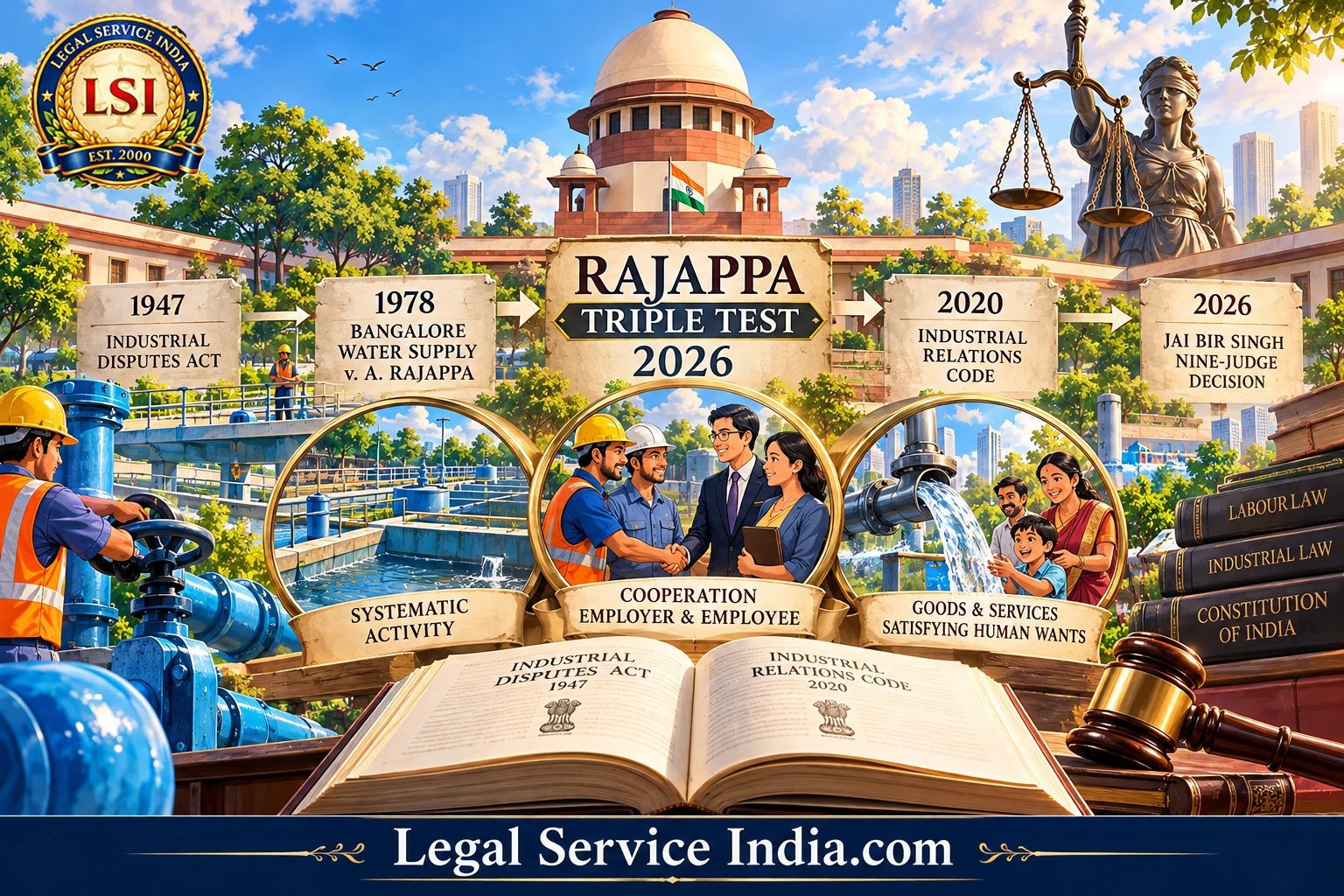
The decision of a seven-judge Constitution Bench of the Supreme Court of India in Bangalore [1] Water Supply and Sewerage Board v. A. Rajappa, (1978) 2 SCC 213, delivered on 21 February 1978, remains the most important interpretation of the expression ‘industry’ in Section 2(j) of the Industrial Disputes Act, 1947. Authored principally by Justice V.R. Krishna Iyer, the judgment displaced a body of earlier, narrower decisions that had excluded hospitals, universities, clubs, and charitable bodies from the Act and laid down what came to be known as the triple test: systematic activity, cooperation between employer and employee, and the production or distribution of goods and services calculated to satisfy human wants and wishes, excluding purely spiritual or religious services.
This paper traces the judicial evolution of the definition before 1978, examines the reasoning and architecture of the Rajappa judgment, and assesses its effect: the massive expansion of coverage under the Industrial Disputes Act, the litigation that followed, the reference saga through Safdar Hashmi Samaj Manch v. State of Jharkhand (2009) and State of U.P. v. Jai Bir Singh (2005), and the nine-judge decision of 20 August 2026 in State of U.P. v. Jai Bir Singh, 2026 INSC 897, which refined the triple test prospectively while preserving it for all pending disputes under the repealed 1947 Act, and which held that the Industrial Relations Code, 2020, must be interpreted independently of the 1978 precedent. The paper concludes that Rajappa functioned for nearly five decades as the sheet anchor of Indian industrial jurisprudence and that its core functional insight survives, in modified form, in the under-the-law definition now found in Section 2(p) of the Industrial Relations Code [2], 2020.
Keywords: Industry, Section 2(j), Industrial Disputes Act 1947, Triple Test, Dominant Nature Test, Sovereign Functions, Bangalore Water Supply, Rajappa, Industrial Relations Code 2020.
Introduction
Every claim to the machinery of industrial legal dispute resolution in India begins with a definitional question: does the establishment in which the dispute arises fall within the meaning of ‘industry’ in Section 2(j) of the Industrial Disputes Act, 1947? The answer determines whether workers in a factory, a hospital, a university, a club, or a government department may invoke the protective apparatus of conciliation, labor courts, and tribunals, or whether they stand outside the Act altogether. It is for this reason that the definition of ‘industry’ has been described as the gateway to Indian labor law and why a single word of the 1947 statute has generated more than seven decades of judicial attention.
The Supreme Court’s decision in Bangalore Water Supply and Sewerage Board v. A. Rajappa, delivered on 21 February 1978 by a seven-judge Constitution Bench, is the main legal answer of that question. Writing the leading opinion, Justice V.R. Krishna Iyer adopted a broad, [3] purpose-based reading of Section 2(j) and set out the well-known triple test, holding that the Bangalore Water Supply and Sewerage Board itself was an ‘industry’ within the meaning of the Act. The judgment recognized that earlier decisions had taken a ‘zigzag course,’ overruled the restrictive line of authority, and brought hospitals, educational institutions, clubs, charitable bodies, co-operatives, research institutes, and, subject to a narrow sovereign-function exclusion, government departments within the reach of the Act. For nearly five decades Rajappa operated as the sheet anchor of Indian industrial jurisprudence. It also attracted persistent criticism for definitional expansionism, producing what a five-judge bench later described as a docket explosion in labor courts.
This paper examines the case as a case study: its under-the-law setting, its judicial pedigree, its reasoning, its effects, the long process of reconsideration that culminated in the nine-judge [4] decision of August 2026, and the legislative response now codified in the Industrial Relations Code, 2020. The main research takeaway is that the triple test transformed the scope of Indian labor law by shifting the focus from who the employer was to what activity was being carried on, and that this shift, though criticized for over-inclusiveness, remained the governing law for nearly five decades before being partially superseded by under-the-law codification.
Research Objectives
To Understand the Facts and Decision of the Bangalore Water Supply Case
The Facts: Employees of the Bangalore Water Supply and Sewerage Board were heavily fined for alleged misconduct. The workers challenged these fines in a labor court, arguing they violated natural justice. The Board claimed it was a statutory body providing essential public utility and sovereign-like basic amenities, meaning it was not an “industry,” and therefore the Labour Court had no jurisdiction.
The Decision: A seven-judge bench of the Supreme Court ruled against it [5] and held that the Board is an “industry” under Section 2(j) of the Industrial Disputes Act, meaning public utility services and statutory bodies fall within the ambit of labor laws.
To Study the Meaning of “Industry” Given by the Supreme Court
The Triple Test: The Court formulated a broad, inclusive definition of “industry.” An activity qualifies if it satisfies three main conditions:
- Systematic
- Organized cooperation between the employer and the
- Production or distribution of goods and services calculated to satisfy human wants and wishes (not necessarily for profit).
Rejection of Profit Motive: The Court clarified that a profit motive or commercial-only intent is not required for an enterprise to be called an industry. Hospitals, educational institutions, and clubs were thus brought under the definition, excluding only strict sovereign functions.
To Law: Examine the Effect of the Judgment on Labor
Expansion of Protections: The ruling drastically widened the umbrella of labor legislation. Employees in non-profit, charitable, educational, and governmental departments gained the legal right to raise industrial disputes and seek remedies against unfair retrenchment or termination.
Shift in Jurisprudence: The emphasis shifted away from the identity or ownership model of an organization toward the nature of the activity performed and the employer-employee dynamic.
To Understand Its Importance for Workers and Industrial Relations
Empowerment of Labor: The judgment leveled the playing field for workers in public utility and welfare organizations who were previously left unprotected.
Stability in Relations: By establishing clear parameters for employer-employee cooperation, it reduced arbitrary employer actions and fostered a structured framework for collective bargaining and dispute resolution.
Facts of the Case and Legal Background
The Bangalore Water Supply and Sewerage Board was a statutory authority responsible for supplying water and providing sewerage services in Bangalore. Certain employees of the Board were subjected to disciplinary fines for alleged misconduct. They approached the Labour Court under Section 33C(2) of the Industrial Disputes Act. The Board raised a preliminary objection: it argued that it was performing essential governmental functions and was not an “industry” under Section 2(j). If the Board was not an industry, its employees could not claim the relevant status of “workmen” under the Act, and the Labour Court’s jurisdiction would be affected. The dispute reached the Supreme Court against a background of conflicting judicial approaches. Earlier cases had considered whether hospitals, universities, charitable organizations, research institutions, and government departments could fall within the term. The problem was not simply the meaning of one word in isolation. The Court had to read the word “industry” in the context of the entire labor statute and its purpose. The seven-judge bench consisted of Chief Justice M. Hameed Ullah Beg and Justices Y.V. Chandra Hud, P.N. Bhagwati, V.R. Krishna Iyer, Jaswant Singh, V.D. Tulzapurkar, and D.A. Desai. The judgment was delivered on 21 February [6] 1978, with detailed opinions following. The effective majority was five to two on the principal approach.
Issue Before the Court
The central legal question was, “What activities and organizations fall within the expression ‘industry’ in Section 2(j) of the Industrial Disputes Act, 1947?” The particular dispute about the Water Supply Board became the vehicle for answering this broader question. The Court also had to consider the significance of profit motive, the role of public or statutory bodies, the treatment of welfare activities, and the scope of the sovereign-function exclusion.
Why the Issue Mattered
The answer affected the boundary of labor law. A narrow definition would leave many organized service-sector workers outside the Act. A broad definition would bring a much wider range of employers and activities within industrial dispute legislation. The Court therefore attempted to formulate a test that could be applied across different types of establishments instead of creating separate rules for every sector.
Literature Review
Broad Interpretation and the “Triple Test”: (Justice V.R. Krishna Iyer)
The seven-judge bench formulated the “triple test”—systematic activity, cooperation between employer and employee, and production of goods/services to satisfy human needs/wishes. Philanthropic motives or absence of profit-making were declared irrelevant, bringing public utilities like the Bangalore Water Supply and Sewerage Board firmly under labor welfare laws.
Critical Analysis of Judicial Overreach: (Abhijeet)
Utilizing doctrinal analysis, this literature maps how the “dominant nature test” separated core sovereign functions from separable welfare/utility operations of the state, ensuring accountability and labor rights protection within statutory boards.
The Statutory Framework
[7]Section 2(j) of the Industrial Disputes Act, 1947 defines ‘industry’ to mean any business, trade, undertaking, manufacture or calling of employers and includes any calling, service, employment, handicraft, or industrial occupation or avocation of workmen.
The definition is doubly wide. Its first limb describes the occupations of employers, and its second limb, introduced by the word ‘includes’, extends to the callings, services, employments, handicrafts and industrial occupations of workmen. The width of both limbs, and the absence of any express exclusion for public, charitable or professional activity, created the interpretive problem that occupied the courts for three decades.
Section 2(k) defines an ‘industrial dispute’ as any dispute or difference connected with the employment or non-employment or the terms of employment or with the conditions of labour. The Act is a beneficial, worker-oriented statute; the Supreme Court in Rajappa emphasized that its interpretation must advance the primary objective of facilitating the investigation and settlement of industrial disputes, and that the word ‘undertaking’ cannot be read in isolation but must be understood in the light of the words that surround it.
The Liberal Strand Before Rajappa
In D.N. Banerjee v. P.R. Mukherjee (1953), the Supreme Court upheld the application of industrial legal dispute resolution to departments of a municipality, adopting a relatively liberal approach to the under the law words.[8]In State of Bombay v. Hospital Mazdoor Sabha (1960), the Court held that a hospital run by the State was an industry, adumbrating what would later mature into the employer-employee cooperation element of the triple test.
In Corporation of the City of Nagpur v. Its Employees (1960), the Court divided municipal undertakings into departments and applied a dominant-function criterion: where a department discharges industrial and non-industrial activities alike, the predominant function determines whether that department falls within the scope of the term industry.
The Restrictive Strand Before Rajappa
In Secy., Madras Gymkhana Club Employees’ Union v. Management of Gymkhana Club (1968), the Court, invoking the doctrine of noscitur a sociis, read the word ‘undertaking’ narrowly as a venture analogous to trade or business and held that a members’ club was not an industry. In University of Delhi v. Ram Nath (1963), the Court excluded universities from the scope of industry. In Management of Safdarjung Hospital v. Kuldip Singh Sethi (1970), the Court held that undertakings must be analogous to trade or business for the production of material goods or material services, took the view that the hospital-decision in Hospital Mazdoor Sabha had been extreme and unjustified, and held the hospitals before it not to be industries.
Case Study
Comparative Case Study: D.N. Banerji v. P.R. Mukherjee (1953): Background of the Case
The case arose from a dispute involving employees of the Asansol Municipality in West Bengal. Some employees were dismissed from service, which resulted in an industrial dispute. The dispute was referred for adjudication under the Industrial Disputes Act, 1947. The case became important because it raised a question about whether the activities of a municipality could be covered by the term “industry” under the Act.
Main Legal Issue
The main issue before the Supreme Court was whether the activities carried out by a municipality could be considered an “industry.” The Court also had to consider whether a dispute between municipal employees and the municipal authority could be treated as an industrial dispute under the Industrial Disputes Act. The case therefore required the Court to examine the scope and meaning of the term “industry.”
Court’s Decision
The Supreme Court adopted a broad approach towards the meaning of “industry.” The Court held that the fact that an activity is carried out by a local authority does not automatically make it non-industrial. The nature and character of the activity are important in deciding whether it falls within industrial law. The Court therefore recognized that certain activities of a municipality may have an industrial character.
Importance of the Case
The judgment was important because it moved the interpretation of “industry” beyond only traditional factories and commercial organizations. It recognized that public authorities may also carry out activities that have an industrial character. This case therefore became one of the important early decisions in the development of Indian industrial law.
Relation with Bangalore Water Supply Case
The case has a direct connection with Bangalore Water Supply and Sewerage Board v. A. Rajappa. While deciding the Bangalore Water Supply case, the Supreme Court examined several earlier judgments dealing with the meaning of “industry,” including the principles developed in D.N. Banerji. The Bangalore Water Supply judgment later provided a more systematic approach through the well-known Triple Test—systematic activity, cooperation between employer and employee, and production or distribution of goods or services to satisfy human wants and wishes.
State of Bombay v. Hospital Mazdoor Sabha (1960) Background and Facts
This case is one of the important early Supreme Court decisions concerning the meaning of the word “industry” under the Industrial Disputes Act, 1947. The dispute concerned employees working in a government hospital. The question was whether the hospital could be treated as an “industry” even though its main purpose was to provide medical services and not to earn profit.
The government argued that a hospital was mainly a welfare activity and therefore it should not come within the definition of industry. The employees, on the other hand, argued that the hospital involved organised work performed by employees under the management of the hospital and therefore the Industrial Disputes Act should apply.
Issue
The main issue before the Supreme Court was whether a government hospital providing medical services could fall within the meaning of “industry” under the Industrial Disputes Act.
Decision of the Court
The Supreme Court adopted a relatively broad interpretation of the term “industry”. The Court [11] did not consider the absence of a profit motive to be sufficient to exclude the hospital from the definition. The Court focused on the organized nature of the activity and the relationship between the management and employees. This meant that an institution could potentially be an industry even when it was not established for commercial profit.
Importance
This case became an important foundation for the later development of the law relating to “industry”. It showed that the Court was willing to look at the nature of the activity and the employment relationship, rather than only looking at whether the organization was commercial.
Connection with Bangalore Water Supply
The principles discussed in Hospital Mazdoor Sabha were important in the development of the[12] broader approach later adopted in Bangalore Water Supply and Sewerage Board v. A. Rajappa. The Bangalore Water judgment examined earlier cases and attempted to provide a more systematic test for deciding whether an activity constitutes an industry.
Reliance to the Present Research
D.N. Banerji v. P.R. Mukherjee is relevant to this research because it helps to explain the judicial development of the definition of “industry” before the Bangalore Water Supply judgment. It shows the earlier approach of examining the nature of an activity rather than excluding it simply because it was performed by a public or local authority. Therefore, the case provides useful background for understanding why the Supreme Court later felt the need to clarify and develop a broader test for determining what constitutes an “industry.
Research Methodology
This research follows a qualitative and legal approach. The study is based on secondary sources such as Supreme Court judgments, Constitution Bench decisions, judgment summaries published by Supreme Court Observer, practitioner commentary, academic articles and under the law texts.
Important judicial decisions have been analyzed to understand the development of the definition of ‘industry’ from 1953 to the nine-judge decision of 2026. The method is historical and analytical: it reconstructs the pre-1978 case law from the overruled and overruling judgments as documented in the amicus note and standard commentaries, states the ratio of Rajappa from the judgment itself, and then traces its effect through the reconsideration references and the legislative response. The paper does not undertake an empirical study of labour court dockets; statements about docket burden are drawn from the five-judge reference of 2005 and subsequent commentary.
The Supreme Court’s Reasoning: The Triple Test
The most well-known part of Rajappa is the “triple test”. The majority explained that an activity is ordinarily an industry when three basic features are present: systematic activity, organized cooperation between employer and employee, and production or distribution of goods or services to satisfy human wants or wishes.
| Triple Test Element | Definition | Court’s Reasoning |
|---|---|---|
| Systematic Activity | The enterprise must engage in a structured, organized, and continuous activity. It cannot be a casual, sporadic, or isolated transaction. | A systematic activity implies planning, coordination, and a regular course of operation. |
| Cooperation Between Employer and Employee | There must be a functional relationship based on the joint collaboration of capital/management (the employer) and labor (the employees). | The production of goods or the rendering of services must rely on the collective effort of both parties. |
| Goods or Services Satisfying Human Wants | The activity must result in the production of material goods or the rendering of material services that satisfy human needs and desires. | The focus is on the output of the enterprise. “Material services” include utilities, education, healthcare, entertainment, and professional advice. |
Systematic Activity
Definition: The enterprise must engage in a structured, organized, and continuous activity. It cannot be a casual, sporadic, or isolated transaction.
Court’s Reasoning: A systematic activity implies planning, coordination, and a regular course of operation. The Bangalore Water Supply and Sewerage Board operated continuously to maintain infrastructure and distribute water. The Court ruled that the administrative setup, regularity of functions, and operational continuity of an organization are key indicators of a systematic activity.
Cooperation Between Employer and Employee
Definition: There must be a functional relationship based on the joint collaboration of capital/management (the employer) and labor (the employees).
Court’s Reasoning: The production of goods or the rendering of services must rely on the collective effort of both parties. If a lawyer works entirely alone, it is not an industry. However, if a professional setup hires clerks, typists, and assistants whose work directly contributes to the final output, cooperation exists. The Court emphasized that it is the nature of this work environment—not the individual status of the worker—that fulfills this element.
Goods or Services Satisfying Human Wants
Definition: The activity must result in the production of material goods or the rendering of material services that satisfy human needs and desires.
Court’s Reasoning: The focus is on the output of the enterprise. “Material services” include utilities, education, healthcare, entertainment, and professional advice. The Court specifically excluded spiritual or purely religious services from this definition, as they do not cater to the secular, material demands of society. Water supply and waste management are prime examples of essential material services that fulfill basic human
The Dominant Nature Test
When an institution performs multiple tasks, the Dominant Nature Test looks at its primary, predominant function to see if it counts as an industry.
If the main or dominant character of the service satisfies human needs through organized cooperation, ancillary public duties or statutory backing do not strip it of its status as an industry.
Because the BWSSB’s primary job is delivering water and managing sewage—services vital to human life—it passed this test easily, even though it operated under a statute without a profit motive.
Effect on the Definition of ‘Industry’
Immediate Expansion of Coverage
The immediate effect of Rajappa was a massive expansion in the coverage of the Industrial Disputes Act. Millions of employees in hospitals, universities, clubs and government departments could now invoke the machinery of industrial legal dispute resolution, provided an employer-employee relationship existed.
The judgment was welcomed as a worker-oriented landmark, aligning the under the law definition with the directive principles of the Constitution. The functional test, which looks to the nature of the activity rather than the identity or motive of the employer, prevented employers from escaping the Act merely by labelling themselves charitable, educational or professional.
Definitional Expansionism and Docket Burden
But the expansive reading carried costs. The definition was widely criticized as over-inclusive, and scholarly and judicial commentary identified the primary deficiencies of the decision: its treatment of the boundary between sovereign and non-sovereign functions proved conceptually unstable, and the flood of disputes contributed to what the five-judge Bench in 2005 described as docket explosion in labour courts
Justice Krishna Iyer’s own later caution about ‘definitional expansionism’ and an ‘industrial hazard’ was recorded by the 2005 reference. Employers and governments complained that the judgment blurred the distinction between genuinely industrial activities and sovereign or welfare functions of the State.
Conflicting Readings: The Social Forestry Litigation
The unevenness of the post-Rajappa case law is best illustrated by the social forestry litigation. In Chief Conservator of Forests v. Jagannath Maruti Kondhare (1996), a three-judge Bench, applying Rajappa, held that the Social Forestry Department of a State, a welfare-oriented initiative for environmental improvement, was covered by the definition of industry. Five years later, a two-judge Bench in State of Gujarat v. Pratamsingh Narsinh Parmar (2001) took the opposite view on materially similar facts.
That a welfare department could be an industry in one year and not the next, on the same ratio, demonstrated that the difficulty lay not in any single application but in the definition itself, and it was this apparent conflict that the 2005 Constitution Bench was created to resolve.
The Unnotified 1982 Amendment
The Industrial Disputes (Amendment) Act, 1982 had substituted a new definition of industry and excluded categories including activities relatable to sovereign functions, agricultural operations, hospitals and dispensaries, education, scientific research and training institutes, and institutions managed by organizations engaged in charity; the amendment also excluded khadi and village industries. Because that amendment was never notified, the original 1947 definition continued to govern, and judicial rather than legislative text remained the law that applied for forty-three years.
Reconsideration and the Nine-Judge Bench
Coir Board and Early Reference Attempts
A two-judge Bench in Coir Board, Ernakulam v. Indira Devi referred Rajappa for reconsideration to a larger bench, pointing to the damaging effect of the extended meaning; a three-judge Bench declined the reference on the basis that a two-judge Bench was bound by the larger bench decision.
Safdar Hashmi Samaj Manch (2009)
In Safdar Hashmi Samaj Manch v. State of Jharkhand (2009), a seven-judge Bench answered a reference concerning the correctness of Rajappa in the context of educational institutions. The Bench reaffirmed Rajappa as laying down the correct law and, rather than abridging the definition judicially, suggested that clarification was a matter for the legislature The reaffirmation, however, did not end the controversy.
The Jai Bir Singh Reference of 2005
In State of U.P. v. Jai Bir Singh (2005) 5 SCC 1, a five-judge Bench decided on 5 May 2005 found compelling reasons for making a reference on the interpretation of the definition of ‘industry’ in Section 2(j) to a larger Bench, and for reconsidering Rajappa. The Bench noted the lack of unanimity in the 1978 judgment, the problematic consequences for public welfare institutions and state functions, the conceptual difficulty of drawing a border between sovereign and non-sovereign functions, and the burden the expanded definition had placed on the adjudicatory system In January 2017, a seven-judge Bench directed that the reference be heard by a Bench of nine judges.
The Nine-Judge Decision of 20 August 2026
[18]On 20 August 2026, a nine-judge Constitution Bench led by Chief Justice of India Surya Kant with Justices B.V. Nagarathna, P.S. Narasimha, Dipankar Datta, Ujjal Bhuyan, Satish Chandra Sharma, Joymalya Bagchi, Alok Aradhe and V.M. Pancholi, delivered judgment in State of U.P. Jai Bir Singh, 2026 INSC 897. The Bench had heard three days of arguments, from 17 to 19 March 2026, on four broad questions: whether the triple test in Rajappa was correctly laid down; whether the unnotified Industrial Disputes (Amendment) Act, 1982 or the Industrial Relations Code, 2020 affected the definition; whether social welfare activities of government departments or instrumentalities could be industrial activities; and what State activities fall within the expression ‘sovereign function’.
The Essential Framework Preserved
The essential framework preserved: the majority held that the essential framework of the triple test had stood the test of time, while observing that certain aspects of the triple test and the accompanying guidelines required refinement. The CJI found that the constituent elements of Section 2(j) could have been articulated differently to better reflect the scope of the provision, and reformulated the triple test accordingly.
Prospective Operation
Prospective operation: the reformulated test operates prospectively, without reopening matters that have attained finality; all pending cases under the Industrial Disputes Act, 1947 will be determined on the basis of the ratio laid down in Rajappa, since disturbing it would create artificial discrimination.
No Sheet Anchor for the 2020 Code
No sheet anchor for the 2020 Code: the Bench held that the 1978 judgment will not act as the sheet anchor for interpreting ‘industry’ under the Industrial Relations Code, 2020; the definition under the new Code is to be interpreted independently, and challenges to its provisions may be raised afresh.
The 1982 Amendment
The 1982 amendment: the Court noted that a reading of the Industrial Disputes (Amendment) Act, 1982 is unwarranted since that amendment never came into force.
Minority View
Minority view: Justice B.V. Nagarathna held that the 1978 verdict was correct and that there was no need to refer it for reconsideration.
The 2026 Decision Is Best Understood as a Middle Path
The 2026 decision is best understood as a middle path. The Court declined to overturn the worker-protective core of Rajappa for the thousands of disputes still pending under the old Act, but it also declined to extend that jurisprudence into the new under the law regime. It therefore preserved the practical utility of the triple test for the transitional docket while signalling that the future of the definition lies in the text of the Industrial Relations Code, 2020
Maintainability
Maintainability: by a majority, the Bench held that the reference seeking reconsideration of the 1978 judgment was validly made and maintainable. Justices B.V. Nagarathna, Dipankar Datta and Ujjal Bhuyan dissented on this question, holding the reference unnecessary.
Importance for Workers and Industrial Relations
The judgment is important for workers because the statutory concept of “industry” determines the institutional setting in which industrial disputes can be raised and resolved. When an establishment is treated as an industry, employees performing covered work may come within the machinery created by industrial-dispute legislation. This can affect questions of dismissal, disciplinary action, wages, conditions of service and collective industrial relations, depending on the particular statutory provision involved.
Rajappa also recognized that the modern economy contains many service organizations. If the word industry were restricted to manufacturing or conventional commerce, workers in organized services could be excluded even though they work under an employer in a structured organization. The triple test therefore gave the law a functional basis capable of adapting to different forms of organized employment.
Inclusion of Public Utilities
Essential public services like water, sanitation, and hospitals fall under labour laws. The decision also has significance for employers. A public body or non-profit organization cannot determine its labour-law status simply by choosing an institutional label. The nature of the activity and the structure of the work remain This can provide greater consistency because similar activities may be assessed under similar principles regardless of whether the organization is public or private
Worker Empowerment
Employees gained legal rights to form unions, use collective bargaining, and contest unfair disciplinary actions.
Social Justice
The ruling prioritized worker welfare and industrial peace, aligning statutory interpretation with constitutional goals.
The Industrial Relations Code, 2020
The Industrial Relations Code, 2020 received the assent of the President on 28 September 2020 and was brought into force on 21 November 2025, repealing the Trade Unions Act, 1926, the Industrial Employment (Standing Orders) Act, 1946 and the Industrial Disputes Act, 1947.[20] Section 2(p) of the Code defines ‘industry’ as any systematic activity carried on by cooperation between an employer and worker for the production, supply or distribution of goods or services, whether or not the activity is carried on with a motive to make any gain or profit. The definition thus codifies the essential insight of Rajappa: profit motive is not relevant, and systematic activity organized through employer-worker cooperation is the core of the concept.
The Code, however, departs from the Rajappa architecture by excluding specific categories by statute:
- institutions wholly or substantially engaged in charitable, social or philanthropic service;
- any activity of the government relatable to its sovereign functions, including activities carried on by the departments of the Central Government dealing with defence research, atomic energy and space;
- domestic service; and
- any other activity which may be notified by the Central Government.
This exclusionary scheme reflects the criticisms that had accumulated against Rajappa since 1978, and converts what the judgment had left to judicial line-drawing into express legislative text. Scholars have argued that the catch-all power to notify activities out of the definition, Section 2(p)(iv), delegates an unqualified power to the executive that exceeds constitutional limits on delegated legislation. The nine-judge Bench in August 2026 expressly declined to examine the new definition, holding that the contours of ‘industry’ under the 2020 Code could be the subject of a fresh challenge.
Why the Distinction Matters
The effect is that Rajappa should be understood primarily as an interpretation of the repealed Section 2(j). For a new dispute governed by the IR Code, the starting point is Section 2(p), not an automatic transplantation of every detail of the 1978 case. The new statute has its own wording and exclusions.
This distinction also answers a common research mistake: it would be incorrect to say simply that the 1978 definition is “still the definition of industry” for all present disputes. The historical rule remains important for cases arising under the old Act, while the current statutory regime must be read from the IR Code itself.
Research Gap
The primary research gap in the Bangalore urban water supply case study lies in the structural disconnect between decentralized wastewater treatment and “last-mile” reuse infrastructure, alongside a failure to dynamically map localized socio-economic vulnerabilities.
While current literature extensively documents the macroeconomic supply-demand deficit, aging pipeline leakages, and the rapid collapse of traditional lake networks, there is a critical lack of empirical research modelling circular, localized water economics.
Specifically, current frameworks fail to address the policy and infrastructure gap required to link independent decentralized treatment plants—such as decentralized apartment STPs—to active industrial or environmental sinks in close proximity.
Furthermore, existing research heavily generalizes the crisis, leaving a gap in data regarding:
- how private water markets (the “tanker mafia”) manipulate prices during droughts;
- how “satellite evasion” is used to bypass regional price caps; and
- how the rapid emergence of high-density, water-intensive industries like data centers impacts localized aquifer depletion.
Critical Analysis
Broad Inclusivity vs. Judicial Overreach
Critics argue the ruling made the definition of “industry” overly broad. By sweeping hospitals, universities, clubs, and charitable institutions into labor regulations, the judgment blurred the line between commercial trades and sovereign public governance.
Policy Making by Judiciary
Legal analysts point out that interpreting statutory definitions so expansively amounted to judicial overreach, stepping into the domain of legislative policy making.
Pro-Labor Triumph
Supporters praise the decision for preventing public sector employers from hiding behind “sovereign functions” to exploit or deny basic statutory rights to manual, technical, and administrative staff.
Findings And Discussion
The Triple Test
The Court established that an activity qualifies as an “industry” if it satisfies three criteria:
- systematic activity;
- organized cooperation between employer and employee; and
- production or distribution of goods and services satisfying human wants and wishes (not spiritual or purely charitable).
Irrelevance of Profit Motive
A profit-making design or commercial investment is not Philanthropic, public, or cooperative undertakings are equally covered as long as they meet the triple test.
Sovereign Exception
Regal or strictly sovereign functions of the State (such as legislative power, administration of justice, and police/military defense) are exempt, but welfare and commercial activities run by the government are not.
Dominant Nature Test
If an organization mixes multiple functions, the predominant or dominant nature of the department defines its Separable industrial units within a larger non-industry setup can still fall under the Act.
Discussion And Implications
Expansion of Labor Rights
The judgment extended vital labor law protections and unionization rights to employees in hospitals, universities, clubs, and municipal bodies.
Public Utility Inclusion
By ruling that the Bangalore Water Supply and Sewerage Board is an industry, the Court ensured that public utilities providing basic human amenities cannot claim sovereign immunity to bypass labor disputes.
Subsequent Reconsideration
The wide interpretation sparked long-term legal debate over whether the definition was overly worker-centric, triggering ongoing reviews by larger Supreme Court benches.
Conclusion
The 1978 Supreme Court ruling in Bangalore Water Supply and Sewerage Board v. A. Rajappa established a foundational milestone in Indian labor jurisprudence by broadly defining “industry” under the Industrial Disputes Act, 1947. By formulating the “triple test,” the court prioritized worker welfare and extended statutory protections across public utilities, hospitals, and educational institutions.
The judgment’s effect was double-edged. It extended labour-law protection to millions of workers outside the conventional factory gate, and it simultaneously generated definitional uncertainty, administrative burden and a docket explosion that successive benches found increasingly difficult to defend. The long process of reconsideration, from Coir Board through Safdar Hashmi Samaj Manch and the Jai Bir Singh references, culminated in the nine-judge decision of 20 August 2026, which preserved the essential framework of the triple test for all pending disputes under the repealed Act while holding that the Industrial Relations Code, 2020 must be interpreted independently of the 1978 precedent.
The legacy of Rajappa is therefore best described as legal rather than under the law. Its functional insight, that industry is defined by organized cooperation between employer and worker in the production or distribution of goods and services, and not by the profit motive or the identity of the employer, now lives inside the under the law definition of Section 2(p) of the Industrial Relations Code, 2020, even as the Code’s new exclusions displace parts of the judicial scheme. For the foreseeable future, the case will be remembered both as the high-water mark of worker-oriented interpretation and as the boundary at which Indian labour law passed from judicial definition to legislative codification.
References
- Bangalore Water Supply and Sewerage Board v. A. Rajappa, (1978) 2 SCC
- N. Banerji v. P.R. Mukherjee, AIR 1953 SC 58.
- State of Bombay v. Hospital Mazdoor Sabha, AIR 1960 SC
- Corporation of the City of Nagpur v. Its Employees, AIR 1960 SC
- University of Delhi v. Ram Nath, AIR 1963 SC
- Secretary, Madras Gymkhana Club Employees’ Union Management of Gymkhana Club, AIR 1968 SC 554.
- Management of Safdarjung Hospital v. Kuldip Singh Sethi, (1970) 1 SCC
- Coir Board, Ernakulam v. Indira Devi, (1998) 3 SCC
- Chief Conservator of Forests v. Jagannath Maruti Kondhare, (1996) 2 SCC
- State of Gujarat v. Pratamsingh Narsinh Parmar, (2001) 9 SCC
- State of U.P. v. Jai Bir Singh, (2005) 5 SCC
- Safdar Hashmi Samaj Manch v. State of Jharkhand (2009).
- State of U.P. v. Jai Bir Singh, 2026 INSC
- Industrial Disputes Act, 1947, Section 2(j).
- Industrial Relations Code, 2020, Section 2(p).
Written By: Dhruvi Vansiya, First Year MLW Student At Veer Narmad South Gujrat University, Surat, India

