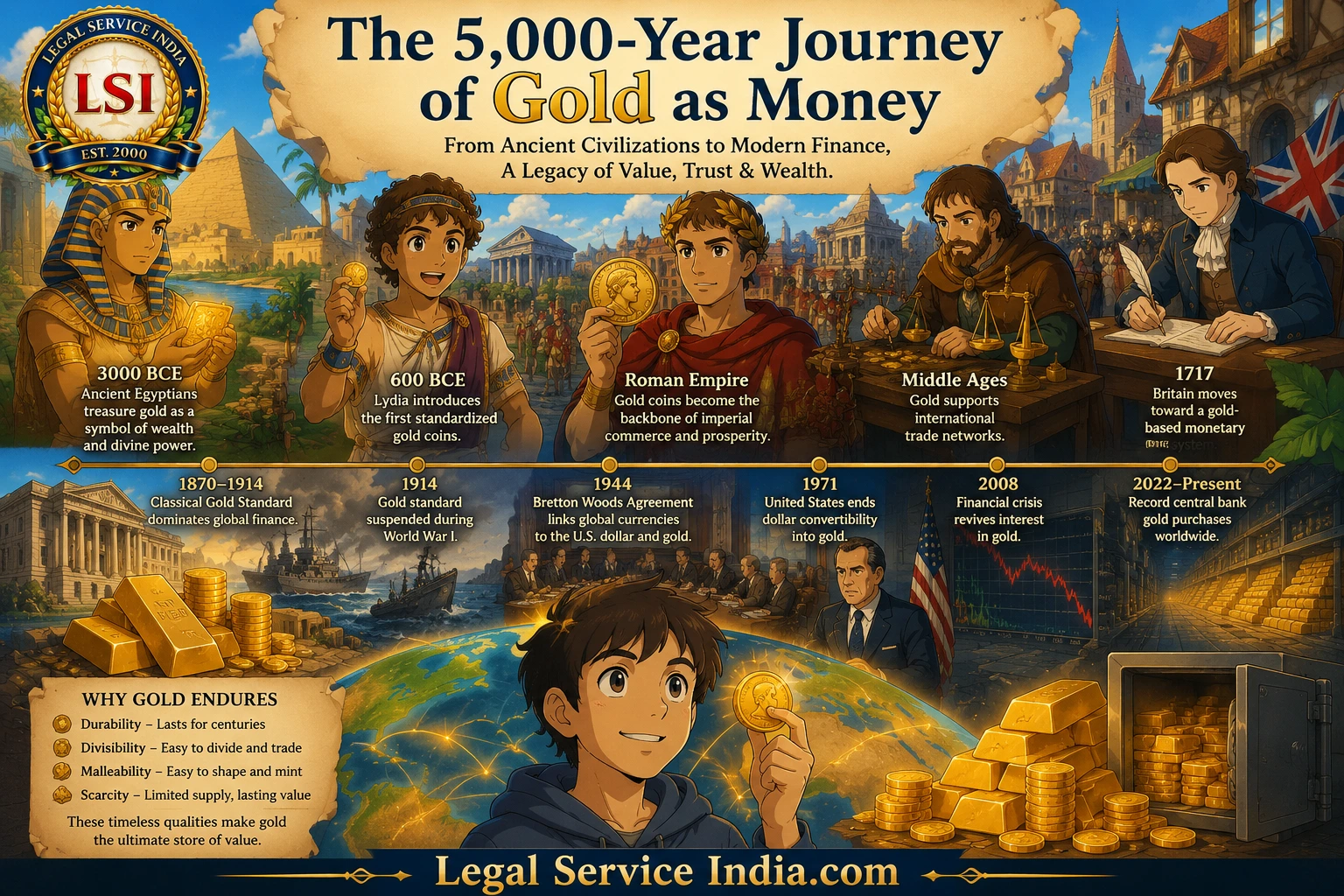
Part 2: Bretton Woods, the Nixon Shock, Fiat Currency, and the Transformation of Money
Introduction
For thousands of years, gold served as the foundation of monetary systems across civilisations. Whether in the form of coins, bullion, or reserve assets, gold provided a tangible anchor that limited governments’ ability to create money arbitrarily.
By the early twentieth century, however, global wars, economic crises, and political pressures began challenging the traditional gold-based system.
The result was one of the most significant financial transformations in human history: the transition from commodity-backed money to fiat currency.
Today, nearly every major currency in the world derives its value not from gold or silver but from public confidence and government authority.
Understanding how this transformation occurred is essential for understanding inflation, debt, central banking, and the modern financial system itself.
The World After World War II
The Second World War left much of Europe and Asia economically devastated.
- Factories had been destroyed.
- Infrastructure lay in ruins.
- Governments faced enormous reconstruction costs.
Meanwhile, the United States emerged from the war as the world’s dominant economic power.
Unlike many nations, America had not experienced widespread destruction on its own soil. Its industrial capacity remained intact, and its gold reserves had grown significantly during the war years.
By 1944, the United States possessed approximately two-thirds of the world’s official gold reserves.
This extraordinary position gave America a unique opportunity to shape the post-war financial order.
The Bretton Woods Conference of 1944
In July 1944, delegates from forty-four countries gathered in the small town of Bretton Woods, New Hampshire.
The conference sought to establish a stable international monetary system capable of preventing the financial chaos that had contributed to the Great Depression and global instability during the interwar period.
The resulting agreement became known as the Bretton Woods System.
Its basic structure was relatively simple:
Key Features of Bretton Woods
| Feature | Description |
|---|---|
| Dollar-Gold Convertibility | The U.S. dollar would be convertible into gold at a fixed rate of $35 per ounce. |
| Currency Pegs | Other participating countries would peg their currencies to the U.S. dollar. |
| Gold Exchange Mechanism | Central banks could exchange dollars for gold through official channels. |
| Stable Exchange Rates | Exchange rates would remain relatively stable. |
In effect, gold remained the ultimate foundation of the system, but the dollar became the world’s primary reserve currency.
This arrangement allowed global trade and investment to expand dramatically during the post-war period.
Why Bretton Woods Worked
The Bretton Woods framework offered several advantages.
Exchange Rate Stability
Businesses could engage in international trade without worrying about extreme currency fluctuations.
Confidence in the Dollar
Because dollars could theoretically be converted into gold, foreign governments trusted the American currency.
Economic Growth
The post-war decades witnessed unprecedented growth in industrial production, consumer spending, and international commerce.
Expansion of the Middle Class
Many historians credit the monetary stability of the period with helping create the prosperous middle-class societies that emerged in North America and Western Europe.
For a time, the system appeared highly successful.
Yet hidden beneath the surface were structural weaknesses that would eventually lead to its collapse.
The Fundamental Problem
The Bretton Woods system depended on trust.
Countries accepted dollars because they believed the United States possessed sufficient gold to honour its commitments.
However, a contradiction gradually emerged.
As global trade expanded, the world needed more dollars.
To provide those dollars, the United States had to run deficits and issue additional currency.
But the more dollars America created, the greater the gap between outstanding dollars and available gold reserves.
Eventually, foreign governments began asking a difficult question:
“Does the United States actually possess enough gold to back all these dollars?”
The answer became increasingly uncertain.
The 1960s: Rising Pressure on the Dollar
During the 1960s, government spending increased substantially.
Several factors contributed:
- The Vietnam War – Military expenditures rose dramatically as American involvement expanded.
- Domestic Social Programmes – The Great Society initiatives introduced ambitious social welfare programmes that required significant funding.
- Growing Deficits – Government spending increasingly exceeded government revenues.
Under a strict gold-based system, excessive money creation would eventually be constrained by limited gold reserves.
However, the growing demand for dollars encouraged continued monetary expansion.
Foreign governments became concerned.
France Challenges the System
Among the most vocal critics was France.
Under the leadership of Charles de Gaulle, French officials questioned whether the United States possessed sufficient gold to support the growing supply of dollars.
Rather than simply holding dollars, France began converting its reserves into physical gold.
Other nations followed.
What began as isolated requests gradually evolved into a broader movement.
Countries increasingly preferred gold to paper claims.
A dangerous dynamic emerged.
- The more governments demanded gold,
- The more pressure was placed on American reserves.
The Bretton Woods system was beginning to crack.
The Run on America’s Gold
By the late 1960s, the situation became increasingly unsustainable.
- Foreign central banks accumulated large quantities of dollars and sought conversion into gold.
- America’s gold reserves declined.
- Confidence weakened.
Economists refer to this situation as a classic confidence crisis.
A monetary system can survive many challenges, but once participants begin doubting its foundation, instability accelerates.
The United States faced a difficult choice:
- Reduce spending dramatically.
- Increase taxes substantially.
- Devalue the dollar.
- End gold convertibility.
The government ultimately chose the fourth option.
August 15, 1971: The Nixon Shock
On August 15, 1971, President Richard Nixon delivered a televised address that changed global finance forever.
During that speech, Nixon announced the temporary suspension of the dollar’s convertibility into gold.
The decision became known as the “Nixon Shock”.
Although described as temporary, the suspension became permanent.
For the first time in modern history, the world’s leading currency was no longer tied to gold.
The Bretton Woods system effectively ended.
The era of fiat money had begun.
What Is Fiat Currency?
The term “fiat” originates from Latin and means “let it be done”.
A fiat currency possesses value because governments declare it legal tender and because people collectively accept it in exchange for goods and services.
Unlike gold-backed money, fiat currency is not redeemable for a physical commodity.
Its value rests primarily on:
- Public confidence
- Government authority
- Economic productivity
- Monetary policy
- Legal recognition
Examples of Fiat Currencies
| Currency | Country/Region |
|---|---|
| Indian Rupee | India |
| U.S. Dollar | United States |
| Euro | European Union |
| Japanese Yen | Japan |
| British Pound | United Kingdom |
Nearly every major currency today operates under a fiat system.
Legal Tender: Why Paper Money Has Value
Many people assume money has value simply because governments print it.
The legal reality is more nuanced.
A currency gains practical legitimacy through legal tender laws.
Legal tender refers to money that must be accepted for the settlement of public and private debts.
When a government designates a currency as legal tender:
- Taxes must be paid in that currency.
- Courts recognise it for debt settlement.
- Financial institutions operate within that framework.
Thus, modern currencies derive value not from gold reserves but from legal structures, economic activity, and public confidence.
India’s Legal Tender Framework
For Indian readers, understanding the legal foundation of money is particularly important.
The monetary system in India is governed primarily through:
Reserve Bank of India
The RBI manages monetary policy and currency issuance.
Reserve Bank of India Act, 1934
This legislation provides the legal framework governing currency issuance and banking regulation.
Coinage Act, 2011
This law governs the minting and circulation of coins in India.
| Institution / Law | Role in India’s Monetary System |
|---|---|
| Reserve Bank of India (RBI) | Manages monetary policy and issues currency. |
| Reserve Bank of India Act, 1934 | Provides the legal framework for currency issuance and banking regulation. |
| Coinage Act, 2011 | Regulates the minting and circulation of Indian coins. |
Today, Indian banknotes are not backed by gold.
Their value depends upon the authority of the state and the credibility of India’s monetary institutions.
Gold Standard vs Fiat Currency
The debate between gold-backed money and fiat currency remains one of the most important discussions in economics.
Arguments Supporting Gold Standards
Supporters argue that gold:
- Limits excessive money creation.
- Restrains government spending.
- Preserves purchasing power.
- Reduces inflation risk.
- Encourages fiscal discipline.
Arguments Supporting Fiat Currency
Supporters of fiat systems argue that they:
- Provide flexibility during economic crises.
- Allow central banks to stabilise markets.
- Support economic growth.
- Enable governments to respond quickly to emergencies.
The reality is that both systems involve trade-offs.
No monetary system is perfect.
The challenge lies in balancing stability with flexibility.
Inflation: The Hidden Consequence of Unlimited Money
One of the most frequently discussed consequences of fiat currency is inflation.
Inflation occurs when the purchasing power of money declines over time.
While inflation can result from multiple factors, rapid expansion of the money supply is often a major contributor.
When more currency chases the same quantity of goods and services, prices tend to rise.
The consequences become visible everywhere:
- Housing costs increase.
- Food prices rise.
- Education becomes more expensive.
- Healthcare costs escalate.
For households, inflation functions as an invisible tax on savings.
Effects of Inflation on Daily Life
| Area | Impact of Inflation |
|---|---|
| Housing | Housing costs increase. |
| Food | Food prices rise. |
| Education | Education becomes more expensive. |
| Healthcare | Healthcare costs escalate. |
| Savings | Purchasing power gradually declines. |
Understanding Purchasing Power
Purchasing power measures what a unit of currency can actually buy.
Suppose an item costs ₹100 today.
If the same item costs ₹200 in the future, the purchasing power of money has declined.
This process often unfolds gradually.
As a result, many individuals underestimate its cumulative impact.
Over decades, even moderate inflation can significantly erode wealth.
This reality explains why investors frequently seek assets that can preserve purchasing power.
Historically, gold has often been viewed as one such asset.
Purchasing Power Example
| Time Period | Item Price | Purchasing Power Status |
|---|---|---|
| Today | ₹100 | Baseline |
| Future | ₹200 | Purchasing power has declined |
The Expansion of Modern Money Supply
Since the abandonment of the gold standard, governments and central banks have enjoyed far greater flexibility in creating money.
This flexibility has been used during:
- Financial crises
- Wars
- Recessions
- Banking emergencies
- Economic stimulus programs
The most dramatic recent example occurred during the COVID-19 pandemic, when governments around the world introduced unprecedented monetary and fiscal support measures.
Supporters argue these interventions prevented economic collapse.
Critics argue they contributed to inflationary pressures that emerged afterwards.
The debate continues.
Major Events Driving Money Creation
| Event | Reason for Monetary Expansion |
|---|---|
| Financial Crises | Market stabilization and liquidity support |
| Wars | Funding national expenditures |
| Recessions | Economic stimulus and recovery |
| Banking Emergencies | Preventing financial system collapse |
| COVID-19 Pandemic | Unprecedented fiscal and monetary support |
Inflation and Wealth Transfer
One of the most overlooked consequences of inflation is its impact on wealth distribution.
Inflation does not affect everyone equally.
Beneficiaries
Individuals who own:
- Stocks
- Real estate
- Businesses
- Precious metals
often see asset values rise over time.
Those Most Vulnerable
Individuals relying primarily on:
- Cash savings
- Fixed salaries
- Fixed pensions
may experience declining purchasing power.
This dynamic has led some economists to describe inflation as a mechanism that can transfer wealth from savers toward asset owners and borrowers.
Understanding this process is essential for anyone seeking to protect long-term financial security.
Inflation Impact Comparison
| Group | Typical Effect of Inflation |
|---|---|
| Stock Owners | Often benefit from rising asset values |
| Real Estate Owners | Property values may increase over time |
| Business Owners | Can pass some costs to consumers |
| Precious Metal Holders | May preserve purchasing power |
| Cash Savers | Face erosion of purchasing power |
| Fixed Salary Earners | Income may lag behind rising prices |
| Fixed Pension Recipients | The real value of income may decline |
The Foundation for the Next Monetary Era
The transition from gold-backed money to fiat currency fundamentally transformed the global economy.
- The Bretton Woods system anchored currencies to gold.
- The Nixon Shock severed that connection.
- Fiat currencies replaced commodity-backed money.
- Central banks gained unprecedented influence over economic activity.
For more than fifty years, the world has operated under this monetary experiment.
Yet the story does not end there.
In recent years, a remarkable development has emerged: governments and central banks around the world have begun buying gold at the fastest pace in decades.
Why are nations accumulating gold if fiat money supposedly replaced it?
The answer reveals a great deal about the future of the global financial system.
Key Monetary Transitions
| Historical Development | Significance |
|---|---|
| Bretton Woods System | Anchored currencies to gold |
| Nixon Shock | Ended the gold-dollar convertibility system |
| Rise of Fiat Currency | Replaced commodity-backed money |
| Expansion of Central Bank Influence | Increased control over monetary policy |
| Modern Gold Accumulation | Renewed strategic interest in gold reserves |
Conclusion
The transition from gold-backed money to fiat currency reshaped the global financial system and redefined the role of central banks. While gold standards emphasise monetary discipline and long-term purchasing power preservation, fiat currencies offer flexibility during crises and economic disruptions. The ongoing debate between stability and flexibility remains central to modern economics. As inflation, wealth distribution, and central bank policies continue to influence global markets, the renewed interest in gold by governments and monetary authorities raises important questions about the future direction of the international financial system.