





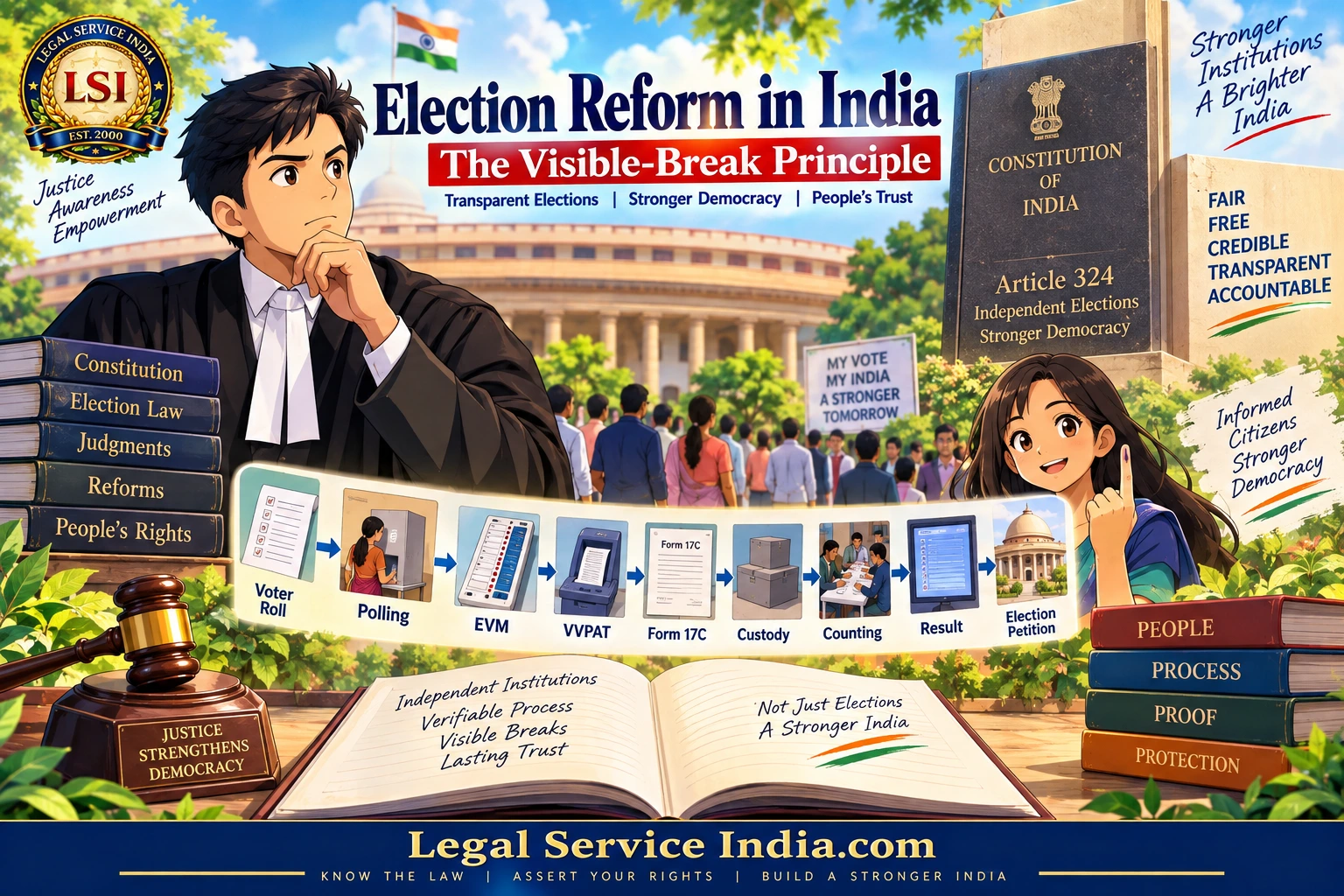
Election Reform in India: The Visible-Break Principle and the Search for a Resilient Election System
Author: Adv. Tarun Choudhury, Supreme Court Advocate | 25+ Years of Legal Experience
Introduction: An Election Cannot Depend Upon Trust Alone
Every democracy eventually confronts an uncomfortable question:
What happens if the people operating an election system are honest, but the system itself is not designed to expose a sophisticated failure?
That question is more important than the familiar debate of whether electronic voting machines are good or bad, whether the Election Commission is independent, or whether political parties trust the electoral process.
The deeper constitutional question is this:
If an electoral result is altered, how many independent things must go wrong before that alteration becomes both invisible and legally final?
This article proposes a way of thinking about election reform in India through what may be called the Visible-Break Principle.
The idea is simple. An election is not one event. It is a chain—or, more accurately, a graph.
Voter eligibility connects to the electoral roll. The roll connects to the polling station. The polling station connects to the machine. The machine connects to custody. Custody connects to counting. Counting connects to the result. The result connects to the election petition.
The real constitutional safeguard is therefore not merely independence at one point in the chain. It is the existence of independent breaks, records, and verification points between successive stages.
The Constitutional Foundation: Article 324 Is Powerful, But Not Unlimited
Article 324 of the Constitution vests the Election Commission of India with the superintendence, direction, and control of elections to Parliament, State Legislatures, and the offices of President and Vice-President. Parliament has also enacted legislation governing elections and the institutional structure of the Commission.
The present statutory appointment framework is contained in the Chief Election Commissioner and Other Election Commissioners (Appointment, Conditions of Service, and Term of Office) Act, 2023. The Act contains separate provisions dealing with the Search Committee, Selection Committee, appointment, tenure, removal, and service conditions.
But Article 324 contains another important feature. Its appointment provision operates subject to legislation made by Parliament.
That produces an important constitutional distinction:
| Source of Protection | Constitutional Significance |
|---|---|
| Constitutional Protection | What the Constitution protects can only be altered through the constitutional amendment process. |
| Ordinary Legislation | What ordinary legislation creates can generally be changed by another Parliament. |
| Administrative Practice | What belongs to administrative practice can potentially be changed even more easily. |
This distinction is crucial to any serious program of election reform in India.
A safeguard written only into an ordinary statute may be strong today but legally removable tomorrow.
That does not mean everything should be inserted into the Constitution. That would turn the Constitution into an election manual.
The better question is
Which protections are so fundamental to electoral independence that they deserve constitutional protection, and which should remain flexible statutory safeguards?
Stop Thinking of Elections as a Chain: Think of Them as a Graph
A conventional description of an election looks like this:
Roll → Poll → Count → Result.
That is too simple.
A more realistic model is
| Stage | Critical Question | Evidence |
|---|---|---|
| Appointment | Who exercises Article 324? | Appointment record |
| Electoral Roll | Who is entitled to vote? | Roll, revision records, objections |
| Polling | What happened at the booth? | Polling records, Form 17A, Form 17C |
| Machine | Which machine recorded the votes? | Identity, commissioning, and custody records |
| Custody | Was the same unit preserved? | Serial records, seals, custody records |
| Counting | What did the machine report? | Control Unit, Form 17C, and Form 20 |
| Verification | Can the electronic result be checked? | VVPAT and prescribed verification |
| Challenge | Can a disputed result be legally challenged? | Election petition and judicial process |
The Election Commission’s existing procedures already contain several important controls, including two-stage randomization, first-level checking, candidate/party participation at specified stages, strong-room procedures, and Form 17C and VVPAT verification.
The point of reform is therefore not to pretend that these mechanisms do not exist.
The better question is
Which of these controls are genuinely independent, and which merely produce several documents from the same institutional source?
The Visible-Break Principle
The proposed principle is deliberately modest:
No critical electoral action capable of changing who may vote, how a vote is recorded, how a machine is held, how a count is made or how a result is certified should rest upon the unilateral and unrecorded discretion of one political or administrative actor.
This principle contains four basic tests:
- Separation—Is the decision separated from its verification?
- Visibility—Does the action create a contemporaneous record?
- Verification—Can another source test that record?
- Challenge—Is there a legally meaningful mechanism to challenge the result?
There is, however, a fifth test that emerged from the deeper analysis:
The Independent-Record Test
Can the same actor manufacture both the event and the evidence used to prove that the event occurred?
This question is surprisingly powerful.
The Single-Scribe Problem: Five Documents May Still Be One Witness
Suppose a presiding officer and his team create:
- the polling-station diary;
- Form 17A records;
- Form 17C Part I;
- seal and paper accounts; and
- other polling-station records.
Five documents may appear to be five safeguards.
But if the same operational team creates all five, they are not five independent witnesses.
They may simply be five versions of the same story.
This is what may be called the Single-Scribe Problem.
The problem can appear again at the counting stage. If the Returning Officer alone reads the Control Unit, records the result, and prepares the corresponding forms, several documents can again originate from one source.
This does not mean that these officers are dishonest.
That is precisely the point.
A good institutional design should not require the law to assume dishonesty before it creates independent evidence.
Form 17C: From Administrative Form to Evidentiary Anchor
Form 17C is particularly interesting because it sits between polling and counting.
The Election Commission explains that Part I records the account of votes recorded and includes information concerning voters and votes recorded, while Part II relates to the result of counting. Copies of Form 17C are provided to polling agents present at the close of the poll.
That makes Form 17C more than a routine form.
It can become an audit anchor.
The proposed reform would connect:
- Polling station
- Form 17C Part I
- Machine identity
- Custody
- Control Unit result
- Form 17C Part II
- Form 20
If there is an unexplained discrepancy, the discrepancy itself should become a recorded fact rather than disappearing into administrative correspondence.
This is a subtle but important shift in the philosophy of election reform in India:
Do not merely create another authority. Create continuity of evidence.
EVM and VVPAT: The Question Is Not Simply “Can a Machine Be Trusted?”
The ECI currently describes EVM management as involving procedures such as first-level checking, randomization, commissioning, mock polls, custody safeguards, and VVPAT verification. Its current material states that mandatory VVPAT verification applies to five randomly selected polling stations per Assembly Constituency or Assembly Segment in a parliamentary constituency election, with additional mechanisms in specified circumstances.
That existing architecture should be acknowledged before proposing new safeguards.
But a sophisticated legal analysis asks a different question:
What exactly does each verification prove?
A firmware hash can prove that a particular file has a particular fingerprint.
It does not, by itself, establish every fact about what software ultimately executed on every physical unit throughout the election.
Similarly, a VVPAT sample can provide important statistical and evidentiary verification.
But a sample is still a sample.
Form 17C can establish consistency between records.
But consistency does not automatically establish that the underlying software or physical process was honest.
This distinction should not be misunderstood as a claim that EVMs are compromised. It is a systems-design question.
The correct question is
If a sophisticated technical failure existed, what independent evidence would expose it?
The Power of Time-Separated Evidence
One of the most interesting lessons from the stress test is that independence does not always require another institution.
Sometimes time itself creates evidentiary independence.
Consider a machine identity record created and distributed before the machine enters later custody.
Later, someone cannot simply change the machine’s identity without creating a conflict with the earlier record.
The same principle applies to physical VVPAT evidence.
The VVPAT slip is generated at the moment of voting. It is therefore not merely another statement written later by the returning officer.
This suggests a general rule:
The actor being tested should not be the sole author of the evidence used to test that actor.
Article 324(6): The Field Force Nobody Should Pretend Belongs to the Commission
One of the most uncomfortable institutional facts is that the Election Commission does not operate every polling station through a permanent independent election cadre.
Article 324(6) provides the constitutional mechanism by which the President or Governor makes staff available to the Commission when requested.
This creates a structural distinction between:
- superintendence over an election
- and
- permanent ownership of every person implementing that election.
A realistic reform should not pretend that Article 324(6) can simply be wished away by statute.
A more modest approach is visibility:
- written requests for staff;
- written reasons for non-supply;
- communication to the governor where appropriate;
- aggregate compliance reporting after the election; and
- disclosure in the Commission’s report laid before Parliament.
This does not create an independent field force.
It does something more realistic:
It makes failure to provide the field machinery visible.
The Constitutional “Master Key”: Ordinary Repeal
There is another lesson that lawyers and law students should not overlook.
Suppose Parliament enacts a detailed statutory architecture containing:
- appointment safeguards;
- roll-in inspection triggers;
- machine-identity requirements;
- VVPAT floors;
- Form 17C reconciliation;
- custody requirements; and
- technical audit duties.
If these protections are all ordinary statutory provisions, a later Parliament can generally amend or repeal them through the ordinary legislative process, subject of course to constitutional limitations.
That is not a drafting defect.
It is a consequence of the constitutional allocation of legislative power.
Therefore, a serious proposal for election reform in India should resist the temptation to constitutionalize every operational safeguard.
The more disciplined approach is to constitutionalize only the institutional independence that genuinely requires constitutional protection—for example, the appointment and removal architecture—while leaving technical and evidentiary safeguards to ordinary legislation.
Why a List of Reserved Matters Is Not Enough
Suppose legislation says that the Commission cannot reduce a particular safeguard except through a special procedure.
Could the same result be achieved indirectly?
Possibly.
A circular might change the technical specification.
A procurement decision might narrow the available suppliers.
A scheduling decision might make meaningful observation practically impossible.
A delegation might move a decision into an apparently ordinary administrative category.
A secrecy classification might prevent meaningful external verification.
This is why a serious statutory design needs a functional anti-circumvention rule:
No rule, notification, circular, technical specification, administrative direction, delegation, or procurement decision should have the effect of reducing a safeguard expressly fixed by the Act.
The purpose is not to prevent the Commission from administering elections.
The purpose is to prevent an administrative instrument from doing indirectly what the statute prohibits directly.
Article 329: The Hard Reality of Electoral Finality
There is another constitutional reality that reformers sometimes overlook.
Election disputes are not ordinary administrative disputes.
Article 329 channels challenges to elections through the election-petition framework established by law. The Representation of the People Act, 1951, provides the statutory framework for election petitions, including the filing provision and appellate mechanism. Section 116A provides an appeal to the Supreme Court from specified High Court orders in election petitions.
This creates an unavoidable tension:
The later a defect is discovered, the harder it may become to obtain an effective remedy for the particular election.
That does not mean the Constitution should be weakened.
It means that evidence must be created early.
The best election dispute is therefore not the dispute discovered years later.
It is the discrepancy that becomes visible:
- at the booth;
- at the counting table;
- immediately after counting; and
- within the election-petition framework.
The Four Barriers to a Resilient Election
| Barrier | Core Question |
|---|---|
| Appointment | Who controls the institution exercising Article 324? |
| Visibility | Does every critical action leave a record? |
| Verification | Can another source test that record? |
| Challenge | Can a detected defect produce an effective legal remedy? |
But after stress-testing the architecture, I would add a fifth:
The Fifth Barrier: Independent Record
| Barrier | Core Question |
|---|---|
| Independent Record | Can the same actor manufacture both the event and its evidence? |
That fifth barrier may ultimately be the most useful contribution of the entire exercise.
What Election Reform Should Not Do
A serious reform should avoid several tempting but structurally weak solutions.
- Do not create a second body to certify the national result. That creates competing constitutional authorities.
- Do not assume that more manufacturers automatically mean more security. Supply-chain complexity can create additional attack surfaces.
- Do not put sitting judges on administrative appointment committees merely to create an appearance of independence.
- Do not pretend that Article 324(6) creates a permanent ECI field cadre.
- Do not bind State Election Commissions through a Union election statute. Local body and Panchayat elections operate under their own constitutional framework.
- Do not treat party participation as institutional verification. Political parties can be absent, weak, obstructed, or simply unwilling to use available mechanisms.
- Do not treat a collection of documents as independent evidence merely because the documents have different names.
What This Teaches Law Students, Lawyers, and Judges
Lesson One: Follow the Power
Do not begin with the question, “Is this safeguard good?”
Ask:
Who has the legal power to activate, alter, suspend, or ignore it?
Lesson Two: Follow the Record
Every critical administrative decision should leave an evidentiary trail.
But then ask the harder question:
Who created that trail?
Lesson Three: Count Independent Failures, Not Documents
Three actions by one commission are not three institutional failures.
Two officers performing different functions may or may not be genuinely independent depending upon their reporting and control structures.
Lesson Four: Distinguish Alteration From Survival
This may be the most important analytical lesson.
Changing a result is one problem.
Keeping the changed result after evidence, scrutiny, and litigation is another.
A legal system should be designed so that the second task is substantially harder than the first.
Lesson Five: Independence and Resilience Are Different
An institution may be independent yet have a weak verification architecture.
An institution may be imperfectly independent yet possess strong evidentiary controls.
The better constitutional question is therefore not merely
“Is the institution independent?”
It is:
“Can one captured node control the event, the evidence, the verification, and the remedy?”
A Narrower Reform Package
After adversarial testing, the reform agenda can be surprisingly small.
1. Limited Constitutional Protection
Constitutional protection should be considered for the appointment architecture and removal protection of election commissioners, rather than constitutionalizing every technical election procedure.
2. Functional Statutory Protection
No administrative instrument should be capable of reducing a statutory electoral safeguard indirectly.
3. Time-Separated Evidence
Important evidence should be created before the actor later responsible for custody or counting obtains exclusive control.
4. Independent Record Creation
At critical points, at least one evidentiary record should originate from an actor or process different from the person creating the underlying event.
5. Form 17C Evidence Chain
Form 17C should operate as a statutory bridge connecting polling, machine identity, custody, and counting records.
6. VVPAT as a Statutory Floor
The existing five-station verification requirement should be treated, in a reform proposal, as a statutory floor rather than a ceiling, while retaining the Commission’s ability to increase verification where circumstances warrant.
The present ECI material records the existing five-station verification framework.
7. Article 324(6) Transparency
Rather than pretending to create an ECI cadre by ordinary legislation, make staff requests, non-supply, and compliance visible.
The Real Test of Election Reform in India
Here is the test I would put before every proposed election reform:
Assume one institution has been captured.
- Can it change the electoral state?
- If yes, can it also manufacture the evidence of that change?
- If yes, can it prevent independent verification?
- If yes, can it exhaust the legal remedy before correction occurs?
If the answer to all four questions is yes, the safeguard is weak no matter how impressive its language appears.
If the answer becomes no at any stage, the architecture has created a visible break.
Conclusion: The Goal Is Not a Perfect Election Machine
There is no institutional design that can promise an absolutely incorruptible election.
That is not how constitutional systems work.
The realistic objective is different.
- Make capture expensive.
- Make critical actions visible.
- Make evidence independent.
- Make discrepancies discoverable.
- Make legal challenges possible before finality closes the door.
The deepest lesson from this exercise is therefore not about EVMs, political parties, election commissioners, or even technology.
It is about evidence.
A democracy ultimately depends upon the ability to answer a simple question:
“How do we know what happened?”
If the answer depends entirely upon the same person who made the decision, the system is fragile.
If the answer comes from several genuinely independent sources created at different stages of the process, the system becomes substantially harder to manipulate without leaving a trace.
That is the essence of the Visible-Break Principle.
And perhaps that is the right direction for the next generation of election reform in India—not an impossible promise of perfect independence, but a legal architecture in which one captured node cannot easily become the author, witness, verifier, and final judge of its own electoral act.
Legal Note
This article presents a constitutional and institutional reform framework for discussion and research.
It should not be read as a statement that the proposed safeguards are presently part of Indian election law.
Existing constitutional provisions, statutes, Supreme Court decisions, and Election Commission procedures must be consulted in their current form before relying upon any proposition in litigation or legislative drafting.
Have Questions About Election Law, Electoral Rights, or Constitutional Remedies?
An election dispute can become difficult to address if the right evidence is not preserved at the right stage.
Whether your concern involves:
- Electoral rolls
- Voter rights
- EVM/VVPAT procedures
- Form 17C
- Counting discrepancies
- Election petitions
- Article 324
- Article 329
- Constitutional remedies
Timely legal advice can make a critical difference.
If you are facing an election-related legal issue, seeking guidance on an electoral dispute, or want to understand your available constitutional and statutory remedies in India, consult an experienced Supreme Court advocate before the opportunity for an effective remedy is lost.
Do not wait until an election dispute becomes impossible to correct.
Understand your legal position, preserve the relevant evidence, and take informed legal steps at the appropriate stage.
Adv. Tarun Choudhury
Supreme Court Advocate | 25+ Years of Legal Experience
📞 Call: 9650499965
💬 WhatsApp: 8851978611
Get professional legal guidance on election law, constitutional law, electoral disputes, and election petitions.
Your legal right is valuable. The timing of protecting it can be even more important.
Frequently Asked Questions
1. What is the Visible-Break Principle in Election Reform in India?
The Visible-Break Principle is a proposed approach to election reform in India under which every critical electoral action should be visible, recorded, and independently verifiable.
It focuses on separation, visibility, verification, challenge, and independent evidence so that one captured actor cannot easily alter an election and conceal the change.
2. How does Article 324 affect Election Commission independence in India?
Article 324 of the Constitution of India gives the Election Commission of India superintendence, direction, and control over elections.
However, Article 324 also permits Parliament to legislate on matters such as the appointment of Election Commissioners.
Therefore, Election Commission independence involves both constitutional protections and statutory safeguards.
3. What role do EVM, VVPAT, and Form 17C play in election verification?
EVMs, VVPAT, and the Form 17C are important parts of India’s electoral verification framework.
VVPAT provides a paper record associated with the vote, while Form 17C records the account of votes at the polling station and connects polling with subsequent counting.
A proposed election-reform framework can strengthen this chain by ensuring that machine identity, custody, Form 17C, and counting records remain continuously verifiable.
4. What is the importance of Form 17C in an election dispute?
Form 17C is important evidence in election disputes because it connects the polling-station account with the counting process.
A legally structured reconciliation between Form 17C, the Control Unit, and Form 20 could make unexplained discrepancies easier to identify and preserve as evidence for an election petition.
5. How can voters challenge an election result in India?
Under Article 329(b) of the Constitution, an election can generally be challenged only through an election petition in the manner provided by law.
The Representation of the People Act, 1951, establishes the statutory framework for election petitions.
Therefore, anyone considering an electoral challenge should understand the applicable grounds, evidence requirements, and statutory limitation periods at the earliest stage.
Key Takeaways: Election Reform in India
Election reform in India should focus on resilience, not merely institutional independence.
The real question is whether one captured electoral node can alter the result and simultaneously prevent detection and legal challenge.
The Visible-Break Principle proposes five safeguards:
- Separation
- Visibility
- Verification
- Challenge
- Independent record creation
- Article 324 gives the Election Commission of India superintendence, direction, and control over elections, but Parliament retains important legislative authority over the electoral framework.
- Article 324(2) creates an important constitutional vulnerability: safeguards created only through ordinary legislation can generally be changed by a later Parliament.
- Article 324(6) means election administration depends substantially on personnel made available to the Election Commission. A statutory reform should therefore increase transparency and accountability of staff deployment, rather than falsely claiming to create a permanent independent field force.
- Article 329 and the election-petition framework make timely evidence critically important because electoral disputes are subject to specific statutory procedures and limitation periods.
- EVM and VVPAT security should be analyzed as an evidence chain, not merely as a question of whether electronic voting machines can be trusted.
- A firmware hash is evidence of a file’s identity but by itself does not establish every fact about what was actually executed on every machine during an election.
- Form 17C can serve as an important evidentiary anchor, connecting the polling-station account with machine results, counting records, and Form 20.
- The Single-Scribe Problem arises when multiple electoral documents are created by the same operational actor. Several documents do not automatically constitute independent verification.
- Time-separated evidence can strengthen electoral integrity. A machine-identity record created before later custody, or a physical VVPAT record created during voting, can provide evidence that the later custodian did not solely author.
- Political-party observation is useful but witness-dependent. Roll inspection, FLC observation, randomization, strong-room monitoring, and Rule 56D applications become weaker if parties or candidates do not participate.
- A strong election reform in the Indian framework should distinguish between alteration and survival: changing an electoral outcome and keeping that change hidden from effective legal challenge are separate problems.
- A functional anti-circumvention rule can prevent administrative circulars, technical specifications, procurement decisions, or other instruments from indirectly reducing safeguards fixed by legislation.
- The objective should not be to create a second authority that certifies election results. Instead, the objective should be to create a continuous and independently testable chain of electoral evidence.
- The central principle is simple: the actor being tested should not be the sole author of the evidence used to test that actor.
- Ultimately, resilient electoral reform in India should make it difficult for one captured institution to become simultaneously the author of the electoral act, author of its evidence, verifier of its own evidence, and final decision-maker on the dispute.
