





Abstract
The Singareni Collieries Company Limited (SCCL) has been a cornerstone of coal mining in Telangana, with operations spanning over 130 years. Nevertheless, the coal mining operation conducted by SCCL has resulted in social consequences. This piece delves into the ramifications of SCCLs’ undertakings, which encompass deforestation, air and water contamination, soil erosion and contributions to climate change.
Furthermore, it sheds light on the repercussions, such as displacement, health challenges, economic reliance and disruptions in practices. Recommendations for practices are put forward to reduce the effects and support mining activities by emphasising restoration efforts and pollution management while considering community well-being and the shift towards renewable energy sources [1].
Introduction
Coal extraction in Telangana has mainly been led by the Singareni Collieries Company Limited (SCCL), a coal mining corporation in India headquartered in Kothagudem, Telangana. SCCL has made contributions towards the economy and energy requirements of the state by managing coal mines in the area.
While the mining operations carried out by SCCL are pivotal for job opportunities and economic growth, they also present societal issues.
Environmental Impacts of SCCL Operations
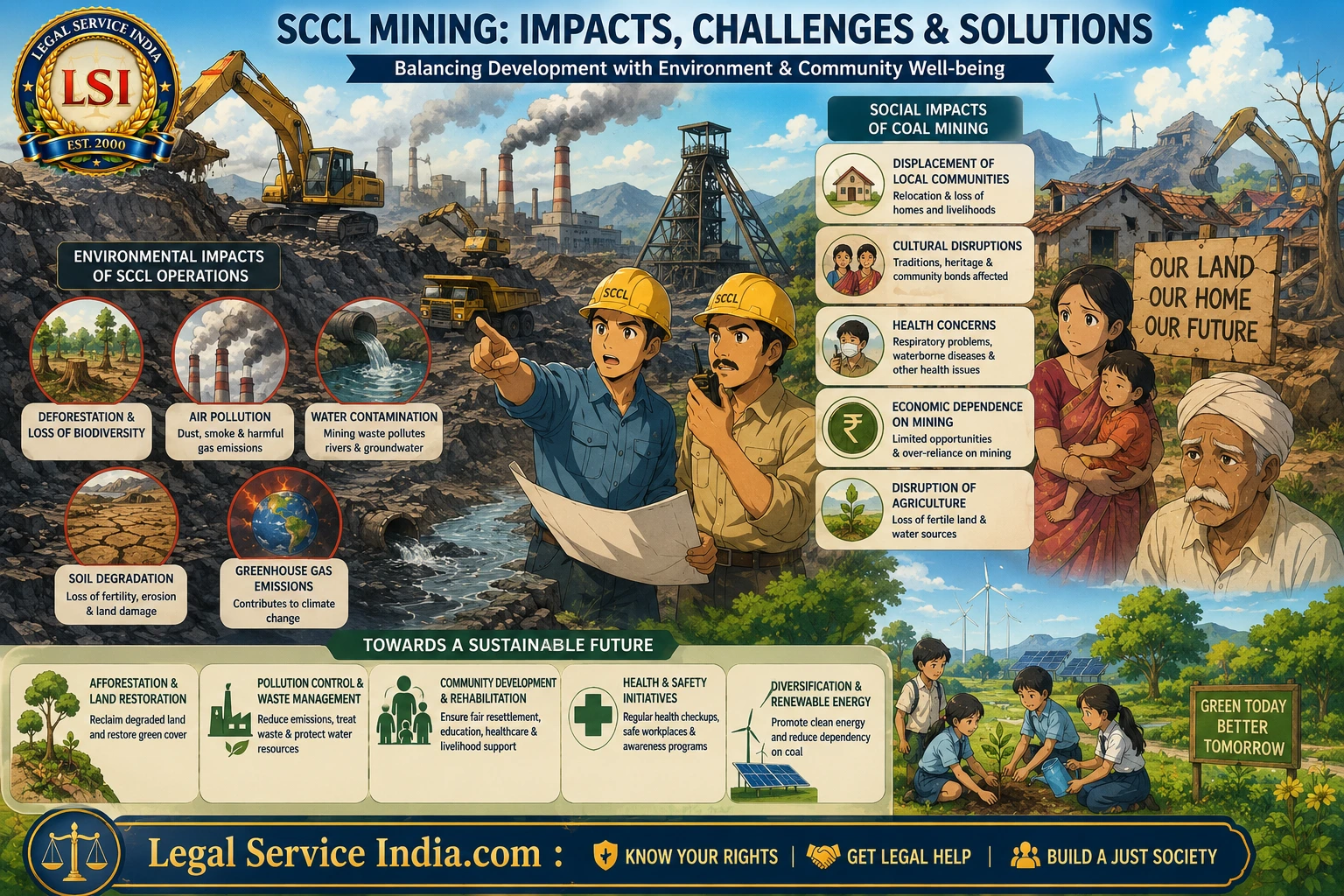
The operations of SCCL have effects such as deforestation and pollution of air and water sources along with soil degradation and greenhouse gas emissions. The harm caused by these activities extends beyond ecosystems. It affects the health of the people living in communities.
- Deforestation
- Air pollution
- Water contamination
- Soil degradation
- Greenhouse gas emissions
Social Issues Associated with Coal Mining
Socially speaking, mines run by SCCL frequently result in cultural disruptions. Even though there have been attempts made towards reducing these impacts, a sustainable and community-focused approach is needed for mining in Telangana.
- Displacement of local communities
- Cultural disruptions
- Health concerns
- Economic dependence on mining activities
Scope of the Study
The paper provides a detailed analysis of the environment and social issues that arise from SCCL’s activities and suggests some strategies for mitigating such impacts to ensure a balance between economic growth and ecological and social responsibility.
Area of Study, Data Acquisition, and Research Methodology
The Singareni Collieries Company Limited is owned by the Government of India and the Andhra Pradesh Government and jointly managed in a 51:49 equity partnership. It remains the only coal mining company operating in South India.
The coal reserves cover an area of 350 km of the Pranahita-Godavari Valley in Andhra Pradesh with proven geological reserves of 8791 million tonnes (Mt) as mentioned in Figure 1.
SCCL is currently operating in 13 opencast and 42 underground mines in 4 districts of Andhra Pradesh, viz., Adilabad, Karimnagar, Khammam and Warangal, with manpower around 78,000.
Overview of SCCL Mining Operations
| Parameter | Details |
|---|---|
| Ownership Pattern | Government of India and Andhra Pradesh Government (51:49 Equity Partnership) |
| Region of Operation | South India |
| Coal Reserve Area | 350 km of Pranahita–Godavari Valley |
| Geological Reserves | 8791 Million Tonnes (Mt) |
| Opencast Mines | 13 |
| Underground Mines | 42 |
| Districts Covered | Adilabad, Karimnagar, Khammam and Warangal |
| Manpower | Approximately 78,000 |
Coal Distribution and Customer Categories
SCCL dispatches coal to most of the customers in Andhra Pradesh and to some extent in other parts of Southern India.
Customers are categorised as Core Sectors (powerhouses, cement plants, railways, defence, etc.) and Non-Core Sectors (paper, textiles, bricks, etc.).
| Customer Category | Examples | Coal Grade Preference |
|---|---|---|
| Core Sector | Powerhouses, Cement plants, Railways, defence, etc. | Varies by industry |
| Non-Core Sector | Paper, Textiles, bricks, etc. | As per industrial requirement |
| Cement Sector | Cement Manufacturing Units | ‘B’ and ‘C’ Grade Coal |
| Power Houses | Electricity Generation Units | ‘E’, ‘F’ and ‘G’ Grade Coal |
Dual Price Policy of SCCL
In keeping with the “dual price policy” of SCCL, non-core sectors are charged 5% over and above the rate charged for the core sector.
Research Approach and Data Analysis
The next section attempts to probe the nature of social and environmental disclosure in SCCL for the period 2001 to 2007.
The data pertaining to CSR are not comparable both within a report and between reports of different years. However, temporal explorations of the trends in such disclosure are possible (Jenkins and Yakovleva 2006).
The paper will therefore attempt to outline how the nature, content and style of reports have developed over time through a look at the social and environmental disclosure of mining companies, whether any development is consistent, and the implications of this for future reporting.
Our main aim is to explore the disclosure of social, environmental and ethical policy statements (looks at the trend in such policy statements) rather than attempting to assess whether these policies are actually applied in any meaningful way. [2]
Key Research Focus Areas
- Social disclosure practices in SCCL reports
- Environmental disclosure trends
- Corporate Social Responsibility (CSR) reporting patterns
- Ethical policy statements and their evolution
- Changes in reporting content and style from 2001–2007
- Implications for future sustainability reporting
Environmental Impact of SCCL Mining
Coal mining operations undertaken by SCCL have significant environmental and social consequences. The following sections explain the key environmental impacts and social challenges associated with mining activities.
1. Deforestation and Loss of Biodiversity
SCCL performs open-pit and underground mining, which require the felling of vast portions of forest areas. Such activities will cause habitat loss and damage to biodiversity. The open pit upsets wildlife species in the region, threatening them and consequently affecting the local ecosystem. This contributes to soil erosion, causing further degradation.
- Large-scale forest clearance
- Habitat destruction and fragmentation
- Threats to wildlife populations
- Increased soil erosion and ecosystem degradation
2. Air Pollution
Mining of coal and transporting also gives out particular matters and harmful gases such as sulphur dioxide and nitrogen oxides which contribute to air pollution. It has been discovered that health effects due to air pollution from mining are more related to respiratory diseases, asthma, and bronchitis among the population that is local to the sites.
- Emission of particulate matter
- Release of sulfur dioxide and nitrogen oxides
- Increased cases of asthma and bronchitis
- Respiratory health concerns for nearby communities
3. Water Pollution and Scarcity
The other effects of coal mining on water are poor water quality due to acid mine drainage that affects nearby sources, for instance, rivers and groundwater. The condition affects the aquatic life by causing its death; besides, it is rendering the water unsafe for use in drinking and farming activities. Secondly, much water is consumed during the mining process, mainly in dust suppression of the coal and its subsequent processing. This affects water accessibility in the area where these mines are situated.
- Acid mine drainage contaminates water resources
- Damage to aquatic ecosystems
- Unsafe water for drinking and agriculture
- High water consumption during mining operations
- Reduced local water availability
4. Soil Degradation
Soil degradation increases with the topsoil removal for mining and the amount of overburden plus mining waste, thus lowering the quality of arable earth.
- Removal of fertile topsoil
- Accumulation of mining waste and overburden
- Reduction in agricultural productivity
- Decline in soil quality
5. Contribution to Global Warming
Climate change emissions from greenhouse gases: Coal mining releases greenhouse gases. Methane is a potent greenhouse released at the time of coal extraction in mining activities conducted by SCCL. The carbon footprint of the company also builds up when the coal produced is used for energy production.
- Release of methane during coal extraction
- Increased greenhouse gas emissions
- Higher carbon footprint from coal-based energy production
- Contribution to climate change and global warming
Social Impacts
1. Displacement and Land Acquisition
The need for land acquisition, leading to local community displacement, including indigenous population groups, arises when SCCL expands its mining areas. They lose access to land, homes, agricultural fields, and livelihoods. Often, resettlement and compensation programmes do little to help the families displaced, creating significant economic and social strain.
- Loss of homes and agricultural land
- Displacement of indigenous communities
- Livelihood disruptions
- Challenges in resettlement and compensation
2. Health Hazards
Residents of the surrounding environment are at risk of various health issues because of exposure to the harmful effects of pollution for a long period. Problems concerning the respiratory and cardiovascular systems exist, mainly as regards air and water pollution. The occupational hazards of miners are also pneumoconiosis, which is that disease of the lungs caused by the inhalation of coal dust.
- Respiratory illnesses
- Cardiovascular health problems
- Long-term exposure to polluted air and water
- Pneumoconiosis among miners due to coal dust inhalation
3. Economic Dependence and Low Diversity
Though providing jobs, SCCL’s dependence on coal is extremely high, which limits the diverse nature of the region’s economy. Areas do not have diversified industries; hence, residents here are at the mercy of the coal market and a likely future fall caused by environmental strings.
- Limited industrial diversification
- Heavy reliance on the coal sector
- Economic vulnerability to market fluctuations
- Potential future risks from environmental regulations
4. Cultural and Social Disruption
Mine impact disrupts the social fabric of local communities, specifically with indigenous groups holding cultural rights on land. Displacement because of land acquisition and the influx of non-local workers can lead to cultural dilution and a loss of traditional practices for the community, affecting identity and heritage.
- Disruption of traditional lifestyles
- Loss of cultural heritage and identity
- Cultural dilution due to migration
- Weakening of community cohesion
Summary of Environmental and Social Impacts
| Category | Key Impact | Major Consequences |
|---|---|---|
| Deforestation | Forest clearance | Biodiversity loss and habitat destruction |
| Air Pollution | Dust and gas emissions | Respiratory diseases and poor air quality |
| Water Pollution | Acid mine drainage | Unsafe water and aquatic life loss |
| Soil Degradation | Topsoil removal and waste accumulation | Reduced agricultural productivity |
| Global Warming | Methane and greenhouse gas emissions | Climate change impacts |
| Displacement | Land acquisition | Loss of homes and livelihoods |
| Health Hazards | Pollution exposure | Respiratory and cardiovascular diseases |
| Economic Dependence | Coal-focused economy | Limited economic diversification |
| Cultural Disruption | Community displacement | Loss of traditional practices and heritage |
Environmental and Social Initiatives
Measures for Improvement of Coal Quality
Singareni Collieries Company has implemented several strategies to upgrade the quality of coal. The company has conducted Quality Assurance Week from November 14th to 20th, 2019, to raise the quality bar. Third-party sampling has been introduced for all the power customers and non-regulated customers for better coal quality evaluation. Furthermore, all the coal analysis laboratories of SCCL, totalling five in number, have obtained NABL accreditation, and the coal testing process has become state-of-the-art.
| Coal Quality Improvement Measure | Description |
|---|---|
| Quality Assurance Week | Conducted from November 14th to 20th, 2019, to improve coal quality standards. |
| Third-Party Sampling | Implemented for power customers and non-regulated customers for transparent quality evaluation. |
| NABL Accreditation | All five SCCL coal analysis laboratories obtained NABL accreditation. |
| Advanced Testing | The coal testing process was upgraded to state-of-the-art standards. |
Exploration and Resource Management
Exploration activities of SCCL have increased coal reserves significantly, where 244.93 million tonnes of reserves were proved during the year, thereby increasing the total reserves to 11,394.76 million tonnes. SCCL is discussing with CMPDI to carry out 2D/3D seismic surveys in the Godavari Valley Coalfield, thereby enhancing the geological structure and coal deposit understanding so that coal is extracted in an efficient and sustainable manner.
| Exploration Achievement | Details |
|---|---|
| Additional Reserves Proved | 244.93 Million Tonnes |
| Total Coal Reserves | 11,394.76 Million Tonnes |
| Future Initiative | 2D/3D Seismic Surveys in Godavari Valley Coalfield |
Safety and Environmental Monitoring
Singareni Collieries Company has also implemented state-of-the-art monitoring technologies to protect its workers and the environment. For instance, LiDAR-based slope monitoring has been deployed at the GK OCP for the stability of open-cast pits and for landslide risk reduction. In addition, a strata monitoring system has been initiated for underground mines, allowing for real-time roof and strata behaviour monitoring for accident and environmental disturbance prevention.
- LiDAR-based slope monitoring at GK OCP.
- Improved open-cast pit stability monitoring.
- Landslide risk reduction measures.
- Real-time underground strata monitoring.
- Enhanced worker and environmental safety.
Employee Welfare and Social Security
SCCL is highly concerned about the welfare of its employees and their families. The company pays the female dependants of employees who die or become permanently disabled due to reasons other than mining accidents. Housing satisfaction among employees is 100%, and improvements in the healthcare facilities of the company are continuously being made. Social welfare activities are also on the agenda, like swimming pools, yoga camps, and highly extensive educational programmes. SCCL also runs nine schools and offers vocational training of various skills for its employees as well as for the local communities.
Key Employee Welfare Measures
- Financial support for female dependents of deceased or permanently disabled employees.
- 100% employee housing satisfaction.
- Continuous healthcare facility improvements.
- Swimming pools and yoga camps.
- Extensive educational programmes.
- Operation of nine schools.
- Vocational skill training for employees and local communities.
Skills Development and Community Engagement
Singareni Collieries has participated in a number of skill development programmes meant for employees, and the local population have been trained in different skills, including tailoring, computer operations, and driving.
Special education for handicapped children, medical support to differently abled and other marginalised groups, and the developed program “Telanganaku Haritha Haram”, promoting environmental sustainability and cleanliness within the enterprise and its neighbourhood. Additionally, SCCL organises training for army recruitment rallies, further benefitting local youth.
| Community Development Initiative | Benefit |
|---|---|
| Tailoring Training | Skill enhancement and employment opportunities |
| Computer Operations Training | Digital literacy and employability |
| Driving Training | Vocational skill development |
| Special Education Programs | Support for handicapped children |
| Medical Assistance | Support for differently abled and marginalized groups |
| Telanganaku Haritha Haram | Environmental sustainability and cleanliness |
| Army Recruitment Training | Career opportunities for local youth |
Corporate Social Responsibility (CSR)
SCCL supported various social causes through its CSR initiatives, from education and health to community welfare. The firm spent Rs 582.96 crore for social welfare programmes, which could improve the overall infrastructure and living standards of locals. For example, it offers financial support to organisations such as the Master EK Society, which is interested in homoeopathic medical care. Moreover, initiatives like Vidya Volunteers facilitate the education process among children in R&R centres and affected areas. These actions support the company’s principle of community development and social responsibility.
| CSR Initiative | Impact |
|---|---|
| Social Welfare Expenditure | Rs. 582.96 Crore |
| Support to Master EK Society | Homeopathic medical care assistance |
| Vidya Volunteers | Educational support for children in R&R centers and affected areas |
| Community Welfare Programs | Improved infrastructure and living standards |
Environmental Mitigation Strategies
SCCL has started reducing its negative impact on the environment through utilisation of waste material and eco-friendly mining techniques. The company plans to set up a manufactured sand plant using the overburden materials from its mining operations in order to make available sand for civil construction works. This reduces the waste of the company’s material and facilitates local infrastructure development. Additionally, SCCL has experimented with newer blasting methods like the auto-stem method in an effort to minimise the environmental effects of blasting that may take place near residential properties.
Major Environmental Mitigation Measures
- Utilisation of mining waste materials.
- Eco-friendly mining techniques.
- Manufactured sand production from overburden material.
- Support for local infrastructure development.
- Auto-stem blasting method to reduce environmental impact.
- Minimisation of disturbances near residential areas.
Conclusion
The Singareni Collieries Company Limited (SCCL) presents the greatest challenges of the environmental and social impact of coal mining.
Although SCCL has contributed a lot to economic growth and energy production, it has been accompanied by the cutting down of forests, air and water pollution, soil degradation, and emission of greenhouse gases that cause climate change. On the social front, issues like displacement, health hazards, economic dependence, and cultural disruption have faced the people of the region.
Despite these difficulties, SCCL has undertaken various initiatives to reduce its environmental footprint and support the affected communities. Some of these initiatives include improvement in coal quality, enhanced safety and environmental monitoring, employee welfare programmes, skill development, and corporate social responsibility (CSR) projects, all reflecting the company’s commitment to sustainable mining. Further, the company’s efforts at environmental mitigation in the form of waste utilisation and eco-friendly mining techniques are indicators of the company’s transition towards more responsible resource management.
However, if SCCL intend to truly reach a balance of economic development with sustainability, they must maintain high levels of environmental conservation and social responsibility. Therefore, rehabilitation for the displaced, cleaner technology investment, and alternate energy will prove to be instrumental in sustaining benefits over time. A three-party effort with the government and industry stakeholders would be needed at the same time to reduce impacts from coal mining while maximising their benefits for both the economy and society.
Key Takeaways
- Coal quality improvement through advanced testing and third-party sampling.
- Significant increase in coal reserves through exploration activities.
- Implementation of advanced safety and environmental monitoring systems.
- Strong employee welfare and social security measures.
- Skill development and community engagement programmes.
- Extensive CSR initiatives supporting education, healthcare, and community welfare.
- Environmental mitigation through waste utilisation and eco-friendly mining techniques.
- Need for continued sustainability efforts and cleaner technologies.
Endnotes:
- chap7AnnualReport2024en2.pdf
- conf_paper_43.pdf

