





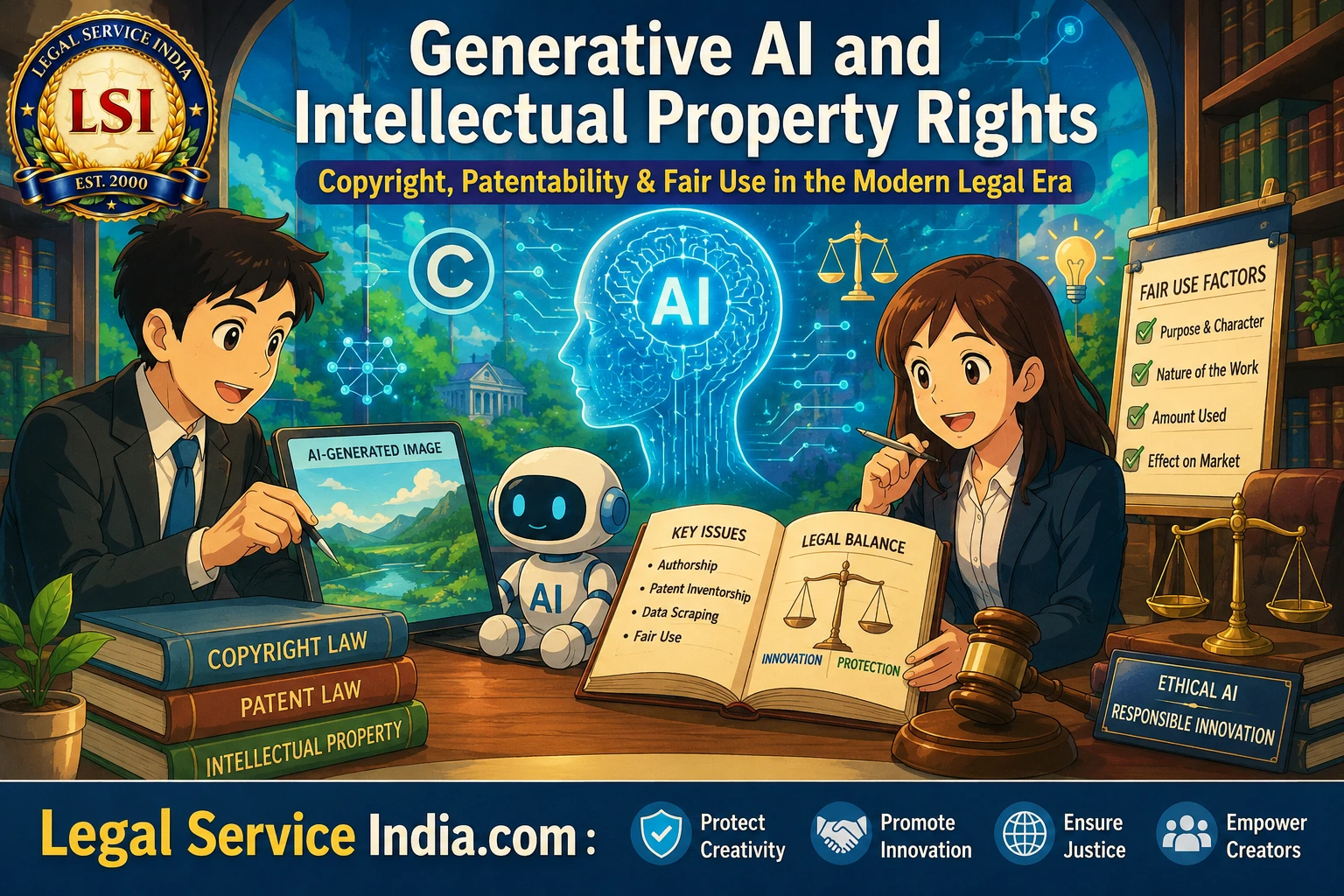
Intellectual Property Rights in the Era of Generative AI: Re-Evaluating Authorship, Patentability, and Fair Use
A Jurisprudence Analysis of Copyright Ownership, Patent Inventorship, and Data Scraping Doctrines
1. Introduction: The Generative AI Paradigm and Intellectual Property Law
The rapid commercialisation and widespread deployment of generative artificial intelligence (‘AI’) systems have initiated a seismic disruption across global intellectual property (‘IPR’) regimes. 1. Intellectual property frameworks—built primarily around human-centric notions of creativity, labour, and economic incentive—are currently struggling to accommodate machine-generated outputs. 2 From generative text and synthetic imagery to autonomous software compilation and molecular design, AI applications challenge the traditional boundary between protected human expression and unprotectable algorithmic output. 3
This technological surge presents two core legal challenges:
- Output-side concerns regarding the subsistence of copyright and patent protection in machine-created works. 4
- Input side issues concerning copyright infringement during model training. 4
As courts and patent offices across major jurisdictions grapple with these questions, legislative bodies face growing pressure to formulate modernised legal standards that balance innovation with the rights of original creators. 5
“The fundamental philosophical foundation of intellectual property protection rests upon human intellectual effort and creative agency. Distorting statutory definitions of authorship to include autonomous software runs the risk of undermining the delicate constitutional bargain that incentivises human creation.”
Key Legal Challenges Presented by Generative AI
| Area | Primary Legal Issue |
|---|---|
| Output Side | Copyright ownership and patent protection for AI-generated works |
| Input Side | Copyright infringement arising from AI model training datasets |
| Policy | Balancing technological innovation with creators’ rights |
2. Copyright Ownership and the Requirement of Human Authorship
A central debate in contemporary copyright jurisprudence concerns whether autonomous or semi-autonomous AI output qualifies for copyright protection. 6 Historically, national copyright statutes have consistently required a direct nexus between the work and human intellectual creativity. 7 Recent judicial rulings and administrative guidance from leading copyright offices have reiterated that works created entirely by machine algorithms without sufficient human control remain in the public domain. 8
However, determining the precise threshold of human intervention required to establish authorship remains complex. 9 When human prompts are highly detailed, iterative, or combined with post-generation editing, courts must evaluate whether the prompt engineer has exercised genuine ‘creative control’ or merely provided high-level instructions analogous to a client commissioning a human artist. 10 As generative tools become increasingly integrated into professional workflows, establishing clear lines between human assistance and autonomous generation remains critical. 11
“To claim copyright in an AI-assisted work, a human author must contribute sufficient creative expression that directly shapes the final arrangement, selection, or composition of the output, rather than relying solely on automated algorithmic execution.”
Important Human Authorship Principles
- Human intellectual creativity remains the foundation of copyright protection.
- Machine-generated works without sufficient human control generally remain in the public domain.
- The degree of human creative control continues to be a major judicial consideration.
- Prompt engineering alone may not always establish copyright authorship.
- Post-generation creative editing can influence authorship determination.
3. Patentability and the Inventorship Dilemma in AI-Driven Discoveries
Parallel challenges have emerged within patent law, where advanced machine learning models now autonomously synthesise novel chemical compounds, optimise engine designs, and engineer mechanical devices. 12 In several landmark cases globally (commonly referred to as the DABUS matters), patent offices and appellate courts examined whether an AI algorithm could be validly listed as a sole or joint inventor. 13
The overwhelming consensus across international tribunals reaffirms that patent statutes mandate a natural person as the named inventor. 14 Nevertheless, denying patent protection to valuable inventions generated through machine intelligence creates potential market gaps. 15 If patent systems require a natural person inventor but reject applications where human scientists relied extensively on automated discovery, companies may conceal technological innovations as trade secrets, reducing transparency in scientific advancement. 16 patent offices are now issuing procedural frameworks to clarify when human reliance on AI tools still permits human inventorship status. 17
Patent Inventorship Issues
| Issue | Current Position |
|---|---|
| AI as Inventor | A natural person is generally required. |
| DABUS Cases | Courts largely rejected AI inventorship. |
| Commercial Concern | Possible shift toward trade-secret protection |
| Emerging Practice | Guidelines clarifying human inventorship when AI tools assist innovation |
4. Model Training, Data Scraping, and the Boundaries of Fair Use
On the input side, the training of large language models and diffusion systems requires assembling massive datasets that often include copyrighted literary works, digital artwork, and proprietary code without prior licensing. 18. Copyright holders argue that unauthorised ingestion and storage of protected material constitutes direct copyright infringement. 19 Conversely, AI developers contend that training models involves transformative data analysis, falling squarely within statutory exceptions such as ‘fair use’ or text and data mining (‘TDM’) exemptions. 20
The resolution of these infringement actions hinges on whether training AI models damages the market value for original works or acts as a commercial substitute for human creators. 21 If generative outputs compete directly with the artists whose works were scraped to build the model, courts may find that fair use defences are unpersuasive. 22 Consequently, technological companies are increasingly entering into collective licensing agreements with content owners to establish sustainable data pipeline models. 23
“Ingesting protected expressions to train commercial models that directly compete with original creators challenges traditional interpretations of fair use. Maintaining a functional equilibrium requires robust licensing frameworks that compensate for human authorship.”
Fair Use Issues in AI Model Training
- Large AI models require extensive datasets for training.
- Many datasets contain copyrighted books, artwork, music, and software.
- Copyright owners argue unauthorised copying constitutes infringement.
- AI developers rely upon fair use or text and data mining exceptions.
- Market substitution remains a major factor in ongoing litigation.
- Collective licensing models are increasingly being explored.
5. Policy Directions: Balancing Innovation and Protection
The rapid expansion of generative technology necessitates modern legal strategies to safeguard intellectual property principles while encouraging technological growth. 24 specialised regulatory responses—such as mandatory disclosure of AI-generated content, standardised metadata tagging, and statutory text-mining exemptions with opt-out mechanisms—are actively under development globally. 25 International harmonisation among treaty bodies like WIPO is crucial to avoid jurisdictional fragmentation in global IP enforcement. 26
Ultimately, intellectual property law must adapt to technological changes without compromising its core objective: encouraging human intellect and public progress. 27 By establishing fair standards for human authorship, inventorship attribution, and data licensing, legal systems can ensure that human creativity and artificial intelligence complement each other constructively. 28
Future Policy Priorities
| Policy Area | Objective |
|---|---|
| AI Disclosure | Increase transparency regarding AI-generated content. |
| Metadata Standards | Improve identification and traceability of AI-created works. |
| Text and Data Mining | Develop balanced statutory exemptions with opt-out mechanisms. |
| International Cooperation | Promote harmonised intellectual property standards through WIPO. |
| Licensing Frameworks | Protect creators while supporting responsible AI innovation. |
Key Takeaways
- Generative AI is fundamentally reshaping global intellectual property law.
- Human authorship remains the cornerstone of copyright protection.
- Patent laws continue to require a natural person as the inventor.
- AI training datasets have intensified debates over copyright infringement and fair use.
- Licensing mechanisms and international harmonisation are emerging as practical solutions.
- Future intellectual property frameworks must balance technological innovation with protection of human creativity.
End-Notes
- Mark A. Lemley, ‘Myth and Reality in Generative AI and Intellectual Property’, Stanford Law Review, Vol. 76, No. 4 (2024), pp. 789–820.
- Jane C. Ginsburg, ‘People Not Machines: Authorship and What It Means in Copyright Law’, Columbia Journal of Law & the Arts, Vol. 41, No. 2 (2018), pp. 221–254.
- Daniel Gervais, The Machine As Author: AI and the Future of Copyright, Oxford University Press (2021), p. 62.
- Pamela Samuelson, ‘Generative AI Meets Copyright Law’, Communications of the ACM, Vol. 66, No. 7 (2023), pp. 22–25.
- World Intellectual Property Organization (WIPO), Revised Issues Paper on Intellectual Property Policy and Artificial Intelligence, WIPO/IP/AI/2/REV (2020), p. 8.
Important Links
Important Links:
- Lawyers in India
- Copyright Registration in India
- Caveat Filing in Supreme Court of India
- Mutual Consent Divorce in Delhi/NCR : WhatsApp 9650499965

