Introduction
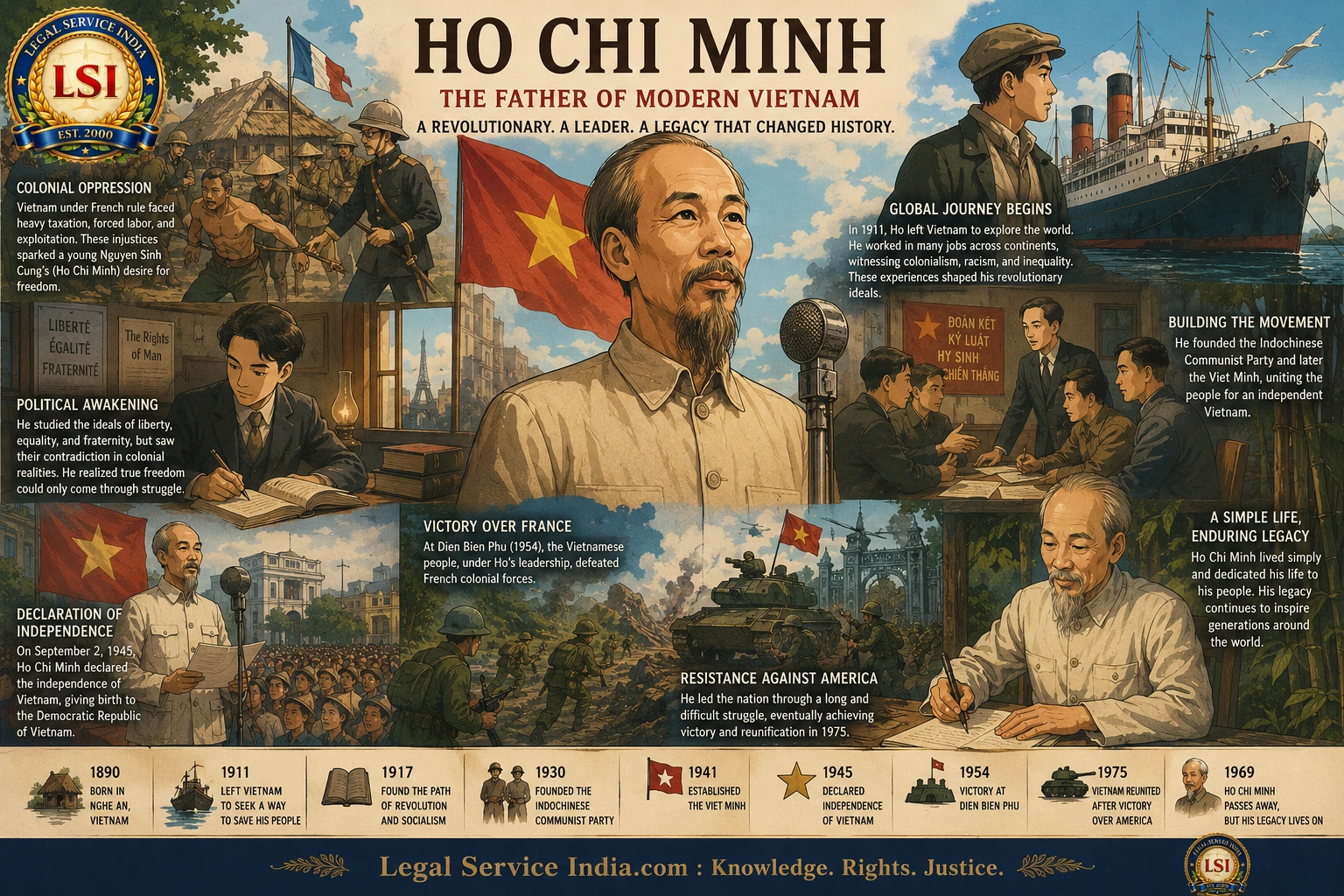
Few individuals have left a deeper imprint on the twentieth century than Ho Chi Minh. Revered by many as the father of modern Vietnam and criticised by others for his revolutionary methods, Ho Chi Minh remains one of history’s most complex political figures. His life traversed continents, wars, revolutions, prisons, and ideological struggles.
From a poor colonial subject working in ship kitchens to the architect of Vietnamese independence, his journey symbolised the broader struggle of colonised peoples against imperial domination.
For more than three decades, he wandered across Europe, Africa, America, Russia, and China before returning to Vietnam to lead a movement that would ultimately defeat two of the world’s most powerful military powers—France and the United States.
His story is not merely the biography of a man; it is the story of modern Vietnam’s birth and the collapse of the colonial age.
Childhood Under Colonial Rule
Ho Chi Minh was born in 1890 as Nguyen Sinh Cung in the village of Hoang Tru in central Vietnam. His childhood unfolded against the backdrop of French colonial domination.
France had gradually conquered Vietnam during the nineteenth century and divided it into administrative regions designed to facilitate colonial control.
The Vietnamese people endured heavy taxation, forced labour, monopolies over essential commodities such as salt and alcohol, and widespread economic exploitation. Colonial rule penetrated every aspect of daily life, creating profound resentment among ordinary Vietnamese.
Colonial Conditions in Vietnam
| Aspect | Impact on Vietnamese Society |
|---|---|
| Heavy Taxation | Increased financial burden on ordinary people |
| Forced Labor | Compelled labor under colonial authority |
| Commodity Monopolies | Control over essentials such as salt and alcohol |
| Economic Exploitation | Widespread poverty and social inequality |
Ho’s father, Nguyen Sinh Sac, was a scholar who had risen from poverty through education. Despite achieving success in the imperial examination system, he refused to become a compliant servant of the French colonial administration.
His belief that serving under colonial authority amounted to slavery profoundly influenced his young son.
Equally influential were the stories of Vietnamese resistance heroes, tales of foreign invasions, and discussions among early nationalist thinkers who regularly visited the family home.
These conversations exposed the young Ho to competing visions of how Vietnam might regain its freedom.
Education and Early Political Awakening
Ho attended schools designed to train Vietnamese youths for subordinate positions within the colonial bureaucracy.
There he learnt the French language, geography, and the ideals celebrated by the French Republic: liberty, equality, and fraternity.
Yet he quickly recognised a contradiction. The principles proclaimed by France in Europe were denied to the people of Vietnam.
A defining moment came during the anti-tax protests of 1908. Thousands of impoverished peasants marched against excessive taxation and forced labour.
As a teenager, Ho witnessed French authorities suppress the demonstrations with violence. Seeing fellow Vietnamese shot and killed left a lasting impression on him.
His involvement with the protesters attracted the attention of colonial authorities, resulting in his expulsion and increasing surveillance.
Realising that opportunities within the colonial system were limited, he eventually drifted south toward Saigon.
Key Influences on Young Ho
- French colonial rule and social inequality
- His father’s anti-colonial beliefs
- Vietnamese resistance traditions
- The anti-tax protests of 1908
- Exposure to nationalist thinkers
Departure From Vietnam and the Beginning of a Global Journey
In June 1911, at the age of twenty-one, Ho left Vietnam aboard a French steamship.
Working as a kitchen assistant and labourer, he embarked on a journey that would transform him from a colonial subject into a revolutionary thinker.
The voyage introduced him to the global nature of empire.
He encountered African, Chinese, Malagasy, and other colonial workers whose experiences resembled those of the Vietnamese.
Everywhere he travelled, he observed the inequalities embedded in colonial systems.
One lesson particularly shaped his worldview. In France itself, ordinary French workers often treated him with more dignity than colonial officials had shown in Vietnam.
This distinction convinced him that the problem was not an entire people but an oppressive political and economic system.
Encounters with America and Britain
Ho spent time in the United States, living in cities such as Boston and New York.
He worked various jobs, including as a baker and domestic servant.
During these years, he studied American history, especially the Declaration of Independence and the life of Abraham Lincoln.
At the same time, he observed racial discrimination, segregation, and violence against African Americans.
He attended meetings associated with Black liberation movements and began drawing parallels between racial oppression in America and colonial domination in Asia.
Later, in London, he worked in hotels and kitchens while educating himself through extensive reading.
There he encountered the Irish independence movement and followed Ireland’s struggle against British rule with deep sympathy.
These experiences broadened his understanding of oppression beyond Vietnam.
He increasingly saw colonialism as a global phenomenon requiring a global response.
International Experiences and Lessons
| Location | Experience | Influence on Ho Chi Minh |
|---|---|---|
| United States | Studied American history and observed racial discrimination | Drew parallels between racial and colonial oppression |
| Britain | Worked while self-educating through reading | Developed broader political awareness |
| Ireland (through observation) | Followed Irish independence movement | Strengthened anti-colonial convictions |
Paris and the Birth of a Revolutionary
Following World War I, Ho settled in Paris.
The city was filled with colonial soldiers and workers who had contributed to the French war effort.
Living in poverty, he supported himself through odd jobs while immersing himself in political debates.
The Paris Peace Conference of 1919 marked a turning point.
Inspired by President Woodrow Wilson’s rhetoric of self-determination, Ho helped draft an eight-point petition seeking modest reforms for Vietnam, including freedom of speech, political representation, and civil liberties.
The petition was ignored.
The rejection profoundly influenced him. It convinced him that colonial powers would not voluntarily grant meaningful rights to colonised peoples.
Around this time, he adopted the name Nguyen Ai Quoc—”Nguyen the Patriot”—and became increasingly active in socialist circles.
Conversion to Communism
A decisive moment came when Ho read Vladimir Lenin’s writings on colonialism and national liberation.
Unlike many European political thinkers, Lenin viewed colonised peoples as central actors in the global struggle against oppression.
Ho found in Lenin’s ideas a framework capable of addressing Vietnam’s situation.
In 1920, he joined the French Communist movement and became one of the founding members of the French Communist Party.
He launched newspapers, wrote articles exposing colonial abuses, and published works criticising the French colonial system.
His writings circulated among Vietnamese students and activists, helping nurture an emerging nationalist consciousness.
Why Lenin’s Ideas Appealed to Ho
- Recognition of colonized peoples in global struggles
- Support for national liberation movements
- A framework for challenging colonial rule
- A strategy applicable to Vietnam’s political reality
Moscow and Revolutionary Training
Recognised by the Communist International (Comintern), Ho travelled to the Soviet Union in the early 1920s.
There he studied revolutionary organisation, political strategy, and underground activism.
He attended international conferences and argued that traditional Marxist theories underestimated the revolutionary potential of peasant societies.
This insight would later distinguish his approach from many orthodox Marxists.
Vietnam was overwhelmingly rural, and Ho believed peasants—not industrial workers—would form the backbone of national liberation.
Building a Revolutionary Movement in China
In the mid-1920s, Ho relocated to southern China, where he began organising Vietnamese exiles and revolutionaries.
He founded the Vietnamese Revolutionary Youth League and established training programmes for young activists.
His teaching combined Marxist ideas with traditional Vietnamese values such as discipline, modesty, sacrifice, and service.
Rather than promoting class warfare alone, he emphasised national liberation as the primary objective.
His efforts laid the foundations for a disciplined revolutionary movement that would eventually evolve into the Vietnamese Communist Party.
Principles Emphasized in Training
- Discipline
- Modesty
- Sacrifice
- Service
- National liberation
- Revolutionary organization
Arrest, Imprisonment, and Survival
In 1931, British authorities arrested Ho in Hong Kong.
At the time, the French had already sentenced him to death in absentia.
Extradition appeared likely. However, a determined legal defence prevented his transfer to French custody.
During imprisonment, he suffered severe illness, including tuberculosis.
Rumours spread that he had died.
Those rumours ultimately benefited him. French authorities closed their files, believing the revolutionary had perished.
In reality, Ho escaped and reemerged years later under different identities.
Major Events During Imprisonment
| Event | Outcome |
|---|---|
| Arrest in Hong Kong (1931) | Detained by British authorities |
| Threat of Extradition | Prevented through legal defense |
| Severe Illness | Rumors of death circulated widely |
| Disappearance from Records | French authorities believed he had died |
| Return to Revolutionary Activity | Reemerged under different identities |
Return to Vietnam and the Creation of the Viet Minh
After nearly three decades abroad, Ho returned to Vietnam in 1941. Operating from a cave near the Chinese border, he established the Viet Minh, a broad nationalist coalition dedicated to independence.
Recognising the need for unity, Ho temporarily set aside strict ideological concerns. He invited workers, peasants, intellectuals, religious leaders, and even patriotic landlords to join the struggle.
Key Objectives of the Viet Minh
- Unite diverse social groups under a common nationalist cause.
- Fight for Vietnamese independence.
- Mobilise workers, peasants, intellectuals, and religious communities.
- Resist both colonial and wartime occupation.
The movement focused on expelling foreign occupiers—both the French colonial administration and the Japanese forces occupying Vietnam during World War II.
The Famine and Rise of Popular Support
The devastating famine of 1944-45 transformed the political landscape.
Millions of Vietnamese died due to a combination of wartime disruption, colonial mismanagement, and Japanese rice requisitioning.
The Viet Minh responded by seizing rice stores and distributing food to starving populations. In countless villages, they became associated not merely with revolution but with survival.
This humanitarian response significantly expanded popular support.
Major Causes of the Famine
- Wartime disruption.
- Colonial mismanagement.
- Japanese rice requisitioning.
| Factor | Impact |
|---|---|
| Wartime Disruption | Reduced agricultural production and food distribution. |
| Colonial Mismanagement | Worsened food shortages across regions. |
| Japanese Rice Requisitioning | Diverted essential food supplies from local populations. |
| Viet Minh Relief Efforts | Increased public trust and support for the movement. |
Cooperation with the United States During World War II
One of the lesser-known aspects of Ho’s career was his wartime cooperation with the United States.
The American Office of Strategic Services (OSS), the predecessor of the CIA, worked with the Viet Minh against Japanese forces. American operatives provided training, weapons, and intelligence assistance.
Ho repeatedly expressed admiration for American revolutionary ideals and hoped postwar America would support Vietnamese independence.
These hopes would ultimately prove misplaced.
Nature of OSS Support
- Military training.
- Weapons assistance.
- Intelligence cooperation.
- Joint operations against Japanese forces.
The August Revolution and Independence
Following Japan’s surrender in August 1945, the Viet Minh rapidly seized power across Vietnam.
Mass demonstrations swept major cities, and Emperor Bao Dai abdicated.
On September 2, 1945, Ho Chi Minh proclaimed the independence of the Democratic Republic of Vietnam in Hanoi.
Remarkably, he opened his declaration by quoting the American Declaration of Independence and invoking the principles of the French Revolution.
The message was clear: Vietnam demanded the same rights that Western powers claimed for themselves.
Key Events of 1945
| Date/Event | Significance |
|---|---|
| August 1945 | Japan surrendered, creating a political vacuum. |
| August Revolution | Viet Minh rapidly seized power nationwide. |
| Abdication of Bao Dai | Marked the end of imperial rule. |
| September 2, 1945 | Ho Chi Minh proclaimed independence in Hanoi. |
War Against France
Despite the declaration of independence, France sought to re-establish colonial control.
Negotiations failed, and full-scale war erupted in 1946.
Ho attempted diplomacy while General Vo Nguyen Giap organised military resistance. The Viet Minh adopted a strategy of protracted warfare, combining guerrilla tactics with political mobilisation.
The movement established schools, local governments, literacy campaigns, and supply networks throughout rural Vietnam.
The conflict culminated in the Battle of Dien Bien Phu in 1954.
Viet Minh Strategy
- Guerrilla warfare.
- Political mobilisation.
- Development of local governance structures.
- Expansion of literacy campaigns.
- Creation of rural supply networks.
Dien Bien Phu: The Battle That Changed History
Dien Bien Phu became one of the most significant military victories of the twentieth century.
French commanders believed their fortified position was impregnable. Yet Vietnamese forces achieved a logistical feat that astonished military observers worldwide.
Thousands of labourers transported artillery through mountains and jungles, often using reinforced bicycles capable of carrying enormous loads.
After a prolonged siege, French forces surrendered in May 1954.
The victory shattered the myth of European military invincibility and inspired anti-colonial movements across Asia, Africa, and Latin America.
Why Dien Bien Phu Was Historic
- Demonstrated extraordinary logistical capabilities.
- Ended French military dominance in Indochina.
- Inspired anti-colonial movements worldwide.
- Changed the global perception of colonial power.
Divided Vietnam and Challenges of Governance
The Geneva Accords temporarily divided Vietnam into northern and southern zones pending national elections.
Those elections never occurred.
In North Vietnam, Ho faced the enormous challenge of reconstruction after decades of war.
Land reforms redistributed property to peasants and dismantled traditional landlord structures. While these reforms provided significant benefits to many rural families, they also generated severe abuses.
Local officials pursued ideological campaigns that led to wrongful accusations, imprisonments, and executions. Thousands suffered.
Unlike many revolutionary leaders, Ho later publicly acknowledged mistakes and initiated corrective measures. Though controversy remains regarding the extent of his responsibility, the episode remains one of the darkest chapters of his rule.
Impact of Land Reforms
| Positive Outcomes | Negative Consequences |
|---|---|
| Redistribution of land to peasants. | Wrongful accusations. |
| Dismantling of landlord dominance. | Imprisonments. |
| Benefits for many rural families. | Executions and ideological excesses. |
| Social restructuring. | Long-term controversy and suffering. |
Literacy, Healthcare, and Social Development
Despite these failures, North Vietnam achieved notable social progress.
Mass literacy campaigns dramatically reduced illiteracy. Schools expanded across rural areas. Healthcare services reached communities that had previously lacked access to medical care.
Infrastructure development and early industrialisation efforts laid foundations for future growth.
These achievements strengthened Ho’s image as a leader committed to social transformation.
Major Social Achievements
- Mass literacy campaigns.
- Expansion of rural education.
- Improved healthcare access.
- Infrastructure development.
- Early industrialisation initiatives.
- Foundations for long-term economic growth.
| Sector | Development |
|---|---|
| Education | Mass literacy campaigns and school expansion. |
| Healthcare | Medical services extended to underserved communities. |
| Infrastructure | Development projects supporting reconstruction. |
| Industry | Early industrialisation efforts created foundations for future growth. |
Ho Chi Minh’s Political Philosophy
Perhaps Ho’s greatest intellectual contribution was adapting Marxism to a predominantly agrarian society. Traditional Marxist theory emphasised industrial workers. Ho argued that peasants in colonised societies possessed enormous revolutionary potential.
Equally important was his integration of communist principles with Vietnamese cultural traditions. He blended Marxism with Confucian concepts of moral duty, discipline, modesty, and public service.
This synthesis helped make revolutionary ideas accessible to ordinary villagers.
Key Elements of Ho Chi Minh’s Political Philosophy
| Philosophical Element | Description |
|---|---|
| Adaptation of Marxism | Applied Marxist principles to a largely agrarian and colonised society. |
| Role of Peasants | Recognised peasants as a major revolutionary force. |
| Confucian Influence | Integrated values such as moral duty, discipline, modesty, and public service. |
| National Relevance | Made revolutionary ideology understandable and relatable to ordinary Vietnamese villagers. |
The American War
During the 1960s, conflict escalated between North Vietnam and the U.S.-backed South Vietnamese government.
The National Liberation Front emerged in the South, drawing support from those opposed to the Saigon regime.
American military involvement expanded dramatically, bringing hundreds of thousands of troops into Vietnam.
Although increasingly elderly and in poor health, Ho remained the symbolic leader of the struggle. His image became a source of inspiration for Vietnamese resistance.
Major Developments During the War
- Escalation of conflict between North and South Vietnam.
- Rise of the National Liberation Front in South Vietnam.
- Large-scale deployment of American military forces.
- Ho Chi Minh’s continued role as a symbol of national resistance.
Death and Legacy
Ho Chi Minh died in 1969 before witnessing the final reunification of Vietnam.
Yet six years later, North Vietnamese forces captured Saigon, effectively ending the war and unifying the country.
His legacy remains deeply contested.
Supporters regard him as the liberator who ended colonial rule, unified Vietnam, and restored national dignity. Critics point to political repression, land reform abuses, and the immense human costs associated with revolutionary warfare.
Both perspectives contain elements of truth.
Ho Chi Minh was neither a flawless hero nor a simple villain. He was a revolutionary strategist, nationalist leader, communist ideologue, skilled diplomat, and relentless anti-colonial activist. His life embodied both the aspirations and tragedies of the twentieth century.
Contrasting Views on Ho Chi Minh’s Legacy
| Supporters’ Perspective | Critics’ Perspective |
|---|---|
| Ended colonial rule in Vietnam. | Political repression under communist rule. |
| Unified the Vietnamese nation. | Land reform abuses and associated suffering. |
| Restored national dignity and independence. | High human costs of revolutionary warfare. |
| Inspired anti-colonial movements worldwide. | Criticism of authoritarian governance practices. |
Conclusion
The story of Ho Chi Minh is inseparable from the story of modern Vietnam. From a poor scholar’s son in colonial Indochina to one of the most influential revolutionary leaders in history, his journey transformed not only his own nation but also the global struggle against colonialism.
His victories demonstrated that even seemingly powerless peoples could challenge mighty empires. At the same time, his career illustrates the difficult moral choices and immense human costs that often accompany revolutionary change.
More than half a century after his death, debates about Ho Chi Minh continue. Yet one fact remains undeniable: few individuals have altered the course of modern history as profoundly as the man who left Vietnam as an anonymous kitchen worker and returned to become the architect of a nation.
Key Takeaways
- Ho Chi Minh adapted Marxist ideology to the realities of an agrarian society.
- He combined communist principles with traditional Vietnamese and Confucian values.
- He remained a powerful symbol of Vietnamese resistance during the American War.
- His legacy continues to generate debate among historians and political scholars.
- His influence shaped both modern Vietnam and global anti-colonial movements.
Key Takeaways
- Ho Chi Minh transformed from a colonial subject into a revolutionary leader, fighting against French and American powers for Vietnamese independence.
- He adapted Marxist ideology to a primarily agrarian society, promoting peasant roles in the revolution.
- Ho established the Viet Minh, gaining popular support by distributing food during the 1944-45 famine and resisting foreign occupiers.
- Though a symbol of national resistance during the American War, his complex legacy includes both revolutionary successes and significant human costs.
- Debates about his legacy continue, highlighting his influences on modern Vietnam and the global struggle against colonialism.
Ho Chi Minh was a Vietnamese revolutionary leader who dedicated his life to ending colonial rule in Vietnam. He played a central role in Vietnam’s struggle for independence from France and later became the founding leader of modern Vietnam. His efforts inspired anti-colonial movements across Asia and Africa.
Ho Chi Minh left Vietnam at the age of 21 aboard a French steamship. He wanted to understand the wider world, learn how colonial powers operated, and find a path that could eventually help liberate Vietnam from foreign domination.
During his travels through France, the United States, Britain, and other countries, Ho Chi Minh witnessed inequality, racial discrimination, and colonial exploitation. These experiences convinced him that oppressed peoples around the world faced similar struggles and needed organised movements to achieve freedom.
At the Versailles Conference, Ho Chi Minh submitted a petition requesting basic rights and representation for Vietnamese people. The complete lack of response from world leaders convinced him that colonial powers would not voluntarily grant freedom to their colonies.
Ho Chi Minh believed communism offered a practical framework for fighting imperialism and colonialism. He was particularly influenced by Lenin’s writings, which emphasised the importance of national liberation movements in colonised countries.
After years of organising Vietnamese revolutionaries across Asia, Ho Chi Minh helped unite competing nationalist and communist groups in Hong Kong in 1930. This effort led to the creation of the Vietnamese Communist Party, which became the driving force behind Vietnam’s independence movement.
The Viet Minh was a broad nationalist coalition founded by Ho Chi Minh in 1941. Rather than focusing solely on communist ideology, it united people from different social, religious, and economic backgrounds around the common goal of national independence, making it highly effective.
On September 2, 1945, in Hanoi’s Ba Dinh Square, Ho Chi Minh proclaimed Vietnam’s independence. In his speech, he cited both the American Declaration of Independence and the French Declaration of the Rights of Man to justify Vietnam’s right to self-determination.
Ho Chi Minh provided the political leadership for Vietnam’s independence struggle, while General Vo Nguyen Giap led military operations. Their efforts culminated in the historic Vietnamese victory at the Battle of Dien Bien Phu in 1954, which ended French colonial rule in Indochina.
Ho Chi Minh is remembered as the architect of Vietnamese independence and national reunification. Supporters view him as a symbol of liberation and anti-colonial resistance, while critics debate aspects of his communist policies. Nevertheless, his influence on Vietnam and twentieth-century world history remains profound.