“The moment a nation starts believing that power can place a person above the law, democracy begins to lose its soul. The real test of justice is not whether it can punish the powerless—it is whether it can hold the powerful accountable without destroying the institution they lead.”
— Adv. Tarun Choudhury
The Constitutional Battle Over Presidential Immunity, Criminal Liability, and the Rule of Law
There is a deceptively simple question at the heart of one of America’s most difficult constitutional controversies:
Can a Sitting President of the United States Be Criminally Prosecuted While Still in Office?
At first glance, the answer appears straightforward. The president is not supposed to be above the law. If an ordinary citizen commits a crime, the criminal justice system investigates, charges, and prosecutes and, if proved guilty, punishes that person. Why should the president be different?
But the American Constitution creates a problem that cannot be answered by simply saying “nobody is above the law.”
The president is not merely an individual. The President is also the head of the Executive Branch, Commander in Chief, chief representative of the United States in foreign affairs, and the person constitutionally entrusted with executing federal law. A criminal prosecution that consumes the president’s time, disables presidential functions, or permits a state prosecutor to interfere with the national government therefore raises questions that simply do not arise when an ordinary citizen is prosecuted.
That is why I believe the American debate has been asking the wrong question.
The question should not be merely:
“Can we prosecute a president?”
The better question is
“How can America protect the constitutional functioning of the presidency without turning presidential office into a temporary sanctuary from criminal accountability?”
After examining the constitutional text, Supreme Court jurisprudence, the presidential immunity doctrine, impeachment, criminal procedure, and the institutional problems exposed by recent events, I believe there is a third way.
Also Read: Can America Reform the Supreme Court? Latest 5–4 Ruling Reignites Term Limits Debate
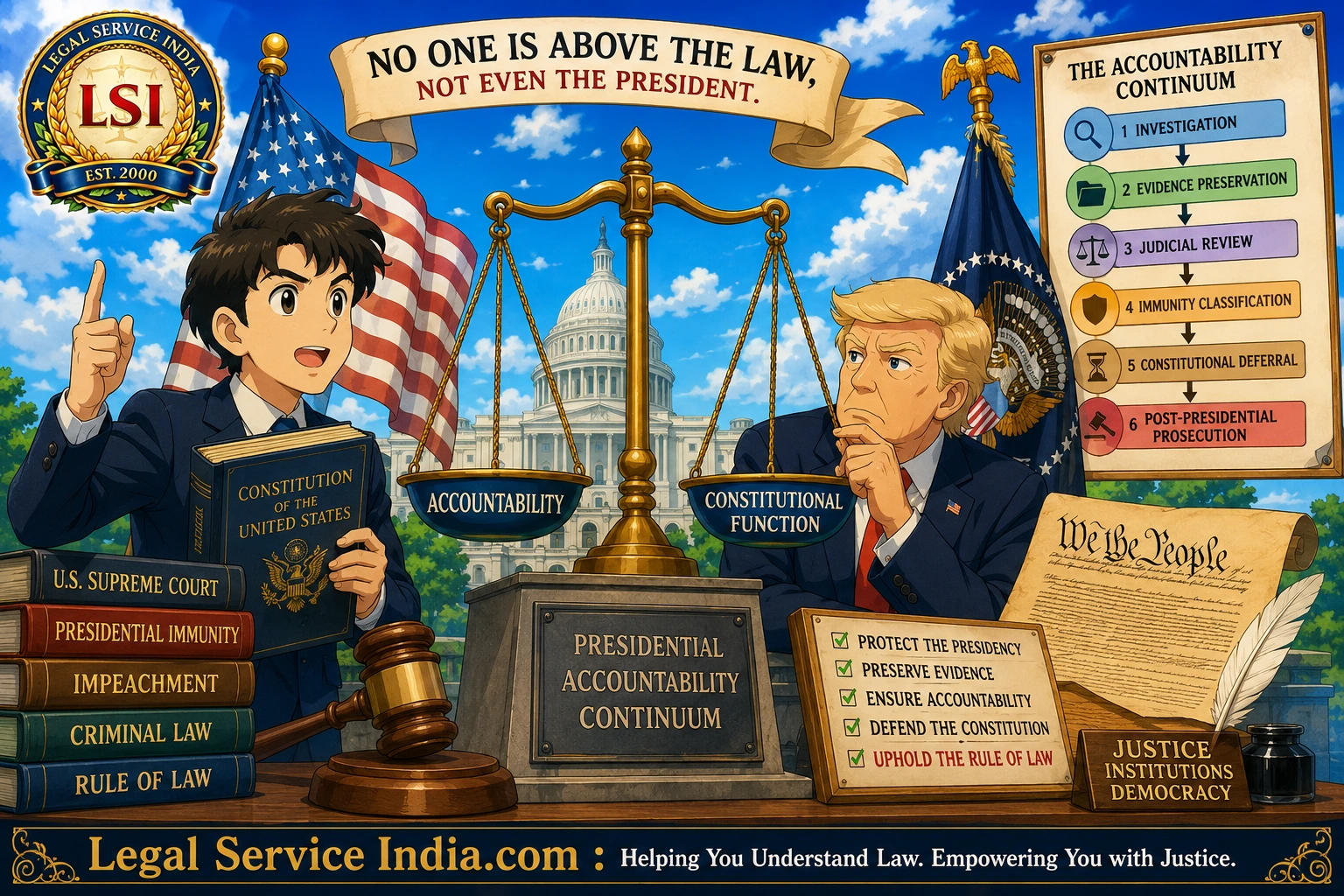
The Presidential Accountability Continuum
I call it the Presidential Accountability Continuum.
Its basic philosophy is simple:
- Investigate when investigation is justified.
- Preserve evidence while it is available.
- Allow courts to decide genuine immunity questions.
- Protect the functioning of the Presidency where necessary.
- But never allow temporary protection of the office to become permanent protection of the individual.
That distinction could become one of the most important constitutional principles for the next generation of American presidential accountability.
1. The Short Answer: It Is Not Simply “Yes” or “No”
The first thing that must be understood is that there are actually several different questions hidden inside the expression “prosecuted while in office.”
Can a Sitting President Be Investigated?
The Supreme Court has made clear that presidential status does not create absolute immunity from criminal investigation. In Trump v. Vance (2020), the Court rejected the argument that a sitting president was categorically immune from a state grand jury subpoena seeking private financial records.
That is important.
It means that being president does not make a person legally invisible.
But investigation is not the same thing as indictment.
The Department of Justice’s Office of Legal Counsel has maintained, since its 1973 opinion and reaffirmed in 2000, that a sitting president cannot constitutionally be indicted or criminally prosecuted while in office because such proceedings could interfere with the president’s constitutional duties.
But there is an equally important qualification:
That is the position of the Executive Branch, not a definitive Supreme Court ruling squarely deciding the issue.
The Supreme Court has therefore left an important constitutional question unresolved.
Then came Trump v. United States in 2024.
That case changed the discussion again.
The Court held that a former president enjoys absolute immunity for certain core constitutional acts, at least presumptive immunity for other official acts, but no presidential immunity for unofficial acts.
This distinction is crucial.
Presidential immunity is therefore not simply
“The President is immune.”
The real question is
“Immune from what, for which act, and for what constitutional reason?”
That is a much more complicated—and much more interesting—question.
2. The Constitution Never Says the President Is “Above the Law”
One of the most common statements in this debate is that the Constitution gives the President immunity from prosecution.
The text is not so simple.
Article II, Section 4 provides for impeachment and removal of the President for treason, bribery, or other high crimes and misdemeanors.
Article I, Section 3 provides that even after impeachment and conviction, the person remains liable to indictment, trial, judgment, and punishment according to law.
That tells us something fundamental.
The constitutional system recognizes both:
- political accountability
- criminal accountability
They are not the same thing.
| Accountability System | Purpose |
|---|---|
| Impeachment | Determines whether an officeholder should remain in constitutional office. |
| Criminal Prosecution | Determines whether an individual committed a crime and should receive the punishment prescribed by law. |
Impeachment determines whether an officeholder should remain in constitutional office.
Criminal prosecution determines whether an individual committed a crime and should receive the punishment prescribed by law.
Confusing these two systems has produced much of the confusion surrounding presidential immunity.
3. The Supreme Court’s Presidential Immunity Journey
To understand where America stands today, we have to look at how the Supreme Court arrived here.
United States v. Nixon: The President Cannot Become Judicially Invisible
The Watergate era produced one of the most important constitutional principles in American history.
In United States v. Nixon, the Supreme Court rejected an absolute claim of presidential privilege against a judicial demand for evidence.
The message was powerful:
The presidency is extraordinarily important, but the judicial process does not simply disappear when the president is involved.
That principle remains enormously important today.
The president has constitutional powers.
The President does not possess a constitutional magic shield against every judicial proceeding.
4. Nixon v. Fitzgerald: Official Presidential Acts Are Different
The Court later recognized absolute civil immunity for a president for official acts in Nixon v. Fitzgerald.
The justification was not that presidents are morally superior to other citizens.
The justification was institutional.
A president must be able to make difficult constitutional and policy decisions without living under the constant threat of personal civil liability for every official decision.
This created an important principle:
Immunity can protect the office’s constitutional functions.
That principle eventually became central to the modern criminal-immunity debate.
5. Clinton v. Jones: The Office Does Not Erase the Person
Then came Clinton v. Jones.
The Supreme Court rejected the argument that a sitting president enjoyed blanket immunity from civil litigation involving unofficial conduct that occurred before taking office.
The significance of that decision is often underestimated.
The Court effectively recognized a distinction between:
- the President acting as President
- the individual who happens to occupy the presidency
That distinction should remain at the center of every serious discussion about presidential immunity.
6. Trump v. Vance: Investigation Is Not Prosecution
Trump v. Vance brought criminal investigation directly into the picture.
The issue involved a state grand jury subpoena for President Trump’s private financial records.
The Supreme Court refused to recognize categorical immunity.
That means something very important:
- A sitting president can be the subject of a criminal investigation.
- But that does not automatically mean that the president can be indicted, arrested, or subjected to an ordinary criminal trial while still serving.
This is where the American system enters constitutional uncertainty.
7. Trump v. United States: The New Immunity Architecture
The 2024 Supreme Court decision in Trump v. United States fundamentally altered the modern landscape.
The Court essentially created three categories of presidential conduct.
| Category | Presidential Conduct | Protection |
|---|---|---|
| First | Core constitutional powers | These receive the strongest protection, including absolute immunity in appropriate circumstances. |
| Second | Other official presidential acts | These receive at least presumptive immunity. |
| Third | Unofficial acts | These do not receive presidential immunity merely because the individual happens to be president. |
This is an extraordinarily important development.
Suppose a person becomes president.
That does not mean every action that person takes during those four years becomes a “presidential act.”
The legal question is not simply
“Did this happen while he was president?”
The better question is
“Was the conduct presidential in constitutional character?”
That distinction could determine the future of presidential criminal law.
8. The Real Constitutional Gap
In my view, this is where the American legal system needs serious reform.
The conventional criminal process looks something like this:
Investigation → indictment → trial → judgment → punishment.
But when the suspect is a sitting president, the normal sequence becomes uncertain.
- The president may be investigated.
- Evidence may be collected.
- A subpoena may be issued.
- But the question of indictment and prosecution becomes constitutionally complicated.
This creates what I call the:
Presidential Accountability Gap
The legal system knows how to investigate.
It knows how to prosecute ordinary citizens.
It knows how to impeach a president.
But it does not have a comprehensive, constitutionally settled mechanism for dealing with the period between:
- credible criminal investigation
- lawful post-presidential criminal adjudication
That is the gap we should fix.
9. Why “Just Prosecute the President” Is Not the Answer
Some commentators understandably argue that the simplest solution is to treat the president exactly like every other citizen.
I disagree.
That sounds attractive from the perspective of equality before law.
But constitutional equality does not necessarily mean identical procedure.
Imagine that a prosecutor in one state could force the president of the United States to spend weeks or months in court during an international crisis.
Imagine 50 states having competing criminal demands.
Imagine a hostile prosecutor using criminal procedure to interfere with national security decisions.
That would create another constitutional problem while attempting to solve the first.
The presidency is an institution.
It must continue functioning.
Therefore the solution cannot be
“Ignore presidential status entirely.”
But neither can it be:
“Once you become president, criminal accountability stops.”
Both extremes are dangerous.
Also Read: Who Controls American Elections? Trump’s Mail-Ballot Order and Supreme Court Battle
My Proposed Solution: The Presidential Accountability Continuum
I would therefore replace the binary debate with a structured system.
The Presidential Accountability Continuum
The system would have six stages:
| Stage | Process |
|---|---|
| 1 | Investigation |
| 2 | Evidence Preservation |
| 3 | Judicial Review |
| 4 | Immunity Classification |
| 5 | Constitutional Deferral, Where Necessary |
| 6 | Post-Presidential Reassessment and Ordinary Criminal Process |
This is fundamentally different from saying:
“Prosecute the President.”
It is also fundamentally different from saying:
“Wait until the president leaves office and do nothing in the meantime.”
The philosophy is
Delay punishment when constitutionally necessary—not truth-finding.
Stage One: Independent Investigation
A criminal allegation against a president should not automatically trigger extraordinary federal machinery.
There must first be a meaningful evidentiary threshold.
Credible Evidence Standard
I would call it the:
Credible Evidence Standard
There should be identifiable evidence providing a reasonable basis to believe:
- A specific criminal offense may have occurred;
- The President may have participated;
- identifiable evidence exists;
- The allegation is not merely political disagreement;
- Investigation is reasonably necessary.
A complaint alone should not be enough.
A partisan press conference should not be enough.
An opposition politician’s allegation should not be enough.
The system must distinguish:
political opposition
from
evidence of criminal conduct.
That distinction is essential if the criminal law is not to become another weapon in America’s increasingly polarized political system.
Stage Two: Preserve the Evidence
This is where I believe the system should depart most clearly from conventional thinking.
The question should not immediately be
“Can we put the president on trial?”
The first question should be:
“Can we ensure that the truth remains discoverable when the Constitution permits the case to be tried?”
Evidence can disappear.
Witnesses can die.
Memories deteriorate.
Electronic records can be altered or deleted.
Foreign evidence can become inaccessible.
Therefore, where a credible investigation exists, courts should have authority—within constitutional limits—to supervise preservation of relevant evidence.
Evidence Preservation Measures
That could include:
- preservation orders;
- third-party records;
- digital forensic preservation;
- witness preservation where lawful;
- banking records;
- communications records;
- foreign evidence requests;
- chain-of-custody documentation.
The objective is not to punish the president.
The objective is to prevent the passage of time from destroying the possibility of justice.
Stage Three: Judicial Review
A president should not be subjected to extraordinary criminal process merely because a prosecutor demands it.
Nor should a president be able to block every investigation simply by saying:
“I am President.”
A neutral federal judge should therefore have a central role.
The judge should examine:
- Is there a legitimate criminal investigation?
- What evidence is actually sought?
- Is it relevant?
- Can it be obtained elsewhere?
- How much interference with presidential functions would result?
- Does the requested process concern official presidential conduct?
- Is the burden proportionate to the seriousness of the alleged offense?
This would create what I call a:
Presidential Burden Test
The Presidential Burden Test
Before an extraordinary criminal process is imposed on a sitting president, the court should examine six questions.
| No. | Question | What the Court Should Examine |
|---|---|---|
| 1 | Governmental Burden | How much time and attention will the process consume? |
| 2 | Evidentiary Necessity | Is the evidence genuinely necessary? |
| 3 | Alternative Availability | Can substantially equivalent evidence be obtained elsewhere? |
| 4 | Constitutional Sensitivity | Does the evidence involve national security, diplomacy, or core presidential functions? |
| 5 | Seriousness of the Alleged Offense | Is the allegation minor, or does it involve serious criminal conduct? |
| 6 | Timing | Would waiting until the president leaves office destroy the possibility of justice? |
The objective should be
Minimum necessary interference with maximum preservation of lawful accountability.
Stage Four: Official or Unofficial?
Every serious allegation should then undergo a structured immunity analysis.
I would divide the conduct into four categories.
Category A — Clearly Unofficial Conduct
For example, purely private commercial fraud unrelated to presidential responsibilities.
There is no presidential immunity merely because the person is president.
Category B — Core Presidential Conduct
Conduct falling within exclusive constitutional powers.
The strongest immunity protection applies.
Category C — Other Official Conduct
Conduct undertaken in an official presidential capacity but outside the core category.
Presumptive immunity may apply.
Category D — Mixed Conduct
This is where the hardest cases will arise.
A president might use government officials, presidential communications, or official resources in conduct that prosecutors characterize as personal or criminal.
These cases require careful judicial analysis.
A Simple but Powerful Principle: Office ≠ Act ≠ Person
I believe this deserves to become a central constitutional principle.
| Element | Principle |
|---|---|
| Office | The presidency receives constitutional protection. |
| Act | An individual act must be examined to determine whether it is official or unofficial. |
| Person | The individual occupying the presidency does not automatically receive permanent personal immunity from criminal law. |
In simple terms:
Being president does not automatically make every act presidential.
And:
An official act does not necessarily make every related act immune.
This three-part distinction provides a far better framework than the crude statement that “the President has immunity.”
Stage Five: Constitutional Deferral
Suppose the investigation establishes a serious potential crime.
Suppose the evidence is preserved.
Suppose the prosecutor believes prosecution is warranted.
But the court determines that allowing ordinary criminal proceedings against a sitting president would substantially interfere with the constitutional functioning of the presidency.
What then?
This is where I propose:
Constitutional Deferral
The case is not dismissed merely because the defendant is president.
Nor does the government obtain an automatic right to prosecute immediately.
Instead:
- The criminal adjudication is deferred;
- The evidence is preserved
- The legal issues are preserved;
- The investigative record is preserved;
- Applicable limitations periods are protected by narrowly tailored legislation;
- The case can be reconsidered when the president leaves office.
This is the central innovation.
Deferred Does Not Mean Guilty
This distinction is essential.
A deferred case must not become a secret conviction.
The president remains presumed innocent.
There should be:
- no finding of guilt;
- no automatic indictment becoming effective later;
- no public declaration of criminal liability merely because investigators reached a preliminary conclusion.
The system preserves the possibility of future prosecution, not the outcome.
That protects both accountability and due process.
The Accountability Record Should Normally Be Sealed
I would modify another element of my earlier proposal.
I would not support routinely publishing a detailed prosecutorial report accusing a sitting president who cannot yet receive an ordinary criminal trial.
That could become a political weapon.
Instead, the investigative record should generally remain confidential, subject to:
- judicial orders;
- legitimate congressional proceedings;
- impeachment proceedings;
- later criminal proceedings;
- legally required disclosure.
The objective should be justice—not political theatre.
20. Stage Six: The President Leaves Office
When the president leaves office, the case should not automatically result in prosecution.
This is another important safeguard.
A fresh prosecutorial review should occur.
The prosecutor must ask:
- Is there sufficient evidence?
- Is the conduct criminal?
- Is the conduct protected by presidential immunity?
- Is the evidence admissible?
- Is prosecution still legally possible?
- Has the applicable limitations period been preserved?
- Is prosecution consistent with ordinary criminal justice standards?
Only after that review should ordinary prosecution begin.
This prevents the system from becoming an automatic punishment mechanism.
21. The “Three-Key” Safeguard
I would add one additional protection.
For extraordinary criminal processes involving a sitting president, three independent judgments should generally align.
Key 1 — Prosecutorial
A qualified prosecutor finds credible evidence.
Key 2—Judicial
A court determines that the requested process is constitutionally permissible.
Key 3—Institutional
An independent review mechanism confirms that the investigation satisfies the statutory threshold and is not merely a partisan retaliation exercise.
| Key | Independent Judgment |
|---|---|
| Key 1 | Prosecutorial — A qualified prosecutor finds credible evidence. |
| Key 2 | Judicial—A court determines that the requested process is constitutionally permissible. |
| Key 3 | Institutional—An independent review mechanism confirms that the investigation satisfies the statutory threshold and is not merely a partisan retaliation exercise. |
No single institution should possess unchecked power.
This is similar to the logic behind multi-factor authorization systems used in cybersecurity and high-value financial transactions.
The more constitutionally dangerous the action, the more independent safeguards should be required.
22. But Do Not Make the System Impossible to Use
There is an obvious danger here.
If every subpoena requires three layers of approval, investigators could be paralyzed.
Therefore, ordinary investigative steps that do not materially interfere with presidential functions should remain available.
The enhanced three-key procedure should apply primarily to extraordinary measures such as
- Highly intrusive searches;
- Compelled presidential testimony;
- Unusually burdensome subpoenas;
- Processes threatening to substantially interfere with presidential duties.
That creates proportionality.
23. What Happens If the President Commits a Very Serious Crime?
This is where critics will ask:
“What if the president commits an extremely serious crime while in office? Are we supposed to wait?”
Not necessarily.
The Constitution already contains an extraordinary mechanism:
Impeachment
If presidential misconduct threatens the constitutional order or is sufficiently serious to warrant removal, Congress can use impeachment.
That is why I would not replace impeachment with the proposed system.
I would create two parallel tracks.
| Track | Process | Purpose |
|---|---|---|
| Criminal Accountability Track | Investigation → preservation → judicial review → possible deferral → post-presidential prosecution. | Preserve and pursue criminal accountability within constitutional limits. |
| Constitutional Emergency Track | House impeachment → Senate trial → removal/disqualification. | Address serious presidential misconduct through the constitutional removal process. |
These mechanisms serve different purposes.
24. Impeachment Is Not a Criminal Trial
This distinction deserves emphasis.
Impeachment asks:
Should this person continue to hold constitutional office?
Criminal prosecution asks:
Did this individual commit a crime, and if so, what punishment does the law prescribe?
The Constitution itself recognizes this distinction.
A person can be removed through impeachment and still face criminal prosecution.
Conversely, a person might leave office without being impeached and later face criminal proceedings if legally permissible.
Therefore:
- Impeachment protects the constitutional system.
- Criminal prosecution protects the integrity of criminal law.
America needs both.
25. The State Prosecutor Problem
This is one of the most difficult parts of the entire issue.
The president is the head of the national government.
What happens if a local or state prosecutor wants to impose extensive criminal proceedings against the president?
If every state could freely impose unlimited criminal processes on a sitting president, presidential duties could potentially be disrupted by dozens of jurisdictions.
That cannot be the constitutional answer.
At the same time, Trump v. Vance makes clear that state criminal investigation is not categorically prohibited.
Therefore the proper answer is not
State prosecutors can never investigate the president.
Nor:
State prosecutors can do whatever they want.
The answer should be
State criminal processes involving extraordinary interference with presidential functions must be subject to a uniform federal constitutional standard and judicial review.
That protects federalism without turning the president into a person beyond state criminal law.
26. The Statute of Limitations Problem
There is another issue that cannot be ignored.
Suppose an alleged offense carries a five-year statute of limitations.
The president takes office.
Constitutionally sensitive criminal proceedings are deferred.
Several years pass.
The president leaves office.
If the limitations period has expired, the entire accountability mechanism may become meaningless.
Congress should therefore consider a narrowly drafted:
Presidential Criminal Limitations Tolling Rule
Where:
- A legally authorized criminal investigation exists;
- Credible evidence supports the investigation;
- Criminal prosecution is constitutionally deferred because of presidential status;
- The government has formally recorded the matter with a designated federal court;
The applicable limitations period should be suspended for the period of constitutionally required deferral.
But there should be no unlimited blank check.
The tolling should correspond to the period of legitimate constitutional deferral.
That is much more defensible than simply extending every limitation period indefinitely.
27. What I Would Not Do: Use the Twenty-Fifth Amendment
Some may suggest using the Twenty-Fifth Amendment to remove a president temporarily so that the criminal trial can proceed.
I would strongly resist that approach.
The Twenty-Fifth Amendment concerns presidential inability to discharge the duties of office.
It was not designed as a criminal-prosecution mechanism.
Turning it into a device for temporarily removing a president because prosecutors want access to him would create an extraordinary constitutional precedent.
It could itself become a political weapon.
That would be far more dangerous than the problem it attempts to solve.
28. What Would Actually Be New Here?
At this point, a skeptical reader might ask:
Isn’t this simply another special counsel system?
No.
Special counsel already provides an investigative mechanism.
My proposal is different because it creates a structured sequence separating:
- Investigation
- Evidence preservation
- Immunity determination
- Criminal adjudication
It also introduces the:
- Credible Evidence Standard;
- Presidential Burden Test;
- Three-key authorization system;
- Constitutional deferral mechanism;
- Sealed accountability record;
- Narrowly tailored limitations tolling;
- Mandatory post-presidential reassessment.
The innovation is therefore not a new office with a fancy title.
It is a new institutional architecture for sequencing constitutional accountability.
29. The Deeper Idea: Accountability Escrow
There is a concept from finance that provides a useful analogy.
When two parties cannot safely transfer something immediately, the asset may be placed in escrow.
The transaction is not abandoned.
It is protected until the legal conditions for completion are satisfied.
I propose applying the same conceptual logic to presidential accountability.
- Evidence goes into legal escrow.
- The investigation continues within constitutional limits.
- The trial may be deferred.
- The accountability claim survives.
- The ordinary justice system resumes when the constitutional obstacle disappears.
The important point is
The system should escrow accountability, not erase it.
30. This Changes the Political Incentive
The present system creates a dangerous political temptation.
A party in opposition may believe:
“If we can get a prosecutor to attack the president, we can weaken the president.”
The President’s party may respond:
“If they can prosecute our president, we will prosecute theirs.”
Criminal law then becomes part of electoral warfare.
The proposed system tries to change the incentive structure.
- Because allegations must pass objective thresholds, political actors gain less from filing frivolous accusations.
- Because the investigative record is not automatically public, prosecutors have less incentive to create political headlines.
- Because the case can be preserved without immediately producing a trial, constitutional continuity is protected.
- Because the matter receives fresh review after the presidency, the system does not guarantee prosecution merely because an investigation once existed.
31. Ten Strongest Objections—and My Honest Answers
Objection 1: “Congress Cannot Legislate Away Presidential Immunity.”
Correct.
The legislation must not attempt to overrule constitutional immunity recognized by the Supreme Court.
It should regulate procedure only within Congress’s constitutional authority.
If legislation is insufficient, the final solution may require constitutional amendment.
Objection 2: “The Review Panel Could Become Political.”
That risk is real.
Therefore, it should not decide guilt.
It should not impose punishment.
Its role should be limited to threshold review and institutional safeguards.
Objection 3: “The System Could Still Be Weaponized.”
Yes.
No legal architecture can eliminate political incentives.
The answer is to make politically motivated prosecution difficult, costly, and procedurally transparent to independent reviewers.
Objection 4: “A President Could Destroy Evidence.”
That is precisely why evidence preservation must occur early.
Third-party records, digital preservation, and judicial orders are particularly important.
Objection 5: “Why Not Simply Wait Until the President Leaves?”
Because waiting can destroy evidence and create statute-of-limitations problems.
Investigation and preservation should not necessarily wait simply because adjudication must.
Objection 6: “Why Not Prosecute Immediately?”
Because the criminal process can potentially interfere with the functioning of the national executive branch.
The constitutional interests are different from those involved in prosecuting an ordinary citizen.
Objection 7: “Doesn’t This Create Two Classes of Citizens?”
There is a distinction between:
- personal immunity
- temporary procedural accommodation of a constitutional office.
The proposal does not say that presidents are personally superior.
It says that the criminal process may sometimes have to accommodate the constitutional functions of the office.
Objection 8: “What If the Conduct Is Clearly Private?”
Then presidential immunity should not be assumed merely because the person occupies the White House.
Clinton v. Jones and the unofficial-act component of Trump v. United States are important here.
Objection 9: “What If the Supreme Court Rejects the System?”
Then the country must confront the constitutional question honestly.
If ordinary legislation cannot solve it, a constitutional amendment may ultimately be required.
Objection 10: “Isn’t All of This Too Complicated?”
Perhaps.
But constitutional problems are often complicated because the Constitution itself balances competing institutions.
The choice is not between complexity and simplicity.
It is between:
- carefully designed complexity
- constitutional chaos.
32. The Three Alternatives
| Approach | Strength | Weakness |
|---|---|---|
| Immediate prosecution | Strong appearance of equality | Risks of disabling the presidency and political abuse |
| Impeachment alone | Constitutionally established | Political process does not replace criminal adjudication. |
| Wait and do nothing. | Protects presidential functioning | Evidence and limitations problems |
| Presidential Accountability Continuum | Preserves evidence while protecting constitutional functions | Requires careful legislation and judicial review |
I do not claim that the proposed system is perfect.
I claim that it addresses the problem more intelligently.
33. The Practical Pilot
I would not begin by experimenting on a sitting president.
That would be irresponsible.
Instead, Congress or a suitable institutional body should conduct a six-month pilot involving hypothetical or non-presidential federal cases.
The Pilot Should Test:
- evidence preservation;
- independent investigative procedures;
- judicial review;
- immunity classification;
- classified information;
- digital evidence;
- limitations tolling;
- sealed investigative records;
- post-service criminal review.
Estimated Pilot Cost
A reasonable planning estimate would be approximately $1.5 million to $3 million, assuming significant use of existing federal personnel and infrastructure.
This is an estimate, not an official Congressional Budget Office figure.
34. How We Would Measure Success
The system should not measure success by asking:
“How many presidents were prosecuted?”
That would create a terrible incentive.
The better questions are
- Were credible allegations investigated?
- Were frivolous allegations rejected?
- Was evidence preserved?
- Were presidential functions protected?
- Were prosecutors insulated from improper political pressure?
- Were judicial disputes resolved efficiently?
- Were limitations periods protected?
- Did cases survive appropriately until the constitutional obstacle disappeared?
- Did the system reduce rather than increase partisan retaliation?
The most important metric should be
Did the system prevent credible criminal accountability from disappearing merely because the suspect occupied the presidency?
35. The 0–30 Day Roadmap
The first month should not be about passing a giant new law.
It should be about understanding the constitutional problem.
- Create a bipartisan working group.
- Ask the Department of Justice to reassess the 1973 and 2000 OLC opinions in light of subsequent Supreme Court jurisprudence.
- Commission a comprehensive Congressional Research Service analysis.
- Map federal and state criminal procedures involving sitting presidents.
- Identify every Supreme Court decision affecting the presidential judicial process.
- Draft model legislation.
- Design evidence-preservation procedures.
- Develop objective investigation thresholds.
- Design the judicial review process.
- Run constitutional tabletop exercises.
36. The 31–90 Day Roadmap
During the next phase:
- draft the Presidential Criminal Process Act;
- consult former judges and prosecutors;
- consult constitutional scholars across ideological lines;
- develop classified-information protocols;
- create limitations-tolling language;
- test state/federal jurisdictional conflicts;
- develop anti-frivolous-complaint protections;
- Create independent evaluation procedures.
The legislation should then be subjected to adversarial review.
Not only supporters should examine it.
Its strongest opponents should be invited to try to destroy it.
37. The 3–6 Month Roadmap
Run the pilot.
Create fictional scenarios involving:
- private financial fraud;
- campaign misconduct;
- alleged obstruction;
- misuse of official power;
- national-security-sensitive conduct;
- a politically motivated false accusation.
Then ask whether investigators and judges can distinguish these categories consistently.
38. The 6–12 Month Roadmap
At the end of the pilot, publish an independent evaluation.
If the system:
- preserves evidence;
- reduces political abuse;
- protects presidential functioning;
- survives constitutional scrutiny;
Then expand it.
If it fails, modify it.
If the Supreme Court ultimately makes clear that the necessary architecture cannot be created through legislation, then Congress should consider whether a constitutional amendment is necessary.
That is what responsible constitutional reform looks like.
39. The Amendment Question
A constitutional amendment should be the last—not first—option.
But I believe America should at least explore language along these lines:
No person shall be immune from criminal accountability solely by reason of holding the office of president, provided that Congress may establish procedures reasonably necessary to prevent criminal proceedings from substantially impairing the constitutional functions of the presidency.
The precise wording would require extensive constitutional drafting.
The important principle is the balance:
- No personal immunity merely because someone is president.
- No criminal process should be permitted to destroy the constitutional functioning of the Presidency.
40. The Principle America Should Adopt
After studying the constitutional structure, I believe the United States should move away from the simplistic proposition:
“The President is immune.”
It should also reject the opposite simplification:
“The president is exactly like every other criminal defendant.”
Neither is adequate.
The better principle is
The Presidency receives functional constitutional protection; the person occupying the Presidency does not receive permanent personal immunity from criminal law.
That distinction allows the constitutional system to protect both institutions and individuals.
41. The Real Lesson of the Trump Era
Whatever one’s political opinion about Donald Trump, his presidency has exposed a constitutional problem that will outlive him.
This should not be treated merely as a Republican problem.
It is not a Democratic problem.
It is not a Trump problem.
It is an American constitutional problem.
Tomorrow’s president could belong to either political party.
Tomorrow’s prosecutor could belong to either political party.
Tomorrow’s Supreme Court could confront facts that today’s lawyers cannot predict.
Therefore the rule must be designed so that:
We would be comfortable applying exactly the same rule to a president we strongly support and a president we strongly oppose.
That is the real test of constitutional neutrality.
42. My Final Position
I do not believe America should rush toward a system in which prosecutors can simply indict and try a sitting president as though he were an ordinary criminal defendant.
That would ignore the constitutional structure of the presidency.
But I equally reject the idea that presidential office should create a temporary four-year zone in which criminal accountability simply stops.
That is not a satisfactory understanding of the rule of law.
The answer lies between those extremes.
The Proposed Principles
- Investigate credible allegations.
- Preserve the evidence.
- Use independent prosecutors.
- Put extraordinary criminal process under judicial supervision.
- Separate official acts from unofficial conduct.
- Apply a constitutional burden test before imposing extraordinary process on a sitting president.
- Defer criminal adjudication where necessary to protect the functioning of the Presidency.
- Protect the statute of limitations during legitimate constitutional deferral.
- Keep the investigative record protected from premature political exploitation.
- When the presidency ends, conduct a fresh independent review rather than assuming either guilt or prosecution.
And where presidential misconduct threatens the constitutional order itself:
Let impeachment do the job the Constitution designed it to do.
43. The Constitutional Principle I Would Put Before Congress
If I had to reduce this entire proposal to one sentence, it would be this:
The Constitution should protect the Presidency from being disabled by criminal process, but it should never allow protection of the office to become permanent protection of the person.
That, in my view, is the missing middle ground in America’s presidential-immunity debate.
The choice is not
- Presidential immunity OR criminal prosecution.
There is a third possibility:
Continuity without impunity.
And that may ultimately be the constitutional principle America needs—not only for Donald Trump, but for every president who will occupy the White House after him.
Need Legal Guidance on a Constitutional or Criminal Law Matter?
When constitutional rights, criminal liability, presidential powers, or complex legal disputes are involved, experienced legal advice matters. Get professional guidance from an advocate with extensive experience in constitutional and criminal law.
Adv. Tarun Choudhury
Supreme Court Advocate | 25+ Years of Legal Experience
📞 Call: 9891244487
💬 WhatsApp: 9891244487
For legal consultation, case analysis, strategic advice, or guidance on complex legal matters, contact Adv. Tarun Choudhury directly.
LegalServiceIndia.com — Helping You Understand Law. Empowering You with Justice.
Frequently Asked Questions
1. Can a U.S. President Be Prosecuted While in Office?
The U.S. Supreme Court has not definitively ruled on whether a sitting U.S. president can be criminally indicted and prosecuted while in office. The Department of Justice has historically taken the position that a sitting president cannot be federally indicted or criminally prosecuted because doing so could interfere with the constitutional functions of the presidency.
2. Does Presidential Immunity Protect a U.S. President From Criminal Prosecution?
Presidential immunity is not absolute for every act. In Trump v. United States (2024), the Supreme Court recognized absolute immunity for certain core constitutional acts, presumptive immunity for other official presidential acts, and no presidential immunity for unofficial conduct. Therefore, whether criminal liability exists depends significantly on whether the alleged conduct was official or unofficial.
3. Can a Sitting U.S. President Be Criminally Investigated?
Yes. Presidential immunity does not create complete immunity from criminal investigation. In Trump v. Vance (2020), the Supreme Court rejected a categorical rule preventing a state grand jury from seeking a sitting president’s private records. However, criminal investigative procedures involving a president may require careful judicial review to prevent unnecessary interference with presidential duties.
4. What Is the Difference Between Presidential Impeachment and Criminal Prosecution?
Impeachment and criminal prosecution serve different constitutional purposes. Impeachment is a constitutional process through which Congress can remove a president from office and potentially disqualify the person from future federal office. Criminal prosecution determines whether an individual committed a crime and, if convicted, imposes criminal punishment. A president may therefore face impeachment and criminal liability as separate forms of accountability.
5. How Can the U.S. Hold a President Criminally Accountable Without Disrupting the Presidency?
A potential solution is the Presidential Accountability Continuum, which separates criminal investigation from immediate prosecution. Under this approach, credible allegations could be independently investigated, evidence could be preserved under judicial supervision, official and unofficial conduct could be distinguished, and criminal proceedings could be constitutionally deferred where necessary until the president leaves office. The objective is “continuity without impunity”—protecting the constitutional functions of the Presidency without allowing presidential office to become permanent protection from criminal accountability.
Key Takeaways: U.S. Presidential Immunity and Criminal Prosecution
- A sitting U.S. President cannot currently be said to be categorically immune from every criminal investigation, but the Supreme Court has not definitively settled whether a sitting President can be criminally indicted and tried while in office.
- The DOJ’s Office of Legal Counsel has historically concluded that a sitting president cannot be federally indicted or criminally prosecuted while serving, primarily because criminal proceedings could interfere with the constitutional functions of the presidency.
- Presidential immunity depends heavily on the nature of the conduct. Under Trump v. United States (2024), core constitutional presidential acts receive the strongest immunity, other official acts receive presumptive immunity, while unofficial acts do not receive presidential immunity.
- Being president does not automatically make every act an official presidential act. The crucial legal question is whether the alleged conduct was genuinely connected to the President’s constitutional functions or was personal and unofficial.
- A sitting president can be subject to criminal investigation. Trump v. Vance (2020) rejected categorical presidential immunity from a state grand-jury subpoena seeking private records, demonstrating that presidential status does not make a person completely beyond judicial process.
- Impeachment and criminal prosecution are separate constitutional mechanisms. Impeachment addresses whether a president should remain in office, while criminal prosecution determines individual criminal liability and potential punishment.
- The major unresolved issue is the gap between criminal investigation and criminal prosecution. America needs a system that can preserve evidence and protect legitimate accountability without unnecessarily disrupting the constitutional functioning of the presidency.
- The proposed Presidential Accountability Continuum offers a third approach between immediate prosecution and complete immunity: investigate credible allegations, preserve evidence, obtain judicial review, classify official and unofficial conduct, defer prosecution where constitutionally necessary, and reassess the case after the presidency ends.
- Constitutional deferral should not mean a finding of guilt. A deferred case should preserve evidence and legal options while maintaining the president’s presumption of innocence and right to a future fair trial.
- A presidential burden test could help courts balance competing interests, including the seriousness of the alleged crime, evidentiary necessity, availability of alternative evidence, national security concerns, burden on presidential duties, and whether delaying proceedings could undermine justice.
- The statute of limitations requires special attention. Where prosecution is constitutionally deferred because of presidential status, Congress could consider narrowly tailored tolling provisions so legitimate criminal claims do not expire solely because the accused was serving as president.
- The Twenty-Fifth Amendment should not be used as a criminal-prosecution tool. It addresses presidential inability to discharge the duties of office, not the removal of a president simply to facilitate criminal proceedings.
- The proposed framework should be politically neutral. The same rules must apply whether the president is Republican, Democrat, popular, unpopular, or personally supported by the investigators.
- The central constitutional principle is “continuity without impunity.” The presidency should be protected from unnecessary disruption, but protection of the constitutional office should never become permanent personal immunity from criminal accountability.
- The ultimate reform may require a constitutional amendment if the Supreme Court determines that Congress lacks sufficient authority to establish the necessary procedures through ordinary legislation.
Summary
Can a U.S. president be prosecuted while in office? The Supreme Court has not definitively answered whether a sitting president can be criminally indicted and tried while serving. Existing Supreme Court decisions allow criminal investigation in appropriate circumstances and recognize significant immunity for official presidential acts, while unofficial conduct is not protected merely because the person is president. The strongest practical solution is therefore to preserve credible criminal investigations and evidence during the presidency, use judicial safeguards to protect presidential functions, and permit ordinary criminal proceedings when constitutionally and legally permissible after the president leaves office.
Top Lawyers in the United States – Search by City
| New York Lawyers | Los Angeles Lawyers | Chicago Lawyers |
| San Diego Lawyers | Boston Lawyers | Houston Lawyers |
| Sacramento Lawyers | Austin Lawyers | San Jose Lawyers |
| Philadelphia Lawyers | San Francisco Lawyers |